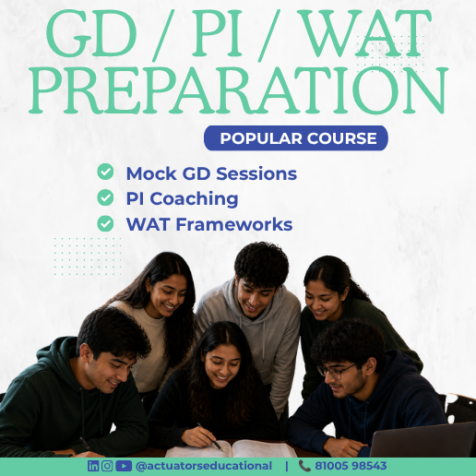
GD / PI / WAT Preparation
Faculty: Praveen Patwari & Prachi Patwari
Course: Mock Sessions & Coaching

Mock GD Sessions
PI Coaching
WAT Frameworks
Technical Support
Mentoring Sessions
Course Extension (2 More Terms)
Interactive Q & A Forum


₹41,000.00
GD / PI / WAT Preparation
Faculty: Praveen Patwari & Prachi Patwari
Course: Mock Sessions & Coaching
Group Discussion (GD) and Personal Interview (PI) are important components of the selection process for MBA and postgraduate management programmes offered by leading business schools in India.
After qualifying through management entrance examinations such as CAT, XAT, CMAT, MAT, SNAP or NMAT, shortlisted candidates may be required to participate in Group Discussions, Personal Interviews, Written Ability Tests (WAT) and other assessments, depending on the institution’s admission process.
These selection rounds evaluate a candidate’s communication skills, analytical thinking, leadership potential, general awareness, personality, decision-making ability and suitability for management education.
GD and PI preparation is particularly relevant for final-year undergraduate students, graduates and working professionals aspiring to pursue an MBA or other postgraduate management qualifications.
MBA Group Discussion (GD), Personal Interview (PI) and Written Ability Test (WAT) preparation focuses on developing communication, analytical thinking, leadership, business awareness and professional skills required during MBA admission assessments.
Key Topics Covered:
GD, PI and WAT assessments focus on communication skills, confidence, analytical reasoning, leadership potential, business awareness and professional judgement, evaluating candidates’ suitability for postgraduate management education.
GD, PI and WAT rounds are generally conducted after candidates have been shortlisted by the respective business schools.
General Eligibility Requirements:
Each business school determines its own shortlisting criteria, assessment stages and admission requirements.
Unlike standardised entrance examinations, GD, PI and WAT do not follow a universal examination pattern.
| Assessment | Primary Evaluation Areas |
| Group Discussion (GD) | Communication, teamwork, leadership and reasoning |
| Personal Interview (PI) | Personality, academic knowledge, career goals and motivation |
| Written Ability Test (WAT) | Critical thinking, written communication and analytical ability |
| Case Discussion | Business analysis, problem-solving and decision-making |
| Extempore | Spontaneous thinking, confidence and communication |
Important Assessment Guidelines:
There is no universal passing score or qualifying percentage for GD, PI and WAT.
Business schools assess candidates using institution-specific selection frameworks.
Common Evaluation Parameters:
Performance in these assessment rounds may contribute significantly to the final admission decision. A strong entrance examination score does not independently guarantee admission to an MBA programme.
GD and PI preparation aims to develop the ability to:
Group Discussions, Personal Interviews and Written Ability Tests play an important role in evaluating a candidate’s readiness for postgraduate management education.
These assessments go beyond entrance examination scores to evaluate personality, communication, analytical thinking, professional awareness and leadership potential.
A strong understanding of business issues, clarity of career objectives and effective communication skills can help candidates present their capabilities during the selection process.
MBA admissions are not determined by aptitude scores alone—communication, critical thinking, professional judgement and the ability to present ideas effectively are equally important.

| Keshav Khaitan | IIM - Bangalore |

Praveen Patwari is a Chartered Accountant (CA), Financial Risk Manager (FRM) and Associate of the Institute of Actuaries of India (AIAI), with additional professional credentials including CIRA, CCRA, CIDT, CIIB and NISM Series VIII (Equity Derivatives). With over 15 years of experience in finance, actuarial education, mentoring and professional training, he has built a strong reputation for simplifying complex concepts and guiding students across multiple professional pathways.
As the Founder and Lead Mentor at Actuators Educational Institute (AEI), Praveen has taught and mentored 50,000+ students across Actuarial Science, FRM, CFA, finance and related professional programmes. He has mentored numerous rankers and top-performing students and is a regular speaker at leading institutions including SRCC, Miranda House, Hansraj College, Lady Shri Ram College, St. Xavier’s College, NMIMS, Ramjas College, NM College and HR College of Commerce.

Prachi Patwari is an MBA from NMIMS, Mumbai, with 12+ years of experience in Capital Markets, investments and financial education. She is the Founder of Yashas Capital and has previously worked with Motilal Oswal Financial Services and Edelweiss, gaining extensive experience in equity advisory, portfolio analysis, investment research and wealth management. She is also an APMI Registered PMS Specialist and holds multiple certifications across capital-market disciplines.
Her expertise extends beyond markets into financial modelling, data analysis and technology, with working knowledge of Python and C++ and their application in investment research and analytics. Alongside her industry experience, Prachi is actively involved in teaching and mentoring students across ACET, MBA and CA Foundation, where she focuses on combining conceptual clarity with practical market understanding.