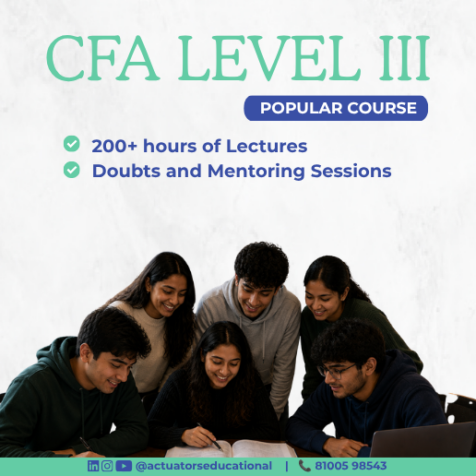
📈 CFA Level III – Chartered Financial Analyst
Master Advanced Portfolio Management, Wealth Planning and Investment Strategy
The Chartered Financial Analyst (CFA) Level III examination is the final examination stage of the globally recognised CFA Program conducted by the CFA Institute.
Building upon the financial analysis and valuation techniques developed in Levels I and II, CFA Level III focuses on portfolio management, asset allocation, investment strategy, risk management and professional decision-making.
The programme emphasises the integration of financial knowledge into practical investment scenarios, enabling candidates to develop sophisticated investment strategies and manage portfolios according to client objectives and constraints.
CFA Level III offers three specialised pathways: Portfolio Management, Private Wealth and Private Markets, allowing candidates to develop expertise aligned with different areas of the investment industry.
📚 Course Structure & Syllabus
The CFA Level III curriculum consists of a common core curriculum (65–70%) and a specialised pathway (30–35%).
All candidates study the common core and select one of the three specialised pathways during registration.
📘 1. Asset Allocation (15–20%)
This subject focuses on developing investment strategies and allocating capital across different asset classes.
Key Topics:
- Principles of asset allocation
- Strategic and tactical asset allocation
- Capital market expectations
- Economic forecasting
- Risk and return estimation
- Asset allocation with real-world constraints
- Asset-liability management
- Investment objectives and portfolio constraints
📊 2. Portfolio Construction (15–20%)
Portfolio Construction develops advanced knowledge of designing and managing investment portfolios.
Key Topics:
- Investment Policy Statements (IPS)
- Portfolio optimisation
- Equity and fixed-income portfolio management
- Active and passive investment strategies
- Risk budgeting and portfolio diversification
- Factor-based investment approaches
- Portfolio rebalancing
- Integration of alternative investments
📉 3. Derivatives and Risk Management (10–15%)
This subject focuses on managing financial risks through derivatives and other investment strategies.
Key Topics:
- Options strategies and portfolio applications
- Futures and forwards
- Swap strategies
- Currency risk management
- Hedging techniques
- Interest rate risk
- Portfolio risk measurement
- Risk management strategies
📑 4. Performance Measurement (5–10%)
This subject examines investment performance evaluation and the effectiveness of portfolio management decisions.
Key Topics:
- Portfolio performance measurement
- Performance attribution
- Investment manager evaluation
- Risk-adjusted performance measures
- Benchmark selection
- Global Investment Performance Standards (GIPS)
- Trade execution and performance analysis
⚖️ 5. Ethical and Professional Standards (10–15%)
This subject emphasises ethical responsibilities and professional conduct in investment management.
Key Topics:
- CFA Institute Code of Ethics
- Standards of Professional Conduct
- Fiduciary responsibilities
- Duties towards clients and employers
- Conflicts of interest
- Professional judgement
- Ethical decision-making
🎯 Specialised Pathways (30–35%)
Candidates must select one of the following three pathways. Each pathway shares the common core curriculum but focuses on a different investment specialisation.
💼 Pathway 1 – Portfolio Management
This pathway focuses on advanced investment portfolio construction and management for institutional and individual investors.
Key Topics:
- Active equity portfolio management
- Fixed-income portfolio strategies
- Index investing
- Institutional portfolio management
- Liability-driven investment strategies
- Portfolio trading and execution
- Investment risk management
- Portfolio performance evaluation
Primary Focus: Designing, implementing and managing diversified investment portfolios.
🏦 Pathway 2 – Private Wealth
This pathway focuses on wealth management for high-net-worth individuals, families and private clients.
Key Topics:
- Private wealth management principles
- High-net-worth client profiling
- Wealth planning and investment objectives
- Tax-aware investment strategies
- Retirement and estate planning considerations
- Behavioural finance and client management
- Asset allocation for private clients
- Wealth preservation and succession planning
Primary Focus: Managing individual and family wealth through personalised investment and financial planning strategies.
🏢 Pathway 3 – Private Markets
This pathway focuses on investment analysis, valuation and management of privately held assets.
Key Topics:
- Private equity and private credit
- Private investment structures
- Investment screening and due diligence
- Private company valuation
- Deal structuring and financing
- Fund management and performance evaluation
- Value creation strategies
- Investment exit strategies
Primary Focus: Evaluating, structuring and managing investments in private markets.
All three pathways lead towards the same CFA charter, subject to fulfilment of the applicable charter requirements.
🎓 Eligibility Criteria
Candidates must fulfil the following requirements to register for CFA Level III:
- Successfully pass the CFA Level II examination.
- Meet CFA Institute’s applicable registration requirements.
- Possess a valid international travel passport.
- Comply with the examination and professional conduct policies.
Candidates are not required to complete the full professional work experience requirement before appearing for CFA Level III.
However, obtaining the CFA charter requires the completion of qualifying professional work experience and other CFA Institute membership requirements.
📝 Examination Pattern
CFA Level III is a computer-based examination consisting of case-based multiple-choice questions and constructed-response questions.
| Particulars |
Details |
| Examination |
CFA Level III |
| Conducting Organisation |
CFA Institute |
| Examination Mode |
Computer-Based |
| Question Format |
Item Sets and Constructed Responses |
| Total Item Sets |
11 |
| Total Constructed-Response Sets |
11 |
| Total Question Sets |
22 |
| Examination Sessions |
2 |
| Duration per Session |
132 Minutes |
| Total Examination Time |
4 Hours 24 Minutes |
| Negative Marking for MCQs |
No |
| Examination Windows |
February and August |
Important Examination Guidelines:
- Each item set contains a case scenario followed by four multiple-choice questions.
- Constructed-response questions require written explanations, calculations or recommendations.
- Each question set carries 12 points.
- The examination includes 20 scored sets and two unscored trial sets.
- Candidates must demonstrate practical application and integration of investment concepts.
- Only CFA Institute-approved calculators are permitted.
✅ Passing Criteria
CFA Level III does not have a fixed passing percentage.
The Minimum Passing Score (MPS) is determined by CFA Institute using its established examination standard-setting process.
Important Information:
- Candidates must achieve the applicable MPS to pass.
- Examination results are reported as Pass or Fail.
- Candidates must complete the required Practical Skills Module (PSM) to receive their results.
- Passing Level III completes the examination component of the CFA Program.
- Passing all three examinations does not automatically confer the CFA charter.
To become a CFA charterholder, candidates must also satisfy the professional work experience, membership and other applicable requirements established by CFA Institute.
🎯 Learning Objectives
CFA Level III develops the ability to:
- Design and manage sophisticated investment portfolios.
- Develop strategic and tactical asset allocation strategies.
- Evaluate risk-return trade-offs across asset classes.
- Apply derivatives for portfolio risk management.
- Prepare and interpret Investment Policy Statements.
- Evaluate portfolio performance and investment managers.
- Apply advanced investment strategies to client-specific requirements.
- Develop expertise in Portfolio Management, Private Wealth or Private Markets.
- Integrate ethical considerations into investment decisions.
🚀 Develop Expertise in Advanced Investment Management
CFA Level III represents the integration of financial analysis, investment valuation and portfolio management into practical investment decision-making.
The curriculum emphasises asset allocation, portfolio construction, risk management, investment performance and specialised investment strategies.
By combining advanced analytical concepts with practical applications, CFA Level III prepares candidates to address complex investment challenges across institutional portfolios, private wealth and private markets.
CFA Level III develops the advanced investment knowledge, portfolio management capabilities and professional judgement essential for pursuing the CFA charter and expertise in global investment management.
💻 Technical Requirements – Actuators Educational Institute (AEI)
To ensure a smooth and uninterrupted learning experience, students enrolling in courses offered by Actuators Educational Institute (AEI) are required to use devices that meet the minimum technical specifications supported by the AEI Learning Application.
📱 Minimum Device & Operating System Requirements
| Device / Platform |
Minimum Technical Requirements |
| Android |
Android 9.0 or above |
| Windows PC / Laptop |
Windows 10 or above |
| iPhone / iPad (iOS) |
iOS 12.0 or above |
| MacBook / iMac (macOS) |
Apple M1 chip or above, with macOS 14 or later |
📌 Important Information for Students
- Students must ensure that their devices meet the above minimum technical requirements before enrolling in a course.
- A stable internet connection is recommended for accessing online lectures, study materials and other digital learning resources.
- Devices running older or unsupported operating systems may experience compatibility issues or may not support the application.
Note: These are the official minimum technical requirements for accessing courses through the Actuators Educational Institute (AEI) Learning Application. Students are advised to verify device compatibility before completing their course enrolment.