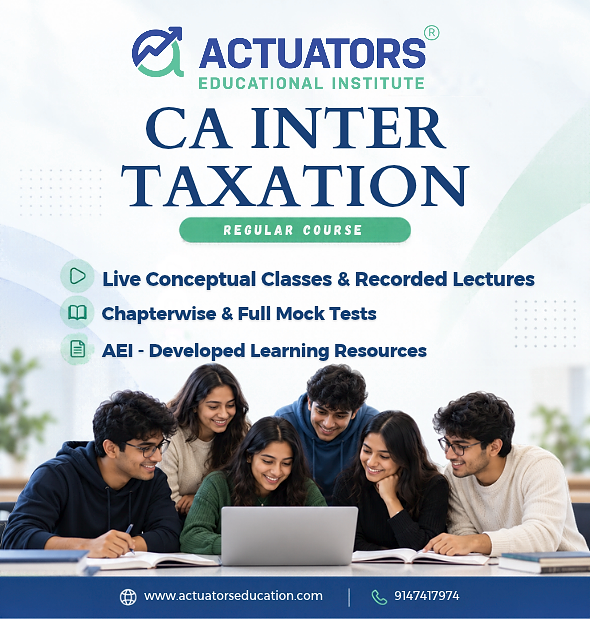
📘 CA Intermediate – Taxation
Strengthen Your Expertise in Income-tax Law, Goods and Services Tax and Tax Compliance
CA Intermediate – Taxation is Paper 3 of Group I of the Chartered Accountancy Intermediate programme conducted by the Institute of Chartered Accountants of India (ICAI).
The subject introduces important concepts relating to Income-tax Law, Goods and Services Tax (GST), tax computation, statutory compliance, tax deductions and indirect taxation.
It aims to develop students’ ability to interpret applicable tax laws, compute taxable income and tax liabilities, understand GST provisions and apply relevant taxation principles to practical business and financial transactions.
📚 CA Intermediate – Taxation: Course Structure & Syllabus
CA Intermediate – Taxation is Paper 3 of Group I of the Chartered Accountancy Intermediate programme conducted by the Institute of Chartered Accountants of India (ICAI).
The subject comprises two compulsory sections: Section A – Income-tax Law (50 marks) and Section B – Goods and Services Tax (50 marks).
Key Topics Covered:
01
Basic Concepts of Income-tax & Residential Status: Fundamental taxation concepts, tax year, persons liable to tax, residential status, scope of total income and classification of taxable and exempt income.
02
Income under Different Heads: Computation of income from salaries, house property, profits and gains of business or profession, capital gains and income from other sources.
03
Clubbing, Set-Off of Losses & Deductions: Income of other persons included in taxable income, aggregation of income, set-off and carry-forward of losses and deductions from gross total income.
04
Income-tax Liability & Compliance: Computation of total income and tax liability, applicable tax provisions, advance tax, tax deduction and collection at source, return filing and self-assessment.
05
GST Fundamentals, Supply & Charge of Tax: Introduction to GST, classification of supplies, composite and mixed supplies, levy and collection of GST, place of supply and exemptions.
06
GST Valuation, Time of Supply & Input Tax Credit: Determination of the time and value of supply, GST liability, eligibility for input tax credit, restrictions, reversals and utilisation of available credit.
07
GST Registration, Documentation & Returns: Registration requirements, tax invoices, credit and debit notes, accounts and records, e-way bills, payment of GST, TDS/TCS provisions and return filing.
The Taxation examination focuses on conceptual understanding, statutory interpretation, numerical accuracy, computation of tax liabilities and practical application of direct and indirect tax provisions, developing essential competencies in taxation and compliance.
Important Syllabus Update: ICAI has prescribed the Income-tax Act, 2025 for CA Intermediate Paper 3A from the May 2027 examination onwards. Students appearing in earlier examination terms must follow the tax law and study material applicable to their respective examinations.
🎓 Eligibility Criteria
CA Intermediate is the second level of the Chartered Accountancy programme.
Students can register through either of the following routes:
1. Foundation Route
●Successfully clear the CA Foundation examination.
●Register for the CA Intermediate programme.
2. Direct Entry Route
●Commerce graduates/postgraduates with at least 55% marks.
●Non-commerce graduates/postgraduates with at least 60% marks.
●Candidates who have passed the prescribed Intermediate-level examinations of ICSI or ICMAI.
Students must satisfy the applicable ICAI registration and study-period requirements before appearing in the examination.
📝 Examination Pattern
The CA Intermediate Taxation examination follows ICAI’s prescribed assessment structure.
| Particulars |
Details |
| Paper |
Paper 3 – Taxation |
| Group |
Group I |
| Maximum Marks |
100 |
| Income-tax Law |
50 Marks |
| Goods and Services Tax |
50 Marks |
| Examination Duration |
3 Hours |
| Descriptive Questions |
70 Marks |
| Case-Based MCQs |
30 Marks |
| Negative Marking |
No |
| Examination Frequency |
January, May and September |
Important Examination Guidelines:
●The examination combines descriptive questions with case-scenario-based MCQs.
●Questions assess tax computation, statutory interpretation, relevant tax provisions and practical application.
●Accurate calculations, clear working notes and application of the correct tax laws are important for descriptive answers.
●Students must follow the statutory amendments and tax rates applicable to their examination term.
●There is no negative marking for incorrect MCQ answers.
✅ Passing Criteria
To pass CA Intermediate Group I, students must:
●Secure a minimum of 40% marks in each paper.
●Obtain at least 50% aggregate marks across the three papers of Group I.
For Taxation, a minimum of 40 marks out of 100 is required in the combined paper, along with satisfying the overall group passing criteria.
Exemption Provision:
Students scoring 60 marks or more in Taxation may qualify for a paper-wise exemption under ICAI’s prescribed rules, generally applicable for the next three examinations, subject to the relevant conditions.
🎯 Learning Objectives
On studying Taxation, students develop the ability to:
●Understand and apply the fundamental provisions of Income-tax Law.
●Determine residential status and the scope of taxable income.
●Compute income under different heads of income.
●Apply clubbing provisions, set-off of losses and eligible deductions.
●Calculate total income and income-tax liability.
●Understand TDS, TCS, advance tax and income-tax return requirements.
●Understand the GST framework and classification of taxable supplies.
●Determine time, place and value of supply under GST.
●Evaluate input tax credit eligibility and utilisation.
●Understand GST registration, invoices, payments and return filing.
●Apply taxation principles to practical business and financial transactions.
🚀 Build Strong Expertise in Taxation
Taxation is an essential subject in the CA Intermediate curriculum, connecting accounting and financial transactions with the statutory requirements of direct and indirect taxation.
A sound understanding of income-tax computation, GST provisions, input tax credit, tax liability and compliance procedures provides a strong academic foundation for advanced studies in Direct Tax Laws and International Taxation and Indirect Tax Laws at the CA Final level.
Mastering Taxation develops the technical knowledge, computational accuracy, analytical abilities and statutory interpretation skills essential for the Chartered Accountancy qualification.
💻 Technical Requirements – Actuators Educational Institute (AEI)
To ensure a smooth and uninterrupted learning experience, students enrolling in courses offered by Actuators Educational Institute (AEI) are required to use devices that meet the minimum technical specifications supported by the AEI Learning Application.
📱 Minimum Device & Operating System Requirements
| Device / Platform |
Minimum / Recommended Requirements |
| Android |
Min: Android 10, quad-core 1.4 GHz, 2 GB RAM, 4 GB free. Recommended: Android 12+, octa-core 2.0 GHz+, 4 GB RAM, 8 GB free. |
| Windows PC / Laptop |
Min: Windows 10 (64-bit), Core i3 (6th Gen) / Ryzen 3 1200, 4 GB RAM, 128 GB storage. Recommended: Windows 11, Core i5 (8th Gen) / Ryzen 5 3600+, 8 GB RAM, 256 GB SSD. |
| iPhone / iPad (iOS) |
Min: iOS 12.0+. Recommended: latest compatible iOS. |
| MacBook / iMac (macOS) |
Min: Intel Core i3, 4 GB RAM, 128 GB free storage (minimum macOS version to be confirmed). Recommended: macOS 14+, Apple M1 / Intel Core i5, 8 GB RAM, 256 GB SSD. |
📌 Important Information for Students
●Students must ensure that their devices meet the above minimum technical requirements before enrolling in a course.
●A stable internet connection is recommended for accessing online lectures, study materials and other digital learning resources.
●Devices running older or unsupported operating systems may experience compatibility issues or may not support the application.
Note: These are the official minimum technical requirements for accessing courses through the Actuators Educational Institute (AEI) Learning Application. Students are advised to verify device compatibility before completing their course enrolment.