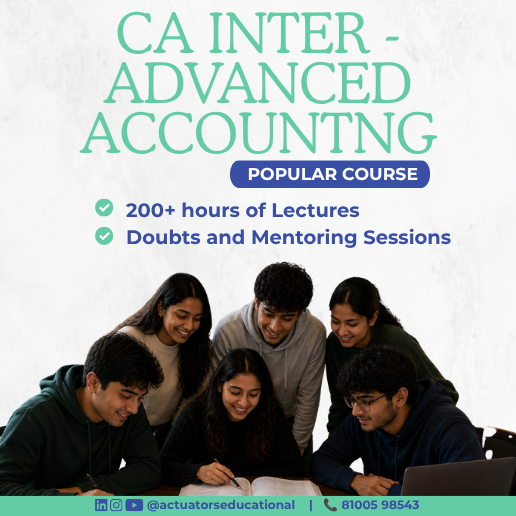
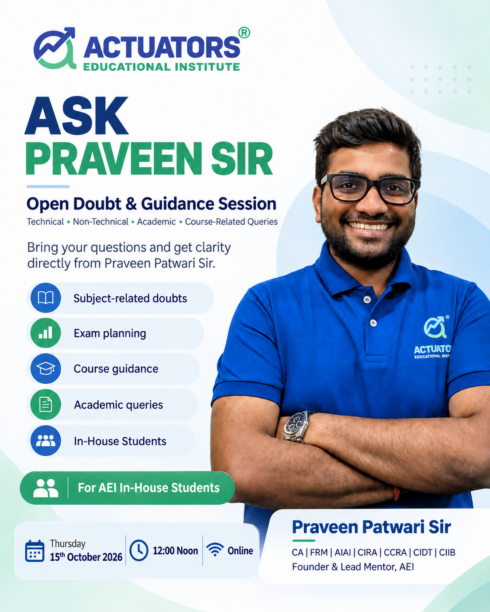
📘 CA Intermediate – Advanced Accounting
Strengthen Your Expertise in Accounting Standards and Financial Reporting
CA Intermediate – Advanced Accounting is Paper 1 of Group I of the Chartered Accountancy Intermediate programme conducted by the Institute of Chartered Accountants of India (ICAI).
The subject builds upon fundamental accounting principles and introduces advanced concepts relating to Accounting Standards, corporate financial reporting, consolidation, amalgamation and financial statement preparation.
It aims to develop students’ ability to understand complex accounting transactions, apply relevant accounting standards and prepare financial statements in accordance with applicable regulatory requirements.
📚 CA Intermediate – Advanced Accounting: Course Structure & Syllabus
CA Intermediate – Advanced Accounting is Paper 1 of Group I of the Chartered Accountancy Intermediate programme conducted by the Institute of Chartered Accountants of India (ICAI).
The subject focuses on advanced accounting principles, Accounting Standards, corporate financial reporting and the preparation of financial statements.
Key Topics Covered:
- Accounting Standards & Financial Reporting: Introduction to Accounting Standards, financial reporting frameworks, recognition, measurement, presentation and disclosure requirements.
- Accounting for Assets & Liabilities: Inventory valuation, property, plant and equipment, depreciation, intangible assets, impairment, investments, provisions and contingent liabilities.
- Revenue Recognition & Other Accounting Standards: Revenue recognition, construction contracts, leases, borrowing costs, employee benefits, foreign exchange transactions and accounting for income taxes.
- Company Financial Statements: Preparation and presentation of company financial statements, including balance sheets, statements of profit and loss, cash flow statements and related disclosures.
- Amalgamation & Corporate Restructuring: Accounting for amalgamation of companies, internal reconstruction, buyback of securities and other corporate accounting transactions.
- Consolidated Financial Statements: Accounting for subsidiaries, associates and joint ventures, consolidation adjustments and preparation of consolidated financial statements.
- Branch Accounting & Specialised Transactions: Accounting for domestic and foreign branches, inter-branch transactions and other specialised financial reporting requirements.
The Advanced Accounting examination focuses on conceptual understanding, application of Accounting Standards, numerical accuracy and financial statement preparation, developing essential competencies in corporate accounting and financial reporting.
🎓 Eligibility Criteria
CA Intermediate is the second level of the Chartered Accountancy programme.
Students can register through either of the following routes:
- Foundation Route
- Successfully clear the CA Foundation examination.
- Register for the CA Intermediate programme.
- Direct Entry Route
- Commerce graduates/postgraduates with at least 55% marks.
- Non-commerce graduates/postgraduates with at least 60% marks.
- Candidates who have passed the prescribed Intermediate-level examinations of ICSI or ICMAI.
Students must satisfy the applicable ICAI registration and study-period requirements before appearing in the examination.
📝 Examination Pattern
The CA Intermediate Advanced Accounting examination follows ICAI’s prescribed assessment structure.
| Particulars |
Details |
| Paper |
Paper 1 – Advanced Accounting |
| Group |
Group I |
| Maximum Marks |
100 |
| Examination Duration |
3 Hours |
| Descriptive Questions |
70 Marks |
| Case-Based MCQs |
30 Marks |
| Negative Marking |
No |
| Examination Frequency |
January, May and September |
Important Examination Guidelines:
- The examination combines descriptive questions with case-scenario-based MCQs.
- Questions assess conceptual understanding, accounting treatment and practical application.
- Proper calculations, working notes and financial statement presentation are important for descriptive answers.
- There is no negative marking for incorrect MCQ answers.
✅ Passing Criteria
To pass CA Intermediate Group I, students must:
- Secure a minimum of 40% marks in each paper.
- Obtain at least 50% aggregate marks across the three papers of Group I.
For Advanced Accounting, a minimum of 40 marks out of 100 is required, along with satisfying the overall group passing criteria.
Exemption Provision:
Students scoring 60 marks or more in Advanced Accounting may qualify for a paper-wise exemption under ICAI’s prescribed rules, generally applicable for the next three examinations, subject to the relevant conditions.
🎯 Learning Objectives
On studying Advanced Accounting, students develop the ability to:
- Understand and apply Accounting Standards.
- Recognise, measure and disclose financial transactions appropriately.
- Prepare company financial statements and cash flow statements.
- Account for amalgamations and corporate restructuring.
- Understand consolidation and financial reporting for group entities.
- Apply accounting principles to complex practical scenarios.
- Develop analytical and problem-solving abilities in corporate accounting.
🚀 Build Strong Expertise in Advanced Accounting
Advanced Accounting is an essential subject in the CA Intermediate curriculum, connecting fundamental accounting knowledge with professional financial reporting practices.
A sound understanding of Accounting Standards, financial statement preparation, consolidation and corporate accounting provides a strong academic foundation for advanced studies in Financial Reporting at the CA Final level.
Mastering Advanced Accounting develops the technical knowledge, analytical abilities and financial reporting skills essential for the Chartered Accountancy qualification.
💻 Technical Requirements – Actuators Educational Institute (AEI)
To ensure a smooth and uninterrupted learning experience, students enrolling in courses offered by Actuators Educational Institute (AEI) are required to use devices that meet the minimum technical specifications supported by the AEI Learning Application.
📱 Minimum Device & Operating System Requirements
| Device / Platform |
Minimum Technical Requirements |
| Android |
Android 9.0 or above |
| Windows PC / Laptop |
Windows 10 or above |
| iPhone / iPad (iOS) |
iOS 12.0 or above |
| MacBook / iMac (macOS) |
Apple M1 chip or above, with macOS 14 or later |
📌 Important Information for Students
- Students must ensure that their devices meet the above minimum technical requirements before enrolling in a course.
- A stable internet connection is recommended for accessing online lectures, study materials and other digital learning resources.
- Devices running older or unsupported operating systems may experience compatibility issues or may not support the application.
Note: These are the official minimum technical requirements for accessing courses through the Actuators Educational Institute (AEI) Learning Application. Students are advised to verify device compatibility before completing their course enrolment.