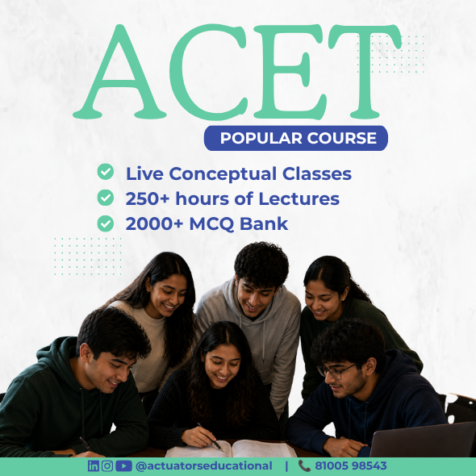
ACET – Regular Course
Faculty: Devansh Dhona, Prachi Patwari & Itika Sureka
Course Duration: 250+ hours


₹14,000.00
ACET – Regular Course
Faculty: Devansh Dhona, Prachi Patwari & Itika Sureka
Course Duration: 250+ hours
The Actuarial Common Entrance Test (ACET) is an entrance examination conducted by the Institute of Actuaries of India (IAI) for students aspiring to pursue actuarial science as a professional qualification.
ACET provides a pathway towards obtaining student membership of IAI and beginning the actuarial examination journey. Certain candidates may also qualify for student membership through IAI’s prescribed Direct Entry routes.
The examination assesses candidates’ knowledge of Mathematics, Statistics, Data Interpretation, English and Logical Reasoning, focusing on numerical ability, analytical thinking, problem-solving and comprehension skills.
ACET is suitable for students from Commerce, Science, Mathematics, Economics, Engineering and other academic backgrounds who wish to pursue a career in actuarial science, insurance, finance or risk management.
ACET evaluates mathematical, statistical, analytical and communication skills through five principal subject areas.
Key Topics Covered:
The ACET syllabus focuses on mathematical accuracy, statistical understanding, logical reasoning, data interpretation and effective problem-solving.
The ACET examination consists of five sections carrying a total of 100 marks.
| Subject | Marks |
|---|---|
| Mathematics | 30 |
| Statistics | 30 |
| Data Interpretation | 15 |
| English | 15 |
| Logical Reasoning | 10 |
| Total | 100 |
Mathematics and Statistics together account for 60% of the examination, making quantitative proficiency an important component of ACET preparation.
ACET is a computer-based multiple-choice examination conducted by the Institute of Actuaries of India.
| Particulars | Details |
|---|---|
| Examination | Actuarial Common Entrance Test (ACET) |
| Conducting Body | Institute of Actuaries of India (IAI) |
| Examination Format | Multiple-Choice Questions |
| Total Questions | 70 |
| Maximum Marks | 100 |
| Examination Duration | 3 Hours |
| Examination Mode | Computer-Based Online Examination |
| Negative Marking | No |
| Passing Marks | 50 out of 100 |
| Sectional Cut-Off | None |
| Exam Months | Generally June and December, subject to IAI announcements |
| Examination Sessions | Single Day, Single Slot |
| Question Type | Number of Questions | Total Marks |
|---|---|---|
| 1-Mark Questions | 45 | 45 |
| 2-Mark Questions | 20 | 40 |
| 3-Mark Questions | 5 | 15 |
| Total | 70 | 100 |
ACET is suitable for students beginning their actuarial qualification journey.
The ACET result remains valid for three years from the date of result declaration for applying for IAI student membership.
After successfully clearing ACET, eligible candidates can apply for membership of the Institute of Actuaries of India.
Once membership is approved, students can progress towards professional actuarial examinations under the IAI qualification pathway.
Candidates should complete the membership application process within the prescribed validity period.
Studying ACET develops the ability to:
The knowledge developed through ACET preparation provides a foundation for further actuarial and quantitative studies.
ACET provides an entry pathway into professional actuarial education through IAI, helping students establish the mathematical, statistical and analytical foundation required for further actuarial studies.
To access online classes, recorded lectures and digital study resources, students must ensure their devices meet the following minimum technical requirements of the Actuators Educational Institute (AEI) Learning Application.
| Device / Platform | Minimum Requirement |
|---|---|
| Android | Android 9.0 or above |
| Windows PC / Laptop | Windows 10 or above |
| iPhone / iPad (iOS) | iOS 12.0 or above |
| MacBook / iMac (macOS) | Apple M1 chip or above with macOS 14 or later |
ACET course fees paid to Actuators Educational Institute (AEI) are non-refundable.
In the event that the Institute of Actuaries of India (IAI) withdraws, discontinues or cancels the ACET examination, the course fees paid to AEI will not be refunded.










| Vandita Sarda | AIR 1 |
| Shashank Bajaj | 96 |
| Girisha Jain | 94 |
| Madhav Khandelwal | 93 |
| Angel Agarwal | 92 |
| Anjali Patwa | 91 |
| Raghav Khera | 91 |
| Kaushal Sultania | 90 |
| Palkesh Bharuka | 88 |
| Sanya Agarwal | 88 |
| Mehana R | 88 |
| Neeraj Zagade | 86 |
| Soumili Majumder | 86 |
| Rahul Sow | 83 |
| Palak Gupta | 81 |

Devansh Dhona is an accomplished actuarial professional who has cleared 10 out of 13 actuarial papers and secured All India Rank 1 in CP2. A B.Com (Hons.) graduate from St. Xavier’s College, Kolkata, he brings strong technical knowledge along with practical experience from the General Insurance industry.
At Actuators Educational Institute, Devansh teaches ACET, CP2 and SOA FAM. His teaching approach focuses on conceptual clarity, structured problem-solving, and application-oriented learning, helping students build strong fundamentals and approach actuarial examinations with greater clarity and confidence.

Prachi Patwari is an MBA from NMIMS, Mumbai, with 12+ years of experience in Capital Markets, investments and financial education. She is the Founder of Yashas Capital and has previously worked with Motilal Oswal Financial Services and Edelweiss, gaining extensive experience in equity advisory, portfolio analysis, investment research and wealth management. She is also an APMI Registered PMS Specialist and holds multiple certifications across capital-market disciplines.
Her expertise extends beyond markets into financial modelling, data analysis and technology, with working knowledge of Python and C++ and their application in investment research and analytics. Alongside her industry experience, Prachi is actively involved in teaching and mentoring students across ACET, MBA and CA Foundation, where she focuses on combining conceptual clarity with practical market understanding.
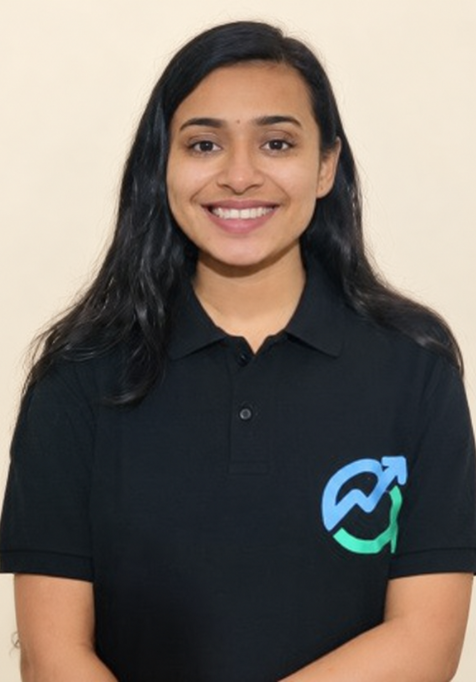
Itika Sureka holds a Master’s degree in English and is associated with ICICI Prudential Life Insurance Company Limited. At Actuators, she teaches the English section of the ACET examination along with MBA VARC.
With a strong command over language and verbal ability, she focuses on improving students’ vocabulary, grammar, reading comprehension, and verbal reasoning skills through a clear and structured approach.