
IAI November 2026 Exams: A Strategic Guide to the Last 10 Days Before Your Exams
With the IAI November 2026 examinations approaching, many students are facing the same dilemma:
Should I complete the remaining syllabus, revise what I’ve already studied, solve past-year questions, or attempt more mocks?
In our recent student survey, several students expressed concerns about unfinished syllabus, forgotten concepts, limited time for practice and uncertainty about how many past papers to attempt.
With limited time remaining, the goal is not to do everything. It is to prioritise the right things and make the best possible use of the time you have left.
Given that we are days away from the examination, let’s focus on what all particularly matters at this point.
10 Days Before The Exam: Final Sprint Begins
This is where you stand right now. With 10 days still in hand, there’s plenty of scope to make significant progress in your exam preparation – as long as you use your time strategically and study smart.
Don’t jump into revising the entire syllabus just yet. You will end up spending valuable time on topics you already know well – or on areas you haven’t even covered at all. This will leave you with less time for topics where you can make meaningful improvements and boost your score.
We recommend that you start by:
Identifying topics where you are likely to make mistakes. Focus on the areas where you feel less confident or tend to lose marks.
Revisiting your study material. Go back to the Course Notes, summaries, and any notes you have prepared over the past few months for these topics. Revise them carefully and make sure you understand the fundamental concepts thoroughly.
Practising past-paper questions under timed conditions. If you don’t have enough time to attempt an entire paper, that’s okay! Pick one or two questions and attempt them within the time limit based on the marks allocated to each question. Do this every single day. This will help you build both speed and accuracy.
Reviewing your answers against the Indicative Solutions. Identify gaps, missed points, and areas for improvement. Add any new insights or key points you discover to your notes – they’ll be valuable when you revisit them during your final revision.
A few past years’ papers have Examiner’s Reports along with Indicative Solutions for your reference. Treat Indicative Solutions as the starting point. They give you a direction in which you can type your answer, but know that this is not the only acceptable solution.
For past papers where Examiner’s Reports are available, review the answers along with Examiner’s comments at the end of each part in the question. They will come in handy while trying to understand what points were expected to be presented in the exam.
Remember, the best way to strengthen your understanding of topics where you tend to make the most mistakes is to practise as many questions as possible after revising the concept from your course notes.
7 Days Before The Exam: It’s Time To Shift To Past Paper Practice
With just 7 days to go, it’s time to shift into full exam mode!
At this stage, Past Papers – especially the most recent ones – should become your primary focus. You need to get comfortable tackling a mix of questions under exam conditions, managing your time effectively, and switching between different topics with ease. Since your actual exam will be computer-based, it is crucial to practise typing your answers on a keyboard as much as possible. The more closely you replicate the exam experience now, the more confident and comfortable you’ll feel on exam day.
Broadly, while attempting the Past Papers, you must identify:
$\bullet \quad$Questions where you could not recall the concept to which it relates.
$\bullet \quad$Questions where you could recall the concept but could not generate sufficient relevant points which catered to its specific ask.
$\bullet \quad$Questions where you misunderstood the concept and answered from a completely different perspective.
$\bullet \quad$Questions you struggled to type the answers to within the allocated time.
$\bullet \quad$Questions where you made calculation errors.
💡 Bonus Tip For Attempting Past Papers
The idea is not just to complete the past paper under timed conditions. The idea is to:
$\bullet \quad$Allot a rough estimate of the exact minutes you would spend on each question – this completely depends on how much marks the question is for. The faculty at AEI is there to guide you on this so make sure you ask this question in the final revision classes, if not already.
$\bullet \quad$DO NOT exceed that rough estimate by more than 5 minutes. For example, if a 4 marker should take you 10 minutes to write, and you happen to spend around 14 minutes on it, immediately move on to the next question. Keep in mind to compensate these 4 minutes elsewhere. The goal is to attempt the entire exam paper to increase your chances of passing.
$\bullet \quad$Review the past papers as well. You may be able to finish the mocks on time, but make sure that your answers are progressively improving with each mock you write. That comes with analysing the indicative solutions, understanding your weaknesses in the paper, working on them and making sure to not repeat them next time.
$\bullet \quad$You have 7 days before the exam, make sure to properly attempt (under timed conditions) and analyse at least 4 past papers.
💡 Bonus Tips For Revision
$\bullet \quad$At this stage, spend 1 hour 30 minutes every day revisiting your Notes and short chapter summaries (or formulas, if any). Spend around 50 minutes revisiting topics you’re less confident in, 20 minutes to refresh topics you already know well, and the remaining 20 minutes looking at very selective IFOA questions where there is a syllabus overlap.
This ensures you’re not solely relying on question practice, but also taking time to revisit your notes and keeping both your weaker and stronger topics fresh.
$\bullet \quad$Avoid taking on any new topics. Focus on consolidating what you already know and strengthening your existing preparation.
$\bullet \quad$If you struggle to remember points, practice active recall – try saying the concepts out loud using your memory, without looking at your Notes. This will promote long-term retention.
3 Days Before The Exam: Focus on the Final Details
At this stage, stop attempting Past Papers under full timed-exam conditions. Instead, shift your focus to targeted revision and consolidation:
Revisit specific questions: Go back to questions where you made mistakes, questions from topics that are frequently tested, and a few easier questions to maintain a healthy balance and build confidence.
Revise your notes topic-wise: Work through your notes systematically, covering the entire syllabus or, at the very least, everything you have studied so far.
Review key formulas: Revise all formulas you are expected to use in the exam. Make sure you also type a question or two to be familiar with how to type equations in Word or Exam Platform, wherever you might be expected to use them.
1 Day Before Exam: Keep It Light and Be Exam Ready
The day before the exam should not be about heavy preparation. Start your day by going through the May 2026 Exam Paper, i.e. the paper from the previous sitting. Once done, keep your revision light and work through the topics you have studied so far. A useful way to test your recall is to go through your Notes without looking at them and try to say the key points out loud from memory.
Then, spend the rest of your time familiarising yourself with the Exam Instructions and guidelines. Stay tuned for a more detailed post on Exam Guidelines and what to expect at the centre.
💡 Bonus Tip
This is the final day of preparation. DO NOT:
$\bullet \quad$Look at an unfamiliar topic.
$\bullet \quad$Attempt full Past Papers under timed exam conditions.
$\bullet \quad$Pull an all-nighter.
$\bullet \quad$Compare yourself to other students.
Take a deep breath and focus on showing up consistently right now instead of worrying about the outcome. You got this!
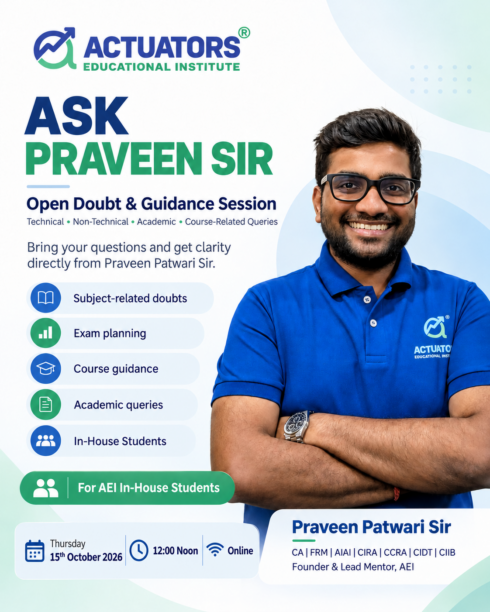
For further queries, clarifications or guidance, feel free to reach out to us. We’re always happy to help.
+91-9147417974 – Kolkata
+91-8274936565 – Delhi
+91-8100598543 – Mumbai
Email: