

How to Become an Actuary with the IFoA: Your Complete Roadmap To Qualification
The actuarial profession has gained significant attention in recent years. As more students seek careers that combine mathematical, analytical, and problem-solving skills, actuarial science has emerged as an increasingly popular career choice. With this growing interest, choosing the right professional body to pursue an actuarial qualification has become an important decision for aspiring actuaries.
If you are considering an actuarial qualification with the Institute and Faculty of Actuaries (IFoA), understanding the different pathways available is an important first step. This guide explores the routes to becoming a qualified Actuary through the IFoA and provides a clear starting point for your actuarial journey.
University (without exemption) → Full-Time Role
This is the most widely chosen pathway for students embarking on their journey towards becoming a Qualified Actuary.
Below, we address some frequently asked questions about this route to help provide clarity and guide you on where to begin.
❓ Frequently Asked Questions
a. Which course should I pick in University?
Moving from school to university marks an important turning point, as you begin making decisions that can shape your academic and professional journey. If you are considering a career in Actuarial Science and intend to pursue the no-exemption route, you are not required to complete any specific undergraduate degree. However, certain disciplines can provide a strong foundation for your actuarial studies, including:
$\bullet \quad$Mathematics
$\bullet \quad$Statistics
$\bullet \quad$Economics
$\bullet \quad$Accountancy
$\bullet \quad$Engineering
$\bullet \quad$Sciences, such as Physics and Chemistry
The key is to choose a degree that keeps you engaged with mathematics and helps you build a strong quantitative foundation, which will be invaluable as you progress through your actuarial studies and career.
b. What should my next steps be once university is over?
Many students choose to sit for their first few actuarial exams while they are still in university. Although this is not mandatory, it is generally recommended, as balancing actuarial exams with university studies can be more manageable than preparing for them alongside a full-time job.
Starting early also allows you to develop effective study habits and learn how to manage your time alongside other commitments. Building this balance while you are still in university can make the transition into the professional world much smoother.
Bonus: Giving Your First Exam As A Non-Member
If you are unsure whether you want to commit to the actuarial qualification journey through an annual membership, you can consider taking your first exam as a non-member. The IFoA allows prospective students to sit either CM1 or CS1 without first becoming a member, meaning you do not have to pay the annual membership fee at this stage. However, you will still pay the relevant exam fee upfront.
If you successfully pass your first exam as a non-member, you will then need to apply for student membership with the IFoA to continue progressing through the qualification pathway.
🎓 The Next Step: Securing a Graduate or Trainee Role
The actuarial profession is not just about clearing exams. It is also about gaining practical knowledge and developing the right skill set required to qualify. Hence, once university is over, you will need to secure your first actuarial role.
You may also choose to take your first actuarial exam after securing a graduate or trainee role in the corporate sector. The timing is entirely up to you and will depend on your individual circumstances. Many employers offer study support, such as dedicated study leave before exams, and may also cover the cost of actuarial exams. For this reason, starting your actuarial qualification after entering the workforce can be an attractive option for many students.
c. What does the exam hierarchy look like?
There is a recommended order in which you can take your exams, although it is not compulsory. The hierarchy looks something like this:
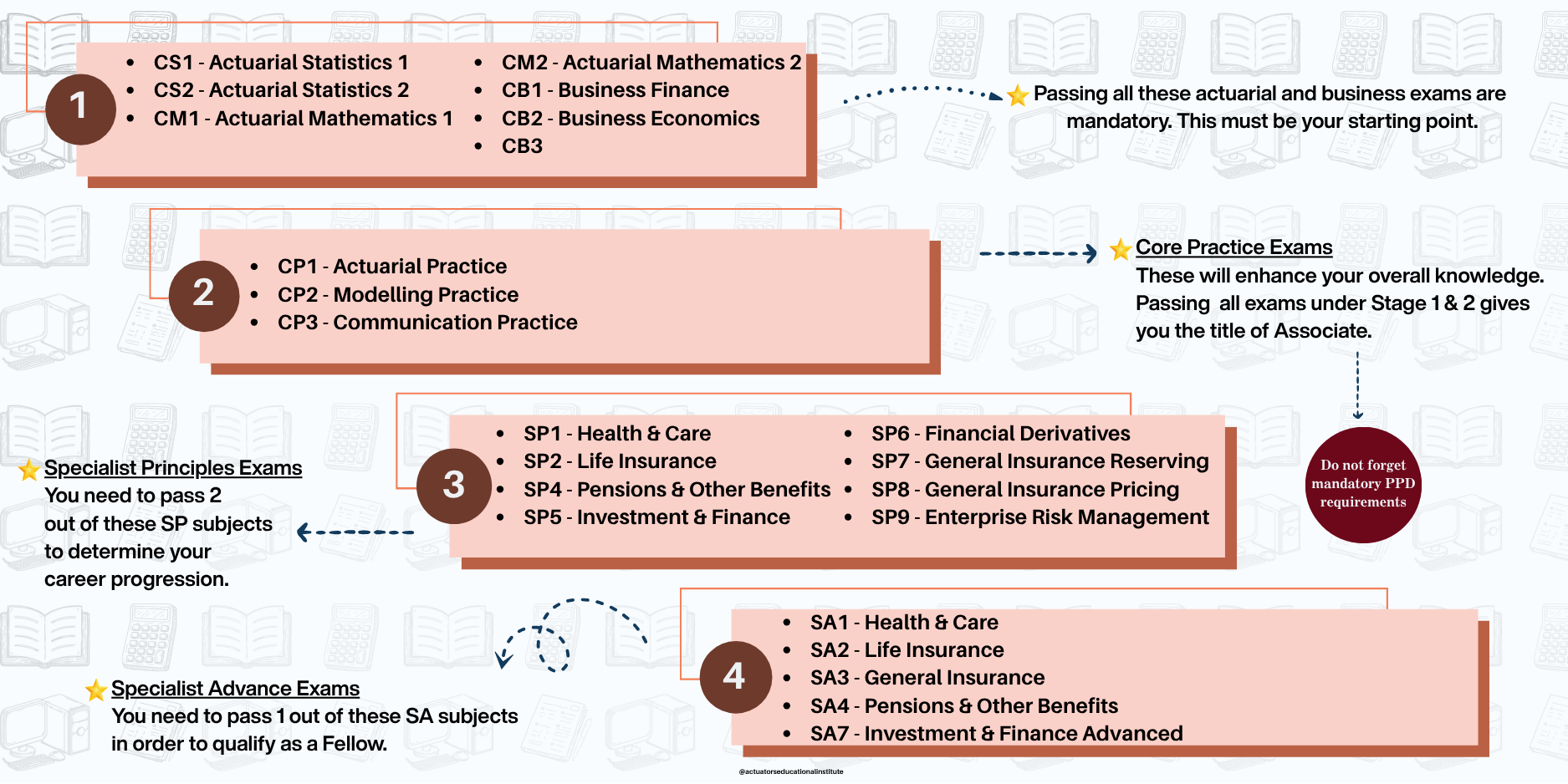
Key things to note:
$\bullet \quad$IFOA conducts exams twice every year: April and September.
$\bullet \quad$There is no strict capping on how many exams you can sit for in each sitting. For a deeper guide on which exams to sit in your first sitting, refer to this post.
d. Is clearing exams enough to qualify?
Clearing exams is a big part of your actuarial journey, but it is not enough. You also have to fulfil Personal and Professional Development (PPD) requirements as a Student Actuary.
To read more about PPD requirements, refer here.
A summary is included below:
Qualification requirements for IFoA students who joined before 2 January 2019
| Category | Minimum Number of Months PPD Required | Minimum Number of Credits Required | Minimum Credits per Year | Minimum Hours of Formal Learning Activity Total |
|---|---|---|---|---|
| Associate | 12 Months | 10 | 3 | 2 Hours |
| Fellow | 36 Months | 20 | 3 | 6 Hours (2 per year) |
Qualification requirements for IFoA students who joined after 2 January 2019
| Category | Minimum Number of Months PPD Required | Number of Credits Required | Minimum Credits per Year | Minimum Hours of Formal Learning Activity Total |
|---|---|---|---|---|
| Associate* | 24 Months | 15 | 3 | 4 Hours (2 per year) |
| Fellow | A further 12 months of PPD recording after Associate status is confirmed | A further 5 credits | 3 | A further 2 hours |
University (with exemption) → Full-Time Role
Students do not necessarily have to take all exams from scratch. A few universities worldwide are on IFOA’s accredited list. This means that if you take certain courses at these universities and meet the minimum requirements, you may be exempt from some exams.
This route is a fast track through your actuarial qualification journey, although it can also involve higher expenses.
Any exams not covered by your exemptions can be completed alongside your professional career, allowing you to gain valuable work experience while continuing to progress with your actuarial qualification.
📌 Note
For a detailed guide to the university courses accredited by the IFoA and the exemptions they offer, stay tuned!
Broadly, these are the two main routes to qualifying as an Actuary through the Institute and Faculty of Actuaries (IFoA). Understanding how each pathway works can help you make informed decisions about your university studies, exams, and career plans. Whichever route you choose, remember that becoming a qualified Actuary is not just about clearing exams – it is a journey that combines academic learning, professional development, and relevant practical experience.
If you have any questions or concerns, feel free to reach out to us.
+91-9147417974 – Kolkata
+91-8274936565 – Delhi
+91-8100598543 – Mumbai
Email: