
CB1 QUESTIONS BANK
Quiz-summary
0 of 500 questions completed
Questions:
- 1
- 2
- 3
- 4
- 5
- 6
- 7
- 8
- 9
- 10
- 11
- 12
- 13
- 14
- 15
- 16
- 17
- 18
- 19
- 20
- 21
- 22
- 23
- 24
- 25
- 26
- 27
- 28
- 29
- 30
- 31
- 32
- 33
- 34
- 35
- 36
- 37
- 38
- 39
- 40
- 41
- 42
- 43
- 44
- 45
- 46
- 47
- 48
- 49
- 50
- 51
- 52
- 53
- 54
- 55
- 56
- 57
- 58
- 59
- 60
- 61
- 62
- 63
- 64
- 65
- 66
- 67
- 68
- 69
- 70
- 71
- 72
- 73
- 74
- 75
- 76
- 77
- 78
- 79
- 80
- 81
- 82
- 83
- 84
- 85
- 86
- 87
- 88
- 89
- 90
- 91
- 92
- 93
- 94
- 95
- 96
- 97
- 98
- 99
- 100
- 101
- 102
- 103
- 104
- 105
- 106
- 107
- 108
- 109
- 110
- 111
- 112
- 113
- 114
- 115
- 116
- 117
- 118
- 119
- 120
- 121
- 122
- 123
- 124
- 125
- 126
- 127
- 128
- 129
- 130
- 131
- 132
- 133
- 134
- 135
- 136
- 137
- 138
- 139
- 140
- 141
- 142
- 143
- 144
- 145
- 146
- 147
- 148
- 149
- 150
- 151
- 152
- 153
- 154
- 155
- 156
- 157
- 158
- 159
- 160
- 161
- 162
- 163
- 164
- 165
- 166
- 167
- 168
- 169
- 170
- 171
- 172
- 173
- 174
- 175
- 176
- 177
- 178
- 179
- 180
- 181
- 182
- 183
- 184
- 185
- 186
- 187
- 188
- 189
- 190
- 191
- 192
- 193
- 194
- 195
- 196
- 197
- 198
- 199
- 200
- 201
- 202
- 203
- 204
- 205
- 206
- 207
- 208
- 209
- 210
- 211
- 212
- 213
- 214
- 215
- 216
- 217
- 218
- 219
- 220
- 221
- 222
- 223
- 224
- 225
- 226
- 227
- 228
- 229
- 230
- 231
- 232
- 233
- 234
- 235
- 236
- 237
- 238
- 239
- 240
- 241
- 242
- 243
- 244
- 245
- 246
- 247
- 248
- 249
- 250
- 251
- 252
- 253
- 254
- 255
- 256
- 257
- 258
- 259
- 260
- 261
- 262
- 263
- 264
- 265
- 266
- 267
- 268
- 269
- 270
- 271
- 272
- 273
- 274
- 275
- 276
- 277
- 278
- 279
- 280
- 281
- 282
- 283
- 284
- 285
- 286
- 287
- 288
- 289
- 290
- 291
- 292
- 293
- 294
- 295
- 296
- 297
- 298
- 299
- 300
- 301
- 302
- 303
- 304
- 305
- 306
- 307
- 308
- 309
- 310
- 311
- 312
- 313
- 314
- 315
- 316
- 317
- 318
- 319
- 320
- 321
- 322
- 323
- 324
- 325
- 326
- 327
- 328
- 329
- 330
- 331
- 332
- 333
- 334
- 335
- 336
- 337
- 338
- 339
- 340
- 341
- 342
- 343
- 344
- 345
- 346
- 347
- 348
- 349
- 350
- 351
- 352
- 353
- 354
- 355
- 356
- 357
- 358
- 359
- 360
- 361
- 362
- 363
- 364
- 365
- 366
- 367
- 368
- 369
- 370
- 371
- 372
- 373
- 374
- 375
- 376
- 377
- 378
- 379
- 380
- 381
- 382
- 383
- 384
- 385
- 386
- 387
- 388
- 389
- 390
- 391
- 392
- 393
- 394
- 395
- 396
- 397
- 398
- 399
- 400
- 401
- 402
- 403
- 404
- 405
- 406
- 407
- 408
- 409
- 410
- 411
- 412
- 413
- 414
- 415
- 416
- 417
- 418
- 419
- 420
- 421
- 422
- 423
- 424
- 425
- 426
- 427
- 428
- 429
- 430
- 431
- 432
- 433
- 434
- 435
- 436
- 437
- 438
- 439
- 440
- 441
- 442
- 443
- 444
- 445
- 446
- 447
- 448
- 449
- 450
- 451
- 452
- 453
- 454
- 455
- 456
- 457
- 458
- 459
- 460
- 461
- 462
- 463
- 464
- 465
- 466
- 467
- 468
- 469
- 470
- 471
- 472
- 473
- 474
- 475
- 476
- 477
- 478
- 479
- 480
- 481
- 482
- 483
- 484
- 485
- 486
- 487
- 488
- 489
- 490
- 491
- 492
- 493
- 494
- 495
- 496
- 497
- 498
- 499
- 500
Information
CB1 Question Bank
You have already completed the quiz before. Hence you can not start it again.
Quiz is loading...
You must sign in or sign up to start the quiz.
You have to finish following quiz, to start this quiz:
Your Result
You scored 0 of 0 points, (0)0 of 500 questions answered correctly
Time Taken:
Time has elapsed
Categories
- Not categorized 0%
- CB1 IAI FEB 2025 DIET 0%
- CB1- CB1 X1 Mock 0%
- CB1- CB1 X2 Mock 0%
- CB1- CB1 X3 Mock 0%
- CB1- CB1 X4 Mock 0%
- CB1- CB1 x5 mOCK 0%
- CB1- CB1 X6 Mock 0%
- CB1- TV CB1 Accounts for groups, insurance companies and banks 0%
- CB1- TV CB1 Interpreting accounts (1) 0%
- CB1- TV CB1 Interpreting accounts (2) 0%
- CB1- TV CB1 Introduction to accounts 0%
- CB1- TV CB1 Alternative sources of finance 0%
- CB1- TV CB1 Business ownership 0%
- CB1- TV CB1 Capital project appraisal (1) 0%
- CB1- TV CB1 Capital project appraisal (2) 0%
- CB1- TV CB1 Capital structure and dividend policy 0%
- CB1- TV CB1 Constructing accounts 0%
- CB1- TV CB1 Derivatives 0%
- CB1- TV CB1 Growth and restructuring of companies 0%
- CB1- TV CB1 Issue of shares 0%
- CB1- TV CB1 Key principles of corporate governance and ethics 0%
- CB1- TV CB1 Key principles of finance 0%
- CB1- TV CB1 Long term finance 0%
- CB1- TV CB1 Short and medium term finance 0%
- CB1- TV CB1 Taxation 0%
- CB1- TV CB1 The main accounts 0%
- CB1- TV CB1 Weighted average cost of capital 0%
- Cb2- TV CB2 Classical and keynesian theory 0%
- CS2-Exposed to risk 0%
- 1
- 2
- 3
- 4
- 5
- 6
- 7
- 8
- 9
- 10
- 11
- 12
- 13
- 14
- 15
- 16
- 17
- 18
- 19
- 20
- 21
- 22
- 23
- 24
- 25
- 26
- 27
- 28
- 29
- 30
- 31
- 32
- 33
- 34
- 35
- 36
- 37
- 38
- 39
- 40
- 41
- 42
- 43
- 44
- 45
- 46
- 47
- 48
- 49
- 50
- 51
- 52
- 53
- 54
- 55
- 56
- 57
- 58
- 59
- 60
- 61
- 62
- 63
- 64
- 65
- 66
- 67
- 68
- 69
- 70
- 71
- 72
- 73
- 74
- 75
- 76
- 77
- 78
- 79
- 80
- 81
- 82
- 83
- 84
- 85
- 86
- 87
- 88
- 89
- 90
- 91
- 92
- 93
- 94
- 95
- 96
- 97
- 98
- 99
- 100
- 101
- 102
- 103
- 104
- 105
- 106
- 107
- 108
- 109
- 110
- 111
- 112
- 113
- 114
- 115
- 116
- 117
- 118
- 119
- 120
- 121
- 122
- 123
- 124
- 125
- 126
- 127
- 128
- 129
- 130
- 131
- 132
- 133
- 134
- 135
- 136
- 137
- 138
- 139
- 140
- 141
- 142
- 143
- 144
- 145
- 146
- 147
- 148
- 149
- 150
- 151
- 152
- 153
- 154
- 155
- 156
- 157
- 158
- 159
- 160
- 161
- 162
- 163
- 164
- 165
- 166
- 167
- 168
- 169
- 170
- 171
- 172
- 173
- 174
- 175
- 176
- 177
- 178
- 179
- 180
- 181
- 182
- 183
- 184
- 185
- 186
- 187
- 188
- 189
- 190
- 191
- 192
- 193
- 194
- 195
- 196
- 197
- 198
- 199
- 200
- 201
- 202
- 203
- 204
- 205
- 206
- 207
- 208
- 209
- 210
- 211
- 212
- 213
- 214
- 215
- 216
- 217
- 218
- 219
- 220
- 221
- 222
- 223
- 224
- 225
- 226
- 227
- 228
- 229
- 230
- 231
- 232
- 233
- 234
- 235
- 236
- 237
- 238
- 239
- 240
- 241
- 242
- 243
- 244
- 245
- 246
- 247
- 248
- 249
- 250
- 251
- 252
- 253
- 254
- 255
- 256
- 257
- 258
- 259
- 260
- 261
- 262
- 263
- 264
- 265
- 266
- 267
- 268
- 269
- 270
- 271
- 272
- 273
- 274
- 275
- 276
- 277
- 278
- 279
- 280
- 281
- 282
- 283
- 284
- 285
- 286
- 287
- 288
- 289
- 290
- 291
- 292
- 293
- 294
- 295
- 296
- 297
- 298
- 299
- 300
- 301
- 302
- 303
- 304
- 305
- 306
- 307
- 308
- 309
- 310
- 311
- 312
- 313
- 314
- 315
- 316
- 317
- 318
- 319
- 320
- 321
- 322
- 323
- 324
- 325
- 326
- 327
- 328
- 329
- 330
- 331
- 332
- 333
- 334
- 335
- 336
- 337
- 338
- 339
- 340
- 341
- 342
- 343
- 344
- 345
- 346
- 347
- 348
- 349
- 350
- 351
- 352
- 353
- 354
- 355
- 356
- 357
- 358
- 359
- 360
- 361
- 362
- 363
- 364
- 365
- 366
- 367
- 368
- 369
- 370
- 371
- 372
- 373
- 374
- 375
- 376
- 377
- 378
- 379
- 380
- 381
- 382
- 383
- 384
- 385
- 386
- 387
- 388
- 389
- 390
- 391
- 392
- 393
- 394
- 395
- 396
- 397
- 398
- 399
- 400
- 401
- 402
- 403
- 404
- 405
- 406
- 407
- 408
- 409
- 410
- 411
- 412
- 413
- 414
- 415
- 416
- 417
- 418
- 419
- 420
- 421
- 422
- 423
- 424
- 425
- 426
- 427
- 428
- 429
- 430
- 431
- 432
- 433
- 434
- 435
- 436
- 437
- 438
- 439
- 440
- 441
- 442
- 443
- 444
- 445
- 446
- 447
- 448
- 449
- 450
- 451
- 452
- 453
- 454
- 455
- 456
- 457
- 458
- 459
- 460
- 461
- 462
- 463
- 464
- 465
- 466
- 467
- 468
- 469
- 470
- 471
- 472
- 473
- 474
- 475
- 476
- 477
- 478
- 479
- 480
- 481
- 482
- 483
- 484
- 485
- 486
- 487
- 488
- 489
- 490
- 491
- 492
- 493
- 494
- 495
- 496
- 497
- 498
- 499
- 500
-
Question 1 of 500CB1022985
Question 1
FlagWhich of the following is NOT a method of reducing principal-agent problems?
Correct
The correct answer is C.
EXPLANATIONPrincipal-agent problems arise when there is a conflict of interest between the principal, eg the shareholder and the agent, eg the manager. These conflicts can be reduced by incentives to encourage the managers to work in the interest of the shareholders, eg by executive share options and profit-related bonuses …
… and having written agreements setting out the roles and responsibilities of all stakeholders.
Performance-related pay would be a greater incentive for workers and managers to strive to increase profits than payment by the hour.Incorrect
The correct answer is C.
EXPLANATIONPrincipal-agent problems arise when there is a conflict of interest between the principal, eg the shareholder and the agent, eg the manager. These conflicts can be reduced by incentives to encourage the managers to work in the interest of the shareholders, eg by executive share options and profit-related bonuses …
… and having written agreements setting out the roles and responsibilities of all stakeholders.
Performance-related pay would be a greater incentive for workers and managers to strive to increase profits than payment by the hour. -
Question 2 of 500CB1022986
Question 2
FlagWhich of the following is NOT a means of expressing the goal of the financial manager?
Correct
The correct answer is C.
EXPLANATIONThe financial manager aims to maximize shareholder wealth (or the share price) by investing in projects that display a positive net present value when discounted at the (opportunity) cost of capital. They do not discount at the cost of borrowing, but at the weighted average rate that shareholders and debt holders could have received on equivalent alternative investments.
Incorrect
The correct answer is C.
EXPLANATIONThe financial manager aims to maximize shareholder wealth (or the share price) by investing in projects that display a positive net present value when discounted at the (opportunity) cost of capital. They do not discount at the cost of borrowing, but at the weighted average rate that shareholders and debt holders could have received on equivalent alternative investments.
-
Question 3 of 500CB1022988
Question 3
FlagMatch each of these stakeholders in a company with a potential conflict of interest with the interests of the company’s shareholders.
I $\quad$Debtholders
II $\quad$Employees
III $\quad$Local community
IV $\quad$ GovernmentA $\quad$ Company exploiting tax minimising opportunities when choosing ventures
B $\quad$ Delivery of raw materials to company sites causing traffic noise and congestion
C $\quad$ Company pursuing risky projects in pursuit of higher returns
D $\quad$ Implementation of more efficient technology in the compan/s operationsCorrect
The correct answer is A.
EXPLANATIONDebtholders would want the company to invest in projects with minimum risk of return, make bare minimum profits (just enough to make interest payments). They would want the company to go for safe route of making profits, since their money is with the company.
Employees would not want to be replaced with efficient technologies, hence there would be a conflict of interest.
Local community would not want to be disturbed with loud noise, hence again there would be a conflict of interest.
Government would want the company to duly pay their taxes.Incorrect
The correct answer is A.
EXPLANATIONDebtholders would want the company to invest in projects with minimum risk of return, make bare minimum profits (just enough to make interest payments). They would want the company to go for safe route of making profits, since their money is with the company.
Employees would not want to be replaced with efficient technologies, hence there would be a conflict of interest.
Local community would not want to be disturbed with loud noise, hence again there would be a conflict of interest.
Government would want the company to duly pay their taxes. -
Question 4 of 500CB1022989
Question 4
FlagConsider both Statement 1 and Statement 2 and decide, for each statement, whether it is true or false.
If, and only if, you consider both statements to be true, you must decide whether Statement 2 is a valid explanation as to why Statement 1 is true.
$\begin{array}{|l|l|l|}
\hline \text{ Statement 1 (Assertion) } & & \text{ Statement 2 (Reason) } \\
\hline \text{So long as the projects being} & \text{BECAUSE } & \text{Projects with positive NPVs will in} \\
\text{undertaken have a positive NPV, } & & \text{theory add to the company’s value} \\
\text{there should be no capital} & & \text{and all increase shareholders’ wealth.}\\
\text{budgeting restrictions } \\
\text{projects should be undertaken.}\\
\hline
\end{array}$Correct
The correct answer is D.
EXPLANATIONStatement 1 is false. Companies do not have access to unlimited resources and so only those projects adding most value can be financed and this means rejecting some projects that may be profitable.
Statement 2 is true. In theory a company’s value is the sum of the NPVs of all the projects that company undertakes. Therefore it is true that, in theory, projects with positive NPVs add to the shareholders’ wealth.
Incorrect
The correct answer is D.
EXPLANATIONStatement 1 is false. Companies do not have access to unlimited resources and so only those projects adding most value can be financed and this means rejecting some projects that may be profitable.
Statement 2 is true. In theory a company’s value is the sum of the NPVs of all the projects that company undertakes. Therefore it is true that, in theory, projects with positive NPVs add to the shareholders’ wealth.
-
Question 5 of 500CB1022990
Question 5
FlagIn seeking to address the problem of the separation of ownership and control, attempts should be made to align the interests of which TWO of the following stakeholders?
Correct
The correct answer is A & D.
EXPLANATIONControl of the decisions within a company will usually lie with the managers, who are acting as agents of the shareholders (the company’s owners). If the interests of the shareholders and managers diverge, this could give rise to agency problems.
The interests of employees, regulators and auditors respectively may conflict with those of either the shareholders and/or the managers. However, employees, regulators and auditors neither own companies nor control their decisions.
Incorrect
The correct answer is A & D.
EXPLANATIONControl of the decisions within a company will usually lie with the managers, who are acting as agents of the shareholders (the company’s owners). If the interests of the shareholders and managers diverge, this could give rise to agency problems.
The interests of employees, regulators and auditors respectively may conflict with those of either the shareholders and/or the managers. However, employees, regulators and auditors neither own companies nor control their decisions.
-
Question 6 of 500CB1022992
Question 6
FlagConsider both Statement 1 and Statement 2 and decide, for each statement, whether it is true or false.
If, and only if, you consider both statements to be true, you must decide whether Statement 2 is a valid explanation as to why Statement 1 is true.
$\begin{array}{|l|l|l|}
\hline \text{ Statement 1 (Assertion) } & & \text{ Statement 2 (Reason) } \\
\hline\text{The share price is commonly used } & \text{BECAUSE} & \text{A fall in a company’s share price is}\\
\text{as a measure of shareholder value} & & \text{evidence that the company’s } \\
\text{when considering the maximisation} & & \text{directors are underperforming.}\\
\text{of shareholder value.} & \\
\hline
\end{array}$Correct
The correct answer is C.
EXPLANATIONStatement 1 is true. For publicly quoted companies, maximising shareholder value is generally taken to mean maximising the share price.
Statement 2 is false. Share prices fall for many possible reasons, eg a market crash, and reflect the general industry and economic outlook, not just the performance of the directors of the particular company concerned. While a fall in the share price may indicate that shareholders believe the directors are underperforming, it is not necessarily evidence that this is the case.
Incorrect
The correct answer is C.
EXPLANATIONStatement 1 is true. For publicly quoted companies, maximising shareholder value is generally taken to mean maximising the share price.
Statement 2 is false. Share prices fall for many possible reasons, eg a market crash, and reflect the general industry and economic outlook, not just the performance of the directors of the particular company concerned. While a fall in the share price may indicate that shareholders believe the directors are underperforming, it is not necessarily evidence that this is the case.
-
Question 7 of 500CB1022993
Question 7
FlagTwo friends have set up a new soft drinks company. The two friends are directors of the company. The company employs a qualified accountant on a part-time basis to manage the company’s record-keeping and produce the financial statements.
I $\quad$ The directors are responsible for the company’s financial affairs and they are not allowed to employ someone else to manage the record-keeping and produce the financial statements.
II $\quad$ Provided the accountant complies with their contract of employment and the financial statements are produced on time, they have met all their responsibilities.
Ill $\quad$ The directors could take legal action against the accountant if the accountant behaved fraudulently.
Which of the statements is/are true?Correct
The correct answer is C.
EXPLANATIONI is false. The directors retain ultimate responsible for the company’s financial affairs, but they are allowed to delegate that work to other, more qualified, people.
II is false. As a regulated professional, the accountant also has professional responsibilities, eg as set out by their professional body and accounting standards.
III is true. The directors retain legal responsibility for the company’s affairs, but they are entitled in turn to take action against the accountant in the event of fraud.
Incorrect
The correct answer is C.
EXPLANATIONI is false. The directors retain ultimate responsible for the company’s financial affairs, but they are allowed to delegate that work to other, more qualified, people.
II is false. As a regulated professional, the accountant also has professional responsibilities, eg as set out by their professional body and accounting standards.
III is true. The directors retain legal responsibility for the company’s affairs, but they are entitled in turn to take action against the accountant in the event of fraud.
-
Question 8 of 500CB1022994
Question 8
FlagWhich TWO of the following are key factors affecting the market value of a quoted company’s shares?
Correct
The correct answer is B & E.
EXPLANATIONThe market value of a quoted company’s shares can be reviewed as the present value of the future expected returns it provides. This can be assessed as the present value of the future expected returns (ie profits not revenues) discounted at the shareholders’ required return on their investment.
Incorrect
The correct answer is B & E.
EXPLANATIONThe market value of a quoted company’s shares can be reviewed as the present value of the future expected returns it provides. This can be assessed as the present value of the future expected returns (ie profits not revenues) discounted at the shareholders’ required return on their investment.
-
Question 9 of 500CB1022995
Question 9
FlagWhich of these statements about the ethical responsibilities of a company’s managers is correct?
Correct
The correct answer is C.
EXPLANATIONManagers are agents of the shareholders and so the managers should consider the shareholders’ ethical principles.
Ensuring the company complies with relevant regulations is part of the managers’ responsibilities, but their ethical responsibilities extend beyond this.
The managers’ ethical responsibilities also extend beyond their own personal views.
Membership of a professional body is likely to bring additional ethical responsibilities, but is not their only source.Incorrect
The correct answer is C.
EXPLANATIONManagers are agents of the shareholders and so the managers should consider the shareholders’ ethical principles.
Ensuring the company complies with relevant regulations is part of the managers’ responsibilities, but their ethical responsibilities extend beyond this.
The managers’ ethical responsibilities also extend beyond their own personal views.
Membership of a professional body is likely to bring additional ethical responsibilities, but is not their only source. -
Question 10 of 500CB1022996
Question 10
FlagWhich of the following best describes corporate governance?
Correct
The correct answer is B.
EXPLANATIONThe UK Corporate Governance Code defines corporate governance as the system by which companies are directed and controlled.
Incorrect
The correct answer is B.
EXPLANATIONThe UK Corporate Governance Code defines corporate governance as the system by which companies are directed and controlled.
-
Question 11 of 500CB1022997
Question 11
FlagConsider the following statements related to business ethics.
I $\quad$ Milton Friedman believed that the one social responsibility of business is to provide employment.
II $\quad$ For a multinational firm, business ethics apply in how it conducts its operations both where it is based and internationally.
III $\quad$ Ethical investors should sell their shares in companies that do not comply with the investors ethical stance.
Which of the statements is/are true?Correct
The correct answer is B.
EXPLANATIONI is false. Milton Friedman argued that the social responsibility of business is to increase profits. His qualifiers to this view, eg that the ethics of a business be determined by its owners, and that companies should comply with the rules of society, still do not makel true.
II is true. Ethical standards apply wherever the firm conducts its operations.
III is false. Ethical investors may choose to sell their shares, but do not have to do so. In particular, they may decide it is more appropriate to maintain their investments and to try and influence companies’ future behaviour than to sell the shares to other investors who may be unconcerned with ethical behaviour.Incorrect
The correct answer is B.
EXPLANATIONI is false. Milton Friedman argued that the social responsibility of business is to increase profits. His qualifiers to this view, eg that the ethics of a business be determined by its owners, and that companies should comply with the rules of society, still do not makel true.
II is true. Ethical standards apply wherever the firm conducts its operations.
III is false. Ethical investors may choose to sell their shares, but do not have to do so. In particular, they may decide it is more appropriate to maintain their investments and to try and influence companies’ future behaviour than to sell the shares to other investors who may be unconcerned with ethical behaviour. -
Question 12 of 500CB1022998
Question 12
FlagCorporate governance codes often require that companies disclose many aspects of their executive remuneration policy. Which TWO of the following are least likely to be possible reasons for such a disclosure requirement?
Correct
The correct answer is C & D.
EXPLANATIONThe objectives of corporate governance codes are more likely to include management of conflicts of interest, transparent reporting to shareholders and ensuring corporate actions are in line with long-term sustainable success.
While it may be true that disclosure may help managers in their salary negotiations, this is unlikely to be a motivation for corporate governance requiring such disclosure.
A lack of disclosure requirements may help private equity backed firms in their recruitment as they may be prepared to offer more attractive remuneration to top executives (without the potential adverse publicity) and executives may prefer their remuneration not to be publicly disclosed.
Incorrect
The correct answer is C & D.
EXPLANATIONThe objectives of corporate governance codes are more likely to include management of conflicts of interest, transparent reporting to shareholders and ensuring corporate actions are in line with long-term sustainable success.
While it may be true that disclosure may help managers in their salary negotiations, this is unlikely to be a motivation for corporate governance requiring such disclosure.
A lack of disclosure requirements may help private equity backed firms in their recruitment as they may be prepared to offer more attractive remuneration to top executives (without the potential adverse publicity) and executives may prefer their remuneration not to be publicly disclosed.
-
Question 13 of 500CB1022999
Question 13
FlagWhich of the following arrangements would NOT be in line with the UK Corporate Governance Code?
Correct
The correct answer is D.
EXPLANATIONThe chair deciding the remuneration of all directors would be inappropriate as individuals should not be involved in deciding their own remuneration.
The AGM is typically the major regular opportunity for the shareholders and board to communicate.
A transparent and merit-based procedure for the appointment of new directors is required under the Code’s composition, succession and evaluation section.
Requiring all directors to undertake induction training should ensure they have the skills and knowledge to make an effective contribution, as required by the Code.
Incorrect
The correct answer is D.
EXPLANATIONThe chair deciding the remuneration of all directors would be inappropriate as individuals should not be involved in deciding their own remuneration.
The AGM is typically the major regular opportunity for the shareholders and board to communicate.
A transparent and merit-based procedure for the appointment of new directors is required under the Code’s composition, succession and evaluation section.
Requiring all directors to undertake induction training should ensure they have the skills and knowledge to make an effective contribution, as required by the Code.
-
Question 14 of 500CB1023000
Question 14
FlagWhich of the following is NOT an advantage of a principles-based corporate governance code?
Correct
The correct answer is D.
EXPLANATIONConsistent minimum standards, and the investor confidence they provide, are an advantage of rules-based corporate governance codes.
The onus on boards and shareholders to form their own view (rather than.rely on potential tickbox that rules are being followed) is an advantage of a principles-based approach.
It is difficult to prescribe rules that would be appropriate for every imaginable situation, whereas a principles-based approach has the advantage of allowing for flexibility in unusual situations.
Incorrect
The correct answer is D.
EXPLANATIONConsistent minimum standards, and the investor confidence they provide, are an advantage of rules-based corporate governance codes.
The onus on boards and shareholders to form their own view (rather than.rely on potential tickbox that rules are being followed) is an advantage of a principles-based approach.
It is difficult to prescribe rules that would be appropriate for every imaginable situation, whereas a principles-based approach has the advantage of allowing for flexibility in unusual situations.
-
Question 15 of 500CB1023001
Question 15
FlagWhich of the following is NOT true of a limited company?
Correct
The correct answer is B.
EXPLANATIONOnly a public limited company must have an issued share capital of at least $£ 50,000$.
Incorrect
The correct answer is B.
EXPLANATIONOnly a public limited company must have an issued share capital of at least $£ 50,000$.
-
Question 16 of 500CB1023002
Question 16
FlagBob has run a plumbing business as a sole trader for many years. His son Caspar and daughter Camilla have joined and are now able to run much of the business. Bob is considering changing the business to a partnership to begin to transfer ownership of the business to Caspar and Camilla. Which THREE of the following statements are correct with regard to this change?
Correct
The correct answer is A, D & E.
EXPLANATIONBob would give some ownership rights to Camilla and Caspar and so would no longer own $100 \%$ of the company.
Bob and the other partners will be jointly and severally liable for $100 \%$ of any liabilities occurring from the business activity, so Bob could still be responsible for the full amount of a liability.
Camilla and Caspar could be sleeping partners, but there is no requirement that this be the case.
No documentation would be required as it is not a limited company, but a partnership agreement could be drawn up if desired.Camilla and Caspar would indeed pay income tax on the share of partnership profits.
Neither a sole trader nor a partnership is a separate legal entity.Incorrect
The correct answer is A, D & E.
EXPLANATIONBob would give some ownership rights to Camilla and Caspar and so would no longer own $100 \%$ of the company.
Bob and the other partners will be jointly and severally liable for $100 \%$ of any liabilities occurring from the business activity, so Bob could still be responsible for the full amount of a liability.
Camilla and Caspar could be sleeping partners, but there is no requirement that this be the case.
No documentation would be required as it is not a limited company, but a partnership agreement could be drawn up if desired.Camilla and Caspar would indeed pay income tax on the share of partnership profits.
Neither a sole trader nor a partnership is a separate legal entity. -
Question 17 of 500CB1023003
Question 17
FlagWhich of these statements about social enterprises is correct?
Correct
The correct answer is D.
EXPLANATIONA social enterprise is defined by its social or environmental purpose.
A social enterprise can accept donations provided that once established they make the majority of their income from trading.A social enterprise cannot have profit maximisation as its primary objective, but it must make the majority of its income from trading.
An ethical business aims to make profits while minimising its negative impact on society or the environment. However, unlike a social enterprise it does not have to have its social or environmental mission as its primary focus.
Incorrect
The correct answer is D.
EXPLANATIONA social enterprise is defined by its social or environmental purpose.
A social enterprise can accept donations provided that once established they make the majority of their income from trading.A social enterprise cannot have profit maximisation as its primary objective, but it must make the majority of its income from trading.
An ethical business aims to make profits while minimising its negative impact on society or the environment. However, unlike a social enterprise it does not have to have its social or environmental mission as its primary focus.
-
Question 18 of 500CB1023004
Question 18
FlagWhich of the following businesses would benefit most from being a limited company rather than a partnership?
Correct
The correct answer is A.
EXPLANATIONWhile all of the businesses may benefit from the potentially greater capital availability of a limited company, the general insurance business is very risky, and could incur a large, unexpected liability. As a result it is unlikely to survive as a partnership.
Incorrect
The correct answer is A.
EXPLANATIONWhile all of the businesses may benefit from the potentially greater capital availability of a limited company, the general insurance business is very risky, and could incur a large, unexpected liability. As a result it is unlikely to survive as a partnership.
-
Question 19 of 500CB1023005
Question 19
FlagConsider the following statements related to limited liability partnerships (LLPs).
I $\quad$ There is a minimum number of members necessary to form an LLP.
II $\quad$ There is a maximum number of members permitted to form an LLP.
Ill $\quad$ Members of an LLP are not exposed to any risk of loss.
Which of the statements is/are true?Correct
The correct answer is A.
EXPLANATIONI is true. There must be at least two members to form an LLP.
II is false. There is no upper limit on the number of members in an LLP.
III is false. The exposure of the members of an LLP to loss is limited, but it is not removed entirely.Incorrect
The correct answer is A.
EXPLANATIONI is true. There must be at least two members to form an LLP.
II is false. There is no upper limit on the number of members in an LLP.
III is false. The exposure of the members of an LLP to loss is limited, but it is not removed entirely. -
Question 20 of 500CB1023006
Question 20
FlagWhich of the following is likely to concern the owners of a private company most when the company starts to employ external professional managers?
Correct
The correct answer is A.
EXPLANATIONThe costs of employing the managers are likely to be small in comparison to the costs incurred by bad decisions made by managers who pursue their own agenda rather than the aims of the owners.
The make-up of the Board is usually flexible, and may not change much when professional managers are employed.
There would be no change to the liability of the owners as the company remains a limited company.
Incorrect
The correct answer is A.
EXPLANATIONThe costs of employing the managers are likely to be small in comparison to the costs incurred by bad decisions made by managers who pursue their own agenda rather than the aims of the owners.
The make-up of the Board is usually flexible, and may not change much when professional managers are employed.
There would be no change to the liability of the owners as the company remains a limited company.
-
Question 21 of 500CB1023007
Question 21
FlagThe managers of a listed public limited company are about to begin a rights issue on the stock market during an economic downturn. Which of the following is likely to concern share investors most?
Correct
The correct answer is D.
EXPLANATIONThe discount is of less importance as it is a discount offered to all the existing shareholders.
If the issue is underwritten it is guaranteed to succeed, but that is more of an advantage to the managers and not the shareholders.The risk of takeover is more linked to the share price in relation to other similar companies, which may not be materially changed by a rights issue.
If the economy is turning down, and the managers know more about the short-term prospects for the company, the fact that they have chosen to issue shares and not debt would be a worry for shareholders. If the prospects had been good, the managers might have issued debt instead to avoid diluting the ownership of the company before the profitable period. However, if the prospects are bad or uncertain, they would be more likely to issue shares.
Incorrect
The correct answer is D.
EXPLANATIONThe discount is of less importance as it is a discount offered to all the existing shareholders.
If the issue is underwritten it is guaranteed to succeed, but that is more of an advantage to the managers and not the shareholders.The risk of takeover is more linked to the share price in relation to other similar companies, which may not be materially changed by a rights issue.
If the economy is turning down, and the managers know more about the short-term prospects for the company, the fact that they have chosen to issue shares and not debt would be a worry for shareholders. If the prospects had been good, the managers might have issued debt instead to avoid diluting the ownership of the company before the profitable period. However, if the prospects are bad or uncertain, they would be more likely to issue shares.
-
Question 22 of 500CB1023008
Question 22
FlagWhich of the following is the most likely to be true of a system for the taxation of capital gains made by individuals?
Correct
The correct answer is A.
EXPLANATIONCapital gains tax will normally beassociated with a gain which has been crystallised and therefore be associated with a cashflow.
It is normally payable in arrears rather than deducted at source.
Capital gains are typically taxed when an asset is sold (and so the selling price is known), avoiding the need to regularly value the asset during the period it is held.Capital gains tax rates may be higher for those with higher incomes, but capital gains tax will often affect more than just the highest earners.
Incorrect
The correct answer is A.
EXPLANATIONCapital gains tax will normally beassociated with a gain which has been crystallised and therefore be associated with a cashflow.
It is normally payable in arrears rather than deducted at source.
Capital gains are typically taxed when an asset is sold (and so the selling price is known), avoiding the need to regularly value the asset during the period it is held.Capital gains tax rates may be higher for those with higher incomes, but capital gains tax will often affect more than just the highest earners.
-
Question 23 of 500CB1023009
Question 23
FlagThe government of a developed country is concerned that large multinational companies are able to manipulate profits in different jurisdictions in order to reduce their liability for corporation tax in their home country. The government has proposed to withdraw from double taxation treaties with other countries. Which of the following is NOT correct about the likely consequences of this proposal for the government’s total tax revenue?
Correct
The correct answer is A.
EXPLANATIONThe country may lose employers (eg domestically based multinationals relocating their base overseas needing fewer staff in the domestic country or overseas companies closing their operations in the domestic market) with knock on consequences for the number of employed people and so for income tax revenue.
Double taxation treaties reduce the extent to which companies are taxed twice by offsetting tax paid overseas against the liability to domestic tax. As this can considerably reduce the tax that a company has to pay in its home country, withdrawing from the treaties may increase the government’s total tax revenue.
However, companies are free to domicile themselves in different countries, and many countries are competing via their low corporation tax rates to attract multinationals to be based there. If companies move their base overseas, then withdrawing from double tax treaties may result in the government losing more tax revenue than it gains.
If there is no double tax treaty with a foreign country, companies based in the overseas country may choose to close down operations in the home country because they are no longer tax effective or profitable. The government would lose out on the corporation tax these companies would have paid.
Incorrect
The correct answer is A.
EXPLANATIONThe country may lose employers (eg domestically based multinationals relocating their base overseas needing fewer staff in the domestic country or overseas companies closing their operations in the domestic market) with knock on consequences for the number of employed people and so for income tax revenue.
Double taxation treaties reduce the extent to which companies are taxed twice by offsetting tax paid overseas against the liability to domestic tax. As this can considerably reduce the tax that a company has to pay in its home country, withdrawing from the treaties may increase the government’s total tax revenue.
However, companies are free to domicile themselves in different countries, and many countries are competing via their low corporation tax rates to attract multinationals to be based there. If companies move their base overseas, then withdrawing from double tax treaties may result in the government losing more tax revenue than it gains.
If there is no double tax treaty with a foreign country, companies based in the overseas country may choose to close down operations in the home country because they are no longer tax effective or profitable. The government would lose out on the corporation tax these companies would have paid.
-
Question 24 of 500CB1023010
Question 24
FlagWhich of the following is the best reason for a country’s taxation system to have a capital gains allowance?
Correct
The correct answer is D.
EXPLANATIONThe cost of measuring small gains, and then collecting the tax, would almost certainly be higher than the tax collected. So this is the most likely reason for a taxation system to have a capital gains allowance.
Capital gains are generally earned by the wealthy but this does not give a reason to suggest having an allowance to avoid taxing a portion of the gains. Indeed, it may be an argument in favour of increasing the amount of tax on gains.
Simply copying elements of other countries’ systems is unlikely to produce a good strategy for designing a taxation system
The existence of a capital gains allowance results in gains being favourably taxed relative to income, which may in turn encourage companies to retain more profits rather than pay them as dividends. However, this impact is not in itself a reason for a government to have such a tax system. The impact on dividends is, in any event, indirect, likely to be quite small and only a small number of companies may change their dividend behaviour.
Incorrect
The correct answer is D.
EXPLANATIONThe cost of measuring small gains, and then collecting the tax, would almost certainly be higher than the tax collected. So this is the most likely reason for a taxation system to have a capital gains allowance.
Capital gains are generally earned by the wealthy but this does not give a reason to suggest having an allowance to avoid taxing a portion of the gains. Indeed, it may be an argument in favour of increasing the amount of tax on gains.
Simply copying elements of other countries’ systems is unlikely to produce a good strategy for designing a taxation system
The existence of a capital gains allowance results in gains being favourably taxed relative to income, which may in turn encourage companies to retain more profits rather than pay them as dividends. However, this impact is not in itself a reason for a government to have such a tax system. The impact on dividends is, in any event, indirect, likely to be quite small and only a small number of companies may change their dividend behaviour.
-
Question 25 of 500CB1023011
Question 25
FlagConsider the following statements related to taxation.
I $\quad$ It is usually preferable for the tax system to raise tax in advance of a transaction so that the government receives the revenue earlier and does not have to chase the taxpayer.
II $\quad$ Companies often prefer to give employees non-financial rewards such as free healthcare, because there is no tax paid on these benefits.
Ill $\quad$ The tax system in most countries increases the tax rate as an individual’s taxable income increases.
Which of the statements is/are true?Correct
The correct answer is D.
EXPLANATIONI is false. It is preferable to tax in arrears because the cash or profit have been earned and can be used to pay the tax. A tax in advance could often have no cashflow that allowed the taxpayer to pay the tax bill.
II is false. Non-financial rewards such as healthcare benefits (often called income in kind) are usually taxed, even though the taxpayer does not receive any cash directly.
III is true. Most countries aim to increase the marginal rate of taxation as a person’s income rises as this is deemed to be fairer.
Incorrect
The correct answer is D.
EXPLANATIONI is false. It is preferable to tax in arrears because the cash or profit have been earned and can be used to pay the tax. A tax in advance could often have no cashflow that allowed the taxpayer to pay the tax bill.
II is false. Non-financial rewards such as healthcare benefits (often called income in kind) are usually taxed, even though the taxpayer does not receive any cash directly.
III is true. Most countries aim to increase the marginal rate of taxation as a person’s income rises as this is deemed to be fairer.
-
Question 26 of 500CB1023012
Question 26
FlagConsider both Statement 1 and Statement 2 and decide, for each statement, whether it is true or false.
If, and only if, you consider both statements to be true, you must decide whether Statement 2 is a valid explanation as to why Statement 1 is true.
$\begin{array}{|l|l|l|}
\hline \text{ Statement 1 (Assertion) } && \text{ Statement 2 (Reason) } \\
\hline\text{A company’s tax charge is unlikely } & \text{BECAUSE} & \text{The pre-tax profit shown in a}\\
\text{to be equal to the company’s pre- } && \text{company’s published accounts}\\
\text{tax profit multiplied by the} && \text{contains a ‘capital allowance’} \\
\text{corporation tax.}&& \text{which is replaced when}\\
&&\text{determining its taxable profits.}\\
\hline
\end{array}$Correct
The correct answer is C.
EXPLANATIONStatement 1 is true. A company’s published financial statements are primarily to show shareholders a true and fair view of the company’s prospects, not to calculate its legal obligation to pay tax. The pre-tax profit shown in these statements contains items that are not allowable in tax accounts, such as depreciation, and may contain expenses that are not allowable for tax.
Statement 2 is wrong because the published statements contain depreciation, which is replaced by a capital allowance when determining taxable profits.
Incorrect
The correct answer is C.
EXPLANATIONStatement 1 is true. A company’s published financial statements are primarily to show shareholders a true and fair view of the company’s prospects, not to calculate its legal obligation to pay tax. The pre-tax profit shown in these statements contains items that are not allowable in tax accounts, such as depreciation, and may contain expenses that are not allowable for tax.
Statement 2 is wrong because the published statements contain depreciation, which is replaced by a capital allowance when determining taxable profits.
-
Question 27 of 500CB1023013
Question 27
FlagA UK pension scheme has invested funds in an offshore property fund that invests in a property portfolio but pays no tax in the jurisdiction in which it is based. Which TWO of the following statements are correct?
Correct
The correct answer is B & E.
EXPLANATIONThe offshore scheme is legal and there is no law making it illegal to invest offshore.
If the pension scheme is due to pay any taxes on income or gains, it would pay these to the UK authorities directly based on the dividends and the capital gains it makes on the offshore fund shares.Schemes based in other jurisdictions will be governed by the rules in those jurisdictions, and cannot be required to pay UK taxes.
Most investors, including pension schemes, do invest overseas, and it is not generally seen as a moral duty to invest domestically, certainly not to invest entirely domestically.
If the pension scheme invested in a UK fund, the fund may be required to pay taxes that the pension scheme could avoid (for example, by investing directly in property). Therefore by using the offshore fund the pension scheme is simply avoiding these irrecoverable taxes in the UK.
Incorrect
The correct answer is B & E.
EXPLANATIONThe offshore scheme is legal and there is no law making it illegal to invest offshore.
If the pension scheme is due to pay any taxes on income or gains, it would pay these to the UK authorities directly based on the dividends and the capital gains it makes on the offshore fund shares.Schemes based in other jurisdictions will be governed by the rules in those jurisdictions, and cannot be required to pay UK taxes.
Most investors, including pension schemes, do invest overseas, and it is not generally seen as a moral duty to invest domestically, certainly not to invest entirely domestically.
If the pension scheme invested in a UK fund, the fund may be required to pay taxes that the pension scheme could avoid (for example, by investing directly in property). Therefore by using the offshore fund the pension scheme is simply avoiding these irrecoverable taxes in the UK.
-
Question 28 of 500CB1023014
Question 28
FlagFor each statement, choose whether it is TRUE or FALSE.
Double taxation treaties ensure that a country’s government receives the full corporation tax due on the global business profits of that country’s companies.
Correct
The correct answer is B.
EXPLANATIONDouble taxation treaties have the effect that if a company has paid tax on overseas profits to an overseas tax authority, it will reduce the home government’s taxes due by a significant amount, so the domestic government will receive less tax. (It may be that overseas companies with subsidiaries in the country pay taxes based on their subsidiaries’ operations, which can help make up for the shortfall, but this is not guaranteed.)
Incorrect
The correct answer is B.
EXPLANATIONDouble taxation treaties have the effect that if a company has paid tax on overseas profits to an overseas tax authority, it will reduce the home government’s taxes due by a significant amount, so the domestic government will receive less tax. (It may be that overseas companies with subsidiaries in the country pay taxes based on their subsidiaries’ operations, which can help make up for the shortfall, but this is not guaranteed.)
-
Question 29 of 500CB1023015
Question 29
FlagFor each statement, choose whether it is TRUE or FALSE.
If double taxation treaties were cancelled, companies would be less likely to expand abroad due to the tax penalties.
Correct
The correct answer is A.
EXPLANATIONIf double tax treaties were cancelled, companies would pay overseas taxes and domestically on their overseas earnings, and so would be less keen to expand abroad. (They could set up a separate company based abroad to pursue the expansion, but this would incur costs so again make overseas expansion less attractive.)
Incorrect
The correct answer is A.
EXPLANATIONIf double tax treaties were cancelled, companies would pay overseas taxes and domestically on their overseas earnings, and so would be less keen to expand abroad. (They could set up a separate company based abroad to pursue the expansion, but this would incur costs so again make overseas expansion less attractive.)
-
Question 30 of 500CB1023016
Question 30
FlagFor each statement, choose whether it is TRUE or FALSE.
Whether double taxation treaties exist is not a big issue for companies as there are many ways to avoid them
Correct
The correct answer is B.
EXPLANATIONCompanies have no incentive to ‘avoid’ double tax treaties as such treaties reduce the amount of tax companies pay.
Incorrect
The correct answer is B.
EXPLANATIONCompanies have no incentive to ‘avoid’ double tax treaties as such treaties reduce the amount of tax companies pay.
-
Question 31 of 500CB1023017
Question 31
FlagFor each statement, choose whether it is TRUE or FALSE.
Double taxation treaties mean that companies in high corporation tax jurisdictions can avoid tax by building up profits in subsidiaries based in low tax areas.
Correct
The correct answer is B.
EXPLANATIONIf companies in high corporation tax jurisdictions pay less tax in an overseas country; they would have to pay a balance of tax in the UK, so little tax would be saved by building up profits abroad.
Incorrect
The correct answer is B.
EXPLANATIONIf companies in high corporation tax jurisdictions pay less tax in an overseas country; they would have to pay a balance of tax in the UK, so little tax would be saved by building up profits abroad.
-
Question 32 of 500CB1023069
Question 32
FlagWhich of the following is NOT a reason why the gross redemption yield on corporate loan stock is usually greater than that on government bonds of equivalent term and coupon?
Correct
The correct answer is B.
EXPLANATIONMarketability and credit risk are the key differences between government bonds and loan stock which are of concern to investors. The size of a bond issue affects its marketability. Tax is, however, paid on government bond interest and corporate bond interest in the same way.
Incorrect
The correct answer is B.
EXPLANATIONMarketability and credit risk are the key differences between government bonds and loan stock which are of concern to investors. The size of a bond issue affects its marketability. Tax is, however, paid on government bond interest and corporate bond interest in the same way.
-
Question 33 of 500CB1023070
Question 33
FlagA company is issuing a 10 year 5% debenture stock. Which TWO of the following statements in relation to £100 nominal of this loan stock are correct?
Correct
The correct answer is B & E.
EXPLANATIONIt is possible (although unlikely) that the loan will be issued at a price above par. It is likely that it will be issued at a price close to or a little below par.
The total repayment will be: $500 \times 0.05 \times 10+500=£ 750$
The repayment of the capital occurs at the end of the loan period. The loan is very likely to be fixed interest in nature.Incorrect
The correct answer is B & E.
EXPLANATIONIt is possible (although unlikely) that the loan will be issued at a price above par. It is likely that it will be issued at a price close to or a little below par.
The total repayment will be: $500 \times 0.05 \times 10+500=£ 750$
The repayment of the capital occurs at the end of the loan period. The loan is very likely to be fixed interest in nature. -
Question 34 of 500CB1023071
Question 34
FlagWhich of the following is the most likely reason why a company would choose to issue a debenture with a floating charge?
Correct
The correct answer is B.
EXPLANATIONA floating charge offers more flexibility as a company with a fixed charge on an asset cannot sell that asset without agreement from the debenture holders.
Investors cannot choose to float the charge. The remaining options are incorrect as it is likely to be the value of the securing asset(s) that is the primary concern of investors.
Incorrect
The correct answer is B.
EXPLANATIONA floating charge offers more flexibility as a company with a fixed charge on an asset cannot sell that asset without agreement from the debenture holders.
Investors cannot choose to float the charge. The remaining options are incorrect as it is likely to be the value of the securing asset(s) that is the primary concern of investors.
-
Question 35 of 500CB1023072
Question 35
FlagA bank in the UK has issued a large asset-backed security (ABS) divided into three tranches: A, B and C. Tranche A is the prior ranking tranche and tranche C is the lowest ranking. Complete each of the three statements below with the most appropriate of the six features that follow. (The remaining three features will not be used in your answer.)
I $\quad$ Pension funds and life insurers would typically prefer to invest in tranche A because of it s …
II $\quad$ A key feature of tranche C would be its …
Ill $\quad$ An ABS such as this offers investors the benefit of …A … poor marketability. bT
B … diversification across many underlying loans.
C … shorter term.
D … inflation-linked return.
E … superior credit rating.
F … currency diversification.Correct
The correct answer is A.
EXPLANATIONInstitutions would prefer the top ranking tranche to back their liabilities due to its higher rating (and despite its lower yield). The lowest tranche is typically very small and thinly traded. The portfolio of $£ 1,000 \mathrm{~m}$ underlying loans would give diversified exposure to a new type of asset class that institutions cannot normally access.
Asset-backed securities are typically in one currency and offer no currency diversification. All tranches would likely be the same term, and there is no suggestion that the coupon is inflation linked.
Incorrect
The correct answer is A.
EXPLANATIONInstitutions would prefer the top ranking tranche to back their liabilities due to its higher rating (and despite its lower yield). The lowest tranche is typically very small and thinly traded. The portfolio of $£ 1,000 \mathrm{~m}$ underlying loans would give diversified exposure to a new type of asset class that institutions cannot normally access.
Asset-backed securities are typically in one currency and offer no currency diversification. All tranches would likely be the same term, and there is no suggestion that the coupon is inflation linked.
-
Question 36 of 500CB1023073
Question 36
FlagA bank has an outstanding issue of contingent convertible bonds. The most likely concern for investors in this bond is that:
Correct
The correct answer is C.
EXPLANATIONConversion of a contingent convertible is a negative event, and conversion is not determined by the investor. It occurs automatically when a trigger event happens, such as during a banking crisis. At this point the bond investors would prefer to remain higher-ranking bondholders, but they will be converted to lower-ranking shareholders and suffer losses.
If the bank is acquired by another bank, the conversion would simply be legally changed to convert into the shares of the new merged entity.
Incorrect
The correct answer is C.
EXPLANATIONConversion of a contingent convertible is a negative event, and conversion is not determined by the investor. It occurs automatically when a trigger event happens, such as during a banking crisis. At this point the bond investors would prefer to remain higher-ranking bondholders, but they will be converted to lower-ranking shareholders and suffer losses.
If the bank is acquired by another bank, the conversion would simply be legally changed to convert into the shares of the new merged entity.
-
Question 37 of 500CB1023074
Question 37
FlagA company wishes to issue a tranche of long-term debt. One director has suggested issuing debenture stock. Another director has suggested issuing unsecured loan stock
I $\quad$ Debenture holders face a lower level of default risk than holders of unsecured loan stock and so the level of coupon on a debenture may be lower than that on an unsecured loan stock (all else being equal).
II $\quad$ Debentures may be less marketable than unsecured stock, which would reduce the level of coupon on a debenture relative to that on an unsecured loan stock (all else being equal).
Ill $\quad$ The asset providing security for the debenture may only be sold with permission from the debenture holders (or the trustees), which gives more security to the company.
Which of the statements is/are true?Correct
The correct answer is A.
EXPLANATIONI is true as the lower default risk would suggest a lower required return and so a lower coupon rate all else being equal.
II is false as lower marketability would reduce the attractiveness to investors and so require a higher return to compensate.
III is false as, while this feature of debentures may increase security for investors, it reduces the flexibility of actions of the company.
Incorrect
The correct answer is A.
EXPLANATIONI is true as the lower default risk would suggest a lower required return and so a lower coupon rate all else being equal.
II is false as lower marketability would reduce the attractiveness to investors and so require a higher return to compensate.
III is false as, while this feature of debentures may increase security for investors, it reduces the flexibility of actions of the company.
-
Question 38 of 500CB1023075
Question 38
FlagAn investor is considering investing in a debenture stock.
I $\quad$ The investor would not face any default risk as a debenture is secured.
II $\quad$ The investor would face the risk that the real value of the payments they receive from the debenture may be eroded by inflation.
Ill $\quad$ Provided the issuer does not default, the investor would make a positive return on their investment.
Which of the statements is/are true?Correct
The correct answer is B.
EXPLANATIONI is false. There is still default risk since if the company failed then the expected stream of payments from the debenture would not be received and, even if the value of the securing assets is sufficient to repay the amount outstanding, the investor still has to reinvest this amount to replace their original investment.
II is true. The real value of the debenture’s fixed nominal payments will be less if inflation is high.
III is false as, while the investor may be sure of a positive return if they held the debenture until maturity, they may make a loss if they sell before the debenture matures.Incorrect
The correct answer is B.
EXPLANATIONI is false. There is still default risk since if the company failed then the expected stream of payments from the debenture would not be received and, even if the value of the securing assets is sufficient to repay the amount outstanding, the investor still has to reinvest this amount to replace their original investment.
II is true. The real value of the debenture’s fixed nominal payments will be less if inflation is high.
III is false as, while the investor may be sure of a positive return if they held the debenture until maturity, they may make a loss if they sell before the debenture matures. -
Question 39 of 500CB1023076
Question 39
FlagA company is about to issue a 20-year Eurobond in US dollars and is considering whether to issue a fixed coupon or a floating rate bond. Consider the following statements and decide whether each is true or false.
If a floating rate Eurobond is Issued, when inflation rises, the company would have to raise the interest rate.
Correct
The correct answer is B.
EXPLANATIONFloating rate bond coupons move with the short-term interest rate set by central banks and are not tied to inflation (as index-linked bonds are). Although short-term rates could rise with rising inflation, it is not a certainty. Also, the central bank would determine the rate, not the company.
Incorrect
The correct answer is B.
EXPLANATIONFloating rate bond coupons move with the short-term interest rate set by central banks and are not tied to inflation (as index-linked bonds are). Although short-term rates could rise with rising inflation, it is not a certainty. Also, the central bank would determine the rate, not the company.
-
Question 40 of 500CB1023077
Question 40
FlagA company is about to issue a 20-year Eurobond in US dollars and is considering whether to issue a fixed coupon or a floating rate bond. Consider the following statements and decide whether each is true or false.
The company would need to have a good credit rating before it could successfully issue a Eurobond in the US dollar Eurobond market.
Correct
The correct answer is A.
EXPLANATIONMost companies that issue in the Eurobond markets are well known, have good credit ratings and issue large liquid tranches of bonds.
Incorrect
The correct answer is A.
EXPLANATIONMost companies that issue in the Eurobond markets are well known, have good credit ratings and issue large liquid tranches of bonds.
-
Question 41 of 500CB1023078
Question 41
FlagA company is about to issue a 20-year Eurobond in US dollars and is considering whether to issue a fixed coupon or a floating rate bond. Consider the following statements and decide whether each is true or false.
A fixed rate Eurobond would need to be secured on an asset due to the higher risk profile of the bond from an investor’s perspective.
Correct
The correct answer is B.
EXPLANATIONEurobonds are almost always unsecured, so no security would be required for either fixed or floating rate Eurobonds.
Incorrect
The correct answer is B.
EXPLANATIONEurobonds are almost always unsecured, so no security would be required for either fixed or floating rate Eurobonds.
-
Question 42 of 500CB1023079
Question 42
FlagA company is about to issue a 20-year Eurobond in US dollars and is considering whether to issue a fixed coupon or a floating rate bond. Consider the following statements and decide whether each is true or false.
It may be easier to get US stock market authorisation for the issue of a fixed interest Eurobond rather than a floating rate Eurobond as fixed rate bonds are more common.
Correct
The correct answer is B.
EXPLANATIONUS stock market authorisation would not be required as Eurobonds are issued through investment banks, and not in the markets of any country. The US stock market may choose to begin trade in the bond, but in most cases the bond will trade through investment banks.
Incorrect
The correct answer is B.
EXPLANATIONUS stock market authorisation would not be required as Eurobonds are issued through investment banks, and not in the markets of any country. The US stock market may choose to begin trade in the bond, but in most cases the bond will trade through investment banks.
-
Question 43 of 500CB1023080
Question 43
FlagXYZ Limited wishes to obtain a full listing to broaden its pool of shareholders beyond the existing owners and to raise cash. Which of the following is NOT a possible way to achieve these aims?
Correct
The correct answer is D.
EXPLANATIONAll four options are methods of obtaining a listing and so could broaden the pool of shareholders. However, an introduction would not involve issuing any new shares and so would not raise the desired additional finance.
Incorrect
The correct answer is D.
EXPLANATIONAll four options are methods of obtaining a listing and so could broaden the pool of shareholders. However, an introduction would not involve issuing any new shares and so would not raise the desired additional finance.
-
Question 44 of 500CB1023081
Question 44
FlagA company is undertaking an offer for sale by tender, issuing 1 million shares. It has received the following offers:
$\bullet$ $\quad$ 250,000 at £1.00
$\bullet$ $\quad$ 800,000 at £1.10
$\bullet$ $\quad$ 250,000 at £1.20.
How much would the issue be expected to raise?Correct
The correct answer is B.
EXPLANATIONWhen evaluating the tender offers received, the company must determine a single strike price for all applicants. This is the highest price at which it can sell all of the shares on offer.
The company can sell only 250,000 at $£ 1.20$. In order to sell all 1 million shares it must sell its shares at $£ 1.10$. The company would then raise $£ 1.1$ million.
Incorrect
The correct answer is B.
EXPLANATIONWhen evaluating the tender offers received, the company must determine a single strike price for all applicants. This is the highest price at which it can sell all of the shares on offer.
The company can sell only 250,000 at $£ 1.20$. In order to sell all 1 million shares it must sell its shares at $£ 1.10$. The company would then raise $£ 1.1$ million.
-
Question 45 of 500CB1023082
Question 45
FlagThe directors of Phillips plc are considering a 1-for-4 rights issue at a 20% discount to the current share price. The book value of the company’s ordinary 50p shares is £8m and the current market capitalisation is £60m. Which of the following is the theoretical ex-rights share price?
Correct
The correct answer is C.
EXPLANATIONNumber of issued shares before the rights issue:
$
\frac{£ 8 \mathrm{~m}}{£ 0.50}=16 \mathrm{~m}
$Current share price:
$
\frac{£ 60 \mathrm{~m}}{16 m}=£ 3.75
$Rights issue price $=(1-20 \%) \times £ 3.75=£ 3.00$
Theoretical ex-rights share price:
$
\frac{4 \times £ 3.75+1 \times £ 3.00}{5}=£ 3.60
$Incorrect
The correct answer is C.
EXPLANATIONNumber of issued shares before the rights issue:
$
\frac{£ 8 \mathrm{~m}}{£ 0.50}=16 \mathrm{~m}
$Current share price:
$
\frac{£ 60 \mathrm{~m}}{16 m}=£ 3.75
$Rights issue price $=(1-20 \%) \times £ 3.75=£ 3.00$
Theoretical ex-rights share price:
$
\frac{4 \times £ 3.75+1 \times £ 3.00}{5}=£ 3.60
$ -
Question 46 of 500CB1023083
Question 46
FlagA company has 10 million issued shares and 15 million authorised shares. The current share price is £3.50. The company is about to undertake a 1-for-5 rights issue at a price of £2.50 per share. Which TWO of the following statements are correct?
Correct
The correct answer is C & E.
EXPLANATIONThe theoretical ex-rights share price:
$
\frac{10 \times £ 3.50+2 \times £ 2.50}{12}=£ 3.33
$There will now be a further 2 million of issued shares.
There is no change to the amount of shares of the company is authorised to be allowed to sell. The company will raise $2 m \times 2.50=£ 5 m$. The expected market capitalisation will be $10 \mathrm{~m} \times \mathrm{£} 3.50+2 \mathrm{~m} \times 2.50=£ 40 \mathrm{~m}$.
Incorrect
The correct answer is C & E.
EXPLANATIONThe theoretical ex-rights share price:
$
\frac{10 \times £ 3.50+2 \times £ 2.50}{12}=£ 3.33
$There will now be a further 2 million of issued shares.
There is no change to the amount of shares of the company is authorised to be allowed to sell. The company will raise $2 m \times 2.50=£ 5 m$. The expected market capitalisation will be $10 \mathrm{~m} \times \mathrm{£} 3.50+2 \mathrm{~m} \times 2.50=£ 40 \mathrm{~m}$.
-
Question 47 of 500CB1023084
Question 47
FlagThe directors of EFG plc are planning a rights issue to finance the continued expansion of the existing business and have decided to have the issue underwritten. Which TWO of the following are the most likely reasons for the decision to have the issue underwritten?
Correct
The correct answer is C & E.
EXPLANATIONThe main benefit of underwriting is that it removes the risk of the company being left with unsold shares, so the directors should assess how likely this risk is to occur and how bad are the consequences if it does.
Market confidence in the stock market generally, or this company in particular, reduces the risk of the issue being undersubscribed.
A small discount to the share price reduces the attractiveness of the rights issue and so would increase the perceived value of underwriting the issue.
If unsold shares resulted in modified plans rather than complete cancellation of plans this may be, seen as an acceptable risk.
The directors may see the risk of takeover after a failed rights issue as an unacceptable risk.
Incorrect
The correct answer is C & E.
EXPLANATIONThe main benefit of underwriting is that it removes the risk of the company being left with unsold shares, so the directors should assess how likely this risk is to occur and how bad are the consequences if it does.
Market confidence in the stock market generally, or this company in particular, reduces the risk of the issue being undersubscribed.
A small discount to the share price reduces the attractiveness of the rights issue and so would increase the perceived value of underwriting the issue.
If unsold shares resulted in modified plans rather than complete cancellation of plans this may be, seen as an acceptable risk.
The directors may see the risk of takeover after a failed rights issue as an unacceptable risk.
-
Question 48 of 500CB1023085
Question 48
FlagWhich of the following is correct with regard to a company that is issuing new shares in an offer for sale at a fixed price, where at the end of the process five times as many applications for shares were made than there are shares available to sell?
Correct
The correct answer is B.
EXPLANATIONIt would not be legally permissible to cancel the issue after investors have sent in their binding offers. The company accepted the issuing house’s advice on the price, which seems to be too low, and so the company cannot have legal redress. The stock exchange has no power to prevent investors from applying in large numbers, and therefore could not prevent the incident.
Incorrect
The correct answer is B.
EXPLANATIONIt would not be legally permissible to cancel the issue after investors have sent in their binding offers. The company accepted the issuing house’s advice on the price, which seems to be too low, and so the company cannot have legal redress. The stock exchange has no power to prevent investors from applying in large numbers, and therefore could not prevent the incident.
-
Question 49 of 500CB1023086
Question 49
FlagIn recent years, there has been an increase in the number of companies moving from the public quoted markets into the private equity market and delisting. Which TWO of the following are the most likely explanations for this trend?
Correct
The correct answer is B & C.
EXPLANATIONCorporate governance disclosure costs are extremely high for quoted companies but are less costly for private companies. Private equity investors are generally more focused on the long term.
The authorities that manage competition in the market have remained constant in their attempts to limit monopoly powers. In any case, this does not explain the trend in the question.
It is easier for quoted companies to raise further finance through equity rights issues, and harder for private companies. Similarly, quoted companies must meet the Stock Exchange’s quotation requirements, which can mean providers of debt finance are happier to lend to a quoted company.
Private equity markets are denominated in a currency and it is harder to raise private finance in a foreign currency.
Incorrect
The correct answer is B & C.
EXPLANATIONCorporate governance disclosure costs are extremely high for quoted companies but are less costly for private companies. Private equity investors are generally more focused on the long term.
The authorities that manage competition in the market have remained constant in their attempts to limit monopoly powers. In any case, this does not explain the trend in the question.
It is easier for quoted companies to raise further finance through equity rights issues, and harder for private companies. Similarly, quoted companies must meet the Stock Exchange’s quotation requirements, which can mean providers of debt finance are happier to lend to a quoted company.
Private equity markets are denominated in a currency and it is harder to raise private finance in a foreign currency.
-
Question 50 of 500CB1023087
Question 50
FlagA company has an overdraft facility in place. Which TWO of the following statements are true?
Correct
The correct answer is B & D.
EXPLANATIONA bank has the right to recall the overdraft immediately.
An overdraft can be drawn up to its maximum size without notice by the customer, and can be paid down at any time, whereas a bank loan will have a fixed term and fixed repayment schedule.There are no explicit arrangements for the repayment of overdrafts. Overdrafts are usually secured by a floating charge. Overdrafts often have a high interest rate compared to other forms of borrowing.
Incorrect
The correct answer is B & D.
EXPLANATIONA bank has the right to recall the overdraft immediately.
An overdraft can be drawn up to its maximum size without notice by the customer, and can be paid down at any time, whereas a bank loan will have a fixed term and fixed repayment schedule.There are no explicit arrangements for the repayment of overdrafts. Overdrafts are usually secured by a floating charge. Overdrafts often have a high interest rate compared to other forms of borrowing.
-
Question 51 of 500CB1023088
Question 51
FlagA small company that operates a chain of shops struggles to successfully manage its cashflow.
The company’s managers have obtained two proposals from financial institutions that may help the situation. The first is a six-month loan from a factor on a recourse basis, for an amount of £0.Sm at a rate of 6% pa. The second is a bank loan of £0.5m for three years at a rate of 5% above short-term floating rates, repayable at the end of the term.
Consider the following statements regarding these two options and decide whether each is true or false.A disadvantage of the bank loan relative to the factoring loan is that if the company fails to pay the interest, the bank could seek to wind the company up to recover its money.
Correct
The correct answer is B.
EXPLANATIONThe bank could seek to wind up the company if necessary to repay its loan, but the factoring loan is also recourse, which means that the repayment is a liability of the company, and must be made in the same way as the bank loan.
Incorrect
The correct answer is B.
EXPLANATIONThe bank could seek to wind up the company if necessary to repay its loan, but the factoring loan is also recourse, which means that the repayment is a liability of the company, and must be made in the same way as the bank loan.
-
Question 52 of 500CB1023089
Question 52
FlagA small company that operates a chain of shops struggles to successfully manage its cashflow.
The company’s managers have obtained two proposals from financial institutions that may help the situation. The first is a six-month loan from a factor on a recourse basis, for an amount of £0.Sm at a rate of 6% pa. The second is a bank loan of £0.5m for three years at a rate of 5% above short-term floating rates, repayable at the end of the term.
Consider the following statements regarding these two options and decide whether each is true or false.The factoring loan is secured, but bank loans are usually unsecured and so will not require any collateral assets.
Correct
The correct answer is B.
EXPLANATIONThe bank loan will normally be secured on some assets of the company, typically with a floating charge.
Incorrect
The correct answer is B.
EXPLANATIONThe bank loan will normally be secured on some assets of the company, typically with a floating charge.
-
Question 53 of 500CB1023090
Question 53
FlagA small company that operates a chain of shops struggles to successfully manage its cashflow.
The company’s managers have obtained two proposals from financial institutions that may help the situation. The first is a six-month loan from a factor on a recourse basis, for an amount of £0.Sm at a rate of 6% pa. The second is a bank loan of £0.5m for three years at a rate of 5% above short-term floating rates, repayable at the end of the term.
Consider the following statements regarding these two options and decide whether each is true or false.It is likely that the factoring loan could be extended after the six-month period if the company has the same volume of unpaid customer invoices at that point.
Correct
The correct answer is A.
EXPLANATIONIf the company has a similar volume of customer invoices to cover the same loan, then there is no reason why the factor would not repeat the deal for the company.
Incorrect
The correct answer is A.
EXPLANATIONIf the company has a similar volume of customer invoices to cover the same loan, then there is no reason why the factor would not repeat the deal for the company.
-
Question 54 of 500CB1023091
Question 54
FlagA small company that operates a chain of shops struggles to successfully manage its cashflow.
The company’s managers have obtained two proposals from financial institutions that may help the situation. The first is a six-month loan from a factor on a recourse basis, for an amount of £0.Sm at a rate of 6% pa. The second is a bank loan of £0.5m for three years at a rate of 5% above short-term floating rates, repayable at the end of the term.
Consider the following statements regarding these two options and decide whether each is true or false.The payments on the bank loan are known and fixed for a longer period.
Correct
The correct answer is B.
EXPLANATIONThe bank loan payments float up and down based on short-term rates, and are therefore unknown.
Incorrect
The correct answer is B.
EXPLANATIONThe bank loan payments float up and down based on short-term rates, and are therefore unknown.
-
Question 55 of 500CB1023092
Question 55
FlagA large company requires a significant fleet of company cars for its sales staff, and has in the past always purchased the fleet. It is considering leasing the cars from now on. Leasing the cars using a finance lease would:
Correct
The correct answer is D.
EXPLANATIONWith an operating lease, the car leases would need to be renewed on a rolling basis. If the leasing companies prefers not to renew the lease then it will end and the cars will be returned, leaving the company in a difficult situation.
Cars leased with a finance lease would appear on the balance sheet as an asset, along with a liability equal to the value of the future lease payments, even though the company does not own the cars.
Fleet companies will be flexible, and will offer both forms of lease.
Whichever way the lease is structured, the payments will be an allowable expense against tax.Incorrect
The correct answer is D.
EXPLANATIONWith an operating lease, the car leases would need to be renewed on a rolling basis. If the leasing companies prefers not to renew the lease then it will end and the cars will be returned, leaving the company in a difficult situation.
Cars leased with a finance lease would appear on the balance sheet as an asset, along with a liability equal to the value of the future lease payments, even though the company does not own the cars.
Fleet companies will be flexible, and will offer both forms of lease.
Whichever way the lease is structured, the payments will be an allowable expense against tax. -
Question 56 of 500CB1023093
Question 56
FlagConsider both Statement 1 and Statement 2 and decide, for each statement, whether it is true or false.
If, and only if, you consider both statements to be true, you must decide whether Statement 2 is a valid explanation as to why Statement 1 is true.
$\begin{array}{|l|c|l|}
\hline \mathbf{\text{ Statement 1 (Assertion)}} & & \mathbf{\text{Statement 2 (Reason) }} \\
\hline \text{Very few companies use trade} & \text{BECAUSE} & \text{Competition with other companies} \\
\text{credit arrangements with their} & & \text{influences trade credit decisions.} \\
\text{customers and their suppliers.} &&\\
\hline
\end{array}$Correct
The correct answer is D.
EXPLANATIONStatement 1 is false. Many companies do use trade credit with their suppliers and offer it to their customers.
Statement 2 is however true. If a company chooses not to offer trade credit, their customers might move their business elsewhere, so commercial pressure is an important factor. Trade credit is a cost to the company that offers it, so it is unlikely to be offered if there is no pressure to do so.Incorrect
The correct answer is D.
EXPLANATIONStatement 1 is false. Many companies do use trade credit with their suppliers and offer it to their customers.
Statement 2 is however true. If a company chooses not to offer trade credit, their customers might move their business elsewhere, so commercial pressure is an important factor. Trade credit is a cost to the company that offers it, so it is unlikely to be offered if there is no pressure to do so. -
Question 57 of 500CB1023094
Question 57
FlagA large domestic company has had an overdraft of between £2m and £50m for the past year. The cost of the overdraft is significant as the interest rate is high, so the company has investigated issuing £50m in the commercial paper markets instead.
Which TWO of the following five statements relating to this situation are correct?Correct
The correct answer is B & E.
EXPLANATIONCommercial paper is unsecured.
Commercial paper would be cheaper because the commercial paper market is highly liquid and tradeable.The commercial paper loan would be issued for a set period of days but could not be raised or lowered during that period and could only be repaid at the end.
The costs of the commercial paper issue would not include any stock exchange listing costs as the paper is not listed on the stock exchange. It trades on the money markets.
The bank would offer a variety of services to customers that it values, such as import export insurance, customer credit rating advice, foreign exchange transactions, etc.,
Incorrect
The correct answer is B & E.
EXPLANATIONCommercial paper is unsecured.
Commercial paper would be cheaper because the commercial paper market is highly liquid and tradeable.The commercial paper loan would be issued for a set period of days but could not be raised or lowered during that period and could only be repaid at the end.
The costs of the commercial paper issue would not include any stock exchange listing costs as the paper is not listed on the stock exchange. It trades on the money markets.
The bank would offer a variety of services to customers that it values, such as import export insurance, customer credit rating advice, foreign exchange transactions, etc.,
-
Question 58 of 500CB1023095
Question 58
FlagA company has put in place an eligible bill of exchange.
I $\quad$ The bill is a single-named paper
II $\quad$ A bill of exchange is an example of a medium-term finance instrument.
Ill $\quad$ A bank will act as a guarantor to the bill.
Which of the statements is/are true?Correct
The correct answer is C.
EXPLANATIONI is false. An eligible bill of exchange is a two-named paper, the two names being the company that owes the money and the bank acting as a guarantor.
II is false. A bill of exchange is an example of a short-term finance instrument.
III is true. A bank will act as a guarantor, agreeing for a fee to meet the payment due on the bill if the company that owes the money is unable to pay.Incorrect
The correct answer is C.
EXPLANATIONI is false. An eligible bill of exchange is a two-named paper, the two names being the company that owes the money and the bank acting as a guarantor.
II is false. A bill of exchange is an example of a short-term finance instrument.
III is true. A bank will act as a guarantor, agreeing for a fee to meet the payment due on the bill if the company that owes the money is unable to pay. -
Question 59 of 500CB1023098
Question 59
FlagConsider the following statements related to shadow banks.
I $\quad$ Shadow banks offer a service that is useful to some customers as an alternative to mainstream banks.
II $\quad$ Shadow banks are based offshore.
Ill $\quad$ Shadow banks benefit from a central bank guarantee without having to undertake the work and incur the costs involved with financial regulation.
Which of the statements is/are true?Correct
The correct answer is A.
EXPLANATIONShadow banks are useful to some customers, eg they may offer loans to customers that might not be provided by mainstream banks.
They are not necessarily based offshore and they are not guaranteed by a central bank.
Incorrect
The correct answer is A.
EXPLANATIONShadow banks are useful to some customers, eg they may offer loans to customers that might not be provided by mainstream banks.
They are not necessarily based offshore and they are not guaranteed by a central bank.
-
Question 60 of 500CB1023099
Question 60
FlagThe following statements relate to the financing and management of the project.
I $\quad$ The project is likely to be financed largely by debt raised in the financial markets.
II $\quad$ Any debt raised will be on ABC’s balance sheet.
Ill $\quad$ The government will provide a great deal of the finance and will be closely involved in managing the project.
Which of the statements is/are true?Correct
The correct answer is A.
EXPLANATIONI is true. Project finance is almost always financed through the capital markets.
II is false. The finance is raised by a special purpose vehicle and will not show on ABC’s balance sheet.
III is false. The government will leave the financing and management of the project largely to the companies in the consortium, and will rarely get involved.Incorrect
The correct answer is A.
EXPLANATIONI is true. Project finance is almost always financed through the capital markets.
II is false. The finance is raised by a special purpose vehicle and will not show on ABC’s balance sheet.
III is false. The government will leave the financing and management of the project largely to the companies in the consortium, and will rarely get involved. -
Question 61 of 500CB1023101
Question 61
FlagThe following statements relate to the risks for investors in the project.
I $\quad$ There will be a stream of government-backed cashflows to service the debt and equity of the project from the start, so any capital invested will be secure.
II $\quad$ The national and local government may give commitments and guarantees to the companies in the consortium which will help to reduce the risks.
Ill $\quad$ The risks faced by investors are highest at the start of the project.
Which of the statements is/are true?Correct
The correct answer is C.
EXPLANATIONI is false. There will likely be no cashflows for the project financers until the sewerage pipeline is constructed and rented back to the local government. This is the most risky period of the project for investors. So, III is true.
II is true. Government may give guarantees such as a guarantee to rent the pipeline for a minimum period, a guarantee to have access to the land required, etc. This will reduce the risks to the consortium and to investors.
Incorrect
The correct answer is C.
EXPLANATIONI is false. There will likely be no cashflows for the project financers until the sewerage pipeline is constructed and rented back to the local government. This is the most risky period of the project for investors. So, III is true.
II is true. Government may give guarantees such as a guarantee to rent the pipeline for a minimum period, a guarantee to have access to the land required, etc. This will reduce the risks to the consortium and to investors.
-
Question 62 of 500CB1023102
Question 62
FlagWhich of the following is LEAST likely to use crowdfunding?
Correct
The correct answer is D.
EXPLANATIONAn individual looking to raise money for charity could use donation-based crowdfunding to do this.
The partnership running the food truck could raise the funds they need using either loan- or investment-based crowdfunding.
The company that’s invented a boardgame could use reward-based crowdfunding to raise the funds they need. Those who provide funds would then receive the game once it’s released.
A large company with an established reputation is unlikely to try to raise large amounts of money using crowdfunding. It is more likely to raise debt or equity finance via more traditional routes.
Incorrect
The correct answer is D.
EXPLANATIONAn individual looking to raise money for charity could use donation-based crowdfunding to do this.
The partnership running the food truck could raise the funds they need using either loan- or investment-based crowdfunding.
The company that’s invented a boardgame could use reward-based crowdfunding to raise the funds they need. Those who provide funds would then receive the game once it’s released.
A large company with an established reputation is unlikely to try to raise large amounts of money using crowdfunding. It is more likely to raise debt or equity finance via more traditional routes.
-
Question 63 of 500CB1023103
Question 63
FlagWhich of the following is correct in relation to a microloan?
Correct
The correct answer is C.
EXPLANATIONThe loan will be small in size, so the associated costs with issuing and managing the loan are large in comparison.
There is no interest charged on microloans and they often have flexibility on the time for repayment. Microloans are not available to all borrowers, they are commonly offered to individuals or small businesses who otherwise would be unable to raise funds using traditional loans.
Incorrect
The correct answer is C.
EXPLANATIONThe loan will be small in size, so the associated costs with issuing and managing the loan are large in comparison.
There is no interest charged on microloans and they often have flexibility on the time for repayment. Microloans are not available to all borrowers, they are commonly offered to individuals or small businesses who otherwise would be unable to raise funds using traditional loans.
-
Question 64 of 500CB1023266
Question 64
FlagWhich of the following best describes an intended use of International Financial Reporting Standards (IFRSs)?
Correct
The correct answer is B.
EXPLANATIONIFRSs help to improve and harmonise financial reporting internationally.
Many countries do adopt the IFRSs but the IFRSs do not prevent national accounting bodies issuing their own standards. The standards are technical rather than ethical in nature, ie they deal with the statements themselves, rather than the professional and ethical behaviour of those who produce them. The standards are sometimes quite general or allow alternative possible treatments of certain items.Incorrect
The correct answer is B.
EXPLANATIONIFRSs help to improve and harmonise financial reporting internationally.
Many countries do adopt the IFRSs but the IFRSs do not prevent national accounting bodies issuing their own standards. The standards are technical rather than ethical in nature, ie they deal with the statements themselves, rather than the professional and ethical behaviour of those who produce them. The standards are sometimes quite general or allow alternative possible treatments of certain items. -
Question 65 of 500CB1023267
Question 65
FlagWhich TWO of the following statements about the materiality concept are NOT correct?
Correct
The correct answer is C & D.
EXPLANATIONWhile the materiality concept can allow for the approximation of small items in the accounts, it is not true to say that any figure can be approximated. Using too many approximate figures in the financial statements could lead to material misstatements, which could mislead the users of the accounts.
Some transactions or adjustments that are small in size could be material to the users of the accounts by their nature. For example, if the company had to pay a regulatory fine or if a fraudulent transaction took place, these items would be of interest to the users of the accounts regardless of their size.
Incorrect
The correct answer is C & D.
EXPLANATIONWhile the materiality concept can allow for the approximation of small items in the accounts, it is not true to say that any figure can be approximated. Using too many approximate figures in the financial statements could lead to material misstatements, which could mislead the users of the accounts.
Some transactions or adjustments that are small in size could be material to the users of the accounts by their nature. For example, if the company had to pay a regulatory fine or if a fraudulent transaction took place, these items would be of interest to the users of the accounts regardless of their size.
-
Question 66 of 500CB1023268
Question 66
FlagThe following statements relate to a company that has recently had a qualified audit opinion
I $\quad$ Shareholders may react negatively and sell their shares, sending the share price downwards and potentially leading to an unwelcome takeover bid.
II $\quad$ Shareholders may view the reason for the qualification as relatively unimportant, in which case the consequences would be minimal.
Ill $\quad$ The qualification will only be of concern to shareholders. Other company stakeholders are only concerned about the company’s ability to continue operating as normal, so a qualified audit opinion is of little importance to them.
Which of the statements is/are true?Correct
The correct answer is C.
EXPLANATIONI and II are true. III is false.
III is incorrect since a qualified audit opinion could indicate that the company is being managed poorly. This could result in the company’s other stakeholders responding with negative consequences. For example, creditors could be less willing to lend and customers and suppliers might be less likely to do business with the company.Incorrect
The correct answer is C.
EXPLANATIONI and II are true. III is false.
III is incorrect since a qualified audit opinion could indicate that the company is being managed poorly. This could result in the company’s other stakeholders responding with negative consequences. For example, creditors could be less willing to lend and customers and suppliers might be less likely to do business with the company. -
Question 67 of 500CB1023269
Question 67
FlagA quoted company’s directors are discussing the company’s draft financial statements with the external auditor. The external auditor believes that a key machine used in the production process should be depreciated more quickly than the company is currently depreciating it in the draft statements. The company’s directors claim that their method is justifiable.
Consider both Statement 1 and Statement 2 and decide, for each statement, whether it is true or false.If, and only if, you consider both statements to be true, you must decide whether Statement 2 is a valid explanation as to why Statement 1 is true.
$\begin{array}{|l|l|l|}
\hline \text{ Statement 1 (Assertion) } & & \text{ Statement 2 (Reason) } \\
\hline \text{If the company directors and} &\text{BECAUSE} & \text{The method used by the directors} \\
\text{auditor cannot agree on a} & & \text{has the impact of increasing the} \\
\text{depreciation method, the auditor}&& \text{company’s reported profits, which} \\
\text{may issue a qualified opinion.} && \text{may lead the auditor to consider}\\
&& \text{that the company’s financial} \\
&& \text{position is not being presented} \\
&&\text{fairly.}\\
\hline
\end{array}$Correct
The correct answer is A.
EXPLANATIONThe directors’ depreciation treatment would reduce expenses and therefore increase the company’s reported profits and affects a key asset, which the auditor may feel prevents the statements from being fair and necessitates a qualification to the audit opinion. The auditor may therefore issue a qualified audit opinion that will state that the financial statements present fairly ‘except for’ the impact of the depreciation treatment of the particular asset.
Incorrect
The correct answer is A.
EXPLANATIONThe directors’ depreciation treatment would reduce expenses and therefore increase the company’s reported profits and affects a key asset, which the auditor may feel prevents the statements from being fair and necessitates a qualification to the audit opinion. The auditor may therefore issue a qualified audit opinion that will state that the financial statements present fairly ‘except for’ the impact of the depreciation treatment of the particular asset.
-
Question 68 of 500CB1023270
Question 68
FlagWhich of the following is NOT a difficulty associated with reporting on a quoted oil company’s environmental sustainability?
Correct
The correct answer is C.
EXPLANATIONWhile sustainability reporting is a reasonably new practice, it is not true to say that there is no guidance available and plenty of companies (even oil companies) have reported on sustainability for some years now, so there are plenty of examples from similar companies. In addition, the Global Reporting Initiative provides some standards on sustainability reporting.
Incorrect
The correct answer is C.
EXPLANATIONWhile sustainability reporting is a reasonably new practice, it is not true to say that there is no guidance available and plenty of companies (even oil companies) have reported on sustainability for some years now, so there are plenty of examples from similar companies. In addition, the Global Reporting Initiative provides some standards on sustainability reporting.
-
Question 69 of 500CB1023271
Question 69
FlagA large logistics company has a substantial fleet of trucks that it uses to provide transportation of goods. A major shareholder is concerned about the impact on the company of climate-related risks such as government policies designed to reduce carbon emissions. This shareholder has challenged the company to increase the extent to which it includes such issues in both its financial and non-financial reporting.
I $\quad$ The impact of climate-related risks is likely to be material for this company given the nature of its business and enhanced reporting will help in increasing the usefulness of the company’s statements to shareholders.
II $\quad$ Reporting on the company’s carbon emissions will allow shareholders to appreciate how much risk is faced from possible government policy measures
III $\quad$ Producing comprehensive sustainability reporting is a ‘quick win’ for the company as it is a straightforward task and is unlikely to result in significant changes to the company’s operations.
Which of the above statements is/are true?Correct
The correct answer is B.
EXPLANATIONI and II are true.
Statement III is false as producing useful, comprehensive sustainability reporting can be difficult and time-consuming. A company reviewing and reporting on its operations in this way may also be compelled to make some operational changes, eg by introducing vehicles powered by renewable energy.Incorrect
The correct answer is B.
EXPLANATIONI and II are true.
Statement III is false as producing useful, comprehensive sustainability reporting can be difficult and time-consuming. A company reviewing and reporting on its operations in this way may also be compelled to make some operational changes, eg by introducing vehicles powered by renewable energy. -
Question 70 of 500CB1023272
Question 70
FlagWhich of the following is NOT a possible explanation for why accounting standards require companies to produce a cashflow statement?
Correct
The correct answer is D.
EXPLANATIONThe statement of financial position (balance sheet) at the start of the year and at the end of the year will show the company’s cash balances.
Incorrect
The correct answer is D.
EXPLANATIONThe statement of financial position (balance sheet) at the start of the year and at the end of the year will show the company’s cash balances.
-
Question 71 of 500CB1023273
Question 71
FlagA company has historically revalued its non-current assets each year when producing its accounts. In this accounting year, for the first time, the revaluation has placed a slightly lower value on the assets than previously. Which of the following statements are correct?
Correct
The correct answer is B.
EXPLANATIONThe company has an existing revaluation reserve in the equitypart of the statement of financial position. This will be reduced by the size of the loss and a similar reduction made to the value of the non-current assets (therefore following the dual aspect concept).
Incorrect
The correct answer is B.
EXPLANATIONThe company has an existing revaluation reserve in the equitypart of the statement of financial position. This will be reduced by the size of the loss and a similar reduction made to the value of the non-current assets (therefore following the dual aspect concept).
-
Question 72 of 500CB1023274
Question 72
FlagWhich of the following changes in working capital will result in an improvement in a company’s net cash inflow from operating activities?
Correct
The correct answer is A.
EXPLANATIONAn increase in trade payables, eg credit offered by trade suppliers, improves the company’s cash position. All the other options reduce cash.
Incorrect
The correct answer is A.
EXPLANATIONAn increase in trade payables, eg credit offered by trade suppliers, improves the company’s cash position. All the other options reduce cash.
-
Question 73 of 500CB1023275
Question 73
FlagAt the start of the year, a company had assets of 840,000 and liabilities of 288,000 At the end of the year, its assets were 1,183,000 and its liabilities were 338,000. There has been no change in the number of issued shares and no dividend paid during the year. What profit did the company make during the year?
Correct
The correct answer is A.
EXPLANATIONThe company’s profit is equal to the change in equity.
$\begin{aligned}
\text { So, profit } \quad & =\text { (end year assets }- \text { end year liabilities })-(\text { start year assets }- \text { start year liabilities }) \\\\
& =(1,183,000-338,000)-(840,000-288,000) \\\\
& =845,000-552,000 \\\\
& =293,000
\end{aligned}$343,000 is incorrect as it is the increase in assets only. 393,000 is incorrect as it is the increase in assets plus the increase in liabilities. 845,000 is incorrect as it is the company’s equity at the end of the year (rather than the change in equity).
Incorrect
The correct answer is A.
EXPLANATIONThe company’s profit is equal to the change in equity.
$\begin{aligned}
\text { So, profit } \quad & =\text { (end year assets }- \text { end year liabilities })-(\text { start year assets }- \text { start year liabilities }) \\\\
& =(1,183,000-338,000)-(840,000-288,000) \\\\
& =845,000-552,000 \\\\
& =293,000
\end{aligned}$343,000 is incorrect as it is the increase in assets only. 393,000 is incorrect as it is the increase in assets plus the increase in liabilities. 845,000 is incorrect as it is the company’s equity at the end of the year (rather than the change in equity).
-
Question 74 of 500CB1023276
Question 74
FlagWhich of the following would NOT be included in a firm’s equity?
Correct
The correct answer is B.
EXPLANATIONDividends are a payment out of earnings and reduce the amount retained in the business. Equity includes share capital and reserves. Reserves include revaluation reserves and retained earnings.
Incorrect
The correct answer is B.
EXPLANATIONDividends are a payment out of earnings and reduce the amount retained in the business. Equity includes share capital and reserves. Reserves include revaluation reserves and retained earnings.
-
Question 75 of 500CB1023277
Question 75
FlagUnlike tangible assets, an intangible asset:
Correct
The correct answer is C.
EXPLANATIONIntangible assets, eg patents, can be sold, and they do depreciate, Although they may be difficult and subjective to value, they do have a value.
Goodwill is an intangible asset that can be created on the consolidated statement of financial position when a parent company buys a subsidiary.
Incorrect
The correct answer is C.
EXPLANATIONIntangible assets, eg patents, can be sold, and they do depreciate, Although they may be difficult and subjective to value, they do have a value.
Goodwill is an intangible asset that can be created on the consolidated statement of financial position when a parent company buys a subsidiary.
-
Question 76 of 500CB1023278
Question 76
FlagThe following statements relate to the effects of a company having a successful rights issue of ordinary shares.
I $\quad$ Assets are increased.
II $\quad$ Share premium account is reduced.
Ill $\quad$ Investments are increased.
Which of the statements is/are true?Correct
The correct answer is A.
EXPLANATIONI is true. A successful rights issue will increase cash and therefore assets.
II is false. The share premium account will probably increase (as shares are usually issued at a price above their nominal/value).
III is false. Investments will be unchanged.
Incorrect
The correct answer is A.
EXPLANATIONI is true. A successful rights issue will increase cash and therefore assets.
II is false. The share premium account will probably increase (as shares are usually issued at a price above their nominal/value).
III is false. Investments will be unchanged.
-
Question 77 of 500CB1023279
Question 77
FlagThe users of a company’s accounts are likely to be interested in the cashflow statement as well as the statement of profit or loss. Which TWO of the following do NOT provide an explanation for this?
Correct
The correct answer is B & C.
EXPLANATIONThe realisation and accruals concept are designed to give an accurate representation of the income and expenses for a given reporting period, and therefore the company’s performance. However, note that these accounting concepts do not always give an accurate representation of the company’s overall financial position, eg a company could be profitable but still have liquidity issues.
The cashflow statement is not the only way to establish the amount of cash a company has as the company’s bank balance can be found on the statement of financial position. This should give the users of the financial statements an idea of the appropriateness of the size of the company’s bank balance relative to its size and scale of operations. The directors may also communicate with stakeholders in other ways, eg by explaining significant movements in cash in the directors’ report or notes to the accounts.
Incorrect
The correct answer is B & C.
EXPLANATIONThe realisation and accruals concept are designed to give an accurate representation of the income and expenses for a given reporting period, and therefore the company’s performance. However, note that these accounting concepts do not always give an accurate representation of the company’s overall financial position, eg a company could be profitable but still have liquidity issues.
The cashflow statement is not the only way to establish the amount of cash a company has as the company’s bank balance can be found on the statement of financial position. This should give the users of the financial statements an idea of the appropriateness of the size of the company’s bank balance relative to its size and scale of operations. The directors may also communicate with stakeholders in other ways, eg by explaining significant movements in cash in the directors’ report or notes to the accounts.
-
Question 78 of 500CB1023280
Question 78
FlagOn 1 January Nafco Ltd bought some machinery for £70,000. The machinery will be depreciated using the reducing balance method over ten years, assuming a scrap value of £5,000 at the end of the period.
What was the value shown in the statement of financial position at the end of the year in respect of this machinery?Correct
The correct answer is C.
EXPLANATIONDepreciation is calculated using the reducing balance method, the depreciation rate $r$ is:
$
r=1-(5,000 / 70,000)^{0.1}=23.195 \%
$After one year, the value of machinery shown under ‘non-current assets’ will be:
$
=70,000 \times(1-0.23195)=£ 53,763
$Incorrect
The correct answer is C.
EXPLANATIONDepreciation is calculated using the reducing balance method, the depreciation rate $r$ is:
$
r=1-(5,000 / 70,000)^{0.1}=23.195 \%
$After one year, the value of machinery shown under ‘non-current assets’ will be:
$
=70,000 \times(1-0.23195)=£ 53,763
$ -
Question 79 of 500CB1023281
Question 79
FlagWhich of the following is the most likely reason for a company depreciating a particular asset using straight line rather than reducing balance depreciation?
Correct
The correct answer is A.
EXPLANATIONThe other options are incorrect as:
$\bullet$ $\quad$ the reducing balance method would give a higher deprecation cost in the early years
$\bullet$ $\quad$ wishing to reflect an asset’s higher productivity when new is a reason for choosing reducing balance rather than straight line depreciation
$\bullet$ $\quad$ both the straight line and the reducing balance methods are based on the age of an asset rather than its usage.Incorrect
The correct answer is A.
EXPLANATIONThe other options are incorrect as:
$\bullet$ $\quad$ the reducing balance method would give a higher deprecation cost in the early years
$\bullet$ $\quad$ wishing to reflect an asset’s higher productivity when new is a reason for choosing reducing balance rather than straight line depreciation
$\bullet$ $\quad$ both the straight line and the reducing balance methods are based on the age of an asset rather than its usage. -
Question 80 of 500CB1023282
Question 80
FlagA company purchased an asset that cost $\$55,000$. At the time of purchase, it estimated the useful life of the asset to be 10 years and its residual value as $\$5,000$. it has been depreciating the asset using straight line depreciation based on these estimates.
The asset is now six years old. The company now estimates that it has a useful life of 10 years from this point and the auditors have agreed that it would be acceptable for the company to revise the estimated useful life it uses to charge depreciation in its accounts accordingly. The method of depreciation and the asset’s residual value are to remain unchanged.
I $\quad$ The depreciation charge appearing in the company’s accounts for year seven will be lower as a result of this change.
II $\quad$ The total amount of depreciation charged over the life of the asset will be higher as a result of this change.
Ill $\quad$ The company’s reported profits in year ten will be higher as a result of this change.
Which of the statements is/are true?Correct
The correct answer is D.
EXPLANATIONI and III are true. II is false.
The asset has been depreciated by $\$ 5,000$ each year since purchase. Therefore. as it is now six years old its value will be $\$ 55,000-\$ 30,000=\$ 25,000$. With no change to the depreciation, the depreciation charge in years seven to ten would be $\$ 5,000$.The change in the estimated useful life will result in a depreciation charge of \$2,000 each year in years seven to sixteen.
I is true as the year seven depreciation will be $\$ 2,000$ rather than $\$ 5,000$ as a result of the change.
II is not true as the total amount of depreciation charged is the difference between the initial cost $(\$ 55,000)$ and the residual value $(\$ 5,000)$ in either case.
III is true as the year ten depreciation will be $\$ 2,000$ rather than $\$ 5,000$ as a result of the change. Deducting a lower depreciation charge in that year will result in a higher reported profit.Incorrect
The correct answer is D.
EXPLANATIONI and III are true. II is false.
The asset has been depreciated by $\$ 5,000$ each year since purchase. Therefore. as it is now six years old its value will be $\$ 55,000-\$ 30,000=\$ 25,000$. With no change to the depreciation, the depreciation charge in years seven to ten would be $\$ 5,000$.The change in the estimated useful life will result in a depreciation charge of \$2,000 each year in years seven to sixteen.
I is true as the year seven depreciation will be $\$ 2,000$ rather than $\$ 5,000$ as a result of the change.
II is not true as the total amount of depreciation charged is the difference between the initial cost $(\$ 55,000)$ and the residual value $(\$ 5,000)$ in either case.
III is true as the year ten depreciation will be $\$ 2,000$ rather than $\$ 5,000$ as a result of the change. Deducting a lower depreciation charge in that year will result in a higher reported profit. -
Question 81 of 500CB1023283
Question 81
FlagFor a company that pays no dividends, which TWO of the following items from a company’s financial statements would be affected by the amount of depreciation charged in a year?
Correct
The correct answer is A & E.
EXPLANATIONThe depreciation charge each year is part of cost of sales deducted in arriving at operating profit. This changed operating profit would result in a changed profit for the year and so, as the company does not pay dividends, a changed in the earnings for the year that contribute to the retained earnings in the equity section of the statement of financial position.
Finance costs are independent of the depreciation charge.
Depreciation affects a company’s operating profit, but not ‘its taxable profit and so not its tax liability.Depreciation is not a cashflow and so has no impact on cash.
Incorrect
The correct answer is A & E.
EXPLANATIONThe depreciation charge each year is part of cost of sales deducted in arriving at operating profit. This changed operating profit would result in a changed profit for the year and so, as the company does not pay dividends, a changed in the earnings for the year that contribute to the retained earnings in the equity section of the statement of financial position.
Finance costs are independent of the depreciation charge.
Depreciation affects a company’s operating profit, but not ‘its taxable profit and so not its tax liability.Depreciation is not a cashflow and so has no impact on cash.
-
Question 82 of 500CB1023284
Question 82
FlagConsider both Statement 1 and Statement 2 and decide, for each statement, whether it is true or false.
If, and only if, you consider both statements to be true, you must decide whether Statement 2 is a valid explanation as to why Statement 1 is true.
$\begin{array}{|l|l|l|}
\hline \text{ Statement 1 (Assertion) } & & \text{ Statement 2 (Reason) } \\
\hline\text{The maximum dividend that a} & \text{BECAUSE} & \text{A company is likely to have the} \\
\text{company can distribute to} & & \text{retained earnings reserve available} \\
\text{shareholders is normally limited by} && \text{in the form of cash or other liquid } \\
\text{law to be no more than the}&& \text{resources.}\\
\text{company’s retained earnings} &&\\
\text{reserve.}\\
\hline
\end{array}$Correct
The correct answer is C.
EXPLANATIONStatement 1 is true. Company law restricts dividends to a company’s distributable earnings, which are normally made up of the company’s accumulated retained earnings reserve.
Statement 2 is false. The company is likely to have used some proportion of its past earnings in the business, eg investing in more machinery, buying more stock. There is no reason this amount would be expected to all be held as cash.
Company law restricts dividends in order to protect the creditors of a failing company which might otherwise use its assets to pay a large dividend to shareholders.
Incorrect
The correct answer is C.
EXPLANATIONStatement 1 is true. Company law restricts dividends to a company’s distributable earnings, which are normally made up of the company’s accumulated retained earnings reserve.
Statement 2 is false. The company is likely to have used some proportion of its past earnings in the business, eg investing in more machinery, buying more stock. There is no reason this amount would be expected to all be held as cash.
Company law restricts dividends in order to protect the creditors of a failing company which might otherwise use its assets to pay a large dividend to shareholders.
-
Question 83 of 500CB1023285
Question 83
FlagA company owns a property that cost €1.4m. Depreciation to date on the property is €300,000. The property was recently revalued at €2.4m and the directors have chosen to use this figure in the company’s Financial statements. What figure will appear in the revaluation reserve in respect of this asset?
Correct
The correct answer is C.
EXPLANATION$\begin{aligned}
\text { Book value of property } & =\text { Cost }- \text { depreciation to date } \\\\
& = \,\text{€} 1.4 m-\text{€} 0.3 \mathrm{~m} \\\\
& = \,\text{€} 1.1 \mathrm{~m} \\\\
\text { Revaluation reserve } & =\text { Revalued value }- \text { book value } \\\\
& =\,\text{€} 2.4 m-\text{€} 1.1 \mathrm{~m} \\\\
& =\,\text{€} 1.3 \mathrm{~m}
\end{aligned}$On revaluation, the depreciation to date is restated from $\text{€} 0.3 \mathrm{~m}$ to zero, but this is not the revaluation reserve. The revaluation reserve is the difference between the revalued property value and its book value.
$\text{€} 1.1 \mathrm{~m}$ is incorrect as it ignores the depreciation to date. The revaluation reserve is the difference between the revalued property value and its book value (rather than its original cost).
$\text{€} 2.1 \mathrm{~m}$ is incorrect as it applies the depreciation to date to the revalued property value.Incorrect
The correct answer is C.
EXPLANATION$\begin{aligned}
\text { Book value of property } & =\text { Cost }- \text { depreciation to date } \\\\
& = \,\text{€} 1.4 m-\text{€} 0.3 \mathrm{~m} \\\\
& = \,\text{€} 1.1 \mathrm{~m} \\\\
\text { Revaluation reserve } & =\text { Revalued value }- \text { book value } \\\\
& =\,\text{€} 2.4 m-\text{€} 1.1 \mathrm{~m} \\\\
& =\,\text{€} 1.3 \mathrm{~m}
\end{aligned}$On revaluation, the depreciation to date is restated from $\text{€} 0.3 \mathrm{~m}$ to zero, but this is not the revaluation reserve. The revaluation reserve is the difference between the revalued property value and its book value.
$\text{€} 1.1 \mathrm{~m}$ is incorrect as it ignores the depreciation to date. The revaluation reserve is the difference between the revalued property value and its book value (rather than its original cost).
$\text{€} 2.1 \mathrm{~m}$ is incorrect as it applies the depreciation to date to the revalued property value. -
Question 84 of 500CB1023286
Question 84
FlagA company owns a building that cost 800,000. Depreciation to date on the building is 200,000. The company’s directors have decided to revalue the building at its fair value and the resultant revaluation reserve is 350,000. What is the fair value of the building?
Correct
The correct answer is B.
EXPLANATION$\begin{aligned}
\text { Book value of building } & =\text { Cost }- \text { depreciation to date } \\
& =\,800,000-200,000 \\
& =\,600,000 \\\\
\text { Fair value of building } & =\text { Book value }+ \text { revaluation reserve } \\
& =600,000+350,000 \\
& =950,000
\end{aligned}$600,000 is the book value of the building, As the revaluation reserve is the difference between the fair value and the book value, we need to add the revaluation reserve to the book value to obtain the fair value.
$1,000,000$ is incorrect as it has added the depreciation of the building to its original cost.
Subtracting the depreciation would give the book value of the building. Then adding the revaluation reserve would give the fair value as required.
$1,150,000$ is incorrect as it has ignored the depreciation to date.Incorrect
The correct answer is B.
EXPLANATION$\begin{aligned}
\text { Book value of building } & =\text { Cost }- \text { depreciation to date } \\
& =\,800,000-200,000 \\
& =\,600,000 \\\\
\text { Fair value of building } & =\text { Book value }+ \text { revaluation reserve } \\
& =600,000+350,000 \\
& =950,000
\end{aligned}$600,000 is the book value of the building, As the revaluation reserve is the difference between the fair value and the book value, we need to add the revaluation reserve to the book value to obtain the fair value.
$1,000,000$ is incorrect as it has added the depreciation of the building to its original cost.
Subtracting the depreciation would give the book value of the building. Then adding the revaluation reserve would give the fair value as required.
$1,150,000$ is incorrect as it has ignored the depreciation to date. -
Question 85 of 500CB1023287
Question 85
FlagWhich of the following statements about the revaluation of the factory is NOT true?
Correct
The correct answer is C.
EXPLANATIONThe revaluation of the factory will increase equity and non-current assets on the statement of financial position, it will not affect Sheldon’s profit for 20Y7. The amount of the revaluation (£ 100,000 in this case) will also be shown as ‘other comprehensive income’, which is below profit for the year on the statement of comprehensive income.
Incorrect
The correct answer is C.
EXPLANATIONThe revaluation of the factory will increase equity and non-current assets on the statement of financial position, it will not affect Sheldon’s profit for 20Y7. The amount of the revaluation (£ 100,000 in this case) will also be shown as ‘other comprehensive income’, which is below profit for the year on the statement of comprehensive income.
-
Question 86 of 500CB1023288
Question 86
FlagZ plc’s draft accounts for the year ending 30 June 20XX have been passed to Z plc’s auditor for review. The auditor has identified an error relating to advertising expenses. The advertising expenses in the draft statement of profit or loss include £15,000 in respect of an invoice for £15,000. The £15,000 relates to Z hiring a billboard during June, July and August 20XX. The invoice was paid on 29 June 20XX.
Which of the following describes the adjustment required in Z plc’s accounts?Correct
The correct answer is D.
EXPLANATIONIn the draft statements, the full amount of the invoice has been included in the advertising expenses for the year to 30 June 20XX, when only a third of the expense relates to this financial year. The advertising expenses should therefore decrease by two thirds of the invoice amount, ie £ 10,000.
Since the invoice was paid before the year-end date, the full £ 15,000 will have come out of Z plc’s bank account, reducing cash. Since £ 10,000 of this expense relates to the next financial year, the company has prepaid an expense, meaning that a prepayment of £ 10,000 will be shown under current assets on the statement of financial position.
Incorrect
The correct answer is D.
EXPLANATIONIn the draft statements, the full amount of the invoice has been included in the advertising expenses for the year to 30 June 20XX, when only a third of the expense relates to this financial year. The advertising expenses should therefore decrease by two thirds of the invoice amount, ie £ 10,000.
Since the invoice was paid before the year-end date, the full £ 15,000 will have come out of Z plc’s bank account, reducing cash. Since £ 10,000 of this expense relates to the next financial year, the company has prepaid an expense, meaning that a prepayment of £ 10,000 will be shown under current assets on the statement of financial position.
-
Question 87 of 500CB1023312
Question 87
FlagTechno Holdings has shares in three companies. It holds 25% of Wizz’s shares and has the right to choose one of the four directors of the company. Its 55% holding in Warn enables it to control the board of directors. It holds 18% of Watt’s shares and has one of the three seats on the board. Which are associate companies of Techno Holdings?
Correct
The correct answer is C.
EXPLANATIONAn associate company is defined as one over which the parent has significant influence but not a controlling interest. Wam is therefore not an associate company, it is a subsidiary company.
A significant influence is often taken to mean a holding of between $20 \%$ and $50 \%$ of the company’s shares. However, a parent company can sometimes hold this proportion of shares but have little influence. On the other hand the parent company can hold less than $20 \%$ of the shares and yet still have a significant influence.
Both Wizz and Watt are associate companies. Although Techno only holds $18 \%$ of the shares of Watt, it has 1 of the 3 seats on the board and therefore exerts a significant influence.
Incorrect
The correct answer is C.
EXPLANATIONAn associate company is defined as one over which the parent has significant influence but not a controlling interest. Wam is therefore not an associate company, it is a subsidiary company.
A significant influence is often taken to mean a holding of between $20 \%$ and $50 \%$ of the company’s shares. However, a parent company can sometimes hold this proportion of shares but have little influence. On the other hand the parent company can hold less than $20 \%$ of the shares and yet still have a significant influence.
Both Wizz and Watt are associate companies. Although Techno only holds $18 \%$ of the shares of Watt, it has 1 of the 3 seats on the board and therefore exerts a significant influence.
-
Question 88 of 500CB1023313
Question 88
FlagAlpha, a parent company, is preparing a set of consolidated financial statements and is considering the treatment of Jet, an associate company of Alpha. Which of these is correct about the how Jet should appear in the consolidated statements?
Correct
The correct answer is B.
EXPLANATIONAlpha’s share of Jet’s earnings should be included in the consolidated statement of profit or loss, regardless of whether or not Alpha receives these as dividends. Including all of Jet’s assets and non-controlling interests in the consolidated statement of financial positionwould be correct if Jet was a subsidiary, but both are inappropriate as Jet is an associate.
Incorrect
The correct answer is B.
EXPLANATIONAlpha’s share of Jet’s earnings should be included in the consolidated statement of profit or loss, regardless of whether or not Alpha receives these as dividends. Including all of Jet’s assets and non-controlling interests in the consolidated statement of financial positionwould be correct if Jet was a subsidiary, but both are inappropriate as Jet is an associate.
-
Question 89 of 500CB1023314
Question 89
FlagCompany B is an 80% subsidiary of the Z Group. Z is a major quoted company. Company B has liquidity problems and is struggling to meet its immediate liabilities. Which of the following statements is correct?
Correct
The correct answer is D.
EXPLANATIONIn theory, it would be possible for Z to NOT support Company B. Strictly, a group has no legal identity and so there is no legal requirement for $Z$ to settle Company B’s liabilities. However, there is also nothing forbidding Z from giving its support, even in the absence of contractual guarantees or 100\% ownership.
Z will presumably weigh the potential reputational damage of not supporting Company B against the cost of doing so in making its decision.
Incorrect
The correct answer is D.
EXPLANATIONIn theory, it would be possible for Z to NOT support Company B. Strictly, a group has no legal identity and so there is no legal requirement for $Z$ to settle Company B’s liabilities. However, there is also nothing forbidding Z from giving its support, even in the absence of contractual guarantees or 100\% ownership.
Z will presumably weigh the potential reputational damage of not supporting Company B against the cost of doing so in making its decision.
-
Question 90 of 500CB1023315
Question 90
FlagThe preparation of insurance company financial statements is complicated by the special features of insurance business.
Which of the following does NOT represent an issue that is likely to be encountered when determining the profit for the year to be reported in an insurer’s accounts?Correct
The correct answer is D.
EXPLANATIONIt is not true to say that there is little guidance available to those preparing accounts for insurance companies. Insurance company accounts are subject to the same reporting regime as any other type of limited company, so the preparation of the accounts must follow the International Financial Reporting Standards (IFRSs). There is a specific accounting standard, IFRS 17 (Insurance Contracts) that provides guidance on the preparation of insurance company accounts. In addition to this, the insurance industry is heavily regulated.
Incorrect
The correct answer is D.
EXPLANATIONIt is not true to say that there is little guidance available to those preparing accounts for insurance companies. Insurance company accounts are subject to the same reporting regime as any other type of limited company, so the preparation of the accounts must follow the International Financial Reporting Standards (IFRSs). There is a specific accounting standard, IFRS 17 (Insurance Contracts) that provides guidance on the preparation of insurance company accounts. In addition to this, the insurance industry is heavily regulated.
-
Question 91 of 500CB1023316
Question 91
FlagWhich of the following actions would be expected to result in an increase in a bank’s Common Equity Tier 1 (CETI) capital ratio?
Correct
The correct answer is B.
EXPLANATIONThe CET1 capital ratio is the ratio of a bank’s equity capital to its total risk-weighted assets. Issuing new equity capital would increase the numerator while the denominator would be unchanged as the total risk-weighted assets is unchanged.
Switching from government to corporate bonds and replacing equity finance with debt finance would reduce the ratio (by increasing the risk-weightings of the assets and by reducing the amount of equity capital respectively). Making less use of wholesale money markets should not affect the ratio.
Incorrect
The correct answer is B.
EXPLANATIONThe CET1 capital ratio is the ratio of a bank’s equity capital to its total risk-weighted assets. Issuing new equity capital would increase the numerator while the denominator would be unchanged as the total risk-weighted assets is unchanged.
Switching from government to corporate bonds and replacing equity finance with debt finance would reduce the ratio (by increasing the risk-weightings of the assets and by reducing the amount of equity capital respectively). Making less use of wholesale money markets should not affect the ratio.
-
Question 92 of 500CB1023317
Question 92
FlagA bank’s cost to income ratio is much higher than that of other banks in the same country. Which of the following is the least likely to be an explanation for this?
Correct
The correct answer is D.
EXPLANATIONIf the bank achieves a higher return on equity, it has increased income or reduced costs to below other competitor banks, ie has a lower cost to income ratio.
If the bank is smaller, it would not have economies of scale to keep its costs down and would therefore by likely to show a high cost to income ratio. The bank’s business mix could well increase its costs, particularly if it operates in many niche markets. If the bank had experienced persistent losses in recent years, then its income would be depressed, and the cost to income would be higher.
Incorrect
The correct answer is D.
EXPLANATIONIf the bank achieves a higher return on equity, it has increased income or reduced costs to below other competitor banks, ie has a lower cost to income ratio.
If the bank is smaller, it would not have economies of scale to keep its costs down and would therefore by likely to show a high cost to income ratio. The bank’s business mix could well increase its costs, particularly if it operates in many niche markets. If the bank had experienced persistent losses in recent years, then its income would be depressed, and the cost to income would be higher.
-
Question 93 of 500CB1023318
Question 93
FlagLast year Company X made profits before taxation of £8Sm. Throughout the year, the company had a mortgage of £50m on which £6m interest was paid, and an 8% unsecured loan stock with interest payments of £10m. The interest cover on the unsecured loan stock was:
Correct
The correct answer is B.
EXPLANATIONProfit before tax and interest is: $85+6+10=£ 101 \mathrm{~m}$.
Interest on ULS $=£ 10 \mathrm{~m}$, interest on prior ranking mortgage $=£ 6 \mathrm{~m}$. Total interest $=£ 16 \mathrm{~m}$.
Therefore interest cover on the ULS is $101 \div 16$.Incorrect
The correct answer is B.
EXPLANATIONProfit before tax and interest is: $85+6+10=£ 101 \mathrm{~m}$.
Interest on ULS $=£ 10 \mathrm{~m}$, interest on prior ranking mortgage $=£ 6 \mathrm{~m}$. Total interest $=£ 16 \mathrm{~m}$.
Therefore interest cover on the ULS is $101 \div 16$. -
Question 94 of 500CB1023319
Question 94
FlagThe dividend yield for Arrow plc is currently 3.4%. A year ago it was 1.7%. Which of the following is consistent with this increase?
Correct
The correct answer is C.
EXPLANATION$\begin{array}{ll}
&& \text { Dividend yield }=\frac{\text { dividend per share }}{\text { share price }} \\\\
&& \text { Dividend cover }=\frac{\text { earnings per share }}{\text { dividend per share }} \\\\
& \text { Therefore, } &\text { Dividend yield }=\frac{\text { earnings per share }}{\text { share price }} \times \frac{1}{\text { dividend cover }}
\end{array}$This expression can then be used to evaluate each of the options. For the first two the dividend yield halved and for the final one it remained the same.
Incorrect
The correct answer is C.
EXPLANATION$\begin{array}{ll}
&& \text { Dividend yield }=\frac{\text { dividend per share }}{\text { share price }} \\\\
&& \text { Dividend cover }=\frac{\text { earnings per share }}{\text { dividend per share }} \\\\
& \text { Therefore, } &\text { Dividend yield }=\frac{\text { earnings per share }}{\text { share price }} \times \frac{1}{\text { dividend cover }}
\end{array}$This expression can then be used to evaluate each of the options. For the first two the dividend yield halved and for the final one it remained the same.
-
Question 95 of 500CB1023320
Question 95
FlagConsider both Statement 1 and Statement 2 and decide, for each statement, whether it is true or false.
If, and only if, you consider both statements to be true, you must decide whether Statement 2 is a valid explanation as to why Statement 1 is true.
$\begin{array}{|l|l|l|}
\hline \text{ Statement 1 (Assertion) } & & \text{ Statement 2 (Reason) } \\
\hline\text{From the perspective of an} & \text{BECAUSE} & \text{A company can have any number} \\
\text{investor deciding which shares to} & & \text{of ordinary shares, so earnings per} \\
\text{buy, the earnings per share is a} && \text{share can vary widely between}\\
\text{much less useful measure than the} && \text{companies as a consequence of the} \\
\text{price earnings ratio.} && \text{way their share capital is}\\
&& \text{structured.}\\
\hline
\end{array}$Correct
The correct answer is A.
EXPLANATIONEarnings per share is, in, isolation, not particularly useful as the number of shares per company is somewhat arbitrary. Earnings per share becomes meaningful when compared with, for example, the share price (in the price earnings ratio) or the dividend per share (in the dividend cover or payout ratio).
Incorrect
The correct answer is A.
EXPLANATIONEarnings per share is, in, isolation, not particularly useful as the number of shares per company is somewhat arbitrary. Earnings per share becomes meaningful when compared with, for example, the share price (in the price earnings ratio) or the dividend per share (in the dividend cover or payout ratio).
-
Question 96 of 500CB1023321
Question 96
FlagThe following statements relate to Company X and Company Y.
Which of the statements is/are true?
I $\quad$ Company X’s EBITDA per share is higher than 5p.
II $\quad$ Company X must have more debt than Company Y.
Ill $\quad$ If Company Y had a 1-for-l stock split, its price earnings ratio would half.Correct
The correct answer is A.
EXPLANATIONI is true. EBIDTA is higher than earnings as EBIDTA includes depreciation, interest payments, tax etc that are subtracted to reach the company’s earnings.
II is false. Company X ‘s lower price earnings ratio may be because its earnings are more risky as a result of it having more debt than Company Y , but this is not the only possible explanation so we cannot be sure that Company X has more debt.
III is false. The earnings per share would half and the share price would also be expected to fall to about half its previous level.
Incorrect
The correct answer is A.
EXPLANATIONI is true. EBIDTA is higher than earnings as EBIDTA includes depreciation, interest payments, tax etc that are subtracted to reach the company’s earnings.
II is false. Company X ‘s lower price earnings ratio may be because its earnings are more risky as a result of it having more debt than Company Y , but this is not the only possible explanation so we cannot be sure that Company X has more debt.
III is false. The earnings per share would half and the share price would also be expected to fall to about half its previous level.
-
Question 97 of 500CB1023322
Question 97
FlagAssuming that the two companies are in a similar sector and there are no one-off distortions to any of the earnings figures, which of the following does NOT represent a possible reason for the difference in price earnings ratios between the two companies:
Correct
The correct answer is A.
EXPLANATIONA high price earnings ratio could indicate that a share is over-priced rather than under-priced, since a higher price earnings ratio indicates that the market is prepared to pay more for a given level of current earnings.
Incorrect
The correct answer is A.
EXPLANATIONA high price earnings ratio could indicate that a share is over-priced rather than under-priced, since a higher price earnings ratio indicates that the market is prepared to pay more for a given level of current earnings.
-
Question 98 of 500CB1023323
Question 98
FlagWhich of the following is NOT a valid possible reason for a company having a higher gross profit margin than other similar companies?
Correct
The correct answer is D.
EXPLANATIONBeing more competitive means reducing product prices, which would likely decrease gross profit. The other options would tend to increase gross profit margin.
Incorrect
The correct answer is D.
EXPLANATIONBeing more competitive means reducing product prices, which would likely decrease gross profit. The other options would tend to increase gross profit margin.
-
Question 99 of 500CB1023324
Question 99
FlagA company’s operating profit for a year was $\$ 3.7 m$. Its interest paid was $\$ 1.2 \mathrm{~m}$, tax was $\$ 0.7 \mathrm{~m}$ and dividends paid were $\$ 1.0 \mathrm{~m}$. The company is financed by $\$ 12.0 \mathrm{~m}$ of ordinary share capital, $\$ 8.4 \mathrm{~m}$.of reserves and $\$ 9.0 \mathrm{~m}$ of long-term loans. To calculate return on capital employed using $\$ 29.4 m$ as the figure for capital employed, what figure should be used for return?
Correct
The correct answer is C.
EXPLANATIONAs we are told to use $\$ 29.4 m$ for the capital employed, this includes both debt and equity on the denominator of our ROCE equation (since $\$ 29.4 m=\$ 12.0 m$ share capital $+\$ 8.4 m$ reserves + $\$ 9.0 \mathrm{~m}$ loans). Therefore, we must use the net profit before tax and interest in the numerator. For this company, that is the operating profit of $\$ 3.7 \mathrm{~m}$.
Incorrect
The correct answer is C.
EXPLANATIONAs we are told to use $\$ 29.4 m$ for the capital employed, this includes both debt and equity on the denominator of our ROCE equation (since $\$ 29.4 m=\$ 12.0 m$ share capital $+\$ 8.4 m$ reserves + $\$ 9.0 \mathrm{~m}$ loans). Therefore, we must use the net profit before tax and interest in the numerator. For this company, that is the operating profit of $\$ 3.7 \mathrm{~m}$.
-
Question 100 of 500CB1023325
Question 100
FlagCompany E has a high return on capital employed but a low gross profit margin.
Consider both Statement 1 and Statement 2 and decide, for each statement, whether it is true or false.If, and only if, you consider both statements to be true, you must decide whether Statement 2 is a valid explanation as to why Statement 1 is true.
$\begin{array}{|l|l|l|}
\hline \text{ Statement 1 (Assertion) } & & \text{ Statement 2 (Reason) } \\
\hline\text{The ratios indicate that Company E} & \text{BECAUSE} & \text{Company E is unprofitable despite} \\
\text{should definitely increase its selling} & & \text{its high return on capital employed.} \\
\text{prices.}&&\\
\hline
\end{array}$Correct
The correct answer is E.
EXPLANATIONStatement 1 is false. Company E could increase its selling price, but that might affect sales volumes. Since it currently has a high return on capital employed, increasing selling prices may not be sensible.
Statement 2 is false. Return on capital employed is the most important profitability ratio and this indicates that Company E is profitable. This is despite the low gross profit margin, ie low profit per unit sold.
Incorrect
The correct answer is E.
EXPLANATIONStatement 1 is false. Company E could increase its selling price, but that might affect sales volumes. Since it currently has a high return on capital employed, increasing selling prices may not be sensible.
Statement 2 is false. Return on capital employed is the most important profitability ratio and this indicates that Company E is profitable. This is despite the low gross profit margin, ie low profit per unit sold.
-
Question 101 of 500CB1023326
Question 101
FlagConsider both Statement 1 and Statement 2 and decide, for each statement, whether it is true or false.
If, and only if, you consider both statements to be true, you must decide whether Statement 2 is a valid explanation as to why Statement 1 is true.
$\begin{array}{|l|l|l|}
\hline \text{ Statement 1 (Assertion) } & & \text{ Statement 2 (Reason) } \\
\hline\text{The information suggests that} & \text{BECAUSE} & \text{Company A has a higher return on} \\
\text{Company A is the better choice for} & & \text{capital employed suggesting it is} \\
\text{the investor.}&& \text{using its assets more effectively to}\\
&& \text{generate profits.}\\
\hline
\end{array}$Correct
The correct answer is D.
EXPLANATIONStatement 1 is false. It is not clear which investment is the best choice for the investor, since we do not know anything about the investor’s existing portfolio or investment preferences, eg their appetite for risk, or whether both companies have the same growth prospects.
Statement 2 is true. Company A’s return on capital employed is higher and this does suggest it is generating returns for its investors more effectively than Company B.
The return on capital employed calculations (using the return on all capital definition) are:
$$
\begin{aligned}
& \text { Company } A=\frac{420,000+75,000}{2,500,000+1,500,000}=12.4 \% \\\\
& \text { Company } B=\frac{320,000+30,000}{3,000,000+500,000}=10.0 \%
\end{aligned}
$$Using the alternative definition based on just equity capital also results in a higher return for Company A.
Incorrect
The correct answer is D.
EXPLANATIONStatement 1 is false. It is not clear which investment is the best choice for the investor, since we do not know anything about the investor’s existing portfolio or investment preferences, eg their appetite for risk, or whether both companies have the same growth prospects.
Statement 2 is true. Company A’s return on capital employed is higher and this does suggest it is generating returns for its investors more effectively than Company B.
The return on capital employed calculations (using the return on all capital definition) are:
$$
\begin{aligned}
& \text { Company } A=\frac{420,000+75,000}{2,500,000+1,500,000}=12.4 \% \\\\
& \text { Company } B=\frac{320,000+30,000}{3,000,000+500,000}=10.0 \%
\end{aligned}
$$Using the alternative definition based on just equity capital also results in a higher return for Company A.
-
Question 102 of 500CB1023327
Question 102
FlagThe investor has decided to do further research into the two companies. Match each item of additional information below to the type of further research it will facilitate.
I $\quad$ More detailed accounting information for the most recent reporting period
II $\quad$ Information on the industry sectors the companies are in, eg typical ratios
III $\quad$ Historical performance information for both companies
IV $\quad$ Information about the prospects for the companies, eg business plans
A $\quad$ Assessment of performance vs similar companies
B $\quad$ Consideration of whether observed results are likely to continue
C $\quad$ Assessment of trends and allowance for any special conditions
D $\quad$ Calculation of further ratiosCorrect
The correct answer is A.
EXPLANATIONI-D, II-A, III-C, IV – B
Incorrect
The correct answer is A.
EXPLANATIONI-D, II-A, III-C, IV – B
-
Question 103 of 500CB1023328
Question 103
FlagThe CEO of a company has proposed to review the company’s return on capital employed (ROCE) at board meetings on a monthly basis rather than annually. The CFO disagrees with this decision and has argued that it would not be wise to review ROCE so frequently. Which TWO of the following statements made by the CFO in support of their argument is NOT correct?
Correct
The correct answer is C & D.
EXPLANATIONProfit can vary greatly from month to month for various reasons, eg seasonal sales volumes, estimated stock levels and delays in accounting for accruals due to late receipt of invoices from suppliers may all distort the accounts. This will affect the numerator of the ROCE calculation, resulting in significant fluctuations in ROCE from month tomonth.
Since ROCE can vary significantly from month to month in the normal course of business, it would be unwise to take drastic action as a result of a one-off decline in ROCE.
The directors should monitor ROCE to ensure that they are generating a satisfactory return for investors. This would make ROCE a very important measure for the directors as well as investors.
Share capital and long-term debt generally stay consistent from month to month. That is unless the company has undertaken some sort of financing activities, eg borrowing money or issuing shares. This is unlikely to be something that is done frequently.
On a month-by-month basis, monitoring profitability and asset utilisation ratios may be more useful than monitoring ROCE. Although these fluctuate too, managers will be aware of reasons for changes, and if these are well managed, a healthy ROCE should follow.
Incorrect
The correct answer is C & D.
EXPLANATIONProfit can vary greatly from month to month for various reasons, eg seasonal sales volumes, estimated stock levels and delays in accounting for accruals due to late receipt of invoices from suppliers may all distort the accounts. This will affect the numerator of the ROCE calculation, resulting in significant fluctuations in ROCE from month tomonth.
Since ROCE can vary significantly from month to month in the normal course of business, it would be unwise to take drastic action as a result of a one-off decline in ROCE.
The directors should monitor ROCE to ensure that they are generating a satisfactory return for investors. This would make ROCE a very important measure for the directors as well as investors.
Share capital and long-term debt generally stay consistent from month to month. That is unless the company has undertaken some sort of financing activities, eg borrowing money or issuing shares. This is unlikely to be something that is done frequently.
On a month-by-month basis, monitoring profitability and asset utilisation ratios may be more useful than monitoring ROCE. Although these fluctuate too, managers will be aware of reasons for changes, and if these are well managed, a healthy ROCE should follow.
-
Question 104 of 500CB1023329
Question 104
FlagMatch each scenario below with the ratio that would be most helpful.
I $\quad$ assessing whether a company would be able to pay a large, unexpected invoice
II $\quad$ a potential supplier competing for a company’s business trying to decide what credit terms to offer
III $\quad$ deciding whether a company’s investment in a new piece of machinery has resulted in the projected increase in sales
A $\quad$ asset utilisation ratio
B $\quad$ trade payables turnover period
C $\quad$ quick ratioCorrect
The correct answer is A.
EXPLANATION$\mathrm{I}-\mathrm{C}, \mathrm{II}-\mathrm{B}, \mathrm{III}-\mathrm{A}$
Incorrect
The correct answer is A.
EXPLANATION$\mathrm{I}-\mathrm{C}, \mathrm{II}-\mathrm{B}, \mathrm{III}-\mathrm{A}$
-
Question 105 of 500CB1023330
Question 105
FlagF plc is concerned that its liquidity position has worsened recently. One of F’s managers has suggested F delay payments to its suppliers to remedy this situation.
Which of the statements is/are true?
I $\quad$ This strategy could result in the suppliers withdrawing trade credit terms completely.
II $\quad$ Using trade credit as a source of short-term finance is expensive compared to, say, taking out a short-term bank loan.
Ill $\quad$ This strategy may mask a different cause of F’s liquidity problem.Correct
The correct answer is D.
EXPLANATIONI is true. If F plc exceeds any agreed credit terms, suppliers may withdraw trade credit and insist on cash purchases only.
II is false. Trade credit does not attract interest – this cost is effectively factored into the original cost of goods. So, delaying making payments to suppliers can be seen as a cheap source of funding compared to, say, paying bills using a short-term loan from a bank.
III is true. F plc’s liquidity position may have worsened recently for a variety of reasons, eg inventories are spending longer in the warehouse. If this is managed solely by extending the time taken to pay suppliers, it may mask but not address some more serious issues that F plc faces.
Incorrect
The correct answer is D.
EXPLANATIONI is true. If F plc exceeds any agreed credit terms, suppliers may withdraw trade credit and insist on cash purchases only.
II is false. Trade credit does not attract interest – this cost is effectively factored into the original cost of goods. So, delaying making payments to suppliers can be seen as a cheap source of funding compared to, say, paying bills using a short-term loan from a bank.
III is true. F plc’s liquidity position may have worsened recently for a variety of reasons, eg inventories are spending longer in the warehouse. If this is managed solely by extending the time taken to pay suppliers, it may mask but not address some more serious issues that F plc faces.
-
Question 106 of 500CB1023331
Question 106
FlagThe directors have started to analyse T’s liquidity and have calculated the following:
$\begin{array}{lrrr}
& \text { June 20X3 } & \text { July 20X3 } & \text { August 20X3 } \\
\text { Current ratio } & 1.51 & 1.81 & \\
\text { Quick ratio } & 0.93 & 1.20 &
\end{array}$Consider both Statement 1 and Statement 2 and decide, for each statement, whether it is true or false.
If, and only If, you consider both statements to be true, you must decide whether Statement 2 is a valid explanation as to why Statement 1 is true.$\begin{array}{|l|l|l|}
\hline \text{ Statement 1 (Assertion) } & & \text{ Statement 2 (Reason) } \\
\hline\text{There is no reason for the directors} & \text{BECAUSE} & \text{The current and quick ratios both} \\
\text{to be concerned about T’s liquidity} && \text{indicate improved liquidity during } \\
\text{position.} && \text{this period.}\\
\hline
\end{array}$Correct
The correct answer is D.
EXPLANATIONStatement 1 is false. Although the short-term assets have increased by more than the short-term liabilities, it is not true to say that T’s liquidity position has improved. The growth in short-term assets is largely due to the increase in trade receivables with a single company, U plc. This is quite a concentration of risk. Thas gone from a positive cash position to being overdrawn. This is an issue as it means the bank could demand immediate repayment of the overdraft, leaving $T$ with insufficient liquid funds and therefore facing insolvency.
Statement 2 is true as both the ratios have increased over the period.
Incorrect
The correct answer is D.
EXPLANATIONStatement 1 is false. Although the short-term assets have increased by more than the short-term liabilities, it is not true to say that T’s liquidity position has improved. The growth in short-term assets is largely due to the increase in trade receivables with a single company, U plc. This is quite a concentration of risk. Thas gone from a positive cash position to being overdrawn. This is an issue as it means the bank could demand immediate repayment of the overdraft, leaving $T$ with insufficient liquid funds and therefore facing insolvency.
Statement 2 is true as both the ratios have increased over the period.
-
Question 107 of 500CB1023332
Question 107
FlagThe directors have started to analyse T’s liquidity and have calculated the following:
$\begin{array}{lrrrr}
& \text { June 20×3 } & \text { July 20×3 } & \text { August 20×3 } \\
\text { Inventory turnover (days) (A) } & 26.4 & 25.5 & 25.5 \\
\text { Trade receivables turnover (days) (B) } & 26,6 & 32.1 & 35.6 \\
\text { Trade payables turnover (days) (C) } & 45.6 & 39.2 & 34.3 \\
\text { Average period cash is tied up in a piece of } & 7.4 & 18.4 & 26.8 \\
\text { inventory }(=(A)+(B)-(C)) & & &
\end{array}$Which TWO of the following are possible explanations for the increase in the average period Ts cash is tied up in a piece of inventory?
Correct
The correct answer is B & E.
EXPLANATIONInventory taking longer to leave the warehouse would cause the inventory turnover period to increase, however $T$ has not experienced this. Its inventory turnover period has shortened during the three months being reviewed.
The receivables turnover period has increased, which does appear to be at least partly due to the significant new customer, U plc.
The payables turnover period has shortened, which suggests less competitive terms with suppliers.
Stock turning over more quickly would reduce the period cash is tied up in inventory and we’re looking for reasons why it might have increased.
Making a higher proportion of sales on credit increases the receivables turnover period, which is what the figures show.
Incorrect
The correct answer is B & E.
EXPLANATIONInventory taking longer to leave the warehouse would cause the inventory turnover period to increase, however $T$ has not experienced this. Its inventory turnover period has shortened during the three months being reviewed.
The receivables turnover period has increased, which does appear to be at least partly due to the significant new customer, U plc.
The payables turnover period has shortened, which suggests less competitive terms with suppliers.
Stock turning over more quickly would reduce the period cash is tied up in inventory and we’re looking for reasons why it might have increased.
Making a higher proportion of sales on credit increases the receivables turnover period, which is what the figures show.
-
Question 108 of 500CB1023333
Question 108
FlagT’s directors are considering courses of action to help them manage their liquidity position. Match each action below with the potential risk that would concern the directors about that action.
I $\quad$ Using non-recourse factoring to manage trade receivables…
II $\quad$ Delaying the payment of suppliers until there is enough cash to do so …
Ill $\quad$ Agreeing a higher overdraft with the bank so that more cash is available for day-to-day operations …
IV $\quad$ Adopting a more efficient inventory control system, eg only order stock from suppliers once orders come in …A … risks damaging relationship with customers.
B … risks insufficient funds being available if immediate repayment is requested.
C … risks the loss of favourable credit terms.
D … risks being unable to fulfil larger orders at short notice.Correct
The correct answer is A.
EXPLANATION$\mathrm{I}-\mathrm{A}, \mathrm{II}-\mathrm{C}, \mathrm{III}-\mathrm{B}, \mathrm{IV}-\mathrm{D}$
Statement I matches with A, Non-recourse factoring involves selling receivables to a third party who then collects from customers. This can be aggressive or impersonal, potentially harming customer relations.
Statement II matches with C, Suppliers may respond to late payments by withdrawing discounts or tightening credit terms.
Statement III matches with B, Overdrafts are repayable on demand, so relying too heavily on them carries the risk of a sudden liquidity crunch.
Statement IV matches with D, Lean inventory systems can lead to stockouts if demand surges unexpectedly.Incorrect
The correct answer is A.
EXPLANATION$\mathrm{I}-\mathrm{A}, \mathrm{II}-\mathrm{C}, \mathrm{III}-\mathrm{B}, \mathrm{IV}-\mathrm{D}$
Statement I matches with A, Non-recourse factoring involves selling receivables to a third party who then collects from customers. This can be aggressive or impersonal, potentially harming customer relations.
Statement II matches with C, Suppliers may respond to late payments by withdrawing discounts or tightening credit terms.
Statement III matches with B, Overdrafts are repayable on demand, so relying too heavily on them carries the risk of a sudden liquidity crunch.
Statement IV matches with D, Lean inventory systems can lead to stockouts if demand surges unexpectedly. -
Question 109 of 500CB1023356
Question 109
FlagAn investor hedges interest rate risk by undertaking a derivative on an exchange that gives a profit if interest rates rise and an equivalent-sized loss if interest rates fall. Which of the following statements is correct?
Correct
The correct answer is A.
EXPLANATIONA future is an obligation and is traded on an exchange.
An option would give a different size of profit or loss depending on whether interest rates rose or fell. A call option on a bond would make a profit when rates fell, but the loss when rates rise would be limited to the price of the option.Swaps and forwards are both over the counter (OTC) derivatives and would not be traded on an exchange.
Incorrect
The correct answer is A.
EXPLANATIONA future is an obligation and is traded on an exchange.
An option would give a different size of profit or loss depending on whether interest rates rose or fell. A call option on a bond would make a profit when rates fell, but the loss when rates rise would be limited to the price of the option.Swaps and forwards are both over the counter (OTC) derivatives and would not be traded on an exchange.
-
Question 110 of 500CB1023357
Question 110
FlagA French company entered into a currency futures contract to exchange Euros for one million US dollars on a date 3 months in the future [ie a contract to buy US dollars]. Which of the following will happen if the US dollar strengthens against the Euro?
Correct
The correct answer is D.
EXPLANATIONThe contract will have moved in the favour of the French company, since it has agreed in the contract to provide a certain amount of Euros for one million dollars but the dollar is now worth more. The futures contract has therefore made a profit which will be deposited into the margin account.
As futures contracts are marked-to-market daily, this profit will be credited to the French company by the clearing house, increasing their margin account and enabling them to request a refund (if they choose) from the clearing house.
Incorrect
The correct answer is D.
EXPLANATIONThe contract will have moved in the favour of the French company, since it has agreed in the contract to provide a certain amount of Euros for one million dollars but the dollar is now worth more. The futures contract has therefore made a profit which will be deposited into the margin account.
As futures contracts are marked-to-market daily, this profit will be credited to the French company by the clearing house, increasing their margin account and enabling them to request a refund (if they choose) from the clearing house.
-
Question 111 of 500CB1023358
Question 111
FlagWhich of the following investors in the futures and options markets can never find that the contract is a liability at expiry?
Correct
The correct answer is B.
EXPLANATIONThe buyer of an option does not have an obligation and therefore cannot have a liability at expiry.
In the other cases the investor may have an obligation to settle:
$\bullet$ $\quad$ the seller of a futures contract may be obliged at expiry to sell an asset at a price that is below the then current market price
$\bullet$ $\quad$ the writer of a call may be obliged to sell stock at a price below the current market price
$\bullet$ $\quad$ the buyer of a futures contract may be obliged to buy an asset at a price that is then above the current market price.Incorrect
The correct answer is B.
EXPLANATIONThe buyer of an option does not have an obligation and therefore cannot have a liability at expiry.
In the other cases the investor may have an obligation to settle:
$\bullet$ $\quad$ the seller of a futures contract may be obliged at expiry to sell an asset at a price that is below the then current market price
$\bullet$ $\quad$ the writer of a call may be obliged to sell stock at a price below the current market price
$\bullet$ $\quad$ the buyer of a futures contract may be obliged to buy an asset at a price that is then above the current market price. -
Question 112 of 500CB1023359
Question 112
FlagAn option gives its holder the right to purchase 1,000 shares for £1.50 each. The shares were trading at E1.3S when the options were issued. They are presently trading at £1.40. The holder paid £0.15 per share for the option. What is the option premium?
Correct
The correct answer is A.
EXPLANATIONThe $£ 0.15$ per share that the option holder paid for the option is known as the option premium.
The prices of $£ 1.35$ and $£ 1.40$ are previous and current market values respectively.
The price at which the shares can be purchased, ie $£ 1.50$ each, is the strike price.Incorrect
The correct answer is A.
EXPLANATIONThe $£ 0.15$ per share that the option holder paid for the option is known as the option premium.
The prices of $£ 1.35$ and $£ 1.40$ are previous and current market values respectively.
The price at which the shares can be purchased, ie $£ 1.50$ each, is the strike price. -
Question 113 of 500CB1023360
Question 113
FlagAn international retail company has undertaken currency swaps. Which of the following is the most likely reason for the company to do this?
Correct
The correct answer is C.
EXPLANATIONIf the company generates foreign currency, the swap will pay it to the counterparty in return for a stream of domestic currency, which may be useful.
Swaps require the payment and involve the receipt of funds, and so would not produce ’emergency funds’ for a company. Speculation is relatively rare for most trading companies, being undertaken primarily by investment specialists. It is difficult to hedge option exposure with a swap as one is an option and the other an obligation.
Incorrect
The correct answer is C.
EXPLANATIONIf the company generates foreign currency, the swap will pay it to the counterparty in return for a stream of domestic currency, which may be useful.
Swaps require the payment and involve the receipt of funds, and so would not produce ’emergency funds’ for a company. Speculation is relatively rare for most trading companies, being undertaken primarily by investment specialists. It is difficult to hedge option exposure with a swap as one is an option and the other an obligation.
-
Question 114 of 500CB1023361
Question 114
FlagA company with a large overseas construction project is concerned about the risk that changes in exchange rates would increase costs and make the project unprofitable. It is considering the use of derivatives to hedge this risk.
I $\quad$ Depreciation of the domestic currency against the overseas currency would increase the costs of the project.
II $\quad$ Buying currency futures or forwards could protect the company from adverse movements in the exchange rate.
Ill $\quad$ Buying currency call options could protect the company from adverse movements in the exchange rate.
Which of the statements is/are true?Correct
The correct answer is D.
EXPLANATIONI is true. Depreciation of the domestic currency against the overseas currency would make a cost incurred in the overseas currency more expensive in domestic currency terms.
II is true. Buying currency futures or forwards would protect the company from a depreciation of the domestic currency because the higher project costs could be offset by profits on the futures.
III is true. Buying currency call options would also protect the company because, if the domestic currency depreciates, the company would exercise the option (and so profit from having the option to buy the overseas currency at the agreed better rate).
Incorrect
The correct answer is D.
EXPLANATIONI is true. Depreciation of the domestic currency against the overseas currency would make a cost incurred in the overseas currency more expensive in domestic currency terms.
II is true. Buying currency futures or forwards would protect the company from a depreciation of the domestic currency because the higher project costs could be offset by profits on the futures.
III is true. Buying currency call options would also protect the company because, if the domestic currency depreciates, the company would exercise the option (and so profit from having the option to buy the overseas currency at the agreed better rate).
-
Question 115 of 500CB1023362
Question 115
FlagWhich of the following best describes why a clearing house will require margin from the seller of a future?
Correct
The correct answer is D.
EXPLANATIONMargin is required for default protection for the clearing house. If a customer of a clearing house sells a future, the position will become a liability for the customer (and an asset for the clearing house) if the asset rises, so the clearing house demands more margin.
There is no upfront fee for a future as futures have the same chance of making a profit as a loss. Margin is not posted to cover interest rate risk, as most futures (other than interest rate and bond futures) are not exposed to this risk. Nor is cash required for liquidity management.
Incorrect
The correct answer is D.
EXPLANATIONMargin is required for default protection for the clearing house. If a customer of a clearing house sells a future, the position will become a liability for the customer (and an asset for the clearing house) if the asset rises, so the clearing house demands more margin.
There is no upfront fee for a future as futures have the same chance of making a profit as a loss. Margin is not posted to cover interest rate risk, as most futures (other than interest rate and bond futures) are not exposed to this risk. Nor is cash required for liquidity management.
-
Question 116 of 500CB1023363
Question 116
FlagXYZ is a manufacturing company that requires a great deal of steel, which is made using iron. The iron (and therefore steel) price has been rising rapidly, making the business unprofitable. The directors are considering whether to hedge the risk of rising steel prices over the next 12 months in the derivative markets.
Which TWO of the following strategies would be a valid way to hedge this risk?Correct
The correct answer is D & E.
EXPLANATIONSelling iron futures would make a profit when iron prices fall and a loss when iron prices rise, which would not hedge the risk that the company faces.
The swap described would require the company to pay a high return when iron prices rise, but that would not hedge the risk to the company’s raw material costs if iron rose in price.
Put options would also give the company a profit when iron prices fall and again, would not hedge the risk for the company.
Buying iron forwards will give a profit if iron rises in price, offsetting the losses that the company would make on rising material prices.
Likewise, call options would be worth a lot of money when iron prices are higher, and would offset the risk of rising raw material prices in the company’s manufacturing process.
Incorrect
The correct answer is D & E.
EXPLANATIONSelling iron futures would make a profit when iron prices fall and a loss when iron prices rise, which would not hedge the risk that the company faces.
The swap described would require the company to pay a high return when iron prices rise, but that would not hedge the risk to the company’s raw material costs if iron rose in price.
Put options would also give the company a profit when iron prices fall and again, would not hedge the risk for the company.
Buying iron forwards will give a profit if iron rises in price, offsetting the losses that the company would make on rising material prices.
Likewise, call options would be worth a lot of money when iron prices are higher, and would offset the risk of rising raw material prices in the company’s manufacturing process.
-
Question 117 of 500CB1023364
Question 117
FlagWhich THREE of the following is a bank most likely to make use of?
Correct
The correct answer is B, D & E.
EXPLANATIONCommodity derivatives are usually used by companies that have certain commodities either as raw materials or as products and wish to hedge their risk. Commodity risk is not high in a bank.
Interest rate futures allow hedging of interest rate changes, which banks are highly exposed to.
Banks trade in interest rate products primarily, and not in equity markets, and therefore have less need for equity derivatives, including forwards.Banks are exposed to default risk on customers, which can be hedged using credit derivatives.
They also trade in multiple currencies which causes a currency risk. This can be hedged using currency swaps.Equity markets are less important to banks and so options on equity markets are even less important.
Incorrect
The correct answer is B, D & E.
EXPLANATIONCommodity derivatives are usually used by companies that have certain commodities either as raw materials or as products and wish to hedge their risk. Commodity risk is not high in a bank.
Interest rate futures allow hedging of interest rate changes, which banks are highly exposed to.
Banks trade in interest rate products primarily, and not in equity markets, and therefore have less need for equity derivatives, including forwards.Banks are exposed to default risk on customers, which can be hedged using credit derivatives.
They also trade in multiple currencies which causes a currency risk. This can be hedged using currency swaps.Equity markets are less important to banks and so options on equity markets are even less important.
-
Question 118 of 500CB1023365
Question 118
FlagWhich of the following is least likely to be a constraint on a company’s expansion plans?
Correct
The correct answer is B.
EXPLANATIONHigh demand for shares would indicate support for the expansion and increase the company’s share price, strengthening the position of the company’s management.
Incorrect
The correct answer is B.
EXPLANATIONHigh demand for shares would indicate support for the expansion and increase the company’s share price, strengthening the position of the company’s management.
-
Question 119 of 500CB1023366
Question 119
FlagA food retailer has acquired a logistics and transport company. Which of the following is the most likely reason for this takeover?
Correct
The correct answer is C.
EXPLANATIONIt is unlikely that a food retailer would want to add logistics just to diversify profits, as logistics is a crucial part of the food production and supply chain.
It is also unlikely that a food retailer would suddenly decide that they want to operate in a completely different business sector.
However, controlling a company that can ensure the timing and supply of goods for the shelves of the retailer is a possibility.
There is no pricing power gained unless the retailer increases the size of its retail empire.
Incorrect
The correct answer is C.
EXPLANATIONIt is unlikely that a food retailer would want to add logistics just to diversify profits, as logistics is a crucial part of the food production and supply chain.
It is also unlikely that a food retailer would suddenly decide that they want to operate in a completely different business sector.
However, controlling a company that can ensure the timing and supply of goods for the shelves of the retailer is a possibility.
There is no pricing power gained unless the retailer increases the size of its retail empire.
-
Question 120 of 500CB1023367
Question 120
FlagA food retailer has acquired a logistics and transport company. Which of the following possible reasons for the acquisition would be least likely to be acceptable to the food retailer’s shareholders?
Correct
The correct answer is A.
EXPLANATIONIf the management use shareholder money simply to enhance their empire, this would be frowned upon and be an example of agency conflicts.
Incorrect
The correct answer is A.
EXPLANATIONIf the management use shareholder money simply to enhance their empire, this would be frowned upon and be an example of agency conflicts.
-
Question 121 of 500CB1023368
Question 121
FlagCompany M, a supermarket chain, has attempted a takeover of a competitor, Company N, but failed to get sufficient Company N shareholders to accept the bid. Which of the following is least likely to happen after this failed takeover bid?
Correct
The correct answer is C.
EXPLANATIONThe failed bid may lead Company M’s shareholders to doubt the management’s strategy and the costs involved in the bid would impact the company’sprofits. So, moves to replace the management, falls in Company M’s share price and Company $M$ itself becoming the target as result are all possible.
Company M essentially repeating the same offer is unlikely to get a different result from market participants at the second attempt.
Incorrect
The correct answer is C.
EXPLANATIONThe failed bid may lead Company M’s shareholders to doubt the management’s strategy and the costs involved in the bid would impact the company’sprofits. So, moves to replace the management, falls in Company M’s share price and Company $M$ itself becoming the target as result are all possible.
Company M essentially repeating the same offer is unlikely to get a different result from market participants at the second attempt.
-
Question 122 of 500CB1023369
Question 122
FlagABC is a UK company that has identified a growth opportunity in Europe Match each of these possible ways ABC has identified to carry out the expansion with the feature that applies to that approach.
I $\quad$ Identifying a partner company in Europe to cooperate with to build the new business …
II $\quad$ Taking over a European company that currently does a similar business .„
Ill $\quad$ Expanding organically by buying plant and machinery in European locations …A … gives ABC the least control over the strategy.
B … can most easily be earned out at ABC’s chosen pace
C … would encounter the most regulatory hurdles.Correct
The correct answer is A.
EXPLANATIONI – A, II – C, III – B
I involves cooperation with an existing company and management, and so involves least control. II could encounter regulatory hurdles in terms of, for example, monopolies, competition and/or any restrictions on overseas ownership. III is most fully under ABC’s control in terms of timing.Incorrect
The correct answer is A.
EXPLANATIONI – A, II – C, III – B
I involves cooperation with an existing company and management, and so involves least control. II could encounter regulatory hurdles in terms of, for example, monopolies, competition and/or any restrictions on overseas ownership. III is most fully under ABC’s control in terms of timing. -
Question 123 of 500CB1023370
Question 123
FlagCompany HM is a kitchenware retailer with a number of stores in a particular region of a country. Company HM is in the process of expanding by acquiring Company WD, another kitchenware retailer with stores in this region. After the acquisition Company HM would become the largest such retailer in the region.
Which TWO of the following are the least likely to be motives for Company HM purchasing Company WD?Correct
The correct answer is A & C.
EXPLANATIONThere is no suggestion that Company HM has liquidity problems (it has enough cash to go ahead with the acquisition) or that Company WD stores are owned outright and not subject to constraints on their sale. Diversification benefits are likely to be limited as the target operates in the same business sector in the same location.
The opportunity to achieve greater economies of scale and increased market power are more likely motives.
Incorrect
The correct answer is A & C.
EXPLANATIONThere is no suggestion that Company HM has liquidity problems (it has enough cash to go ahead with the acquisition) or that Company WD stores are owned outright and not subject to constraints on their sale. Diversification benefits are likely to be limited as the target operates in the same business sector in the same location.
The opportunity to achieve greater economies of scale and increased market power are more likely motives.
-
Question 124 of 500CB1023371
Question 124
FlagA share has a beta of 1.5 relative to the diversified market portfolio. If the risk-free rate of interest over the previous year has been 3%, and the market index has risen 5%, by how much would the share price be expected to have risen?
Correct
The correct answer is C.
EXPLANATIONThe return on the share would be described by the following formula:
$
\begin{aligned}
r_{i} & =r_{f}+\beta_{i}\left(r_{m}-r_{f}\right) \\\\
& =3 \%+1.5 \times(5 \%-3 \%) \\\\
& =6 \%
\end{aligned}
$Incorrect
The correct answer is C.
EXPLANATIONThe return on the share would be described by the following formula:
$
\begin{aligned}
r_{i} & =r_{f}+\beta_{i}\left(r_{m}-r_{f}\right) \\\\
& =3 \%+1.5 \times(5 \%-3 \%) \\\\
& =6 \%
\end{aligned}
$ -
Question 125 of 500CB1023372
Question 125
FlagThe structure of company XYZ is such that the company has $\$75$m of shareholders’ capital and reserves and $\$25$m market value of outstanding debt. These funds are invested in a diversified portfolio of assets, which are expected to earn the market return. The risk-free rate of return in the market is 2% and investors expect the market to give a return of 8%.
Assuming that the company can borrow at the risk-free rate and that there are no taxes, what is the return expected from the equity shares in XYZ?Correct
The correct answer is C.
EXPLANATIONIn a tax-free world, the following formula links the returns:
$
\begin{aligned}
& \text { return on assets } =\frac{D}{D+E} \text { (return on debt })+\frac{E}{D+E} \text { (return on equity) } \\\\
\Rightarrow & 8 \%=(0.25 \times 2 \%)+(0.75 \times \text { return on equity })
\end{aligned}
$Thus: return on equity $=10 \%$
Alternatively, we could calculate the return on equity directly as $r_{f}+\beta_{g}\left(r_{m}-r_{f}\right)$.We know that $r_{m}=8 \%, r_{f}=2 \%$. We also know that the assets of the company are invested to give a market return.
Therefore, we can say that the beta of the assets must be 1 and $\beta_{u}$, the ungeared beta, is also 1. However, since there is debt, we adjust the beta according to the following formula:
$
\beta_{g}=\beta_{u} \times\left[1+\frac{D}{E}(1-t)\right]=1 \times\left[1+\frac{25}{75}(1-0)\right]=1.333
$where $\beta_{g}$ is the geared equity beta.
So, the return on the geared shares is:$
r_{f}+\beta_{g} \times\left(r_{m}-r_{f}\right)=2 \%+1.333 \times(8 \%-2 \%)=10 \%
$Incorrect
The correct answer is C.
EXPLANATIONIn a tax-free world, the following formula links the returns:
$
\begin{aligned}
& \text { return on assets } =\frac{D}{D+E} \text { (return on debt })+\frac{E}{D+E} \text { (return on equity) } \\\\
\Rightarrow & 8 \%=(0.25 \times 2 \%)+(0.75 \times \text { return on equity })
\end{aligned}
$Thus: return on equity $=10 \%$
Alternatively, we could calculate the return on equity directly as $r_{f}+\beta_{g}\left(r_{m}-r_{f}\right)$.We know that $r_{m}=8 \%, r_{f}=2 \%$. We also know that the assets of the company are invested to give a market return.
Therefore, we can say that the beta of the assets must be 1 and $\beta_{u}$, the ungeared beta, is also 1. However, since there is debt, we adjust the beta according to the following formula:
$
\beta_{g}=\beta_{u} \times\left[1+\frac{D}{E}(1-t)\right]=1 \times\left[1+\frac{25}{75}(1-0)\right]=1.333
$where $\beta_{g}$ is the geared equity beta.
So, the return on the geared shares is:$
r_{f}+\beta_{g} \times\left(r_{m}-r_{f}\right)=2 \%+1.333 \times(8 \%-2 \%)=10 \%
$ -
Question 126 of 500CB1023373
Question 126
FlagThe following statements relate to the relative return on debt and on equity for a particular company.
I $\quad$ Equity is riskier and therefore the expected return is lower.
II $\quad$ The return on debt is lower, since debt ranks higher than equity in the case of company windup.
Ill $\quad$ The return on debt is lower, since coupons rank higher in terms of being paid than dividends.
Which of the statements is/are true?Correct
The correct answer is A.
EXPLANATIONI is incorrect, as the additional risk posed by equity means shareholders demand a high return as compensation for their investment.
II and III are correct. As debt is less risky to the investor, whether the company continues or fails, providers of debt finance require less reward, ie return.
Incorrect
The correct answer is A.
EXPLANATIONI is incorrect, as the additional risk posed by equity means shareholders demand a high return as compensation for their investment.
II and III are correct. As debt is less risky to the investor, whether the company continues or fails, providers of debt finance require less reward, ie return.
-
Question 127 of 500CB1023374
Question 127
FlagThe following statements relate to systematic and specific risk.
I $\quad$ A large, well-diversified portfolio of projects should have little or no specific risk.
II $\quad$ No amount of diversification can remove the systematic risk involved in a project.
Ill $\quad$ Specific risk arises because of the volatility of the market as a whole.
Which of the statements is/are true?Correct
The correct answer is B.
EXPLANATIONI and II are true.
III is false. Systematic risk arises because of the volatility of the market as a whole.Incorrect
The correct answer is B.
EXPLANATIONI and II are true.
III is false. Systematic risk arises because of the volatility of the market as a whole. -
Question 128 of 500CB1023375
Question 128
FlagA company is seeking to raise further funds. Which of the following types of finance is likely to reduce the company’s weighted average cost of capital by the greatest amount?
Correct
The correct answer is D.
EXPLANATIONIn general, debt is a cheaper form of finance than equity (because creditors bear less risk than shareholders and, in addition, interest on debt is tax-deductible) so increasing the proportion of debt (ie increasing the gearing) would probably lower the WACC.
Debenture stock is cheaper for the company than unsecured loan stock (because debentures are secured against particular assets of the company and so bear less risk for the investor). Furthermore the additional option of converting to shares makes convertible debenture stock even more attractive to investors, so a lower return is demanded. Therefore issuing convertible debenture stock is likely to give the greatest reduction in the WACC.
Incorrect
The correct answer is D.
EXPLANATIONIn general, debt is a cheaper form of finance than equity (because creditors bear less risk than shareholders and, in addition, interest on debt is tax-deductible) so increasing the proportion of debt (ie increasing the gearing) would probably lower the WACC.
Debenture stock is cheaper for the company than unsecured loan stock (because debentures are secured against particular assets of the company and so bear less risk for the investor). Furthermore the additional option of converting to shares makes convertible debenture stock even more attractive to investors, so a lower return is demanded. Therefore issuing convertible debenture stock is likely to give the greatest reduction in the WACC.
-
Question 129 of 500CB1023376
Question 129
FlagWhich of the following reasons best explains why a company would want to lower its weighted average cost of capital (WACC)?
Correct
The correct answer is D.
EXPLANATIONA lower WACC as a hurdle rate, eg used to discount in an NPV or compare against an IRR, would lead to more projects meeting a company’s profitability criterion.
Shareholders will not generally want to know a company’s WACC, viewing it more as an internal factor, and their regard for the management team will depend more on results such as profits and share price performance.
Modigliani and Miller did show that the WACC is independent of the capital structure under certain assumptions (eg in a tax free world), but this does not explain why a lower WACC is preferred.
A lower WACC does not correspond to lower risk of bankruptcy. Indeed if the WACC is lower due to a company’s high debt levels, this may increase the bankruptcy risk.
Incorrect
The correct answer is D.
EXPLANATIONA lower WACC as a hurdle rate, eg used to discount in an NPV or compare against an IRR, would lead to more projects meeting a company’s profitability criterion.
Shareholders will not generally want to know a company’s WACC, viewing it more as an internal factor, and their regard for the management team will depend more on results such as profits and share price performance.
Modigliani and Miller did show that the WACC is independent of the capital structure under certain assumptions (eg in a tax free world), but this does not explain why a lower WACC is preferred.
A lower WACC does not correspond to lower risk of bankruptcy. Indeed if the WACC is lower due to a company’s high debt levels, this may increase the bankruptcy risk.
-
Question 130 of 500CB1023377
Question 130
FlagABC is a house builder in the UK market, Which of the following is correct about the risks that ABC faces?
Correct
The correct answer is B.
EXPLANATIONInterest rate rises represent a systematic risk and therefore cannot be diversified away.
The risk that permission to build on a certain plot is withdrawn is a specific risk and it is correct that this can be diversified away.Although inflation is indeed a systematic risk, systematic risks cannot be diversified away.
The risk that $A B C$ is sued for poor build quality is a specific risk.Incorrect
The correct answer is B.
EXPLANATIONInterest rate rises represent a systematic risk and therefore cannot be diversified away.
The risk that permission to build on a certain plot is withdrawn is a specific risk and it is correct that this can be diversified away.Although inflation is indeed a systematic risk, systematic risks cannot be diversified away.
The risk that $A B C$ is sued for poor build quality is a specific risk. -
Question 131 of 500CB1023378
Question 131
FlagThe following statements relate to the risk/return on investments.
I $\quad$ A security with a high value of beta will provide a high return.
II $\quad$ A security with a beta value of zero is not affected by movements of the marke whole.
III $\quad$ A security with a beta value of zero is risk free.
Which of the statements is/are true?Correct
The correct answer is C.
EXPLANATIONI is false. A high value of beta means investors expect a high return, but there is no guarantee that this will actually be achieved.
II is true. A beta value of zero indicates that the security has zero systematic risk, ie it offers a return that is not affected by movements of the market as a whole.
III is false. Beta tells us nothing about the specific risks of investing in the security, so we don’t know how risky the security is overall.
Incorrect
The correct answer is C.
EXPLANATIONI is false. A high value of beta means investors expect a high return, but there is no guarantee that this will actually be achieved.
II is true. A beta value of zero indicates that the security has zero systematic risk, ie it offers a return that is not affected by movements of the market as a whole.
III is false. Beta tells us nothing about the specific risks of investing in the security, so we don’t know how risky the security is overall.
-
Question 132 of 500CB1023379
Question 132
FlagConsider both Statement 1 and Statement 2 and decide, for each statement, whether it is true or false.
If, and only if, you consider both statements to be true, you must decide whether Statement 2 is a valid explanation as to why Statement 1 is true.
$\begin{array}{|l|l|l|}
\hline \text{ Statement 1 (Assertion) } & & \text{ Statement 2 (Reason) } \\
\hline \text{Return on equity is generally high} & \text{BECAUSE } & \text{According to the Capital Asset} \\
\text{for companies that are heavily} && \text{Pricing Model, companies with}\\
\text{affected by a recessionary business}&&\text{investors for the systematic and} \\
\text{environment.} && \text{high betas must compensate} \\
&& \text{specific risks they take.}\\
\hline
\end{array}$Correct
The correct answer is C.
EXPLANATIONCompanies that are sensitive to the impacts of a recession have high systematic risk and so must compensate their shareholders with higher returns on equity. Statement 1 is therefore true.
According to the Capital Asset Pricing Model, investors only need to be compensated for the systematic risks taken and not specific risks, as the latter can be diversified away. Statement 2 is therefore false.
Incorrect
The correct answer is C.
EXPLANATIONCompanies that are sensitive to the impacts of a recession have high systematic risk and so must compensate their shareholders with higher returns on equity. Statement 1 is therefore true.
According to the Capital Asset Pricing Model, investors only need to be compensated for the systematic risks taken and not specific risks, as the latter can be diversified away. Statement 2 is therefore false.
-
Question 133 of 500CB1023380
Question 133
FlagTUV plc operates in a volatile sector and has taken on a lot of debt. The company’s CEO has stated that investors are put off investing in the company’s shares because the beta is so high.
For each of the following statements, choose whether it is TRUE or FALSE.In the real world there are a limited number of investors with a risk appetite high enough to invest in very high-beta shares.
Correct
The correct answer is A.
EXPLANATIONIn the real world there are a limited number of investors with a risk appetite high enough to invest in very high-beta shares.
Incorrect
The correct answer is A.
EXPLANATIONIn the real world there are a limited number of investors with a risk appetite high enough to invest in very high-beta shares.
-
Question 134 of 500CB1023381
Question 134
FlagTUV plc operates in a volatile sector and has taken on a lot of debt. The company’s CEO has stated that investors are put off investing in the company’s shares because the beta is so high.
For each of the following statements, choose whether it is TRUE or FALSE.Investors are compensated for high systematic risk with high returns, so the level of the beta does not influence the demand for shares.
Correct
The correct answer is B.
EXPLANATIONInvestors are compensated for high systematic risk with high returns, so the level of the beta does not influence the demand for shares.
Incorrect
The correct answer is B.
EXPLANATIONInvestors are compensated for high systematic risk with high returns, so the level of the beta does not influence the demand for shares.
-
Question 135 of 500CB1023382
Question 135
FlagTUV plc operates in a volatile sector and has taken on a lot of debt. The company’s CEO has stated that investors are put off investing in the company’s shares because the beta is so high.
For each of the following statements, choose whether it is TRUE or FALSE.High beta can affect other aspects of a company”s operations negatively.
Correct
The correct answer is A.
EXPLANATIONHigh beta can affect other aspects of a company”s operations negatively.
Incorrect
The correct answer is A.
EXPLANATIONHigh beta can affect other aspects of a company”s operations negatively.
-
Question 136 of 500CB1023383
Question 136
FlagTUV plc operates in a volatile sector and has taken on a lot of debt. The company’s CEO has stated that investors are put off investing in the company’s shares because the beta is so high.
For each of the following statements, choose whether it is TRUE or FALSE.Employees generally prefer to work for companies with high betas as it provides more excitement and career prospects.
Correct
The correct answer is B.
EXPLANATIONEmployees generally prefer to work for companies with high betas as it provides more excitement and career prospects.
Incorrect
The correct answer is B.
EXPLANATIONEmployees generally prefer to work for companies with high betas as it provides more excitement and career prospects.
-
Question 137 of 500CB1023481
Question 137
FlagWhich of the following influences is most likely to result in a company having relatively low financial gearing?
Correct
The correct answer is A.
EXPLANATIONA company that has a high proportion of intangible assets is likely to have relatively few tangible assets to act as security for a loan.
All of the other options would lead to debt being more attractive and so tend to suggest a higher level of gearing. Increased debt interest reduces taxable profits and therefore reduces the tax paid by the company. This becomes more important as tax rates rise.
Incorrect
The correct answer is A.
EXPLANATIONA company that has a high proportion of intangible assets is likely to have relatively few tangible assets to act as security for a loan.
All of the other options would lead to debt being more attractive and so tend to suggest a higher level of gearing. Increased debt interest reduces taxable profits and therefore reduces the tax paid by the company. This becomes more important as tax rates rise.
-
Question 138 of 500CB1023482
Question 138
FlagWhich of the following is NOT a likely consequence of an increase in a company’s gearing?
Correct
The correct answer is B.
EXPLANATIONAn increase in gearing increases the risk of default and so the company’s credit rating will fall. It will have to pay more for its debt finance.
Incorrect
The correct answer is B.
EXPLANATIONAn increase in gearing increases the risk of default and so the company’s credit rating will fall. It will have to pay more for its debt finance.
-
Question 139 of 500CB1023483
Question 139
FlagThe following statements relate to dividend policy.
I $\quad$ Companies with strong growth prospects usually pay high dividends to help attract more investors.
II $\quad$ Having a high proportion of non-taxpaying shareholders increases the proportion of earnings a company is likely to distribute as dividends.
Ill $\quad$ There is a residual relationship between the amount paid as dividends in respect of a year and the retained earnings for that year.
Which of the statements is/are true?Correct
The correct answer is D.
EXPLANATIONI is false. Companies with strong growth prospects are more likely to retainearnings to finance that growth.
II is true. Tax-paying investors may prefer retained earnings to dividend income as they then have greater control over the timing of capital gains from retained earnings in order to minimise the tax they have to pay. Non-tax payers have no such preference for capital gains and are more likely to prefer their reward as dividend income.
III is true. A company’s earnings for a year can either be distributed as dividend or else are retained in the business.
Incorrect
The correct answer is D.
EXPLANATIONI is false. Companies with strong growth prospects are more likely to retainearnings to finance that growth.
II is true. Tax-paying investors may prefer retained earnings to dividend income as they then have greater control over the timing of capital gains from retained earnings in order to minimise the tax they have to pay. Non-tax payers have no such preference for capital gains and are more likely to prefer their reward as dividend income.
III is true. A company’s earnings for a year can either be distributed as dividend or else are retained in the business.
-
Question 140 of 500CB1023484
Question 140
FlagA quoted company has paid a stable level of dividend for many years. The directors of the company now have the opportunity to undertake a profitable project provided they can raise sufficient finance by a certain date. They will be unable to do this unless they substantially reduce the company’s next dividend payment. Which of the following is the least likely implication of the directors reducing the dividend in these circumstances?
Correct
The correct answer is C.
EXPLANATIONThere may not be any arrangement fees, but retained earnings are not a free source of finance. Their cost is given by the shareholders’ required rate of return.
Even if the directors explain that the cash is to be used for the project opportunity, this may not be believed by the market who may perceive the dividend cut less positively.
Shareholders of the company who have invested in the company as part of their post-retirement investments are likely to be using the dividends as part of their pension income, so may be particularly unhappy with unanticipated dividend cuts.
A reduction in the dividend would avoid incurring the costs involved in a rights issue or debt issue.
Incorrect
The correct answer is C.
EXPLANATIONThere may not be any arrangement fees, but retained earnings are not a free source of finance. Their cost is given by the shareholders’ required rate of return.
Even if the directors explain that the cash is to be used for the project opportunity, this may not be believed by the market who may perceive the dividend cut less positively.
Shareholders of the company who have invested in the company as part of their post-retirement investments are likely to be using the dividends as part of their pension income, so may be particularly unhappy with unanticipated dividend cuts.
A reduction in the dividend would avoid incurring the costs involved in a rights issue or debt issue.
-
Question 141 of 500CB1023485
Question 141
FlagWhich of the following are the TWO most likely explanations of a company’s share price increasing on the announcement of a share buyback?
Correct
The correct answer is B & D.
EXPLANATIONA share buyback reduces the supply of shares and would be expected to increase the share price. With fewer shares in issue after the buyback, each remaining share entitles the shareholder to a higher proportion of ownership of the company.
Buybacks are often undertaken to return to shareholders cash which cannot be invested in the business to earn an adequate shareholder return and so is earning less than the company’s other assets, perhaps just a deposit rate of interest.
Buybacks do involve transaction costs.
A buyback is more likely to be seen as a sign of a lack of growth prospects in which to invest than of directors’ confidence in the company’s opportunities.Institutional investors are not particularly keen on share buybacks and so there is no reason for one to increase demand from these investors.
Incorrect
The correct answer is B & D.
EXPLANATIONA share buyback reduces the supply of shares and would be expected to increase the share price. With fewer shares in issue after the buyback, each remaining share entitles the shareholder to a higher proportion of ownership of the company.
Buybacks are often undertaken to return to shareholders cash which cannot be invested in the business to earn an adequate shareholder return and so is earning less than the company’s other assets, perhaps just a deposit rate of interest.
Buybacks do involve transaction costs.
A buyback is more likely to be seen as a sign of a lack of growth prospects in which to invest than of directors’ confidence in the company’s opportunities.Institutional investors are not particularly keen on share buybacks and so there is no reason for one to increase demand from these investors.
-
Question 142 of 500CB1023486
Question 142
FlagA company has experienced volatile earnings in the last five years. The underlying business is unpredictable and risky with a high proportion of overseas earnings Which TWO of the following management actions would NOT reduce the volatility in reported earnings for equity shareholders?
Correct
The correct answer is A & D.
EXPLANATIONIssuing more debt and reducing the amount of equity capital would increase the gearing, increasing the volatility in shareholder earnings.
To hedge the value of overseas profits in the domestic currency the company would sell an appropriate amount of the foreign currency forward.
Fixed-price contracts and export guarantees both reduce earnings volatility by transferring risk away from the company.
Better currency matching of the company’s income and outgo would also reduce earnings volatility.
Incorrect
The correct answer is A & D.
EXPLANATIONIssuing more debt and reducing the amount of equity capital would increase the gearing, increasing the volatility in shareholder earnings.
To hedge the value of overseas profits in the domestic currency the company would sell an appropriate amount of the foreign currency forward.
Fixed-price contracts and export guarantees both reduce earnings volatility by transferring risk away from the company.
Better currency matching of the company’s income and outgo would also reduce earnings volatility.
-
Question 143 of 500CB1023487
Question 143
FlagA company that usually pays dividends is considering substantially reducing the dividend for the current year as the market in which it operates has experienced a sharp economic slowdown.
I $\quad$ The dividend reduction would help the company protect its solvency position.
II $\quad$ The dividend reduction would help the company protect its liquidity position.
Ill $\quad$ The dividend reduction would help the company protect its profitability.
Which of the statements is/are true?Correct
The correct answer is C.
EXPLANATIONI is true. The company’s assets would be higher than if the normal level of dividends had been paid out, improving the solvency position.
II is true. Substantially reducing the dividend would retain cash within the business, improving its liquidity position.
III is false. Reducing the dividend would retain more of the company’s earnings but does not directly change the company’s profitability.
Incorrect
The correct answer is C.
EXPLANATIONI is true. The company’s assets would be higher than if the normal level of dividends had been paid out, improving the solvency position.
II is true. Substantially reducing the dividend would retain cash within the business, improving its liquidity position.
III is false. Reducing the dividend would retain more of the company’s earnings but does not directly change the company’s profitability.
-
Question 144 of 500CB1023488
Question 144
FlagZ plc is an established media company. The Finance Director has raised concerns about the company’s low level of gearing. They feel that shareholders would view favourably a decision to increase the level of gearing by issuing debt to finance a share buyback operation. The following statements relate to the possible shareholder perception of such a finance restructuring operation.
I $\quad$ The finance restructuring is more likely to be viewed favourably by shareholders if the market perception is that the company has limited growth possibilities and there is only a small possibility of it being short of cash in the future.
II $\quad$ The finance restructuring is more likely to be viewed favourably by shareholders if the market perception is that, as a media company, Z plc is susceptible to the business cycle and so an increase in the volatility of earnings is desirable.
Ill $\quad$ The finance restructuring is more likely to be viewed favourably by shareholders if the market perception is that the enhanced prospects for the growth of earnings per share (EPS) are sufficient to compensate for the increase in volatility.
Which of the statements is/are true?Correct
The correct answer is D.
EXPLANATIONThe proposed restructuring would increase the expected return to shareholders and also the volatility of shareholder earnings.
I is true. This might be seen as a good thing by shareholders if the company is starting from a relatively lower return and risk position of having limited growth possibilities and only a small possibility of being short of cash in the future.
II is false as the proposed restructure is increasing volatility further.
III is true. This is the classic trade-off between risk and return. Shareholders are more likely to be happy with increased volatility if it is reflected in a sufficient increase in their expected return.Incorrect
The correct answer is D.
EXPLANATIONThe proposed restructuring would increase the expected return to shareholders and also the volatility of shareholder earnings.
I is true. This might be seen as a good thing by shareholders if the company is starting from a relatively lower return and risk position of having limited growth possibilities and only a small possibility of being short of cash in the future.
II is false as the proposed restructure is increasing volatility further.
III is true. This is the classic trade-off between risk and return. Shareholders are more likely to be happy with increased volatility if it is reflected in a sufficient increase in their expected return. -
Question 145 of 500CB1023489
Question 145
FlagConsider both Statement 1 and Statement 2 and decide, for each statement, whether it is true or false.
If, and only if, you consider both statements to be true, you must decide whether Statement 2 is a valid explanation as to why Statement 1 is true.$\begin{array}{|l|l|l|}
\hline \text{ Statement 1 (Assertion) } & & \text{ Statement 2 (Reason) } \\
\hline \text{Debt will have a greater tax-} & \text{BECAUSE } & \text{A company making losses will not } \\
\text{advantage for a profitable } && \text{have debt finance.}\\
\text{company than it will for a company}&& \\
\text{making losses.} && \\
\hline
\end{array}$Correct
The correct answer is C.
EXPLANATIONStatement 1 is true. Companies pay debt interest out of pre-tax profits and the effect of this is to reduce the pre-tax profits and hence reduce the corporation tax payable by the company, However, this benefit from reducing its tax bill is only available for a company that is making profits.
Statement 2 is false. Although a loss-making company may find debt less available than a profitable company, debt finance is not prohibited. A company may be making losses in the short-term, but lenders may be sufficiently confident that a company willreturn to profits to provide debt and the company could pay any earlier interest out of its retained earnings.
Incorrect
The correct answer is C.
EXPLANATIONStatement 1 is true. Companies pay debt interest out of pre-tax profits and the effect of this is to reduce the pre-tax profits and hence reduce the corporation tax payable by the company, However, this benefit from reducing its tax bill is only available for a company that is making profits.
Statement 2 is false. Although a loss-making company may find debt less available than a profitable company, debt finance is not prohibited. A company may be making losses in the short-term, but lenders may be sufficiently confident that a company willreturn to profits to provide debt and the company could pay any earlier interest out of its retained earnings.
-
Question 146 of 500CB1023490
Question 146
FlagA long-established restaurant chain is considering financing its expansion plans using debt secured on its existing premises rather than from retained earnings.
I $\quad$ The directors may prefer debt finance to retained earnings to avoid further dilution of ownership.
II $\quad$ The directors may prefer debt finance to retained earnings as it less risky for the business.
Ill $\quad$ The directors may prefer debt finance to retained earnings in order to get access to a sufficient amount of cash to use in the expansion.Which of the statements is/are true?
Correct
The correct answer is D.
EXPLANATIONI and II are false. III is true.
The directors may prefer debt finance to the issue of new equity to avoid further dilution of ownership. However, the use of retained earnings would not dilute the ownership of current shareholders.Debt finance is more risky for the business as there are more serious consequences in the event that the business defaults on payments. In particular, the lender would have the right to seize the existing premises in the event of default.
Even a long-established business may not have substantial retained earnings, depending on its past dividend distributions. Even if there are substantial retained earnings, these are likely already invested in the business rather than available as liquid assets.
Incorrect
The correct answer is D.
EXPLANATIONI and II are false. III is true.
The directors may prefer debt finance to the issue of new equity to avoid further dilution of ownership. However, the use of retained earnings would not dilute the ownership of current shareholders.Debt finance is more risky for the business as there are more serious consequences in the event that the business defaults on payments. In particular, the lender would have the right to seize the existing premises in the event of default.
Even a long-established business may not have substantial retained earnings, depending on its past dividend distributions. Even if there are substantial retained earnings, these are likely already invested in the business rather than available as liquid assets.
-
Question 147 of 500CB1023491
Question 147
FlagThe following statements relate to the payback period approach to assessing project cashflows.
I $\quad$ A project with a longer payback period will be preferred.
II $\quad$ The payback period is of most value when payback periods are greater than 3 years.
III $\quad$ Payback period tends to be more important for smaller companies.
Which of the statements is/are true?Correct
The correct answer is C.
EXPLANATIONI and II are false. A project with a shorter payback period will be preferred. The payback period approach is of most value when payback periods are less than 3 years given the method ignores the time value of money, ie discounting.
III is true. The payback period approach tends to be more important for smaller companies which often struggle more with cashflow issues.
Incorrect
The correct answer is C.
EXPLANATIONI and II are false. A project with a shorter payback period will be preferred. The payback period approach is of most value when payback periods are less than 3 years given the method ignores the time value of money, ie discounting.
III is true. The payback period approach tends to be more important for smaller companies which often struggle more with cashflow issues.
-
Question 148 of 500CB1023492
Question 148
FlagA company’s project evaluation policy is written as follows:
‘For expenditures of less than $£ 1$ million, any project submission that demonstrates an IRR of more than $5 \%$ can be put forward for consideration. For projects of between $£ 1$ million and $£ 10$ million the submission document has to demonstrate an IRR in excess of $10 \%$, and for larger expenditure an IRR of greater than $15 \%$ must be demonstrated.’I $\quad$ The policy favours large projects over small projects.
II $\quad$ The policy favours high-risk large projects over low-risk large projects.
III $\quad$ The policy does not favour one company department over another.
Which of the statements is/are true?Correct
The correct answer is B.
EXPLANATIONI is false. The policy favours small projects quite considerably. To demonstrate $15 \%$ IRR on a large project might prove impossible, and the company might end up turning down large projects that might have given superior returns for less risk.
II is true. The high rate of return demanded for larger projects will encourage higher-risk large projects.
III is false. The policy may favour one department above another depending on the size of the typical projects each department undertakes.
Incorrect
The correct answer is B.
EXPLANATIONI is false. The policy favours small projects quite considerably. To demonstrate $15 \%$ IRR on a large project might prove impossible, and the company might end up turning down large projects that might have given superior returns for less risk.
II is true. The high rate of return demanded for larger projects will encourage higher-risk large projects.
III is false. The policy may favour one department above another depending on the size of the typical projects each department undertakes.
-
Question 149 of 500CB1023493
Question 149
FlagA company has traditionally evaluated projects on the basis of their net present value (NPV). It is now considering whether to add strategic fit as an additional factor in its investment appraisals. Which TWO of the following represent advantages to the company of extending its project evaluation to include strategic fit?
Correct
The correct answer is B & D.
EXPLANATIONThe NPV will not be disregarded, it will still be considered alongside strategic fit.
Strategic fit should make it more difficult for managers to seek investments that are intended to use up capital investment budgets if they have to show that there is strategic value beyond the NPV. Managers may be motivated to use up capital in this way in order to avoid a reduction in future years’ budgets.Strategic fit wouldn’t guarantee commercial success. There is still uncertainty when considering strategic fit.
Incorrect
The correct answer is B & D.
EXPLANATIONThe NPV will not be disregarded, it will still be considered alongside strategic fit.
Strategic fit should make it more difficult for managers to seek investments that are intended to use up capital investment budgets if they have to show that there is strategic value beyond the NPV. Managers may be motivated to use up capital in this way in order to avoid a reduction in future years’ budgets.Strategic fit wouldn’t guarantee commercial success. There is still uncertainty when considering strategic fit.
-
Question 150 of 500CB1023494
Question 150
FlagThe directors of ABC, a manufacturing company, evaluate projects using the payback method. The directors are reluctant to switch to the net present value criterion and are justifying their reluctance on the basis that the company has grown steadily since it was founded 20 years ago.
I $\quad$ The payback period might have been important to ABC when it was a smaller company as smaller companies often cannot afford to have capital tied up in a project for too long.
II $\quad$ The fact that the payback period criterion has been used for a long time and ABC has grown steadily means that the directors have been successful in maximising shareholders’ wealth.
Ill $\quad$ The payback period should generally result in the selection of projects with positive net present values.
Which of the statements is/are true?Correct
The correct answer is D.
EXPLANATIONI and III are both true. II is false.
Identifying projects with short payback periods means that the initial investment is recouped quickly, which is likely to mean that the project’s NPV is positive. However, while the payback period should result in projects with positive NPVs being selected, it does not necessarily result in the projects with the highest NPVs being selected, ie it does not identify the most profitable projects. As a result, this approach does not necessarily mean that shareholder wealth is maximised.Incorrect
The correct answer is D.
EXPLANATIONI and III are both true. II is false.
Identifying projects with short payback periods means that the initial investment is recouped quickly, which is likely to mean that the project’s NPV is positive. However, while the payback period should result in projects with positive NPVs being selected, it does not necessarily result in the projects with the highest NPVs being selected, ie it does not identify the most profitable projects. As a result, this approach does not necessarily mean that shareholder wealth is maximised. -
Question 151 of 500CB1023495
Question 151
FlagConsider both Statement 1 and Statement 2 and decide, for each statement, whether it is true or false.
If, and only if, you consider both statements to be true, you must decide whether Statement 2 is a valid explanation as to why Statement 1 is true.
$\begin{array}{|l|l|l|}
\hline \text{ Statement 1 (Assertion) } & & \text{ Statement 2 (Reason) } \\
\hline \text{Opportunity costs are a relevant } & \text{BECAUSE } & \text{The opportunity cost method } \\
\text{consideration for a company when } && \text{means that the project with the }\\
\text{evaluating a potential investment }&& \text{highest net present value will } \\
\text{opportunity.} && \text{always be selected.} \\
\hline
\end{array}$Correct
The correct answer is C.
EXPLANATIONStatement 2 is false because the opportunity cost method aims to consider all the alternatives in order to identify the best use of the company’s capital. The ‘best use of capital’ may sometimes mean targeting the highest net present value, but some companies might be looking at more qualitative measures, eg strategic fit.
Incorrect
The correct answer is C.
EXPLANATIONStatement 2 is false because the opportunity cost method aims to consider all the alternatives in order to identify the best use of the company’s capital. The ‘best use of capital’ may sometimes mean targeting the highest net present value, but some companies might be looking at more qualitative measures, eg strategic fit.
-
Question 152 of 500CB1023496
Question 152
FlagA company is considering a project that requires an investment of $8.5 million at outset. The following income is expected from the investment:
$\begin{array}{|c|c|}
\hline \text { Year } & \text { Amount (\$ millions) } \\
\hline 1 & 3.7 \\
\hline 2 & 5.0 \\
\hline 3 & 2.4 \\
\hline 4 & 5.7 \\
\hline
\end{array}$It is assumed that these cashflows will take place at the end of each year. The company’s cost of capital is 12%.
What are the payback period (PP) and net present value (NPV) of this project?Correct
The correct answer is A.
EXPLANATIONThe net present value of the project is:
$$
-8.5+3.7 \times 1.12^{-1}+5.0 \times 1.12^{-2}+2.4 \times 1.12^{-3}+5.7 \times 1.12^{-4}=\$ 4.12 \mathrm{~m}
$$The payback period is 2 years since this is the earliest point at which the income received is greater than the initial investment.
Incorrect
The correct answer is A.
EXPLANATIONThe net present value of the project is:
$$
-8.5+3.7 \times 1.12^{-1}+5.0 \times 1.12^{-2}+2.4 \times 1.12^{-3}+5.7 \times 1.12^{-4}=\$ 4.12 \mathrm{~m}
$$The payback period is 2 years since this is the earliest point at which the income received is greater than the initial investment.
-
Question 153 of 500CB1023497
Question 153
FlagWhen analysing a project, systematic risk should be allowed for by using:
Correct
The correct answer is C.
EXPLANATIONSystematic risk is allowed for by using an appropriate discount rate. Specific risk is allowed for in the other ways mentioned in the question.
Incorrect
The correct answer is C.
EXPLANATIONSystematic risk is allowed for by using an appropriate discount rate. Specific risk is allowed for in the other ways mentioned in the question.
-
Question 154 of 500CB1023498
Question 154
FlagA company uses a common discount rate across the business when evaluating the net present value of project proposals. The best justification for the use of a single discount rate is that:
Correct
The correct answer is B.
EXPLANATIONIn theory, the discount rate should be different for projects with different levels of systematic risk. However, quantifying this for different project proposals can be complex and cause friction within the company, so the use of a single discount rate has the practical advantages of being clear and consistently applied.
The discount rate can have a significant impact on net present values, particularly of longer-term projects. Shareholders’ required returns will vary depending on the riskiness of projects. The discount rate from another company in the same industry may not be appropriate, for example, that company’s projects may have different levels of risk or the company may have a different level of gearing.
Incorrect
The correct answer is B.
EXPLANATIONIn theory, the discount rate should be different for projects with different levels of systematic risk. However, quantifying this for different project proposals can be complex and cause friction within the company, so the use of a single discount rate has the practical advantages of being clear and consistently applied.
The discount rate can have a significant impact on net present values, particularly of longer-term projects. Shareholders’ required returns will vary depending on the riskiness of projects. The discount rate from another company in the same industry may not be appropriate, for example, that company’s projects may have different levels of risk or the company may have a different level of gearing.
-
Question 155 of 500CB1023499
Question 155
FlagA company is determining an appropriate discount rate to use to calculate the net present value of a proposed expansion of its current activities. Which TWO of the following factors will an appropriate rate depend on?
Correct
The correct answer is B & E.
EXPLANATIONAn appropriate discount rate to be used is one that reflects the systematic risk of the expansion. This can be determined from the current required return of the company’s capital providers. This should be based on the optimal gearing rather than the current gearing and the actual source of the proposed new finance is not relevant.
In determining this required return of capital providers, the tax advantage of debt should be reflected, and so the rate is dependent on the corporation tax rate.
The coupon rate the company is paying on its existing debt finance will reflect its past rather than current cost of borrowing.
Incorrect
The correct answer is B & E.
EXPLANATIONAn appropriate discount rate to be used is one that reflects the systematic risk of the expansion. This can be determined from the current required return of the company’s capital providers. This should be based on the optimal gearing rather than the current gearing and the actual source of the proposed new finance is not relevant.
In determining this required return of capital providers, the tax advantage of debt should be reflected, and so the rate is dependent on the corporation tax rate.
The coupon rate the company is paying on its existing debt finance will reflect its past rather than current cost of borrowing.
-
Question 156 of 500CB1023500
Question 156
FlagA company is performing a risk analysis for a new project that it is considering, The project is much riskier than any single project the company has ever been involved in. It involves designing and commissioning new machinery and the use of technology in an area where the company lacks expertise. The risk-free rate in the market in which the company operates is 4% and the risk premium is 6%.
Consider both Statement 1 and Statement 2 and decide, for each statement, whether it is true or false.If, and only if, you consider both statements to be true, you must decide whether Statement 2 is a valid explanation as to why Statement 1 is true.
$\begin{array}{|l|l|l|}
\hline \text{ Statement 1 (Assertion) } & & \text{ Statement 2 (Reason) } \\
\hline \text{The required rate of return for this} & \text{BECAUSE } & \text{The beta of this project must be } \\
\text{project must be greater than 10%.} && \text{greater than 1.}\\
\hline
\end{array}$Correct
The correct answer is E.
EXPLANATIONThe beta of the project measures the systematic risk only, it ignores specific risk. A project with more systematic risk than the market average will have a beta greater than 1 .
Although this project is risky, it is the specific risk in particular that seems very high, given this project involves new machinery and new technology for this particular company. The extent of systematic risk may be relatively low and therefore beta may be less than 1 .
A beta less than 1 would result in a required return less than $10\%$.
Incorrect
The correct answer is E.
EXPLANATIONThe beta of the project measures the systematic risk only, it ignores specific risk. A project with more systematic risk than the market average will have a beta greater than 1 .
Although this project is risky, it is the specific risk in particular that seems very high, given this project involves new machinery and new technology for this particular company. The extent of systematic risk may be relatively low and therefore beta may be less than 1 .
A beta less than 1 would result in a required return less than $10\%$.
-
Question 157 of 500CB1023501
Question 157
FlagThe local government of a city is proposing a project to build a major new exhibition and concert venue expected to attract both overseas and domestic visitors. Modern construction methods will be adopted to create a low- energy building with minimal environmental impact. Exhibitions and concerts will be arranged by private companies who will pay the local government a fixed amount plusa proportion of ticket sales.
Match each of these steps in the risk identification process of the project with an activity that might occur as part of that step.
I $\quad$ Preliminary analysis
II $\quad$ Brainstorming meeting
III $\quad$ Desktop analysis
IV $\quad$ Risk register
A $\quad$ Research other buildings built using the construction techniques and materials
B $\quad$ Collate information about all of the risks of the proposal, their independencies and the stage of the project at which they apply
C $\quad$ Consider the feasibility of use of the new construction methods as they are as yet untested on such a large building
D $\quad$ Broadly evaluate each risk identified and consider initial mitigation options for eachCorrect
The correct answer is A.
EXPLANATIONI-C, II – D, III – A, IV – B
Preliminary analysis involves testing the feasibility of the plan before they are put to use – this does not involve identifying the correlation between the risks or listing of risks. It involves talking with the experts, etc.
Brainstorming analysis involves looking at the initial risks and the mitigation options for the same.
Desktop analysis involves looking at other buildings and the materials used therein.
Risk register involves listing the risks identified and testing the correlation between the risks identified.Incorrect
The correct answer is A.
EXPLANATIONI-C, II – D, III – A, IV – B
Preliminary analysis involves testing the feasibility of the plan before they are put to use – this does not involve identifying the correlation between the risks or listing of risks. It involves talking with the experts, etc.
Brainstorming analysis involves looking at the initial risks and the mitigation options for the same.
Desktop analysis involves looking at other buildings and the materials used therein.
Risk register involves listing the risks identified and testing the correlation between the risks identified. -
Question 158 of 500CB1023502
Question 158
FlagThe local government of a city is proposing a project to build a major new exhibition and concert venue expected to attract both overseas and domestic visitors. Modern construction methods will be adopted to create a low- energy building with minimal environmental impact. Exhibitions and concerts will be arranged by private companies who will pay the local government a fixed amount plusa proportion of ticket sales.
The local government has identified that one of the major risks it faces in this project is that of reduced ticket revenue as a result of visitor numbers being lower than expected. Which of the following possible mitigations for this risk is not a mechanism for transferring that risk?
Correct
The correct answer is A.
EXPLANATIONIncreasing the number of events should reduce the risk, but does not transfer it. The other mitigations transfer the risk to the event hosts, ticket purchasers and the ticket agency respectively.
Incorrect
The correct answer is A.
EXPLANATIONIncreasing the number of events should reduce the risk, but does not transfer it. The other mitigations transfer the risk to the event hosts, ticket purchasers and the ticket agency respectively.
-
Question 159 of 500CB1023503
Question 159
FlagThe team appraising a particular project has identified three possible scenarios which may occur.
$\begin{array}{cccc}
& \text { Scenario A } & \text { Scenario B } & \text { Scenario C } \\
\text { Probability of occurrence } & 30 \% & 50 \% & 20 \% \\
& \$ m & \$ m & \$ m \\
\text { Initial costs } & -500 & -500 & -600 \\
\text { Net revenue } & & & \\
\text { Year 1 } & 235 & 200 & 170 \\
\text { Year 2 } & 175 & 150 & 125 \\
\text { Year 3 } & 140 & 120 & 125 \\
\text { Year 4 } & 110 & 90 & 100 \\
\text { NPV of scenario } & ? & 4.2 & -134.5
\end{array}$It has been agreed that it is appropriate to evaluate the project over this four-year time horizon. The initial set-up costs are assumed to occur on day 1 and the net revenues are assumed to occur at the end of each year. The net present value (NPV) of each scenario is calculated using a discount rate of 5% per annum.
The following statements relate to the profitability of the project.
I $\quad$ The project is expected to be profitable.
II $\quad$ The project makes a profit with an 80% probability.
Ill $\quad$ The conclusions of the analysis are insensitive to a 1% change in the discount rate.
Which of the statements is/are true?Correct
The correct answer is C.
EXPLANATIONI is true as the expected net present value of the project is positive.
II is true as under these assumptions the project makes a profit under Scenario A ( $30 \%$ chance of occurrence) and Scenario B ($50\%$ chance of occurrence).
III is false. A small increase in the discount rate could result in a negative NPV for Scenario B and then the probability of loss would be high, ie $70\%$.Incorrect
The correct answer is C.
EXPLANATIONI is true as the expected net present value of the project is positive.
II is true as under these assumptions the project makes a profit under Scenario A ( $30 \%$ chance of occurrence) and Scenario B ($50\%$ chance of occurrence).
III is false. A small increase in the discount rate could result in a negative NPV for Scenario B and then the probability of loss would be high, ie $70\%$. -
Question 160 of 500CB1023504
Question 160
FlagA manufacturer of sweets is considering ways in which it can mitigate the risks of reputational damage as a result of selling foods that are considered unhealthy. Which TWO of the following do NOT represent practical mitigation options?
Correct
The correct answer is A & D.
EXPLANATIONIt is unlikely to be practical for the company to completely change the goods that it manufactures. For example, it would need to invest in new machinery or significant changes to existing machinery.
It is also unlikely that there will be insurance available to protect the company against the effects reputational damage.
Incorrect
The correct answer is A & D.
EXPLANATIONIt is unlikely to be practical for the company to completely change the goods that it manufactures. For example, it would need to invest in new machinery or significant changes to existing machinery.
It is also unlikely that there will be insurance available to protect the company against the effects reputational damage.
-
Question 161 of 500CB1023505
Question 161
FlagA company is evaluating a potential project with a net present value (NPV) of €200m. This NPV takes no account of the very low likelihood risk that a change in the relevant regulations would severely disrupt the project and expose the company to very large losses. It Is not possible for the company to insure against this possibility. Which of the following is the most appropriate action for the team evaluating the project to take in response to the threat posed by this risk?
Correct
The correct answer is B.
EXPLANATIONImmediately abandoning a potentially very profitable project because of a very unlikely event is likely to be an over-reaction.
Adjusting the NPV by increasing the discount rate or subtracting the expected value of the costs are possible approaches, but the very low probability of occurrence will result in a negligible adjustment to the discount rate or the NPV and would mean the risk is effectively ignored.
Any risks which would have very serious or disastrous consequences, but where the expected NPV is low because the probability of occurrence is small, would be analysed further and highlighted in the final report.
Incorrect
The correct answer is B.
EXPLANATIONImmediately abandoning a potentially very profitable project because of a very unlikely event is likely to be an over-reaction.
Adjusting the NPV by increasing the discount rate or subtracting the expected value of the costs are possible approaches, but the very low probability of occurrence will result in a negligible adjustment to the discount rate or the NPV and would mean the risk is effectively ignored.
Any risks which would have very serious or disastrous consequences, but where the expected NPV is low because the probability of occurrence is small, would be analysed further and highlighted in the final report.
-
Question 162 of 500CB1025633
Question 162
FlagThe management of Star Light Ltd. is considering change of method used for calculation of depreciation for a machine purchased last year, from Reducing Balance method to Straight line method of depreciation.
The machine was purchased for INR 5,00,000 and was estimated to have a useful lifetimeof 5 years with estimated residual value of INR 50,000 at the end of 5th year.
What is the impact on accounting profit of ABC Ltd. because of this change?
Correct
Correct answer is C
This is a frequently asked question by IAI, so students are expected to be familiar with the concept.
$\text {Depreciation as per SLM} = \frac {500000-50000}{5} = \text {INR} \, 90,000 $
Depreciation rate as per RBM,
$50000 = 500000 \times (1-\text {Depreciation rate})^{5}$
$\text {Depreciation rate} = 36.90 \%$
Machinery was purchased last year, value of the machinery at the end of 1st year:
$\text {Value of machinery} = 500000 \times (1-0.369) = \text {INR} \, 3,15,478.70$
$\text {Depreciation that would have been charged on the machinery had company continued to follow RBM} = 3,15,478.70 \times 0.369 = \text {INR} \, 1,16,425.10$
$\text {Depreciation that would be charged because of changing to SLM} = \text {INR} \, 90,000$
$\text {Gain because of change in depreciation method} = 1,16,425.10 – 90,000 = \text {INR} \, 26,425.10 \approx \text {INR} \, 25,000$Incorrect
Correct answer is C
This is a frequently asked question by IAI, so students are expected to be familiar with the concept.
$\text {Depreciation as per SLM} = \frac {500000-50000}{5} = \text {INR} \, 90,000 $
Depreciation rate as per RBM,
$50000 = 500000 \times (1-\text {Depreciation rate})^{5}$
$\text {Depreciation rate} = 36.90 \%$
Machinery was purchased last year, value of the machinery at the end of 1st year:
$\text {Value of machinery} = 500000 \times (1-0.369) = \text {INR} \, 3,15,478.70$
$\text {Depreciation that would have been charged on the machinery had company continued to follow RBM} = 3,15,478.70 \times 0.369 = \text {INR} \, 1,16,425.10$
$\text {Depreciation that would be charged because of changing to SLM} = \text {INR} \, 90,000$
$\text {Gain because of change in depreciation method} = 1,16,425.10 – 90,000 = \text {INR} \, 26,425.10 \approx \text {INR} \, 25,000$ -
Question 163 of 500CB1025634
Question 163
FlagSachin has acquired 35% equity stake in a general partnership business. He is entitled to 20% of partnership’s profit. What proportion of the firms liabilities will Sachin be legally responsible for in the event the firm incurs liabilities?
Correct
Correct answer is A
A. 100% – Correct. In a general partnership, all partners are jointly and severally liable for 100% of the firm’s liabilities, regardless of ownership or profit share.
B. 0% – Incorrect. General partners cannot avoid liability; they are fully liable.
C. 20% – Incorrect. Profit share does not determine liability in a general partnership.
D. 35% – Incorrect. Equity stake does not limit liability in a general partnership.Incorrect
Correct answer is A
A. 100% – Correct. In a general partnership, all partners are jointly and severally liable for 100% of the firm’s liabilities, regardless of ownership or profit share.
B. 0% – Incorrect. General partners cannot avoid liability; they are fully liable.
C. 20% – Incorrect. Profit share does not determine liability in a general partnership.
D. 35% – Incorrect. Equity stake does not limit liability in a general partnership. -
Question 164 of 500CB1025635
Question 164
FlagA parent company’s only asset is an INR 10 Lac investment in a 70% subsidiary. The subsidiary’s assets are valued at INR 50 Lac. What value will be attributed to group assets in the consolidated financial statements?
Correct
Correct answer is B
A. INR 10 Lac – Incorrect. This is the parent’s investment, but in consolidation, individual investments are eliminated.
B. INR 50 Lac – Correct. Consolidated financials show the full value of subsidiary’s assets regardless of ownership percentage.
C. INR 57 Lac – Incorrect. This may wrongly add non-controlling interest or double count investment.
D. INR 60 Lac – Incorrect. Overstates assets by incorrectly adding parent’s investment to subsidiary’s assets.Incorrect
Correct answer is B
A. INR 10 Lac – Incorrect. This is the parent’s investment, but in consolidation, individual investments are eliminated.
B. INR 50 Lac – Correct. Consolidated financials show the full value of subsidiary’s assets regardless of ownership percentage.
C. INR 57 Lac – Incorrect. This may wrongly add non-controlling interest or double count investment.
D. INR 60 Lac – Incorrect. Overstates assets by incorrectly adding parent’s investment to subsidiary’s assets. -
Question 165 of 500CB1025636
Question 165
FlagBelow is an extract from the statement of financial position ending March 20X1 for S&Z plc.
$\begin{array}{|l|r|r|}
\hline \text { Equity and Liabilities } & \text { INR } & \text { INR } \\
\hline \text { Issued ordinary shares of INR 1 } & & 300,000 \\
\hline \text { Other reserves } & & \\
\hline \text { Share premium account } & 200,000 & \\
\hline \text { Revaluation reserve } & 75,000 & \\
\hline & & 275,000 \\
\hline \text { Retained earnings } & & \underline{87,000} \\
\hline \text { Total equity } & & \mathbf{6 6 2 , 0 0 0} \\
\hline \text { Non-current liabilities } & & \\
\hline 9 \% \text { convertible loan stock } & & 200,000 \\
\hline 10 \% \text { debentures } & & 150,000 \\
\hline
\end{array}$The first conversion date for the 9% convertible loan stock was March 20X2. INR 100,000 nominal was converted. The conversion terms were 3 shares for every INR 5 nominal of convertible stock. Interest was paid before conversion took place.
Calculate the value of S&Z plc ‘Share premium account’ as at March 20X2.
Correct
Correct answer is B
For every INR 5 nominal debt 3 shares, each worth INR 1, is being offered to the shareholder, therefore share premium = 5 – 3 = INR 2.
$\text {Loan stock units which got converted} = \frac {100000}{5} = 20000 \text {units}$
$\text {Additional Share premium} = 20000 \times 2 = \text {INR} 40,000$
$\text {Total Share premium} = 200000 + 40000 = \text {INR} 2,40,000$Incorrect
Correct answer is B
For every INR 5 nominal debt 3 shares, each worth INR 1, is being offered to the shareholder, therefore share premium = 5 – 3 = INR 2.
$\text {Loan stock units which got converted} = \frac {100000}{5} = 20000 \text {units}$
$\text {Additional Share premium} = 20000 \times 2 = \text {INR} 40,000$
$\text {Total Share premium} = 200000 + 40000 = \text {INR} 2,40,000$ -
Question 166 of 500CB1025637
Question 166
FlagWhich of the following could explain a significant difference between a company’s basic earnings per share and diluted earnings per share?
Correct
Correct answer is D
A. Incorrect. Rights issues affect number of shares but are adjusted in EPS calculations; they don’t typically cause a significant basic vs. diluted EPS difference.
B. Incorrect. Regular bonds don’t affect diluted EPS unless convertible.
C. Incorrect. Dividends don’t directly affect EPS calculations.
D. Correct. Convertible debt can dilute EPS if converted to equity, causing a difference between basic and diluted EPS.Incorrect
Correct answer is D
A. Incorrect. Rights issues affect number of shares but are adjusted in EPS calculations; they don’t typically cause a significant basic vs. diluted EPS difference.
B. Incorrect. Regular bonds don’t affect diluted EPS unless convertible.
C. Incorrect. Dividends don’t directly affect EPS calculations.
D. Correct. Convertible debt can dilute EPS if converted to equity, causing a difference between basic and diluted EPS. -
Question 167 of 500CB1025638
Question 167
FlagThe main adjustments made to the accounting profit figure does NOT include the following
Correct
Correct answer is D
A. Expenses incurred for entertainment of customers – Incorrect. These are often disallowed for tax and adjusted in computing taxable profit.
B. Research and development costs – Incorrect. These may be treated differently for tax purposes and require adjustment.
C. Charge for depreciation, and instead subtract the ‘capital allowances’ – Incorrect. This is a common adjustment in tax computations.
D. Expenses incurred to purchase office furniture – Correct. This is a capital expenditure, not an adjustment to accounting profit but rather treated under capital allowances.Incorrect
Correct answer is D
A. Expenses incurred for entertainment of customers – Incorrect. These are often disallowed for tax and adjusted in computing taxable profit.
B. Research and development costs – Incorrect. These may be treated differently for tax purposes and require adjustment.
C. Charge for depreciation, and instead subtract the ‘capital allowances’ – Incorrect. This is a common adjustment in tax computations.
D. Expenses incurred to purchase office furniture – Correct. This is a capital expenditure, not an adjustment to accounting profit but rather treated under capital allowances. -
Question 168 of 500CB1025639
Question 168
FlagWhich of the following is NOT a variation of Preference shares?
Correct
Correct answer is D
A. Convertible – Incorrect. Convertible preference shares can be converted into equity shares and are a common variation.
B. Non-Cumulative – Incorrect. Non-cumulative preference shares do not carry forward unpaid dividends, and are a known type.
C. Redeemable – Incorrect. Redeemable preference shares are repayable after a certain period, making them a valid variation.
D. Non-Participating – Correct. This is a feature, not a separate variation; preference shares are typically non-participating by default unless stated otherwise.Incorrect
Correct answer is D
A. Convertible – Incorrect. Convertible preference shares can be converted into equity shares and are a common variation.
B. Non-Cumulative – Incorrect. Non-cumulative preference shares do not carry forward unpaid dividends, and are a known type.
C. Redeemable – Incorrect. Redeemable preference shares are repayable after a certain period, making them a valid variation.
D. Non-Participating – Correct. This is a feature, not a separate variation; preference shares are typically non-participating by default unless stated otherwise. -
Question 169 of 500CB1025640
Question 169
FlagWhich of the following would NOT be disclosed in a company’s statement of changes in equity?
Correct
Correct answer is D
A. Increase in the revaluation reserve – Incorrect. This affects equity and is disclosed in the statement of changes in equity.
B. Payment of a dividend – Incorrect. Dividends reduce retained earnings and are shown in the statement.
C. Profit for the year – Incorrect. Net profit increases retained earnings and is included in the statement.
D. Repayment of a loan – Correct. This is a cash flow/financing activity, not an equity movement, so it’s not shown in the statement of changes in equity.Incorrect
Correct answer is D
A. Increase in the revaluation reserve – Incorrect. This affects equity and is disclosed in the statement of changes in equity.
B. Payment of a dividend – Incorrect. Dividends reduce retained earnings and are shown in the statement.
C. Profit for the year – Incorrect. Net profit increases retained earnings and is included in the statement.
D. Repayment of a loan – Correct. This is a cash flow/financing activity, not an equity movement, so it’s not shown in the statement of changes in equity. -
Question 170 of 500CB1025641
Question 170
FlagWhich accounting ratio is generally NOT used to measure profitability?
Correct
Correct answer is C
A. Profit Margin – Incorrect. It directly measures profitability by comparing profit to sales.
B. Asset Utilization Ratio – Incorrect. It relates assets to revenue, helping assess how effectively assets generate profit.
C. Quick Ratio – Correct. It measures liquidity, not profitability, by comparing liquid assets to current liabilities.
D. Return on Capital Employed – Incorrect. It evaluates profitability by measuring returns relative to capital used.Incorrect
Correct answer is C
A. Profit Margin – Incorrect. It directly measures profitability by comparing profit to sales.
B. Asset Utilization Ratio – Incorrect. It relates assets to revenue, helping assess how effectively assets generate profit.
C. Quick Ratio – Correct. It measures liquidity, not profitability, by comparing liquid assets to current liabilities.
D. Return on Capital Employed – Incorrect. It evaluates profitability by measuring returns relative to capital used. -
Question 171 of 500CB1025642
Question 171
FlagA company has INR 8 Lac line of credit at 7.5% p.a. with 0.5% p.a. commitment fee on unused amount of the loan. The company draws INR 5 lacs for 6 months. What would be the annual financing cost in terms of % of this arrangement?
Correct
Correct answer is B
$\text {Interest on loan} = 500000 \times 0.075 \times 0.5 = 18750$
$\text {Commitment Cost} = (800000-500000) \times 0.005 \times 0.5 = 750$
$\text {Total Cost} = 19500$
$\text {Annualized Cost} = 19500 \times 2 = 39000$
$\text {Cost of Financing} = 39000/500000 = 7.80 \%$Incorrect
Correct answer is B
$\text {Interest on loan} = 500000 \times 0.075 \times 0.5 = 18750$
$\text {Commitment Cost} = (800000-500000) \times 0.005 \times 0.5 = 750$
$\text {Total Cost} = 19500$
$\text {Annualized Cost} = 19500 \times 2 = 39000$
$\text {Cost of Financing} = 39000/500000 = 7.80 \%$ -
Question 172 of 500CB1025643
Question 172
FlagWhich of the following is NOT a reason why the gross redemption yield on corporate loan stock is usually greater than that on government bonds of equivalent term and coupon?
Correct
Correct answer is B
A. Smaller issue sizes of most corporate loan stocks – Incorrect. Smaller issues reduce liquidity, increasing investor risk and required yield.
B. No tax is paid on interest received from government bonds – Correct. This is a tax-related investor benefit, not a reason for corporate yields to be higher; it affects investor returns, not the required gross redemption yield.
C. Lower marketability of the corporate loan stock – Incorrect. Less marketable instruments carry higher risk premiums, leading to higher yields.
D. Greater chance of default of the corporate loan stock – Incorrect. Higher default risk in corporate bonds leads investors to demand higher yields.Incorrect
Correct answer is B
A. Smaller issue sizes of most corporate loan stocks – Incorrect. Smaller issues reduce liquidity, increasing investor risk and required yield.
B. No tax is paid on interest received from government bonds – Correct. This is a tax-related investor benefit, not a reason for corporate yields to be higher; it affects investor returns, not the required gross redemption yield.
C. Lower marketability of the corporate loan stock – Incorrect. Less marketable instruments carry higher risk premiums, leading to higher yields.
D. Greater chance of default of the corporate loan stock – Incorrect. Higher default risk in corporate bonds leads investors to demand higher yields. -
Question 173 of 500CB1025644
Question 173
FlagWhich of the following is most often used by companies that are suffering from cashflow problems arising from late-paying customers?
Correct
Correct answer is C
A. Hire purchase – Incorrect. It is used for acquiring assets, not for managing receivables or cashflow issues.
B. Bills of exchange – Incorrect. While they formalize receivables, they don’t directly solve cashflow issues.
C. Recourse factoring – Correct. This allows companies to get immediate cash by selling receivables, helping manage cashflow from late-paying customers.
D. Trade credit – Incorrect. This relates to delaying payments to suppliers, not addressing delayed receipts from customers.Incorrect
Correct answer is C
A. Hire purchase – Incorrect. It is used for acquiring assets, not for managing receivables or cashflow issues.
B. Bills of exchange – Incorrect. While they formalize receivables, they don’t directly solve cashflow issues.
C. Recourse factoring – Correct. This allows companies to get immediate cash by selling receivables, helping manage cashflow from late-paying customers.
D. Trade credit – Incorrect. This relates to delaying payments to suppliers, not addressing delayed receipts from customers. -
Question 174 of 500CB1025645
Question 174
FlagEquity will not arise in which of the following ways?
Correct
Correct answer is D
A. Sale of shares to the shareholders – Incorrect. This increases share capital, a direct source of equity.
B. Adjustments, such as the revaluation of non-current assets – Incorrect. These create or increase revaluation reserves, a component of equity.
C. Retention of profit after tax – Incorrect. Retained earnings are part of equity and arise from profits not distributed as dividends.
D. Acquisition of another company – Correct. This is a business transaction; equity doesn’t arise simply from acquiring another company unless shares are issued in the process.Incorrect
Correct answer is D
A. Sale of shares to the shareholders – Incorrect. This increases share capital, a direct source of equity.
B. Adjustments, such as the revaluation of non-current assets – Incorrect. These create or increase revaluation reserves, a component of equity.
C. Retention of profit after tax – Incorrect. Retained earnings are part of equity and arise from profits not distributed as dividends.
D. Acquisition of another company – Correct. This is a business transaction; equity doesn’t arise simply from acquiring another company unless shares are issued in the process. -
Question 175 of 500CB1025646
Question 175
FlagWhat is NOT true about a Forward contract?
Correct
Correct answer is C
A. Contract to trade at a specified price in future – Incorrect. This is a fundamental feature of a forward contract.
B. Non-standardized contract – Incorrect. Forwards are over-the-counter contracts and are customized, hence non-standardized.
C. Exchange tradeable contract – Correct. Forward contracts are not traded on exchanges; that applies to futures contracts.
D. Contract to trade a specified asset on a set date in future – Incorrect. This accurately describes a forward contract.Incorrect
Correct answer is C
A. Contract to trade at a specified price in future – Incorrect. This is a fundamental feature of a forward contract.
B. Non-standardized contract – Incorrect. Forwards are over-the-counter contracts and are customized, hence non-standardized.
C. Exchange tradeable contract – Correct. Forward contracts are not traded on exchanges; that applies to futures contracts.
D. Contract to trade a specified asset on a set date in future – Incorrect. This accurately describes a forward contract. -
Question 176 of 500CB1025647
Question 176
FlagConsider the following two statements and decide whether they are true or false
If and only if, you consider both the statements to be true, you must decide whether statement 2 is a valid explanation as to why statement 1 is true
Statement 1: In a swap between bank and another counterparty, margin is payable only by the non-bank counterparty because
Statement 2: The bank is the seller of a swap and cannot be in a position that the swap is a liability for them and an asset for the counterpartyCorrect
Correct answer is D
Statement 1 – False. In a swap, margin may be payable by either party depending on the mark-to-market value and credit risk, not just the non-bank counterparty.
Statement 2 – False. A bank can also be in a liability position in a swap; swaps are bilateral contracts and can fluctuate in value for either party.Incorrect
Correct answer is D
Statement 1 – False. In a swap, margin may be payable by either party depending on the mark-to-market value and credit risk, not just the non-bank counterparty.
Statement 2 – False. A bank can also be in a liability position in a swap; swaps are bilateral contracts and can fluctuate in value for either party. -
Question 177 of 500CB1025648
Question 177
FlagIt would not be appropriate to spread the cost of a failed AI development over a 5-year period. This is as per which accounting concept.
Correct
Correct answer is C
A. Consistency – Incorrect. This relates to applying accounting policies uniformly, not recognizing losses.
B. Going concern – Incorrect. This assumes the business will continue, but doesn’t directly address expense recognition.
C. Prudence – Correct. Prudence requires recognizing expenses and losses as soon as they are foreseen, so a failed project’s cost should be expensed immediately.
D. Cost concept – Incorrect. This deals with recording assets at their original cost, not the timing of expense recognition.Incorrect
Correct answer is C
A. Consistency – Incorrect. This relates to applying accounting policies uniformly, not recognizing losses.
B. Going concern – Incorrect. This assumes the business will continue, but doesn’t directly address expense recognition.
C. Prudence – Correct. Prudence requires recognizing expenses and losses as soon as they are foreseen, so a failed project’s cost should be expensed immediately.
D. Cost concept – Incorrect. This deals with recording assets at their original cost, not the timing of expense recognition. -
Question 178 of 500CB1025649
Question 178
FlagThe term ‘current asset’ as used in company reports and accounts describes cash and other assets
Correct
Correct answer is B
A. that are marketable – Incorrect. Not all current assets need to be marketable (e.g., inventory isn’t).
B. that will be converted into cash in the normal course of business – Correct. This defines current assets, such as inventory, receivables, and cash.
C. that the company plans to dispose of within the next financial year – Incorrect. Intention to dispose isn’t a defining feature; it’s about normal operating cycle.
D. that are tangible – Incorrect. Current assets can also be intangible, like prepaid expenses or short-term investments.Incorrect
Correct answer is B
A. that are marketable – Incorrect. Not all current assets need to be marketable (e.g., inventory isn’t).
B. that will be converted into cash in the normal course of business – Correct. This defines current assets, such as inventory, receivables, and cash.
C. that the company plans to dispose of within the next financial year – Incorrect. Intention to dispose isn’t a defining feature; it’s about normal operating cycle.
D. that are tangible – Incorrect. Current assets can also be intangible, like prepaid expenses or short-term investments. -
Question 179 of 500CB1025650
Question 179
FlagWhich of the following is true?
Correct
Correct answer is C
A. Incorrect. It shows profit, not cash; cash flows are shown in the cash flow statement.
B. Incorrect. Market value is based on share price, not book value shown in the financial position.
C. Correct. Depreciation charged by the company will not have any impact on the tax levied by the government on the profits – because either government will explicitly provide some allowance for depreciation or will specify the rates of depreciation that will have to be used for the purpose of taxation. Therefore, if company changes their depreciation methodology which causes a gain of 10 lacs post-tax profit will aloo change by 10 lacs.
D. Incorrect. This is the definition of contingent liabilities and not provision.Incorrect
Correct answer is C
A. Incorrect. It shows profit, not cash; cash flows are shown in the cash flow statement.
B. Incorrect. Market value is based on share price, not book value shown in the financial position.
C. Correct. Depreciation charged by the company will not have any impact on the tax levied by the government on the profits – because either government will explicitly provide some allowance for depreciation or will specify the rates of depreciation that will have to be used for the purpose of taxation. Therefore, if company changes their depreciation methodology which causes a gain of 10 lacs post-tax profit will aloo change by 10 lacs.
D. Incorrect. This is the definition of contingent liabilities and not provision. -
Question 180 of 500CB1025651
Question 180
FlagCalculate the book value of the asset at the end of 3rd year using Straight line method. Cost of asset is INR 5 Lacs. Estimate residual value is INR 50,000 and useful life is 5 years.
Correct
Correct answer is A
Depreciation amount to be charged under this method:
$\text {Depreciation} = \frac {500000-50000}{5} = \text {INR} 90,000$
Value of machinery at the end of 1st year:
$\text {Value} = 500000-90000 = \text {INR} 4,10,000$
Value of machinery at the end of 2nd year:
$\text {Value} = 410000-90000 = \text {INR} 3,20,000$
Value of machinery at the end of 3rd year:
$\text {Value} = 320000-90000 = \text {INR} 2,30,000$Incorrect
Correct answer is A
Depreciation amount to be charged under this method:
$\text {Depreciation} = \frac {500000-50000}{5} = \text {INR} 90,000$
Value of machinery at the end of 1st year:
$\text {Value} = 500000-90000 = \text {INR} 4,10,000$
Value of machinery at the end of 2nd year:
$\text {Value} = 410000-90000 = \text {INR} 3,20,000$
Value of machinery at the end of 3rd year:
$\text {Value} = 320000-90000 = \text {INR} 2,30,000$ -
Question 181 of 500CB1025652
Question 181
FlagWhich of the following is NOT an example of Current Liability?
Correct
Correct answer is D
A. Tax provision which is payable in next 6 months – Incorrect. Since it is due within 12 months, it is a current liability.
B. Overdrafts – Incorrect. Overdrafts are repayable on demand and are classified as current liabilities.
C. Trade payables – Incorrect. These are amounts due to suppliers within the operating cycle, making them current liabilities.
D. Medium term bank loans – Correct. These are generally due after more than 12 months, so they are classified as non-current liabilities.Incorrect
Correct answer is D
A. Tax provision which is payable in next 6 months – Incorrect. Since it is due within 12 months, it is a current liability.
B. Overdrafts – Incorrect. Overdrafts are repayable on demand and are classified as current liabilities.
C. Trade payables – Incorrect. These are amounts due to suppliers within the operating cycle, making them current liabilities.
D. Medium term bank loans – Correct. These are generally due after more than 12 months, so they are classified as non-current liabilities. -
Question 182 of 500CB1025653
Question 182
FlagA key difference between the net present value technique and the internal rate of return technique for capital budgeting is:
Correct
Correct answer is B
A. that they use different cash flows – Incorrect. Both NPV and IRR use the same projected cash flows.
B. that they have different reinvestment rate assumptions – Correct. NPV assumes reinvestment at the cost of capital, while IRR assumes reinvestment at the internal rate of return itself.
C. that the net present value is easier to calculate – Incorrect. NPV and IRR both require similar cash flow inputs; IRR is generally more complex to solve as it involves iteration.
D. that they are relevant to the shareholders – Incorrect. Both methods are aimed at maximizing shareholder value.Incorrect
Correct answer is B
A. that they use different cash flows – Incorrect. Both NPV and IRR use the same projected cash flows.
B. that they have different reinvestment rate assumptions – Correct. NPV assumes reinvestment at the cost of capital, while IRR assumes reinvestment at the internal rate of return itself.
C. that the net present value is easier to calculate – Incorrect. NPV and IRR both require similar cash flow inputs; IRR is generally more complex to solve as it involves iteration.
D. that they are relevant to the shareholders – Incorrect. Both methods are aimed at maximizing shareholder value. -
Question 183 of 500CB1025654
Question 183
Flag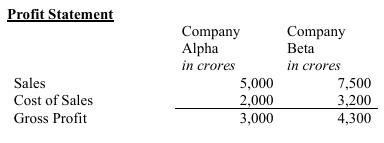
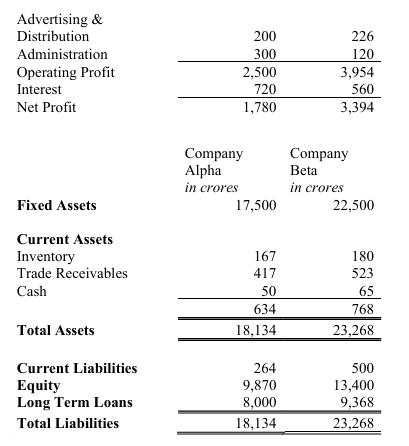
Compute the ‘Return on Equity’ given the above information for Alpha and Beta respectively.
Correct
Correct answer is B
$\text {Return on equity} = \frac {\text {Net Income}}{\text {Equity}}$
For alpha,
$\text {Return on equity} = \frac {1780}{9870} = 18\%$
For Beta,
$\text {Return on equity} = \frac {3394}{13400} = 25\%$Incorrect
Correct answer is B
$\text {Return on equity} = \frac {\text {Net Income}}{\text {Equity}}$
For alpha,
$\text {Return on equity} = \frac {1780}{9870} = 18\%$
For Beta,
$\text {Return on equity} = \frac {3394}{13400} = 25\%$ -
Question 184 of 500CB1025655
Question 184
FlagCompute the ‘Inventory Turnover period’ in days given the above information for Alpha and Beta respectively.
Correct
Correct answer is A
For alpha,
$
\text { Inventory turnover period }=365 \times \frac{167}{2000}=30.4 \text { days }
$For beta,
$
\text { Inventory turnover period }=365 \times \frac{180}{3200}=20.53 \approx 21 \text { days }
$Incorrect
Correct answer is A
For alpha,
$
\text { Inventory turnover period }=365 \times \frac{167}{2000}=30.4 \text { days }
$For beta,
$
\text { Inventory turnover period }=365 \times \frac{180}{3200}=20.53 \approx 21 \text { days }
$ -
Question 185 of 500CB1025656
Question 185
FlagCurrent Ratio of the company Alpha and Beta respectively are?
Correct
Correct answer is D
For alpha,
$
\text { Current ratio }=\frac{\text { Current assets }}{\text { Current Liabilities }}=\frac{634}{264}=2.4
$For beta,
$
\text { Current ratio }=\frac{\text { Current assets }}{\text { Current Liabilities }}=\frac{768}{500}=1.536
$Incorrect
Correct answer is D
For alpha,
$
\text { Current ratio }=\frac{\text { Current assets }}{\text { Current Liabilities }}=\frac{634}{264}=2.4
$For beta,
$
\text { Current ratio }=\frac{\text { Current assets }}{\text { Current Liabilities }}=\frac{768}{500}=1.536
$ -
Question 186 of 500CB1025658
Question 186
FlagWhich of the following statements is true?
I. Systematic risk arises because of volatility of market as a whole
II. Diversification across a well-diversified portfolio will entirely remove systematic risk
III. Specific risk can be diversified away on a large well spread portfolioCorrect
Correct answer is C
Statement I is true – Systematic risk because of volatility in the entire market.
Statement II is incorrect – diversification will not remove systematic risk as it affects the entire market, so all the shares in investor’s portfolio would be affected because of this.
Statement III is true – specific risk is volatility in the prices of a single asset class, single currency, or a single security. Hence, this risk can be diversified away.Incorrect
Correct answer is C
Statement I is true – Systematic risk because of volatility in the entire market.
Statement II is incorrect – diversification will not remove systematic risk as it affects the entire market, so all the shares in investor’s portfolio would be affected because of this.
Statement III is true – specific risk is volatility in the prices of a single asset class, single currency, or a single security. Hence, this risk can be diversified away. -
Question 187 of 500CB1025659
Question 187
FlagWhich of the following is a short document recording the intention of people concerned to form a company?
Correct
The correct answer is B
A. Share Certificates – Incorrect. These are issued to shareholders as proof of ownership after the company is formed.
B. Memorandum of Association – Correct. It records the intention of people to form a company and lays down the company’s fundamental conditions.
C. Articles of Association – Incorrect. These govern the internal rules and management of the company, not its formation.
D. Annual Report & Accounts – Incorrect. These are financial and operational reports prepared annually after the company is established.Incorrect
The correct answer is B
A. Share Certificates – Incorrect. These are issued to shareholders as proof of ownership after the company is formed.
B. Memorandum of Association – Correct. It records the intention of people to form a company and lays down the company’s fundamental conditions.
C. Articles of Association – Incorrect. These govern the internal rules and management of the company, not its formation.
D. Annual Report & Accounts – Incorrect. These are financial and operational reports prepared annually after the company is established. -
Question 188 of 500CB1025660
Question 188
FlagShare premium account is the difference between which of the following?
Correct
The correct answer is D
The definition of share premium is excess of what company is charging from the shareholders as compared to the book value of the shares – which aligns with option D.
Company’s book of accounts will not take market value of shares into consideration – because that has nothing to do with the company. That is the price at which investors of the company are selling company’s share to other investors.
Incorrect
The correct answer is D
The definition of share premium is excess of what company is charging from the shareholders as compared to the book value of the shares – which aligns with option D.
Company’s book of accounts will not take market value of shares into consideration – because that has nothing to do with the company. That is the price at which investors of the company are selling company’s share to other investors.
-
Question 189 of 500CB1025661
Question 189
FlagYou have been asked to determine the internal rate of return (IRR) of a project that has an initial cash outflow, followed by seven years of net cash inflows. The project’s net present value was + INR 100,000 when determined at 8% and – INR 100,000 when determined at 16%.
Which of the following statements concerning the project’s IRR is correct?Correct
The correct answer is A
Since NPV is positive when rate of return used is 8%, therefore returns achieved on the project is more than 8%.
Therefore, option D is incorrect.
Since NPV is positive when rate of return used is 16%, therefore returns achieved on the project is less than 16%.
Therefore, option C is incorrect.
We cannot use linear interpolation here to obtain the answer as the return and NPV might not have a perfect linear relationship.
Therefore, option B is also incorrect.
But, we can conclude that it would be roughly 12%.Incorrect
The correct answer is A
Since NPV is positive when rate of return used is 8%, therefore returns achieved on the project is more than 8%.
Therefore, option D is incorrect.
Since NPV is positive when rate of return used is 16%, therefore returns achieved on the project is less than 16%.
Therefore, option C is incorrect.
We cannot use linear interpolation here to obtain the answer as the return and NPV might not have a perfect linear relationship.
Therefore, option B is also incorrect.
But, we can conclude that it would be roughly 12%. -
Question 190 of 500CB1025662
Question 190
FlagThe table below gives the expected cash inflows and outflows for a project. Determine the approximate payback period in years. Assume continuous cashflows.
$\begin{array}{|l|l|l|l|l|l|l|}
\hline \text { Time in years } & 0 & 1 & 2 & 3 & 4 & 5 \\
\hline \text { Cashflow (INR in Lacs) } & (5) & (3) & (2) & 5 & 8 & 10 \\
\hline
\end{array}$Correct
The correct answer is C
Payback period is that period where all the cash outflows from the project gets recovered, in other words when cash outflows is equal to cash inflows.
Total outflow = INR 10 Lacs
Net Cashflow at the end of year 3 = – INR 5 lacs
Net Cashflow at the end of year 4 = INR 3 lacs
Therefore, payback period must be somewhere in between year 3 and year 4.
Given we have to assume that cashflows are received or paid continuously.
We only need 5 lacs for cashflows to become positive,
Fraction of year 4 = 5/8 = 0.625
Therefore, closest answer we have is option C.Incorrect
The correct answer is C
Payback period is that period where all the cash outflows from the project gets recovered, in other words when cash outflows is equal to cash inflows.
Total outflow = INR 10 Lacs
Net Cashflow at the end of year 3 = – INR 5 lacs
Net Cashflow at the end of year 4 = INR 3 lacs
Therefore, payback period must be somewhere in between year 3 and year 4.
Given we have to assume that cashflows are received or paid continuously.
We only need 5 lacs for cashflows to become positive,
Fraction of year 4 = 5/8 = 0.625
Therefore, closest answer we have is option C. -
Question 191 of 500CB1025663
Question 191
FlagAn increase in value of a non-current asset recognised in the revaluation reserve would NOT
Correct
The correct answer is B
A. Increase the equity of the Company – Incorrect. Revaluation surplus increases the revaluation reserve, which is part of equity.
B. Increase the profit of the Company – Correct. Revaluation gains are not recognized in the profit and loss account; they are taken directly to the revaluation reserve.
C. Make the statement of financial position look stronger – Incorrect. Higher asset values and equity strengthen the balance sheet.
D. Increase the other comprehensive income – Incorrect. Revaluation gains are part of other comprehensive income.Incorrect
The correct answer is B
A. Increase the equity of the Company – Incorrect. Revaluation surplus increases the revaluation reserve, which is part of equity.
B. Increase the profit of the Company – Correct. Revaluation gains are not recognized in the profit and loss account; they are taken directly to the revaluation reserve.
C. Make the statement of financial position look stronger – Incorrect. Higher asset values and equity strengthen the balance sheet.
D. Increase the other comprehensive income – Incorrect. Revaluation gains are part of other comprehensive income. -
Question 192 of 500CB1025664
Question 192
FlagAn Associated Undertaking is which of the following?
Correct
The correct answer is A
A. Correct. An associate is an entity over which the investor has significant influence but not full control.
B. Incorrect. A subsidiary is controlled, not just influenced.
C. Incorrect. If there is control, it is classified as a subsidiary, not an associate.
D. Incorrect. A subsidiary is always under control, which implies full influence.Incorrect
The correct answer is A
A. Correct. An associate is an entity over which the investor has significant influence but not full control.
B. Incorrect. A subsidiary is controlled, not just influenced.
C. Incorrect. If there is control, it is classified as a subsidiary, not an associate.
D. Incorrect. A subsidiary is always under control, which implies full influence. -
Question 193 of 500CB1025665
Question 193
FlagWhich of the following items does NOT occur in the ‘revenue account’ of insurance company accounts?
Correct
The correct answer is C
A. Earned premiums – Incorrect. Earned premiums are part of the revenue account showing income from insurance operations.
B. Incurred claims – Incorrect. Claims incurred are expenses shown in the revenue account of an insurance company.
C. Investment income on investments relating to shareholders’ fund – Correct. This is shown in the profit and loss account, not the revenue account, which focuses on policyholder-related items.
D. Realized capital gains on investments held to cover insurance liabilities – Incorrect. Gains related to policyholder funds are included in the revenue account.Incorrect
The correct answer is C
A. Earned premiums – Incorrect. Earned premiums are part of the revenue account showing income from insurance operations.
B. Incurred claims – Incorrect. Claims incurred are expenses shown in the revenue account of an insurance company.
C. Investment income on investments relating to shareholders’ fund – Correct. This is shown in the profit and loss account, not the revenue account, which focuses on policyholder-related items.
D. Realized capital gains on investments held to cover insurance liabilities – Incorrect. Gains related to policyholder funds are included in the revenue account. -
Question 194 of 500CB1025666
Question 194
FlagWhich of the following statements are correct
I) Asset gearing may be defined as Borrowing/(Borrowing + Equity)
II) Asset gearing may also be defined as Borrowing/Equity
III) Asset gearing is also known as capital gearingCorrect
The correct answer is D
I) Asset gearing may be defined as Borrowing/(Borrowing + Equity) – Correct. This is one common definition showing proportion of debt to total capital.
II) Asset gearing may also be defined as Borrowing/Equity – Correct. Some definitions use just Borrowing divided by Equity.
III) Asset gearing is also known as capital gearing – Correct. Asset gearing and capital gearing are often used interchangeably.Incorrect
The correct answer is D
I) Asset gearing may be defined as Borrowing/(Borrowing + Equity) – Correct. This is one common definition showing proportion of debt to total capital.
II) Asset gearing may also be defined as Borrowing/Equity – Correct. Some definitions use just Borrowing divided by Equity.
III) Asset gearing is also known as capital gearing – Correct. Asset gearing and capital gearing are often used interchangeably. -
Question 195 of 500CB1025667
Question 195
FlagWhich of the following would NOT explain why the PE ratio of the particular company may stand above the average PE ratio of other companies?
Correct
The correct answer is B
A. The Company’s shares are over-valued – Incorrect. Overvaluation can lead to a higher PE ratio.
B. Earnings are perceived to be relatively risky – Correct. Higher risk would usually lower the PE ratio, not increase it.
C. Historical earnings are unusually low – Incorrect. Low current earnings can artificially inflate the PE ratio.
D. Potential earnings growth is very high – Incorrect. High expected growth justifies a higher PE ratio.Incorrect
The correct answer is B
A. The Company’s shares are over-valued – Incorrect. Overvaluation can lead to a higher PE ratio.
B. Earnings are perceived to be relatively risky – Correct. Higher risk would usually lower the PE ratio, not increase it.
C. Historical earnings are unusually low – Incorrect. Low current earnings can artificially inflate the PE ratio.
D. Potential earnings growth is very high – Incorrect. High expected growth justifies a higher PE ratio. -
Question 196 of 500CB1025668
Question 196
FlagWhich of the following is NOT a category of financial futures?
Correct
The correct answer is A
A. Long term interest rates – Correct. Long-term interest rates themselves are not a direct futures category; instead, futures exist on bonds or short-term interest rates.
B. Bond – Incorrect. Bond futures are a standard category of financial futures.
C. Stock index – Incorrect. Stock index futures are a major financial futures category.
D. Currency – Incorrect. Currency futures are a well-established type of financial futures.Incorrect
The correct answer is A
A. Long term interest rates – Correct. Long-term interest rates themselves are not a direct futures category; instead, futures exist on bonds or short-term interest rates.
B. Bond – Incorrect. Bond futures are a standard category of financial futures.
C. Stock index – Incorrect. Stock index futures are a major financial futures category.
D. Currency – Incorrect. Currency futures are a well-established type of financial futures. -
Question 197 of 500CB1025669
Question 197
FlagWhich of the following best explains the fact that a consolidated statement of financial position does not show a figure in respect of non-controlling interest?
Correct
The correct answer is A
A. All of the subsidiaries are wholly owned by the parent company – Correct. If the parent owns 100% of the subsidiaries, there is no non-controlling interest to show.
B. None of the subsidiaries were acquired as going concerns – Incorrect. This does not affect the existence of non-controlling interests.
C. The group has no associated undertakings – Incorrect. Associated undertakings are different from non-controlling interests in subsidiaries.
D. The parent company has a widespread shareholding – Incorrect. This relates to ownership of the parent, not its subsidiaries.Incorrect
The correct answer is A
A. All of the subsidiaries are wholly owned by the parent company – Correct. If the parent owns 100% of the subsidiaries, there is no non-controlling interest to show.
B. None of the subsidiaries were acquired as going concerns – Incorrect. This does not affect the existence of non-controlling interests.
C. The group has no associated undertakings – Incorrect. Associated undertakings are different from non-controlling interests in subsidiaries.
D. The parent company has a widespread shareholding – Incorrect. This relates to ownership of the parent, not its subsidiaries. -
Question 198 of 500CB1025670
Question 198
Flag“Preference shares are more like debt than equity”. Which of the following statements explain this most correctly?”
Correct
The correct answer is C
A. The tax treatment of preference dividends – Incorrect. Preference dividends are not tax-deductible like interest on debt.
B. The ability to buy and sell preference shares – Incorrect. This relates to liquidity, not similarity to debt.
C. The fixed nature of participation in profits – Correct. Like debt, preference shares offer fixed returns, making them similar to debt.
D. The ability to make capital gains or losses – Incorrect. This feature is common to all types of shares, not specific to preference shares.Incorrect
The correct answer is C
A. The tax treatment of preference dividends – Incorrect. Preference dividends are not tax-deductible like interest on debt.
B. The ability to buy and sell preference shares – Incorrect. This relates to liquidity, not similarity to debt.
C. The fixed nature of participation in profits – Correct. Like debt, preference shares offer fixed returns, making them similar to debt.
D. The ability to make capital gains or losses – Incorrect. This feature is common to all types of shares, not specific to preference shares. -
Question 199 of 500CB1025671
Question 199
FlagAt 31 March ’23 the statement of financial position of Pro Trader Ltd. which is a manufacturing company was as follows:
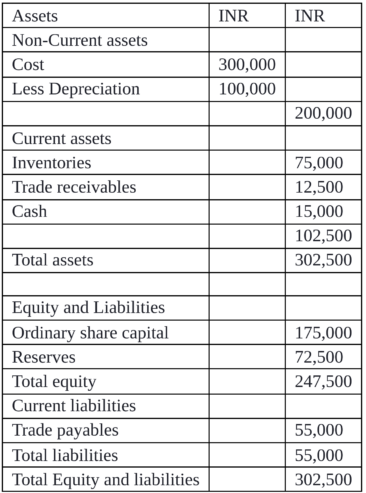
During FY 23-24 the following items appeared in the company’s accounting records:
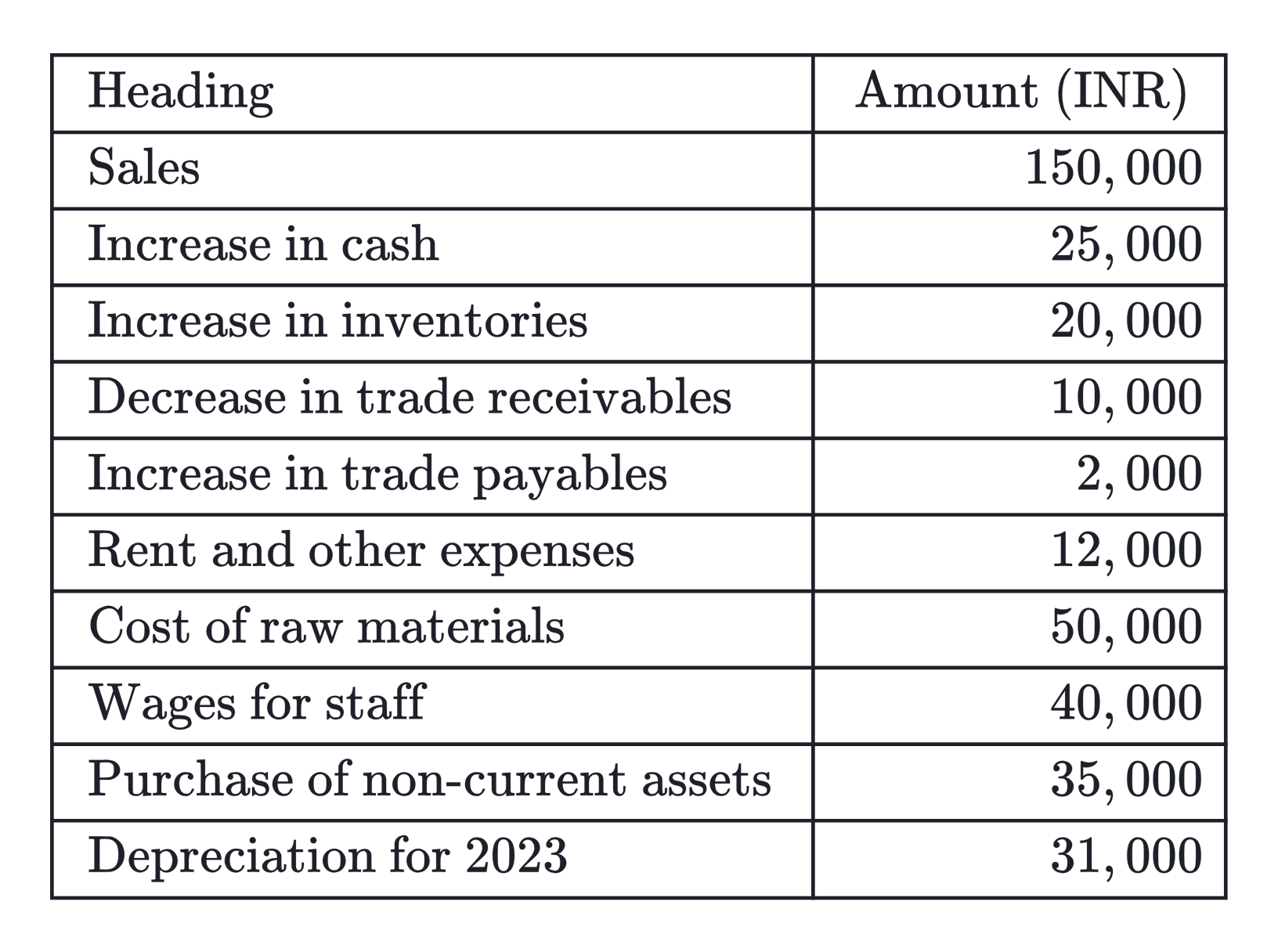
Assume tax rate as 16%
Payment of dividend declared for FY 2023 equaling INR 20,000
Depreciation is related to assets used directly for operations of the business
No depreciation is applicable apart from the one mentioned for Year 2023What is the Profit after tax for the FY 23-24 considering all the information given?
Correct
The correct answer is A
$\begin{array}{|l|r|}
\hline \text { Particulars } & \text { Amount (INR) } \\
\hline \text { Sales } & 150000 \\
\hline \text { Less: COGS } & \underline{101000} \\
\hline \text { Gross Profit } & 49000 \\
\hline \text { Less: Rent } & \underline{12000} \\
\hline \text { Operating Profit } & 37000 \\
\hline \text { Less: Tax @ 16% } & \underline{5920} \\
\hline \text { PAT } & 31080 \\
\hline
\end{array}$Working Note:
$\begin{array}{|l|r|}
\hline \text { Particulars } & \text { Amount (INR) } \\
\hline \text { Raw Materials } & 50000 \\
\hline \text { Inventories } & -20000 \\
\hline \text { Wages } & 40000 \\
\hline \text { Depreciation } & 31000 \\
\hline \text { Total } & 101000 \\
\hline
\end{array}$Incorrect
The correct answer is A
$\begin{array}{|l|r|}
\hline \text { Particulars } & \text { Amount (INR) } \\
\hline \text { Sales } & 150000 \\
\hline \text { Less: COGS } & \underline{101000} \\
\hline \text { Gross Profit } & 49000 \\
\hline \text { Less: Rent } & \underline{12000} \\
\hline \text { Operating Profit } & 37000 \\
\hline \text { Less: Tax @ 16% } & \underline{5920} \\
\hline \text { PAT } & 31080 \\
\hline
\end{array}$Working Note:
$\begin{array}{|l|r|}
\hline \text { Particulars } & \text { Amount (INR) } \\
\hline \text { Raw Materials } & 50000 \\
\hline \text { Inventories } & -20000 \\
\hline \text { Wages } & 40000 \\
\hline \text { Depreciation } & 31000 \\
\hline \text { Total } & 101000 \\
\hline
\end{array}$ -
Question 200 of 500CB1025672
Question 200
FlagAt 31 March ’23 the statement of financial position of Pro Trader Ltd. which is a manufacturing company was as follows:
During FY 23-24 the following items appeared in the company’s accounting records:
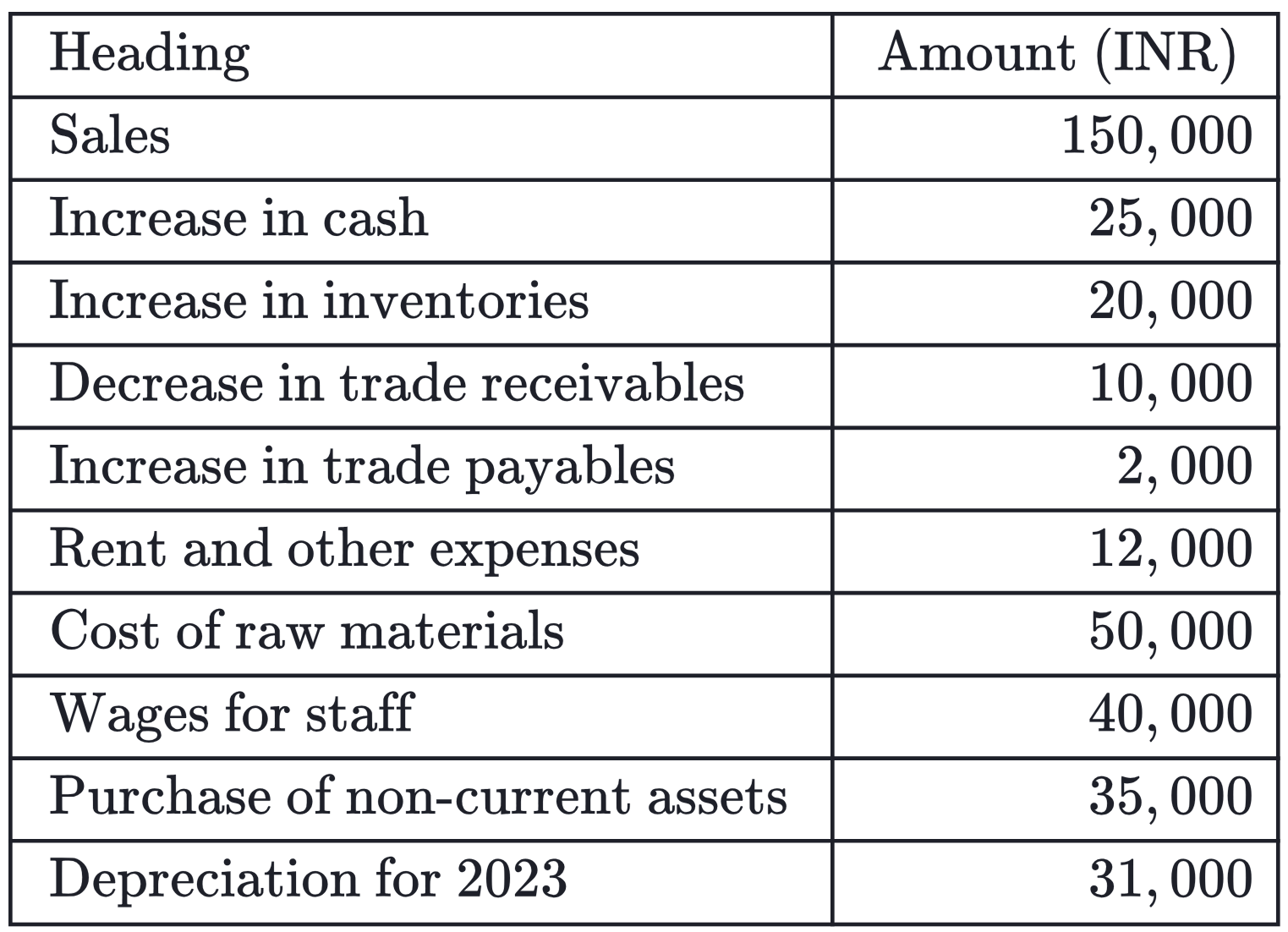
Assume tax rate as 16%
Payment of dividend declared for FY 2023 equaling INR 20,000
Depreciation is related to assets used directly for operations of the business
No depreciation is applicable apart from the one mentioned for Year 2023Given the values for Purchase of non-current assets, Depreciation for 2023, and assuming asset has been depreciated using straight line method, what is the approximate assumed life of the asset? Choose the option that you think is the nearest to the exact number of years
Correct
The correct answer is D
Under SLM method depreciation remains constant.
Therefore, assuming no scrap value for the asset purchased.
Lifetime of non-current asset = 300000/31000 = 9.68 years
Therefore, answer to the nearest exact number of years would be 9 years.Incorrect
The correct answer is D
Under SLM method depreciation remains constant.
Therefore, assuming no scrap value for the asset purchased.
Lifetime of non-current asset = 300000/31000 = 9.68 years
Therefore, answer to the nearest exact number of years would be 9 years. -
Question 201 of 500CB1025673
Question 201
FlagAt 31 March ’23 the statement of financial position of Pro Trader Ltd. which is a manufacturing company was as follows:
During FY 23-24 the following items appeared in the company’s accounting records:
Assume tax rate as 16%
Payment of dividend declared for FY 2023 equaling INR 20,000
Depreciation is related to assets used directly for operations of the business
No depreciation is applicable apart from the one mentioned for Year 2023Compute the value of Current Assets that would be reflected in the Statement of Position as at March ’24
Correct
The correct answer is C
Value of current assets as at the end of March 2023 = 102,500
Value of current assets as at the end of March 2024 = 102500 + Increase in cash + Increase in inventories – Decrease in trade receivables
Value of current assets as at the end of March 2024 = 102500 + 25000 + 20000 – 10000 = INR 137,500Incorrect
The correct answer is C
Value of current assets as at the end of March 2023 = 102,500
Value of current assets as at the end of March 2024 = 102500 + Increase in cash + Increase in inventories – Decrease in trade receivables
Value of current assets as at the end of March 2024 = 102500 + 25000 + 20000 – 10000 = INR 137,500 -
Question 202 of 500CB1025674
Question 202
FlagAt 31 March ’23 the statement of financial position of Pro Trader Ltd. which is a manufacturing company was as follows:
During FY 23-24 the following items appeared in the company’s accounting records:
Assume tax rate as 16%
Payment of dividend declared for FY 2023 equaling INR 20,000
Depreciation is related to assets used directly for operations of the business
No depreciation is applicable apart from the one mentioned for Year 2023Compute the value of Equity and Liabilities that would be reflected in the Statement of Position as at March ’24
Correct
The correct answer is D
$\begin{array}{|l|l|l|}
\hline \text {Assets} & \text {INR} & \text {INR} \\
\hline \text {Non-Current Assets} & & \\
\hline \text {Cost} & 335000 & \\
\hline \text {Less Depreciation:} & \underline{131000} & \\
\hline \text {Total Non-Current Assets} & & 204000 \\
\hline \text {Current Assets} & & \\
\hline \text {Inventories} & & 95000 \\
\hline \text {Trade Receivables} & & 2500 \\
\hline \text {Cash} & & 40000 \\
\hline \text {Total Current Assets} & & 137500 \\
\hline \text {Total Assets} & & 341500 \\
\hline
\end{array}$Working Note:
Cost = 300000 + Purchase in non-current asset during the year
Depreciation = 100000 + 31000 (for the year 2023)
Inventories = 75000 + Increase in inventory
Trade Receivable = 12500 – Decrease in trade receivables
Cash = 15000 + Increase in cashIncorrect
The correct answer is D
$\begin{array}{|l|l|l|}
\hline \text {Assets} & \text {INR} & \text {INR} \\
\hline \text {Non-Current Assets} & & \\
\hline \text {Cost} & 335000 & \\
\hline \text {Less Depreciation:} & \underline{131000} & \\
\hline \text {Total Non-Current Assets} & & 204000 \\
\hline \text {Current Assets} & & \\
\hline \text {Inventories} & & 95000 \\
\hline \text {Trade Receivables} & & 2500 \\
\hline \text {Cash} & & 40000 \\
\hline \text {Total Current Assets} & & 137500 \\
\hline \text {Total Assets} & & 341500 \\
\hline
\end{array}$Working Note:
Cost = 300000 + Purchase in non-current asset during the year
Depreciation = 100000 + 31000 (for the year 2023)
Inventories = 75000 + Increase in inventory
Trade Receivable = 12500 – Decrease in trade receivables
Cash = 15000 + Increase in cash -
Question 203 of 500CB1025675
Question 203
FlagWhich of the following statements is NOT true about Recourse Factoring?
Correct
The correct answer is D
Option A is incorrect – In recourse factoring, the supplier bears the risk if the customer fails to pay.
Option B is incorrect – The primary function of recourse factoring is to accelerate cash flow by advancing money against receivables.
Option C is incorrect – Recourse financing is discounting of invoices of the company.
Option D is correct – The value in factoring depends on the actual value of invoices sold; it is not fixed irrespective of sales.Incorrect
The correct answer is D
Option A is incorrect – In recourse factoring, the supplier bears the risk if the customer fails to pay.
Option B is incorrect – The primary function of recourse factoring is to accelerate cash flow by advancing money against receivables.
Option C is incorrect – Recourse financing is discounting of invoices of the company.
Option D is correct – The value in factoring depends on the actual value of invoices sold; it is not fixed irrespective of sales. -
Question 204 of 500CB1025676
Question 204
FlagLimited Liability Partnership differs from a Limited Company, in that,
Correct
The correct answer is A
A. Correct. An LLP is governed by an LLP agreement, not by a Memorandum or Articles of Association like a company.
B. Incorrect. An LLP is a separate legal entity from its members.
C. Incorrect. All members of an LLP have limited liability.
D. Incorrect. Individual members can be held personally liable for their own fraud or negligence.Incorrect
The correct answer is A
A. Correct. An LLP is governed by an LLP agreement, not by a Memorandum or Articles of Association like a company.
B. Incorrect. An LLP is a separate legal entity from its members.
C. Incorrect. All members of an LLP have limited liability.
D. Incorrect. Individual members can be held personally liable for their own fraud or negligence. -
Question 205 of 500CB1025677
Question 205
FlagA health insurance company allows an inward and outward reinsurance in its business.
Which amongst the following in revenue account will be directly impacted?Correct
The correct answer is D
Outward reinsurance implies that reinsurance was taken by insurer in question – they have transferred some of their risk to some other insurance company.
Inward reinsurance implies that reinsurance was given by insurer in question – they have taken on some of the risk of some other insurance company.A. Net Earned Premium – Correct, outward reinsurance reduces premium income and inward reinsurance adds to it.
B. Net Incurred Claims – Correct, outward reinsurance reduces claim expenses through recoveries, and inward reinsurance increases them.
C. Share Capital – Incorrect, it is a balance sheet item and not affected by reinsurance.
D. Both A and B – Correct, both premium and claim components in the revenue account are impacted.Incorrect
The correct answer is D
Outward reinsurance implies that reinsurance was taken by insurer in question – they have transferred some of their risk to some other insurance company.
Inward reinsurance implies that reinsurance was given by insurer in question – they have taken on some of the risk of some other insurance company.A. Net Earned Premium – Correct, outward reinsurance reduces premium income and inward reinsurance adds to it.
B. Net Incurred Claims – Correct, outward reinsurance reduces claim expenses through recoveries, and inward reinsurance increases them.
C. Share Capital – Incorrect, it is a balance sheet item and not affected by reinsurance.
D. Both A and B – Correct, both premium and claim components in the revenue account are impacted. -
Question 206 of 500CB1025678
Question 206
FlagPeer to Peer Lending is primarily a type of,
Correct
The correct answer is D
A. Shadow Banking – Incorrect, although P2P lending operates outside traditional banks, it is more specifically classified under crowdfunding due to its structure.
B. Project Financing – Incorrect, P2P is not used for large-scale project finance but for individual or small business loans.
C. Non-Recourse Financing – Incorrect, P2P loans typically have recourse, unlike non-recourse structures.
D. Crowdfunding – Correct, P2P lending is a form of crowdfunding where many individuals fund loans to borrowers via online platforms.Incorrect
The correct answer is D
A. Shadow Banking – Incorrect, although P2P lending operates outside traditional banks, it is more specifically classified under crowdfunding due to its structure.
B. Project Financing – Incorrect, P2P is not used for large-scale project finance but for individual or small business loans.
C. Non-Recourse Financing – Incorrect, P2P loans typically have recourse, unlike non-recourse structures.
D. Crowdfunding – Correct, P2P lending is a form of crowdfunding where many individuals fund loans to borrowers via online platforms. -
Question 207 of 500CB1025679
Question 207
FlagBlue jar plc has a debt equity ratio of 1:1.2. The risk-free return is 5% pa, the equity risk premium derived from market is 6.5% pa, and gross cost of debt is 4.5% pa. Its beta is 1.5 and tax on profit is 25%.
Compute the Company’s weighted average cost of capital
Correct
The correct answer is A
$\text {Cost of equity} = 0.05 + 0.065 \times 1.5 = 14.75 \%$
$\text {Post-tax Cost of debt} = 0.045 \times (1-0.25) = 3.375 \%$
$\text {Weighted Average Cost of Capital} = 1.2/2.2 \times 0.1475+ 1/2.2 \times 0.03375 = 9.58 \%$Incorrect
The correct answer is A
$\text {Cost of equity} = 0.05 + 0.065 \times 1.5 = 14.75 \%$
$\text {Post-tax Cost of debt} = 0.045 \times (1-0.25) = 3.375 \%$
$\text {Weighted Average Cost of Capital} = 1.2/2.2 \times 0.1475+ 1/2.2 \times 0.03375 = 9.58 \%$ -
Question 208 of 500CB1025680
Question 208
FlagBlue jar plc has a debt equity ratio of 1:1.2. The risk-free return is 5% pa, the equity risk premium derived from market is 6.5% pa, and gross cost of debt is 4.5% pa. Its beta is 1.5 and tax on profit is 25%.
Calculate the Beta, if the Company were to repay all its debt
Correct
The correct answer is C
$\text {Unlevered beta} = \frac {\text {Levered beta}}{1+(1-\text {Tax rate})\times\text{Debt}/\text{Equity}}$
$\text {Unlevered beta} = \frac {1.5}{1+(1-0.25)\times1/1.2}$
$\text {Unlevered beta} = 92.31 \%$Incorrect
The correct answer is C
$\text {Unlevered beta} = \frac {\text {Levered beta}}{1+(1-\text {Tax rate})\times\text{Debt}/\text{Equity}}$
$\text {Unlevered beta} = \frac {1.5}{1+(1-0.25)\times1/1.2}$
$\text {Unlevered beta} = 92.31 \%$ -
Question 209 of 500CB1031418
Question 209
FlagWhich of the following is legally responsible for the commitment owed by a limited company to the company’s lenders?
Correct
Answer A
Legal responsibility for financial matters, such as ensuring payments are made to lenders, will rest with the board of directors.
Incorrect
Answer A
Legal responsibility for financial matters, such as ensuring payments are made to lenders, will rest with the board of directors.
-
Question 210 of 500CB1031423
Question 210
FlagWhich of the following best explains the problems arising from information asymmetry?
Correct
Answer C
Information asymmetries arise when one party has more or better information available when making a decision. It is true that directors may not have sufficient information to make a sound decision, but this is not asymmetry, simply a lack of information. Similarly, shareholders may not be able to process the information they have, but this is not asymmetry. Some shareholders may be better informed, but in theory they all have access to the same information. The key asymmetry is described in $\mathrm{C}, i e$ that shareholders are not as well informed as the directors and so may struggle to evaluate their behaviour.
Incorrect
Answer C
Information asymmetries arise when one party has more or better information available when making a decision. It is true that directors may not have sufficient information to make a sound decision, but this is not asymmetry, simply a lack of information. Similarly, shareholders may not be able to process the information they have, but this is not asymmetry. Some shareholders may be better informed, but in theory they all have access to the same information. The key asymmetry is described in $\mathrm{C}, i e$ that shareholders are not as well informed as the directors and so may struggle to evaluate their behaviour.
-
Question 211 of 500CB1031431
Question 211
FlagWhen considering the maximisation of shareholder wealth, how is shareholder wealth expressed?
Correct
Answer B or C
Directors’ estimates and surveys of shareholders are definitely not how shareholder wealth is expressed, as the theory tells us it is about market values.
The share price is certainly an element of shareholder wealth. It could be argued that it is the only element, as the share price should reflect the market’s view of future dividends. Alternatively, it could be argued that shareholder wealth consists of the share price and dividends, to ensure that both future growth and current income is being maximised. Therefore, either B or C are acceptable answers.
Incorrect
Answer B or C
Directors’ estimates and surveys of shareholders are definitely not how shareholder wealth is expressed, as the theory tells us it is about market values.
The share price is certainly an element of shareholder wealth. It could be argued that it is the only element, as the share price should reflect the market’s view of future dividends. Alternatively, it could be argued that shareholder wealth consists of the share price and dividends, to ensure that both future growth and current income is being maximised. Therefore, either B or C are acceptable answers.
-
Question 212 of 500CB1031457
Question 212
FlagWhich of the following best describes the relationships between the interests of major groups of stakeholders in a limited company?
Correct
Answer C
There are many groups of stakeholders in an organisation, each with its own objectives. These objectives often conflict and it is unlikely that stakeholders would work together for their mutual benefit.
Problems arise when one group is responsible for taking decisions on behalf of others. The directors of a company are primarily tasked with making strategic decisions on behalf of its shareholders – this means other stakeholders may not be satisfied.
While some relationships (eg with employees) are defined by formal contracts, they cannot cover every eventuality and need to be supplemented by less formal, implicit agreements.
Incorrect
Answer C
There are many groups of stakeholders in an organisation, each with its own objectives. These objectives often conflict and it is unlikely that stakeholders would work together for their mutual benefit.
Problems arise when one group is responsible for taking decisions on behalf of others. The directors of a company are primarily tasked with making strategic decisions on behalf of its shareholders – this means other stakeholders may not be satisfied.
While some relationships (eg with employees) are defined by formal contracts, they cannot cover every eventuality and need to be supplemented by less formal, implicit agreements.
-
Question 213 of 500CB1031461
Question 213
FlagWhy might maximisation of profit be a less acceptable corporate objective than maximisation of shareholder wealth?
Correct
Answer B
If a company always maximises short-term profits, then in the long-run you might expect this to maximise shareholder wealth. However, it might be in the long-term interests of the shareholders to reduce profits (or even make a loss) in the short term in return for more wealth in the long term. For example, making a significant investment in R\&D may reduce short-term profits, but increase profits in the longer term.
Of course, shareholders benefit from profits, but they tend to be a short-term measure only. So, option B is correct. Directors are often judged on their ability to generate profit – or their ability to explain why they have not done so! While profits may lead to pressure to pay dividends, this is only one component of shareholders’ return. Retaining profits can increase the share price and hence shareholders’ capital returns.
Incorrect
Answer B
If a company always maximises short-term profits, then in the long-run you might expect this to maximise shareholder wealth. However, it might be in the long-term interests of the shareholders to reduce profits (or even make a loss) in the short term in return for more wealth in the long term. For example, making a significant investment in R\&D may reduce short-term profits, but increase profits in the longer term.
Of course, shareholders benefit from profits, but they tend to be a short-term measure only. So, option B is correct. Directors are often judged on their ability to generate profit – or their ability to explain why they have not done so! While profits may lead to pressure to pay dividends, this is only one component of shareholders’ return. Retaining profits can increase the share price and hence shareholders’ capital returns.
-
Question 214 of 500CB1031467
Question 214
FlagWhich of the following is an example of an agency problem?
Correct
Answer B
The agency problem arises when the managers of a company may have aims which are not in the best interests of the shareholders. Awarding themselves excessive salaries (option B) is a prime example of such behaviour.
All the other options are valid risks facing a company, but are not examples of the agency problem.
Incorrect
Answer B
The agency problem arises when the managers of a company may have aims which are not in the best interests of the shareholders. Awarding themselves excessive salaries (option B) is a prime example of such behaviour.
All the other options are valid risks facing a company, but are not examples of the agency problem.
-
Question 215 of 500CB1031468
Question 215
FlagWhich of the following best explains why the maximisation of shareholder wealth is said to be the primary objective for company directors?
Correct
Answer D
Maximising shareholder wealth is considered the primary objective because it provides a clear, measurable way to judge whether a decision improves the value of the company. Wealth is reflected in the share price, which incorporates the timing, size, and risk of future cashflows. This makes it a comprehensive measure for evaluating decisions, unlike profit, which can be distorted by accounting choices and ignores risk and timing.
Hence, D is the correct answer.
Incorrect
Answer D
Maximising shareholder wealth is considered the primary objective because it provides a clear, measurable way to judge whether a decision improves the value of the company. Wealth is reflected in the share price, which incorporates the timing, size, and risk of future cashflows. This makes it a comprehensive measure for evaluating decisions, unlike profit, which can be distorted by accounting choices and ignores risk and timing.
Hence, D is the correct answer.
-
Question 216 of 500CB1031471
Question 216
FlagWhich of the following statements about limited companies is correct?
Correct
Answer C
A is incorrect because shareholders can be personally liable if they give personal guarantees or act fraudulently.
B is incorrect because shareholders of a small company do not have to be directors.
C is correct because directors can also be shareholders.
D is incorrect because sole traders and partnerships can also hire managers.Incorrect
Answer C
A is incorrect because shareholders can be personally liable if they give personal guarantees or act fraudulently.
B is incorrect because shareholders of a small company do not have to be directors.
C is correct because directors can also be shareholders.
D is incorrect because sole traders and partnerships can also hire managers. -
Question 217 of 500CB1031477
Question 217
FlagWhich of the following statements best describes the driver of the market price of a quoted company?
Correct
Answer B
The market price of a quoted company may be viewed as the expected present value to the shareholders of the stream of future cashflows they will receive, ie the expected present value of future dividends.
Option A is incorrect as expectations of future company revenues are not sufficient, as a company’s profit and so dividends, will also depend on the company’s outgoings such as expenses, interest payments and tax. Options C and D are incorrect as past profits and dividends are not necessarily a guide to the future.
Incorrect
Answer B
The market price of a quoted company may be viewed as the expected present value to the shareholders of the stream of future cashflows they will receive, ie the expected present value of future dividends.
Option A is incorrect as expectations of future company revenues are not sufficient, as a company’s profit and so dividends, will also depend on the company’s outgoings such as expenses, interest payments and tax. Options C and D are incorrect as past profits and dividends are not necessarily a guide to the future.
-
Question 218 of 500CB1031483
Question 218
FlagWhich of the following statements describes the agency problem?
Correct
Answer C
The potential for the agents’ interests to diverge from the principals’ interests leads to the possibility of conflicts of interest or agency problems. For example in a company, the shareholders may wish to maximise future returns, but directors’ interests may include achieving security and receiving high levels of pay.
Incorrect
Answer C
The potential for the agents’ interests to diverge from the principals’ interests leads to the possibility of conflicts of interest or agency problems. For example in a company, the shareholders may wish to maximise future returns, but directors’ interests may include achieving security and receiving high levels of pay.
-
Question 219 of 500CB1031484
Question 219
FlagWhy would the directors of a quoted company spend more than necessary on their external audit?
Correct
Answer D
The fundamental purpose of the external auditors’ review, and ultimately the auditors’ report, is to add credibility to the financial statements.
The auditors’ report enables shareholders to rely on the financial statements produced by the directors when monitoring how well the directors are managing the company on their behalf. So if the directors spend more than the bare minimum on the external audit, perhaps getting some additional advice from the auditors about best practice reporting in certain areas, this will improve the credibility of the financial statements.
Options A, B and C are incorrect here as they indicate that either the auditors or the company directors are dishonest or incompetent in some way, which should not be the case.
Incorrect
Answer D
The fundamental purpose of the external auditors’ review, and ultimately the auditors’ report, is to add credibility to the financial statements.
The auditors’ report enables shareholders to rely on the financial statements produced by the directors when monitoring how well the directors are managing the company on their behalf. So if the directors spend more than the bare minimum on the external audit, perhaps getting some additional advice from the auditors about best practice reporting in certain areas, this will improve the credibility of the financial statements.
Options A, B and C are incorrect here as they indicate that either the auditors or the company directors are dishonest or incompetent in some way, which should not be the case.
-
Question 220 of 500CB1031485
Question 220
FlagHow can the directors of quoted companies deal with the different risk preferences of the many shareholders who have invested in their companies?
Correct
Answer A
A company’s market capitalisation is equal to the current share price multiplied by the number of shares, ie it is total shareholder wealth. Therefore, maximising market capitalisation is the same as maximising shareholder wealth.
Options B and C are incorrect as directors need to appropriately balance risk and return when selecting projects. This doesn’t mean ignoring risk or minimising risk as much as possible. Option D is incorrect since seeking feedback from shareholders could be very costly and time-consuming, so it’s not a practical solution and isn’t necessary as the market provides that feedback already via the share price.
Incorrect
Answer A
A company’s market capitalisation is equal to the current share price multiplied by the number of shares, ie it is total shareholder wealth. Therefore, maximising market capitalisation is the same as maximising shareholder wealth.
Options B and C are incorrect as directors need to appropriately balance risk and return when selecting projects. This doesn’t mean ignoring risk or minimising risk as much as possible. Option D is incorrect since seeking feedback from shareholders could be very costly and time-consuming, so it’s not a practical solution and isn’t necessary as the market provides that feedback already via the share price.
-
Question 221 of 500CB1031486
Question 221
FlagHow should the directors of a quoted company view agency problems?
Correct
Answer D
Agency problems can be much easier to resolve if all parties are equally well-informed. If a company has a culture of good communication, transparency and accountability, then it is much less likely to experience certain agency problems because the reasons behind directors’ decisions will usually be clear.
Option A is incorrect since agency problems should not be ignored. Option B is incorrect because agency problems do exist. Option C is incorrect because the directors should be concerned about agency problems since they are acting as agents for the shareholders and should therefore act in the shareholders’ best interests.
Incorrect
Answer D
Agency problems can be much easier to resolve if all parties are equally well-informed. If a company has a culture of good communication, transparency and accountability, then it is much less likely to experience certain agency problems because the reasons behind directors’ decisions will usually be clear.
Option A is incorrect since agency problems should not be ignored. Option B is incorrect because agency problems do exist. Option C is incorrect because the directors should be concerned about agency problems since they are acting as agents for the shareholders and should therefore act in the shareholders’ best interests.
-
Question 222 of 500CB1031491
Question 222
FlagWhich of the following is an agency cost?
Correct
Answer C
The Core Reading describes agency costs as including the costs associated with monitoring the actions of others and seeking to influence their actions. The external audit of a company’s financial statements is an example of a cost incurred by the shareholders in monitoring the actions of the directors.
Options A and B are both tempting possibilities as they are both costs that arise in relation to a company’s directors. However, as they are not costs that arise because of the potential different interests of the directors and shareholders, they do not fit the description as well as Option C. Board meetings and directors salaries would be needed even if shareholder and directors interests were exactly aligned.
Option D is incorrect as a company’s debtholders are not agents.
Incorrect
Answer C
The Core Reading describes agency costs as including the costs associated with monitoring the actions of others and seeking to influence their actions. The external audit of a company’s financial statements is an example of a cost incurred by the shareholders in monitoring the actions of the directors.
Options A and B are both tempting possibilities as they are both costs that arise in relation to a company’s directors. However, as they are not costs that arise because of the potential different interests of the directors and shareholders, they do not fit the description as well as Option C. Board meetings and directors salaries would be needed even if shareholder and directors interests were exactly aligned.
Option D is incorrect as a company’s debtholders are not agents.
-
Question 223 of 500CB1031768
Question 223
FlagIn what sense does the stock market serve as a performance monitor of a quoted company?
Correct
Answer C
For a quoted company, while the share price may react to general economic variables or industry-wide factors, the basic component of the share price is the market’s perception of the particular company’s current and expected future performance.
Monitoring how these perceptions of the company’s performance, and hence the share price, respond to management decisions is the mechanism by which the stock market serves as a performance monitor.
Although it is true that economic variables can have an impact on share prices (Option B), this is not serving to monitor the performance of a particular company as share prices of all companies in the economy as a whole are all likely to be impacted by general economic variables.
It is true that having a stock market quotation requires compliance with rules (Option A) and detailed financial disclosures (Option D). However, these help to reduce asymmetries of information rather than monitor performance.
Incorrect
Answer C
For a quoted company, while the share price may react to general economic variables or industry-wide factors, the basic component of the share price is the market’s perception of the particular company’s current and expected future performance.
Monitoring how these perceptions of the company’s performance, and hence the share price, respond to management decisions is the mechanism by which the stock market serves as a performance monitor.
Although it is true that economic variables can have an impact on share prices (Option B), this is not serving to monitor the performance of a particular company as share prices of all companies in the economy as a whole are all likely to be impacted by general economic variables.
It is true that having a stock market quotation requires compliance with rules (Option A) and detailed financial disclosures (Option D). However, these help to reduce asymmetries of information rather than monitor performance.
-
Question 224 of 500CB1031769
Question 224
FlagThe shareholders of Company F, a quoted media company, are concerned that their directors lack the ability to manage the company effectively. How might the capital market support Company F’s shareholders if their concerns are valid?
Correct
Answer D
If the shareholders feel that the directors of Company F are underperforming, the shareholders might express their disapproval by selling their shares. If sufficient shareholders do this, then the share price falls, making the company vulnerable to a takeover bid. Rival companies may be prepared to acquire Company F at a premium to this share price if they believe that under their management Company F’s future performance will be improved.
Incorrect
Answer D
If the shareholders feel that the directors of Company F are underperforming, the shareholders might express their disapproval by selling their shares. If sufficient shareholders do this, then the share price falls, making the company vulnerable to a takeover bid. Rival companies may be prepared to acquire Company F at a premium to this share price if they believe that under their management Company F’s future performance will be improved.
-
Question 225 of 500CB1031770
Question 225
FlagCompany $S$ wishes to remunerate its executive directors in a manner that aligns their interests with those of the shareholders. Which form of remuneration will achieve that objective?
Correct
Answer C
The shareholders’ interests can be considered to be the maximisation of shareholder wealth. To align this with the executive directors’ interests, directors’ remuneration should also be dependent on shareholder wealth.
Neither a generous salary (Option A) nor the use of a company car (Option D) achieves this as neither of these depends on how the company has performed for the shareholders.
Remunerating the directors by a percentage of reported profit (Option B) or by an annual allocation of shares (Option C) are more appropriate possibilities. Of these two, a share allocation, where both the directors and the shareholders are keen to see a high market value for the shares, is preferable. This is because remuneration based on reported profit is potentially vulnerable to the directors manipulating the reported profits or being overfocused on short-term results.
Incorrect
Answer C
The shareholders’ interests can be considered to be the maximisation of shareholder wealth. To align this with the executive directors’ interests, directors’ remuneration should also be dependent on shareholder wealth.
Neither a generous salary (Option A) nor the use of a company car (Option D) achieves this as neither of these depends on how the company has performed for the shareholders.
Remunerating the directors by a percentage of reported profit (Option B) or by an annual allocation of shares (Option C) are more appropriate possibilities. Of these two, a share allocation, where both the directors and the shareholders are keen to see a high market value for the shares, is preferable. This is because remuneration based on reported profit is potentially vulnerable to the directors manipulating the reported profits or being overfocused on short-term results.
-
Question 226 of 500CB1031772
Question 226
FlagWho bears the responsibility for financial decisions made by a quoted company?
Correct
Answer A
Ultimate responsibility for the financial decisions made by any company lies with the board of directors, although the chief financial officer will propose various uses for the company’s finances (hence why Option B is not correct).
The use of the word ‘quoted’ in the question may tempt us into incorrectly selecting Option D’s ‘shareholders’. Shareholders may be interested in the financial decisions of a company, but won’t have responsibility for making those decisions. Nor will shareholders be personally liable for the consequences of those decisions.
The auditor will not take an active role in making any financial decisions for their audit client (Option C).
Incorrect
Answer A
Ultimate responsibility for the financial decisions made by any company lies with the board of directors, although the chief financial officer will propose various uses for the company’s finances (hence why Option B is not correct).
The use of the word ‘quoted’ in the question may tempt us into incorrectly selecting Option D’s ‘shareholders’. Shareholders may be interested in the financial decisions of a company, but won’t have responsibility for making those decisions. Nor will shareholders be personally liable for the consequences of those decisions.
The auditor will not take an active role in making any financial decisions for their audit client (Option C).
-
Question 227 of 500CB1031773
Question 227
FlagWhich of the following explains why the directors of a quoted company would be keen to discourage a takeover bid by a rival company?
Correct
Answer B
A bid for the takeover of the quoted company suggests that the bidding company believes the directors of the target company are not maximising the share price $i e$ that they are underperforming.
Consumers may have fewer choices post-acquisition (Option A), however, that is not guaranteed, nor will that be the primary concern of the target’s directors.
The bidders will need to pay a sufficient amount to the shareholders of the target, such that the shareholders agree to sell their shares. If the offer is deemed an ‘underpayment’ then the shareholders will likely not agree to the offer, therefore Option C is not correct.
The target’s share price could move in either direction depending on the market’s perception of the bid, although since all bids are pitched above the market price, the target price will normally rise on the announcement of a bid. So Option D is also not correct.
Incorrect
Answer B
A bid for the takeover of the quoted company suggests that the bidding company believes the directors of the target company are not maximising the share price $i e$ that they are underperforming.
Consumers may have fewer choices post-acquisition (Option A), however, that is not guaranteed, nor will that be the primary concern of the target’s directors.
The bidders will need to pay a sufficient amount to the shareholders of the target, such that the shareholders agree to sell their shares. If the offer is deemed an ‘underpayment’ then the shareholders will likely not agree to the offer, therefore Option C is not correct.
The target’s share price could move in either direction depending on the market’s perception of the bid, although since all bids are pitched above the market price, the target price will normally rise on the announcement of a bid. So Option D is also not correct.
-
Question 228 of 500CB1031774
Question 228
FlagWhich of the following would be a suitable duty for a non-executive director?
Correct
Answer B
Non-executive directors are not involved in the day-to-day running of a company. Instead, they’re involved in strategic planning, constructing company policy and monitoring the actions of the executive directors.
Options A, C and D are part of a company’s day-to-day operations. Selecting executive directors to perform these tasks is a more suitable task for a non-executive director.
Incorrect
Answer B
Non-executive directors are not involved in the day-to-day running of a company. Instead, they’re involved in strategic planning, constructing company policy and monitoring the actions of the executive directors.
Options A, C and D are part of a company’s day-to-day operations. Selecting executive directors to perform these tasks is a more suitable task for a non-executive director.
-
Question 229 of 500CB1031775
Question 229
FlagWhich of the following best summarises the attitude that the directors of a quoted company should take towards social responsibility?
Correct
Answer A
While it is the directors’ responsibility to maximise the wealth of the company’s shareholders, the need to operate in a socially responsible way puts some constraints on this. The directors need to obey regulations and legislation, as well as complying with ethical customs, and these things will influence the ways in which the directors conduct business. For example, dumping waste chemicals from a factory into a river might maximise profits if it’s much cheaper than paying for safe disposal, but the directors of the company will need to organise appropriate disposal methods in order to obey the law, prevent pollution and avoid reputational damage. In this case, social responsibility has rightly constrained the maximisation of shareholder wealth.
Option B is incorrect because there are times when acting in a socially responsible way is more important than the maximisation of shareholder wealth, as demonstrated in the example above.
While Option C could be correct in some circumstances, it does not describe the attitude the directors should take as well as Option A does. The directors are acting as agents for the shareholders (principals), which means that the directors should act in line with the interests of the shareholders and not (necessarily) their own interests.
Option D is incorrect as this implies that the directors should act in a dishonest fashion
Incorrect
Answer A
While it is the directors’ responsibility to maximise the wealth of the company’s shareholders, the need to operate in a socially responsible way puts some constraints on this. The directors need to obey regulations and legislation, as well as complying with ethical customs, and these things will influence the ways in which the directors conduct business. For example, dumping waste chemicals from a factory into a river might maximise profits if it’s much cheaper than paying for safe disposal, but the directors of the company will need to organise appropriate disposal methods in order to obey the law, prevent pollution and avoid reputational damage. In this case, social responsibility has rightly constrained the maximisation of shareholder wealth.
Option B is incorrect because there are times when acting in a socially responsible way is more important than the maximisation of shareholder wealth, as demonstrated in the example above.
While Option C could be correct in some circumstances, it does not describe the attitude the directors should take as well as Option A does. The directors are acting as agents for the shareholders (principals), which means that the directors should act in line with the interests of the shareholders and not (necessarily) their own interests.
Option D is incorrect as this implies that the directors should act in a dishonest fashion
-
Question 230 of 500CB1031776
Question 230
FlagWhy are quoted companies required to have non-executive directors on their boards?
Correct
Answer C
Boards of directors are responsible for governance and for setting a company’s strategic aims. They also provide the management to put the company strategy into effect. The non-executive directors on the board also have the role of monitoring the executive managers of the company. Non-executive directors are separate from those directors involved in managing the company on a day-to-day basis and are therefore able to perform this oversight role.
While some individual executive directors may be corrupt and incompetent, the strong, blanket statement of Option A is incorrect.
To reach board level usually takes a very long time in a quoted company, and very few executive directors could be described as ‘inexperienced’. They may not have experience in all areas of the company’s business, but that does not justify a statement such as Option B.
Non-executive directors spend less time performing their role for the company, and this results in non-executives’ salaries being lower. However, this doesn’t explain the requirement to have non-executives on the board. Option D is therefore incorrect.
Incorrect
Answer C
Boards of directors are responsible for governance and for setting a company’s strategic aims. They also provide the management to put the company strategy into effect. The non-executive directors on the board also have the role of monitoring the executive managers of the company. Non-executive directors are separate from those directors involved in managing the company on a day-to-day basis and are therefore able to perform this oversight role.
While some individual executive directors may be corrupt and incompetent, the strong, blanket statement of Option A is incorrect.
To reach board level usually takes a very long time in a quoted company, and very few executive directors could be described as ‘inexperienced’. They may not have experience in all areas of the company’s business, but that does not justify a statement such as Option B.
Non-executive directors spend less time performing their role for the company, and this results in non-executives’ salaries being lower. However, this doesn’t explain the requirement to have non-executives on the board. Option D is therefore incorrect.
-
Question 231 of 500CB1031777
Question 231
FlagWhich of the following best explains a ‘comply or explain’ approach to codifying the principles of sound corporate governance?
Correct
Answer B
‘Comply or explain’ means that a company’s management have to either say that they are in compliance with a corporate governance principle, or they must explain why they are choosing not to comply and to do something different.
‘Company or explain’ is an alternative to imposing compulsory adherence to the principles. There may be fines under a compulsory system, but not under this approach. Although some shareholders do not care about compliance, most of them probably do, so option C seems wrong. Option D also looks suspicious because standard setters have developed principles which have evolved with consultation and generally have a high level of agreement.So the best option is B, because if the market participants do not like the managers’ explanations they can sell their shares. This would cause the share price to fall, putting pressure on the managers to change their behaviour. In the extreme, the managers could be sacked or the company taken over and the management team replaced. This is an example of market forces doing their work.
Incorrect
Answer B
‘Comply or explain’ means that a company’s management have to either say that they are in compliance with a corporate governance principle, or they must explain why they are choosing not to comply and to do something different.
‘Company or explain’ is an alternative to imposing compulsory adherence to the principles. There may be fines under a compulsory system, but not under this approach. Although some shareholders do not care about compliance, most of them probably do, so option C seems wrong. Option D also looks suspicious because standard setters have developed principles which have evolved with consultation and generally have a high level of agreement.So the best option is B, because if the market participants do not like the managers’ explanations they can sell their shares. This would cause the share price to fall, putting pressure on the managers to change their behaviour. In the extreme, the managers could be sacked or the company taken over and the management team replaced. This is an example of market forces doing their work.
-
Question 232 of 500CB1031778
Question 232
FlagWhich of the following would be a valid justification for paying the directors of a quoted company a percentage of reported profits rather than fixed salaries?
Correct
Answer A
It is unclear how paying directors a percentage of profits would encourage more accurate financial reporting, so option B seems unlikely. It would certainly ensure that directors are paid well in good times, but when profits fall directors would not be well paid, so option C seems unlikely too. It would punish directors when profits fall due to their mistakes (option D), and it would reward them and encourage them when they manage a good performance (option A), so we have to choose the ‘valid’ option here between option A and D. Option D is too negative, and the best option seems to be A.
Incorrect
Answer A
It is unclear how paying directors a percentage of profits would encourage more accurate financial reporting, so option B seems unlikely. It would certainly ensure that directors are paid well in good times, but when profits fall directors would not be well paid, so option C seems unlikely too. It would punish directors when profits fall due to their mistakes (option D), and it would reward them and encourage them when they manage a good performance (option A), so we have to choose the ‘valid’ option here between option A and D. Option D is too negative, and the best option seems to be A.
-
Question 233 of 500CB1031779
Question 233
FlagWhich of the following would be a suitable succession plan for the membership of a quoted company’s board?
Correct
Answer A
The idea of promoting non-execs to fill executive positions (option B) in unrealistic. Most non-exec directors have had executive management experience, but will have progressed to play a non-exec role in several different companies. They are unlikely to be able to convert to running a company full time, nor would they want to, or indeed have the requisite skills for any particular position. Outgoing directors recommending their chums (Option C) sounds very dubious. We are left with the choice of the Chief Executive appointing all roles, or a committee of non-exec directors running the recruitment process on behalf of shareholders. The best option is the latter as it is a transparent process and option D would put too much power in the hands of one person.
Incorrect
Answer A
The idea of promoting non-execs to fill executive positions (option B) in unrealistic. Most non-exec directors have had executive management experience, but will have progressed to play a non-exec role in several different companies. They are unlikely to be able to convert to running a company full time, nor would they want to, or indeed have the requisite skills for any particular position. Outgoing directors recommending their chums (Option C) sounds very dubious. We are left with the choice of the Chief Executive appointing all roles, or a committee of non-exec directors running the recruitment process on behalf of shareholders. The best option is the latter as it is a transparent process and option D would put too much power in the hands of one person.
-
Question 234 of 500CB1031780
Question 234
FlagThe difference between executive and non-executive directors is that non-executives:
Correct
Answer D
Non-executive directors are not involved in the day-to-day running of a company. Instead, they are involved in governance, strategic planning and monitoring the actions of the executive directors.
The other options are incorrect: both types of director attend board meetings and can hold shares, and neither is considered senior.
Incorrect
Answer D
Non-executive directors are not involved in the day-to-day running of a company. Instead, they are involved in governance, strategic planning and monitoring the actions of the executive directors.
The other options are incorrect: both types of director attend board meetings and can hold shares, and neither is considered senior.
-
Question 235 of 500CB1031781
Question 235
FlagWhich of the following explains why companies have systems of internal control?
Correct
Answer C
Systems of internal control are part of a company’s risk management systems that help a company and its board assess the risks to achieving its objectives. In particular, internal controls protect against the risk of staff errors or fraud.
External stakeholders, such as auditors (Option A) or an exchange (Option D), may recommend or require internal controls, but that is not the underlying reason why companies have them. The board needs to satisfy itself with the internal controls a company has in place, rather than the controls being targeted at board behaviour such as fraud (Option B).
Incorrect
Answer C
Systems of internal control are part of a company’s risk management systems that help a company and its board assess the risks to achieving its objectives. In particular, internal controls protect against the risk of staff errors or fraud.
External stakeholders, such as auditors (Option A) or an exchange (Option D), may recommend or require internal controls, but that is not the underlying reason why companies have them. The board needs to satisfy itself with the internal controls a company has in place, rather than the controls being targeted at board behaviour such as fraud (Option B).
-
Question 236 of 500CB1031782
Question 236
FlagWho should be responsible for the recruitment and appointment of a replacement if a quoted company’s finance director resigns?
Correct
Answer B
A principle of corporate governance is that the board takes collective responsibility. In general, good governance structures will involve more than a single person being responsible for key decisions. So, Options C and D are unlikely to be suitable.
Senior management appointments, including the finance director, are decisions that need board approval. So the recruitment should not involve solely executives, ruling out Options A and C.
Having responsibility rest with a committee of non-executive directors is therefore the best arrangement.
Incorrect
Answer B
A principle of corporate governance is that the board takes collective responsibility. In general, good governance structures will involve more than a single person being responsible for key decisions. So, Options C and D are unlikely to be suitable.
Senior management appointments, including the finance director, are decisions that need board approval. So the recruitment should not involve solely executives, ruling out Options A and C.
Having responsibility rest with a committee of non-executive directors is therefore the best arrangement.
-
Question 237 of 500CB1031783
Question 237
FlagA quoted company has appointed the same individual to serve as both chief executive officer and chair. Why is such an appointment often regarded as undesirable?
Correct
Answer B
Division of responsibilities is a principle of good corporate governance, eg under the UK Corporate Governance Code. This is intended to prevent one person having too much power and dominating decision making.
The other options are not sound explanations: an individual holding both roles would be in charge of the board, there is nothing to suggest they would receive excessive pay, and the illness cover is irrelevant (as the chief executive and chair do not ordinarily cover for each other in the event of illness anyway).
Incorrect
Answer B
Division of responsibilities is a principle of good corporate governance, eg under the UK Corporate Governance Code. This is intended to prevent one person having too much power and dominating decision making.
The other options are not sound explanations: an individual holding both roles would be in charge of the board, there is nothing to suggest they would receive excessive pay, and the illness cover is irrelevant (as the chief executive and chair do not ordinarily cover for each other in the event of illness anyway).
-
Question 238 of 500CB1031784
Question 238
FlagAn individual has served as a lending officer for $K$ Bank for the past year. During that time the lending officer has become increasingly concerned that $K$ Bank is making loans recklessly to borrowers who cannot afford to repay those loans.
Which of the following reflects the lending officer’s ethical responsibility?
Correct
Answer D
The lending officer is an agent of K Bank and so the standards and ethics of K Bank (the principal) are important here. However, this does not mean that the lending officer can simply ignore their own ethical concerns. Ethically, an individual who is unhappy with the behaviour of a company for which they are working should take some action, eg resign their position or report the behaviour to senior management or to an external stakeholder such as a regulator.
Of the actions available as options in this question, Option D is the best ethical option (asking K’s board to resign is unlikely to lead to their resignation and, for reporting externally, using a whistleblowing route such as reporting to an ombudsman or regulator may be more appropriate than reporting to the press).
Incorrect
Answer D
The lending officer is an agent of K Bank and so the standards and ethics of K Bank (the principal) are important here. However, this does not mean that the lending officer can simply ignore their own ethical concerns. Ethically, an individual who is unhappy with the behaviour of a company for which they are working should take some action, eg resign their position or report the behaviour to senior management or to an external stakeholder such as a regulator.
Of the actions available as options in this question, Option D is the best ethical option (asking K’s board to resign is unlikely to lead to their resignation and, for reporting externally, using a whistleblowing route such as reporting to an ombudsman or regulator may be more appropriate than reporting to the press).
-
Question 239 of 500CB1031785
Question 239
FlagHow should the potential conflict between the board’s duty to maximise shareholder wealth and its ethical duty to other stakeholders be addressed?
Correct
Answer D
Directors are required to work to the objective of maximising shareholder wealth, whilst also considering their ethical responsibilities to all stakeholders. Ethical duties may therefore constrain the sole pursuit of maximising shareholder wealth.
Directors need to consider a balance between maximising shareholder wealth and complying with ethical duties. In other words, ethical duties wouldn’t always take priority over maximising shareholder wealth, nor would shareholder wealth always be prioritised over other considerations. Therefore, Options A and B are incorrect.
The board may take guidance from shareholders on particular ethical duties, however, they may also act without consulting shareholders if the board believes their actions to be in line with best practice (ie Option C is not correct).
Incorrect
Answer D
Directors are required to work to the objective of maximising shareholder wealth, whilst also considering their ethical responsibilities to all stakeholders. Ethical duties may therefore constrain the sole pursuit of maximising shareholder wealth.
Directors need to consider a balance between maximising shareholder wealth and complying with ethical duties. In other words, ethical duties wouldn’t always take priority over maximising shareholder wealth, nor would shareholder wealth always be prioritised over other considerations. Therefore, Options A and B are incorrect.
The board may take guidance from shareholders on particular ethical duties, however, they may also act without consulting shareholders if the board believes their actions to be in line with best practice (ie Option C is not correct).
-
Question 240 of 500CB1031786
Question 240
FlagA company has issued $£ 0.25$ shares at a premium of $£ 0.20$ per share. The shareholders have each paid $£ 0.22$ for each share that they hold. What is the maximum liability that each shareholder might bear with respect to each share in the event that the company cannot pay its liabilities?
Correct
Answer C
When shares are issued at a premium to their par value the whole of this share premium must be paid at the outset. So, in this case, $20 p$ of the $22 p$ paid represents the share premium, meaning only $2 p$ of the $25 p$ par value has been paid.
So, the maximum liability each shareholder might bear is:
$$
£ 0.25+£ 0.20-£ 0.22=£ 0.23
$$Incorrect
Answer C
When shares are issued at a premium to their par value the whole of this share premium must be paid at the outset. So, in this case, $20 p$ of the $22 p$ paid represents the share premium, meaning only $2 p$ of the $25 p$ par value has been paid.
So, the maximum liability each shareholder might bear is:
$$
£ 0.25+£ 0.20-£ 0.22=£ 0.23
$$ -
Question 241 of 500CB1031787
Question 241
FlagA manufacturing company has been approached by a public limited company (PLC) that wishes to apply for trade credit. Which of the following statements about the applicant’s PLC status is correct?
Correct
Answer D
A is incorrect because being a PLC does not guarantee a stock market listing; it only means the company can list.
B is incorrect because a PLC can still have concentrated ownership and conflicting interests.
C is incorrect because PLC status does not automatically mean the company is larger than a private limited company.
D is correct because PLC status alone does not determine creditworthiness — the company’s financial strength, cashflows, and repayment ability matter more.Incorrect
Answer D
A is incorrect because being a PLC does not guarantee a stock market listing; it only means the company can list.
B is incorrect because a PLC can still have concentrated ownership and conflicting interests.
C is incorrect because PLC status does not automatically mean the company is larger than a private limited company.
D is correct because PLC status alone does not determine creditworthiness — the company’s financial strength, cashflows, and repayment ability matter more. -
Question 242 of 500CB1031788
Question 242
FlagMartin has just been admitted to a long-established business partnership. He has bought 20\% of the partnership equity, although he has not paid for this yet. He will be entitled to $15 \%$ of the partnership profit. If the firm incurs any liability, what proportion of that liability will be Martin’s legal responsibility?
Correct
Answer D
The partners in a partnership have unlimited liability. They are jointly and severally liable which means that they are both jointly and individually legally responsible for the firm’s liabilities.
The proportion of the partnership that Martin owns ( $20 \%$ ) and the proportion of the future profits to which he is entitled $(15 \%)$ do not change this.
Incorrect
Answer D
The partners in a partnership have unlimited liability. They are jointly and severally liable which means that they are both jointly and individually legally responsible for the firm’s liabilities.
The proportion of the partnership that Martin owns ( $20 \%$ ) and the proportion of the future profits to which he is entitled $(15 \%)$ do not change this.
-
Question 243 of 500CB1031789
Question 243
FlagA limited liability partnership (LLP) is facing bankruptcy because its managing partner had recklessly taken a loan to invest in a new IT system for the LLP. The LLP is now struggling to service this loan. The LLP has three other partners who work in client-facing roles and take no active part in the LLP’s management. Which of the following statements is correct?
Correct
Answer D
An LLP itself is responsible for its assets and liabilities and the liability of its members is limited. However, as with companies, actions may be taken against individual members of an LLP who are found to be negligent or fraudulent in their dealings. In this question the examiners interpreted ‘recklessly’ as meaning potentially negligently.
So, although Option A may be tempting, the additional information provided in the question scenario results in Option D being the correct choice in this situation. In particular, the fact that the managing partner behaved ‘recklessly’ and that the three other partners had no involvement in the loan decision, suggest that creditors may have a claim against the managing partner individually.
Option C is incorrect as it describes the liability in respect of a traditional partnership. Option B is also incorrect as the lender cannot claim the personal assets of the four partners.
Incorrect
Answer D
An LLP itself is responsible for its assets and liabilities and the liability of its members is limited. However, as with companies, actions may be taken against individual members of an LLP who are found to be negligent or fraudulent in their dealings. In this question the examiners interpreted ‘recklessly’ as meaning potentially negligently.
So, although Option A may be tempting, the additional information provided in the question scenario results in Option D being the correct choice in this situation. In particular, the fact that the managing partner behaved ‘recklessly’ and that the three other partners had no involvement in the loan decision, suggest that creditors may have a claim against the managing partner individually.
Option C is incorrect as it describes the liability in respect of a traditional partnership. Option B is also incorrect as the lender cannot claim the personal assets of the four partners.
-
Question 244 of 500CB1031790
Question 244
FlagA company’s authorised share capital is $500,000,000 \$ 1$ shares, of which $300,000,000$ have been issued at a premium of $\$ 0.10$ per share. The issued shares are $\$ 0.45$ paid.
If the company should fail, what is the maximum amount that the company’s lenders could claim directly from its shareholders?
Correct
Answer B
The liability of a company’s shareholders, including in cases where shares are issued partly-paid, is limited to the fully-paid value of the share.
The par value of the shares is $\$ 1$. However, the shares are only $\$ 0.45$ paid, ie they are partly-paid. If the company should fail, lenders could claim the remaining ( $\$ 1-\$ 0.45$ ) $=\$ 0.55$ per issued share. There are $300,000,000$ issued shares, so the maximum amount lenders could claim from the company’s shareholders is $300,000,000 \times \$ 0.55= \$ 165$ million.
Incorrect
Answer B
The liability of a company’s shareholders, including in cases where shares are issued partly-paid, is limited to the fully-paid value of the share.
The par value of the shares is $\$ 1$. However, the shares are only $\$ 0.45$ paid, ie they are partly-paid. If the company should fail, lenders could claim the remaining ( $\$ 1-\$ 0.45$ ) $=\$ 0.55$ per issued share. There are $300,000,000$ issued shares, so the maximum amount lenders could claim from the company’s shareholders is $300,000,000 \times \$ 0.55= \$ 165$ million.
-
Question 245 of 500CB1031791
Question 245
FlagA UK taxpayer has disposed of four assets during the year. Which of the following gains could be subject to Capital Gains Tax?
Correct
Answer B
The main assets from capital gains tax (CGT) in the UK are private motor cars (eliminating option C), a main private residence (eliminating D), foreign currency obtained for personal use (eliminating A ) and British Government securities and other fixed-interest stocks.
A process of elimination therefore leaves B as the correct answer. The fact that the shares are issued by the individual’s employer makes no difference to their treatment for CGT purposes.
Incorrect
Answer B
The main assets from capital gains tax (CGT) in the UK are private motor cars (eliminating option C), a main private residence (eliminating D), foreign currency obtained for personal use (eliminating A ) and British Government securities and other fixed-interest stocks.
A process of elimination therefore leaves B as the correct answer. The fact that the shares are issued by the individual’s employer makes no difference to their treatment for CGT purposes.
-
Question 246 of 500CB1031793
Question 246
FlagWhat is the most logical explanation for the requirement that investment income often has tax deducted at source?
Correct
Answer D
Deducting tax from investment income at source will result in the tax authorities collecting tax from a relatively small number of institutions, compared with the alternative of collecting the tax after the payment of gross investment income to lots of individuals. This system therefore greatly simplifies the collection of tax.
This is slightly complicated in practice if some recipients have to pay a higher rate of tax on this investment income. In this case, these individuals would have to pay that additional tax to the revenue after the deduction of basic tax at source and so some complexity remains. Despite this, the process is simplified in that at least some recipients of the income have met their tax liability in full without any additional effort being required.
Deducting tax at source tells us nothing about the amount or rate of tax on investment income. The three incorrect options relate in some way to amounts of tax.
Incorrect
Answer D
Deducting tax from investment income at source will result in the tax authorities collecting tax from a relatively small number of institutions, compared with the alternative of collecting the tax after the payment of gross investment income to lots of individuals. This system therefore greatly simplifies the collection of tax.
This is slightly complicated in practice if some recipients have to pay a higher rate of tax on this investment income. In this case, these individuals would have to pay that additional tax to the revenue after the deduction of basic tax at source and so some complexity remains. Despite this, the process is simplified in that at least some recipients of the income have met their tax liability in full without any additional effort being required.
Deducting tax at source tells us nothing about the amount or rate of tax on investment income. The three incorrect options relate in some way to amounts of tax.
-
Question 247 of 500CB1031795
Question 247
FlagIn many countries, capital gains are not taxed until the assets on which the gain has arisen are sold. Which of the following is the most logical explanation of this practice?
Correct
Answer C
A chargeable gain for the purposes of capital gains tax is usually the sale price minus the purchase cost (with some adjustments made for costs of sale and improvements made to the asset during the period of ownership). The sale price will not be known until the asset has been sold, so by waiting until the sale has taken place it is possible to determine an objective tax expense.
Option A is incorrect since the ease of taxpayers’ planning is unlikely to be the tax authorities’ primary concern. Option B is incorrect as assets will not always be sold off at their peak value, so this method of taxation does not necessarily maximise tax revenue. Option D is incorrect because the fairness or otherwise of taxing capital gains does not explain the rationale behind the tax. If taxing capital gains was deemed to be unfair, then they would presumably be free of tax.
Incorrect
Answer C
A chargeable gain for the purposes of capital gains tax is usually the sale price minus the purchase cost (with some adjustments made for costs of sale and improvements made to the asset during the period of ownership). The sale price will not be known until the asset has been sold, so by waiting until the sale has taken place it is possible to determine an objective tax expense.
Option A is incorrect since the ease of taxpayers’ planning is unlikely to be the tax authorities’ primary concern. Option B is incorrect as assets will not always be sold off at their peak value, so this method of taxation does not necessarily maximise tax revenue. Option D is incorrect because the fairness or otherwise of taxing capital gains does not explain the rationale behind the tax. If taxing capital gains was deemed to be unfair, then they would presumably be free of tax.
-
Question 248 of 500CB1031797
Question 248
FlagWhich of the following best explains why many countries do not allow depreciation to be treated as an expense for tax purposes?
Correct
Answer B
A company’s accounts show a profit figure that has been calculated using a set of accounting policies that is unique to that company. Certain accounting policies, such as depreciation, can vary widely between companies as directors can choose from a range of acceptable methods to use. When calculating taxable profit for a company, depreciation is added back onto accounting profit and standardised ‘capital allowances’ are deducted instead. This ensures that companies are treated consistently for corporation tax purposes.
Option A is incorrect since depreciation provides companies with a method of spreading the expense of purchasing an asset over its economic life, so it is a real expense. Option C is incorrect as capital allowances are used to provide consistency between companies, rather than to maximise tax revenue. Option D is incorrect since, although there is arguably very little relationship between depreciation and cashflows, tax authorities tend to tax company profits rather than cashflows.
Incorrect
Answer B
A company’s accounts show a profit figure that has been calculated using a set of accounting policies that is unique to that company. Certain accounting policies, such as depreciation, can vary widely between companies as directors can choose from a range of acceptable methods to use. When calculating taxable profit for a company, depreciation is added back onto accounting profit and standardised ‘capital allowances’ are deducted instead. This ensures that companies are treated consistently for corporation tax purposes.
Option A is incorrect since depreciation provides companies with a method of spreading the expense of purchasing an asset over its economic life, so it is a real expense. Option C is incorrect as capital allowances are used to provide consistency between companies, rather than to maximise tax revenue. Option D is incorrect since, although there is arguably very little relationship between depreciation and cashflows, tax authorities tend to tax company profits rather than cashflows.
-
Question 249 of 500CB1031799
Question 249
FlagA parent company has a foreign subsidiary located in a host country that does not have a double tax arrangement with the parent’s home country. The foreign subsidiary pays regular dividends to the parent company. Which of the following will apply?
Correct
Answer C
A double tax arrangement between the two countries would prevent the same income being taxed twice, both in the subsidiary’s host country as well as in the home country of the parent. However, as there is no such agreement, the parent and the subsidiary will both pay tax in the normal way in their respective country. So, the subsidiary will pay tax in its host country on the profits that it has earned and the parent will pay tax in its home country on the dividends it has received.
Options A and B are incorrect since neither the subsidiary nor the parent avoids paying corporation tax by virtue of the relationship between them. Option D is incorrect because each company pays tax in its respective country.
Incorrect
Answer C
A double tax arrangement between the two countries would prevent the same income being taxed twice, both in the subsidiary’s host country as well as in the home country of the parent. However, as there is no such agreement, the parent and the subsidiary will both pay tax in the normal way in their respective country. So, the subsidiary will pay tax in its host country on the profits that it has earned and the parent will pay tax in its home country on the dividends it has received.
Options A and B are incorrect since neither the subsidiary nor the parent avoids paying corporation tax by virtue of the relationship between them. Option D is incorrect because each company pays tax in its respective country.
-
Question 250 of 500CB1031800
Question 250
FlagWhich of the following best explains why the UK does not tax income from certain types of investment, such as an Individual Savings Account (ISA)?
Correct
Answer D
Option A does not seem reasonable as there is nothing that makes measuring income in an ISA any more difficult than measuring income that is not in an ISA. Option B is incorrect as although ISA investment returns may be low in certain market conditions, circumstances may change and returns increase. Option C is possible, but seems very unlikely based on an additional tax on one source of income. Generally it is wealthy investors for whom it is worthwhile to move money offshore. Option D seems likely to the best option.
Incorrect
Answer D
Option A does not seem reasonable as there is nothing that makes measuring income in an ISA any more difficult than measuring income that is not in an ISA. Option B is incorrect as although ISA investment returns may be low in certain market conditions, circumstances may change and returns increase. Option C is possible, but seems very unlikely based on an additional tax on one source of income. Generally it is wealthy investors for whom it is worthwhile to move money offshore. Option D seems likely to the best option.
-
Question 251 of 500CB1031802
Question 251
FlagWhich of the following explains why depreciation is not an allowable expense for tax purposes in many countries?
Correct
Answer A
Seeking consistent treatment of companies for corporation tax purposes and so removing the impact of subjective depreciation policies is the explanation here. Depreciation policies can vary between companies as directors can choose from a range of acceptable methods to use whereas the capital allowances are standardised.
Incorrect
Answer A
Seeking consistent treatment of companies for corporation tax purposes and so removing the impact of subjective depreciation policies is the explanation here. Depreciation policies can vary between companies as directors can choose from a range of acceptable methods to use whereas the capital allowances are standardised.
-
Question 252 of 500CB1031803
Question 252
FlagA company has $100 \%$ ownership of an overseas subsidiary that consistently earns profit. The effect of Double Taxation Relief (DTR) on this group means that it will be taxed:
Correct
Answer A
The effect of the double taxation relief (DTR) will be to offset the tax paid by the subsidiary overseas against the parent company’s liability to domestic tax on that profit. The offset is limited to the tax that the parent would have paid locally on that profit, with the result that it is taxed at the higher of the two countries’ tax rates.
Incorrect
Answer A
The effect of the double taxation relief (DTR) will be to offset the tax paid by the subsidiary overseas against the parent company’s liability to domestic tax on that profit. The offset is limited to the tax that the parent would have paid locally on that profit, with the result that it is taxed at the higher of the two countries’ tax rates.
-
Question 253 of 500CB1031805
Question 253
FlagWhich of the following explains why tax law often makes a taxpayer’s main private residence free from capital gains tax?
Correct
Answer B
Allowing any gains from a main home to be retained free from CGT encourages home ownership.
The other explanations are not convincing. Property transactions have a formal record and so are identifiable by the authorities, making it possible to identify and take action against anyone who refused to pay (Option A). Although not all taxpayers are homeowners (Option B), this does not explain the absence of CGT – there are many examples of taxes that are paid by some but not all taxpayers. Renting rather than owning a home is significantly different – such a choice would not be described as an ‘easy’ means of tax avoidance.
Incorrect
Answer B
Allowing any gains from a main home to be retained free from CGT encourages home ownership.
The other explanations are not convincing. Property transactions have a formal record and so are identifiable by the authorities, making it possible to identify and take action against anyone who refused to pay (Option A). Although not all taxpayers are homeowners (Option B), this does not explain the absence of CGT – there are many examples of taxes that are paid by some but not all taxpayers. Renting rather than owning a home is significantly different – such a choice would not be described as an ‘easy’ means of tax avoidance.
-
Question 254 of 500CB1031807
Question 254
FlagCompany D, based in Country H, paid taxes in Country L of $\$ 2$ million on the $\$ 10$ million that it earned from its activities in that country. Company D pays tax of $15 \%$ in Country H.
What is the maximum offset that Company D can claim in respect of double taxation relief on taxes incurred in Country L?
Correct
Answer C
The maximum offset is the tax that would have been paid locally, ie in Country H .
As Company D pays tax of $15 \%$ in Country H , this is $15 \%$ of $\$ 10$ million, ie $\$ 1.5$ million.Incorrect
Answer C
The maximum offset is the tax that would have been paid locally, ie in Country H .
As Company D pays tax of $15 \%$ in Country H , this is $15 \%$ of $\$ 10$ million, ie $\$ 1.5$ million. -
Question 255 of 500CB1031808
Question 255
FlagWhich of the following explains the purpose of Double Taxation Relief (DTR)?
Correct
Answer B
The purpose of DTR agreements is to prevent the same profit being taxed twice, both in the overseas country of origin as well as in the domestic country of the individual or company receiving the profit.
With DTR, the domestic tax authority will allow individuals and companies with overseas profit to offset tax paid overseas against their liability to domestic tax on that profit. This offsetting will result in the domestic country receiving less tax than it would in the absence of DTR (so Option A is incorrect).
The offsetting also complicates tax calculations (so Option D is also eliminated).
While DTR agreements might encourage overseas investment in a country, it is overstating the case to claim they safeguard countries’ economic interests (Option C).Incorrect
Answer B
The purpose of DTR agreements is to prevent the same profit being taxed twice, both in the overseas country of origin as well as in the domestic country of the individual or company receiving the profit.
With DTR, the domestic tax authority will allow individuals and companies with overseas profit to offset tax paid overseas against their liability to domestic tax on that profit. This offsetting will result in the domestic country receiving less tax than it would in the absence of DTR (so Option A is incorrect).
The offsetting also complicates tax calculations (so Option D is also eliminated).
While DTR agreements might encourage overseas investment in a country, it is overstating the case to claim they safeguard countries’ economic interests (Option C). -
Question 256 of 500CB1031812
Question 256
FlagWhich of the following is most likely to explain a company’s decision to issue subordinated debt?
Correct
Answer B
Subordinated debt or junior debt is debt over which senior debt takes priority. Hence it is likely to be more expensive (ruling out option A). The tax advantages are no different from more senior debt (hence not option C). Subordinated debt, while ranking below other debt, still ranks ahead of shareholders in the event of the wind-up of the company (not option D).
If the company has already issued debt, it may have promised the lenders not to reduce their security by issuing more senior debt, so its only option will be to issue less secure, lower ranking, subordinated debt (option B).
Incorrect
Answer B
Subordinated debt or junior debt is debt over which senior debt takes priority. Hence it is likely to be more expensive (ruling out option A). The tax advantages are no different from more senior debt (hence not option C). Subordinated debt, while ranking below other debt, still ranks ahead of shareholders in the event of the wind-up of the company (not option D).
If the company has already issued debt, it may have promised the lenders not to reduce their security by issuing more senior debt, so its only option will be to issue less secure, lower ranking, subordinated debt (option B).
-
Question 257 of 500CB1031813
Question 257
FlagA company wishes to issue convertible stock with a conversion date in five years’ time.
Which of the following proposals for the conversion terms is likely to be the most attractive to investors?Correct
Answer C
From the investors’ point of view, compulsory conversion (option A) is not attractive as the shares may be worth very little at the point of conversion and investors would prefer to have the option not to convert and allow the bond to mature as normal. Option B offers the prospect of conversion to an indefinite loan stock under which the investors will be unsure about the return of capital. The preference shares under option D rank lower than loan stock, so offering less security to investors. The best offer is C , the option to convert if the shares are valuable, but with more security and a known redemption date otherwise.
Incorrect
Answer C
From the investors’ point of view, compulsory conversion (option A) is not attractive as the shares may be worth very little at the point of conversion and investors would prefer to have the option not to convert and allow the bond to mature as normal. Option B offers the prospect of conversion to an indefinite loan stock under which the investors will be unsure about the return of capital. The preference shares under option D rank lower than loan stock, so offering less security to investors. The best offer is C , the option to convert if the shares are valuable, but with more security and a known redemption date otherwise.
-
Question 258 of 500CB1031814
Question 258
FlagWhich of the following best explains what is meant by the ‘Euro’ prefix in Eurobonds?
Correct
Answer B
The Core Reading states that the market for loan capital issued to investors without it coming under the legal or tax jurisdiction of any country is known as the ‘Euro’ market. Eurobonds are not necessarily denominated in euros or issued in Europe, and they do not fall under European law.
Incorrect
Answer B
The Core Reading states that the market for loan capital issued to investors without it coming under the legal or tax jurisdiction of any country is known as the ‘Euro’ market. Eurobonds are not necessarily denominated in euros or issued in Europe, and they do not fall under European law.
-
Question 259 of 500CB1031815
Question 259
FlagWhich of the following is NOT a disadvantage of issuing preference shares?
Correct
Answer A
The dividend on preference shares can be suspended at the directors’ discretion – hence this is an advantage (ie NOT a disadvantage) of preference shares (at least from the issuing company’s point of view). Options B and D are true but are disadvantages of preference shares.
Whether or not preference shares increase gearing depends upon whether they are classified as equity or debt. If classified as debt, this will increase gearing. This may or may not be seen as a disadvantage!
Incorrect
Answer A
The dividend on preference shares can be suspended at the directors’ discretion – hence this is an advantage (ie NOT a disadvantage) of preference shares (at least from the issuing company’s point of view). Options B and D are true but are disadvantages of preference shares.
Whether or not preference shares increase gearing depends upon whether they are classified as equity or debt. If classified as debt, this will increase gearing. This may or may not be seen as a disadvantage!
-
Question 260 of 500CB1031816
Question 260
FlagA project that is under consideration has a net present value of $\$ 100 \mathrm{~m}$. This evaluation takes no account of the very unlikely possibility that a natural disaster will cause significant disruption and leave the company exposed to serious losses. It is impossible to insure against this disaster.
Which of the following is the most appropriate response to the threat posed by the disaster?
Correct
Answer: B
As the risk of the natural disaster is ‘very unlikely’ and the severity of such an event is unknown, it is not necessary to abandon the project (rules out option A). The discount rate should be used to reflect the systematic risks of the project – not a specific risk such as this (rules out option C). The very low probability of occurrence and unknown severity means adjusting the NPV is unlikely to be helpful in appraising the project (ruling out option D).
The best course of action is to record the risk for further analysis and inform the decisionmakers who can decide on any mitigation (eg insurance) that could be put in place should the project go ahead.
Incorrect
Answer: B
As the risk of the natural disaster is ‘very unlikely’ and the severity of such an event is unknown, it is not necessary to abandon the project (rules out option A). The discount rate should be used to reflect the systematic risks of the project – not a specific risk such as this (rules out option C). The very low probability of occurrence and unknown severity means adjusting the NPV is unlikely to be helpful in appraising the project (ruling out option D).
The best course of action is to record the risk for further analysis and inform the decisionmakers who can decide on any mitigation (eg insurance) that could be put in place should the project go ahead.
-
Question 261 of 500CB1031818
Question 261
FlagWhich of the following best describes a ‘certainty equivalent’ used in project appraisal?
Correct
Answer: B
Using a risk-adjusted discount rate combines two elements, time value of money & risk, and different cashflows may have different levels of risk. So instead, we convert each risky cashflow into a certainty equivalent – the guaranteed amount the decision maker would accept in place of the risky amount. Hence, B is the correct option.
Incorrect
Answer: B
Using a risk-adjusted discount rate combines two elements, time value of money & risk, and different cashflows may have different levels of risk. So instead, we convert each risky cashflow into a certainty equivalent – the guaranteed amount the decision maker would accept in place of the risky amount. Hence, B is the correct option.
-
Question 262 of 500CB1031819
Question 262
FlagWhat is the strongest argument in favour of setting a common hurdle rate across a company for all projects?
Correct
Answer: B
In theory, hurdle rates should be different for projects with different levels of systematic risk. However, while it may be clear that different projects within an industry have different levels of risk (eg a supermarket’s project to launch an online shopping and delivery service is likely more risky than its project to open a store in a new location), quantifying this risk and agreeing on different hurdle rates for the projects would be complex and could lead to friction within the company.
Using the same rate to assess all projects has the practical advantages of being a simple approach that can be consistently applied. Therefore Option B is correct.
Incorrect
Answer: B
In theory, hurdle rates should be different for projects with different levels of systematic risk. However, while it may be clear that different projects within an industry have different levels of risk (eg a supermarket’s project to launch an online shopping and delivery service is likely more risky than its project to open a store in a new location), quantifying this risk and agreeing on different hurdle rates for the projects would be complex and could lead to friction within the company.
Using the same rate to assess all projects has the practical advantages of being a simple approach that can be consistently applied. Therefore Option B is correct.
-
Question 263 of 500CB1031820
Question 263
FlagA company undertaking a major construction project has insured against the risk of accidental injury to construction workers. Which type of risk management does the insurance policy involve?
Correct
Answer: D
Insurance is a means of risk transfer.
Acceptance of the risk would be if the company didn’t take out any insurance.
An example of risk avoidance would be if the company chose not to undertake the project, instead redesigning it completely.One method of risk reduction would be modifying the design of the project to reduce the chance of construction workers incurring accidental injury.
Incorrect
Answer: D
Insurance is a means of risk transfer.
Acceptance of the risk would be if the company didn’t take out any insurance.
An example of risk avoidance would be if the company chose not to undertake the project, instead redesigning it completely.One method of risk reduction would be modifying the design of the project to reduce the chance of construction workers incurring accidental injury.
-
Question 264 of 500CB1031821
Question 264
FlagCompany V is a quoted jewellery retailer. The company is evaluating an opportunity to invest in the manufacture and sale of luxury clothes that will carry the Company V brand name and logo. Which of the following beta coefficients would be the most appropriate basis to determine the required rate of return on this investment?
Correct
Answer: D
The chosen beta coefficient should reflect the systematic risk of the new investment. Option A is not appropriate, as it reflects Company Y’s existing activity as a jewellery retailer. Option B is not appropriate as it reflects the systematic risk of the domestic marker as a whole. Option C is getting closer, but Option D would be the most appropriate as a luxury clothing retailer is closest to the new investment opportunity being considered by Company V.
Incorrect
Answer: D
The chosen beta coefficient should reflect the systematic risk of the new investment. Option A is not appropriate, as it reflects Company Y’s existing activity as a jewellery retailer. Option B is not appropriate as it reflects the systematic risk of the domestic marker as a whole. Option C is getting closer, but Option D would be the most appropriate as a luxury clothing retailer is closest to the new investment opportunity being considered by Company V.
-
Question 265 of 500CB1031822
Question 265
FlagG plans to use their savings to open a holiday resort specialising in beach holidays in their hometown. The business will be G’s only investment and their only significant asset. The weather in G’s hometown can be very variable and unpredictable.
Which of the following is true of the risk faced by G because of the weather?
Correct
Answer: C
Key information from the question is that the holiday resort business will be G’s only investment. They will not have any diversifying assets in their portfolio. As they will be unable to diversify away specific risks, there is no merit in G distinguishing between systematic and specific risks.
The risk associated with bad weather could potentially be mitigated, eg by incorporating some resort activities that are not weather dependent or even by using weather-related derivatives or insurance.
The weather risk is unsystematic (ie not diversifiable), but that is not a reason to ignore it – the risk should be analysed, mitigated and monitored.
Whether G should invest in a risky business depends on G’s risk appetite and whether the expected return on the investment is sufficient reward for the risks G would be taking.
Incorrect
Answer: C
Key information from the question is that the holiday resort business will be G’s only investment. They will not have any diversifying assets in their portfolio. As they will be unable to diversify away specific risks, there is no merit in G distinguishing between systematic and specific risks.
The risk associated with bad weather could potentially be mitigated, eg by incorporating some resort activities that are not weather dependent or even by using weather-related derivatives or insurance.
The weather risk is unsystematic (ie not diversifiable), but that is not a reason to ignore it – the risk should be analysed, mitigated and monitored.
Whether G should invest in a risky business depends on G’s risk appetite and whether the expected return on the investment is sufficient reward for the risks G would be taking.
-
Question 266 of 500CB1031823
Question 266
FlagCompany R’s directors are planning to extend their factory. There is a risk that the site on which the extension will be built is structurally unsound. If it is, then the cost of building the extension will increase.
Company R’s board is considering addressing the risk by asking a building company to agree to build the extension for a fixed price. Which of the following is the most likely outcome of this approach?
Correct
Answer: B
If the building company is unable to vary the price charged to Company $R$ once the extension contract has been agreed, then they will want to mitigate the risk of likely future cost increases by requiring a higher fixed payment from the outset.
The building company wouldn’t be comfortable shouldering costs of known future structural issues themselves (Option A). They could advise Company R to undertake the extension elsewhere but would be unlikely to insist on Option C.
The building company could seek damages from Company $R$ due to complications with the building site, but only if they were mis-led when they were preparing the quotation. If they had the full information, and still quoted a fixed price, then they would have no grounds to seek damages. Option D is not the most likely outcome.
Incorrect
Answer: B
If the building company is unable to vary the price charged to Company $R$ once the extension contract has been agreed, then they will want to mitigate the risk of likely future cost increases by requiring a higher fixed payment from the outset.
The building company wouldn’t be comfortable shouldering costs of known future structural issues themselves (Option A). They could advise Company R to undertake the extension elsewhere but would be unlikely to insist on Option C.
The building company could seek damages from Company $R$ due to complications with the building site, but only if they were mis-led when they were preparing the quotation. If they had the full information, and still quoted a fixed price, then they would have no grounds to seek damages. Option D is not the most likely outcome.
-
Question 267 of 500CB1031824
Question 267
FlagA company is evaluating an investment and has forecast future cash flows. The board wishes to evaluate the project’s cash flows on the basis of certainty equivalents.
Which of the following is true of the determination of certainty equivalents?
Correct
Answer: B
The certainty equivalent cash inflow is calculated by applying a weighting to the originally-forecast cashflow, based on how likely the cashflow is to be incurred. Given no cashflow can be predicted with $100 \%$ certainty, the certainty equivalent will therefore be lower than the forecast cash inflow.
Option A is incorrect due to the reasoning above.
Subjectivity will be employed to produce the percentage weighting to apply to the initial cashflow, hence Option C is not true.Option D is not correct – the certainty equivalents will still need be discounted to produce their present values. However, they may be discounted at a lower ‘risk-free’ rate.
Incorrect
Answer: B
The certainty equivalent cash inflow is calculated by applying a weighting to the originally-forecast cashflow, based on how likely the cashflow is to be incurred. Given no cashflow can be predicted with $100 \%$ certainty, the certainty equivalent will therefore be lower than the forecast cash inflow.
Option A is incorrect due to the reasoning above.
Subjectivity will be employed to produce the percentage weighting to apply to the initial cashflow, hence Option C is not true.Option D is not correct – the certainty equivalents will still need be discounted to produce their present values. However, they may be discounted at a lower ‘risk-free’ rate.
-
Question 268 of 500CB1031825
Question 268
FlagA project that has been under review for some time has been modified so that the cash receipts will remain the same, but their timing will be brought forward throughout the length of the project. How will this affect the project’s internal rate of return and net present value (using a positive risk discount rate)?
Correct
Answer: B
Bring a cashflow forward in time will result in it being discounted over a shorter time period. This will increase both the internal rate of return and the net present value.
Incorrect
Answer: B
Bring a cashflow forward in time will result in it being discounted over a shorter time period. This will increase both the internal rate of return and the net present value.
-
Question 269 of 500CB1031826
Question 269
FlagA new machine will cost a company $£ 700,000$ and will increase profits by $£ 180,000$ per year. The machine will be depreciated over ten years.
What is the payback period on this machine?
Correct
Answer: A
The payback period is defined as the time it takes for the accumulated cashflow to become neutral. Here, the initial investment is $£ 700,000$. The cashflows arising from the machine can be found by adding the deprecation back onto the profits. So, annual depreciation $=£ 700,000 / 10=£ 70,000$ and annual cashflows $=£ 180,000+£ 70,000 =£ 250,000$.
The payback period is then $£ 700,000 / £ 250,000=2.8$ or 2 years and 10 months.
Incorrect
Answer: A
The payback period is defined as the time it takes for the accumulated cashflow to become neutral. Here, the initial investment is $£ 700,000$. The cashflows arising from the machine can be found by adding the deprecation back onto the profits. So, annual depreciation $=£ 700,000 / 10=£ 70,000$ and annual cashflows $=£ 180,000+£ 70,000 =£ 250,000$.
The payback period is then $£ 700,000 / £ 250,000=2.8$ or 2 years and 10 months.
-
Question 270 of 500CB1031827
Question 270
FlagAn investment opportunity involves the purchase of a machine for $\$ 40,000$. The machine will have a useful life of five years, after which time it will be scrapped. The machine will increase reported profit by $\$ 11,000$ every year for five years. The company uses straight line depreciation. The required rate of return is $8 \%$ per annum. The investment will be funded by a loan for five years with an interest rate of $6 \%$ per annum.
Correct
Answer: C
To calculate the NPV, determine the cashflows generated by the new machinery. The question tells us the profits generated by the machine. To get to profit from cash generated depreciation has already been deducted – in this case $\$ 40,000$ spread over five years, ie depreciation of $\$ 8,000$ per year. Hence for the NPV, add back the depreciation to get from profit to cash.
The cashflows need to be discounted at the required rate of return (not the cost of finance).
So, the annual cashflows are:
\begin{array}{|l|l|l|l|l|l|l|}
\hline t & 0 & 1 & 2 & 3 & 4 & 5 \\
\hline Profit & & \$11,000 & \$11,000 & \$11,000 & \$11,000 & \$11,000 \\
\hline Cashflow & -£40,000 & \$19,000 & \$19,000 & \$19,000 & \$19,000 & \$19,000 \\
\hline Discount factor & 1.000 & 0.926 & 0.857 & 0.794 & 0.735 & 0.681 \\
\hline PV & -£40,000 & \$17,594 & \$16,283 & \$15,086 & \$13,965 & \$12,939 \\
\hline
\end{array}Total NPV $=£ 35,867$
Incorrect
Answer: C
To calculate the NPV, determine the cashflows generated by the new machinery. The question tells us the profits generated by the machine. To get to profit from cash generated depreciation has already been deducted – in this case $\$ 40,000$ spread over five years, ie depreciation of $\$ 8,000$ per year. Hence for the NPV, add back the depreciation to get from profit to cash.
The cashflows need to be discounted at the required rate of return (not the cost of finance).
So, the annual cashflows are:
\begin{array}{|l|l|l|l|l|l|l|}
\hline t & 0 & 1 & 2 & 3 & 4 & 5 \\
\hline Profit & & \$11,000 & \$11,000 & \$11,000 & \$11,000 & \$11,000 \\
\hline Cashflow & -£40,000 & \$19,000 & \$19,000 & \$19,000 & \$19,000 & \$19,000 \\
\hline Discount factor & 1.000 & 0.926 & 0.857 & 0.794 & 0.735 & 0.681 \\
\hline PV & -£40,000 & \$17,594 & \$16,283 & \$15,086 & \$13,965 & \$12,939 \\
\hline
\end{array}Total NPV $=£ 35,867$
-
Question 271 of 500CB1031828
Question 271
FlagA company has evaluated a large and complex investment proposal using Monte Carlo simulation. The simulation suggests that there is a $10 \%$ probability of a negative net present value, a $60 \%$ probability of a small positive net present value and a $30 \%$ probability of a substantial positive net present value. How should these results be interpreted?
Correct
Answer: D
Monte Carlo simulation produces a distribution of possible outcomes. There are no guarantees that the actual results would be within any particular limits or that the average outcome is how the project will turn out. A $10 \%$ chance of loss is small, but may be significant, particularly if the negative NPV is large.
The range of outcomes produced by a Monte Carlo simulation do however give the information about the average expected profit, the spread of possible outcomes around the mean and the shape of the distribution of such outcomes, which are all indicators of the risk in the project.
Incorrect
Answer: D
Monte Carlo simulation produces a distribution of possible outcomes. There are no guarantees that the actual results would be within any particular limits or that the average outcome is how the project will turn out. A $10 \%$ chance of loss is small, but may be significant, particularly if the negative NPV is large.
The range of outcomes produced by a Monte Carlo simulation do however give the information about the average expected profit, the spread of possible outcomes around the mean and the shape of the distribution of such outcomes, which are all indicators of the risk in the project.
-
Question 272 of 500CB1031829
Question 272
FlagWhat is the most logical interpretation of a very small positive net present value determined for an investment proposal?
Correct
Answer: C
A positive NPV result indicates that the project will improve shareholder returns and so should be considered. Even a small NPV adds value and may be worth pursuing.
Calculating the IRR may provide additional information, but a positive NPV already indicates that the rate of return is greater than the discount rate used. Short payback periods are generally preferred but a longer payback period would not necessarily prevent the proposal from being accepted.
Incorrect
Answer: C
A positive NPV result indicates that the project will improve shareholder returns and so should be considered. Even a small NPV adds value and may be worth pursuing.
Calculating the IRR may provide additional information, but a positive NPV already indicates that the rate of return is greater than the discount rate used. Short payback periods are generally preferred but a longer payback period would not necessarily prevent the proposal from being accepted.
-
Question 273 of 500CB1031830
Question 273
FlagRisk averse individuals often buy lottery tickets despite the fact that the expected value of doing so is negative. What does this reveal?
Correct
Answer: B
Let us say you were offered a 1 in 50 million chance of winning $£ 50 \mathrm{~m}$. How much would you accept today instead of the prospect of this risky cashflow (ie what is your certainty equivalent)? Anyone playing the UK lottery would accept $£ 2$ or more – as this is the price of a ticket for roughly these odds of winning the jackpot. This means option B is true.
Playing the lottery is not a fair gamble (ie as stated in the question, the cost of playing far exceeds the expected winning, giving a negative value). This means that people are not behaving rationally when buying a ticket. They are wagering a relatively small sum in the hope of wining a life-changing amount of money.
Incorrect
Answer: B
Let us say you were offered a 1 in 50 million chance of winning $£ 50 \mathrm{~m}$. How much would you accept today instead of the prospect of this risky cashflow (ie what is your certainty equivalent)? Anyone playing the UK lottery would accept $£ 2$ or more – as this is the price of a ticket for roughly these odds of winning the jackpot. This means option B is true.
Playing the lottery is not a fair gamble (ie as stated in the question, the cost of playing far exceeds the expected winning, giving a negative value). This means that people are not behaving rationally when buying a ticket. They are wagering a relatively small sum in the hope of wining a life-changing amount of money.
-
Question 274 of 500CB1031831
Question 274
FlagThe net present value of a project has been graphed as follows:
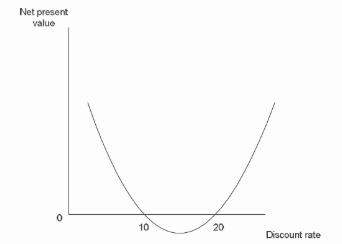
Which of the following statements is correct?
Correct
Answer: D
The graph shows the NPV cutting the $x$-axis at two points, ie there are two solution to the equation NPV $=0$. As this is the definition of the internal rate of return (IRR), there are two IRRs (option D).
The graph shows nothing about the underlying cashflows (although the shape is unlikely to support option A).
Incorrect
Answer: D
The graph shows the NPV cutting the $x$-axis at two points, ie there are two solution to the equation NPV $=0$. As this is the definition of the internal rate of return (IRR), there are two IRRs (option D).
The graph shows nothing about the underlying cashflows (although the shape is unlikely to support option A).
-
Question 275 of 500CB1031832
Question 275
FlagA company often evaluates projects by means of the receipts/costs ratio:
$$
\frac{\text { Net present value (NPV) of the gross revenues }}{\text { Net present value (NPV) of the capital and running costs }}
$$Which of the following best explains the usefulness of this ratio?
Correct
Answer: B
The ratio shows how many times the NPV of revenues exceeds the NPV of the costs. A ratio greater than one means the net NPV will be positive, and a ratio of less than one means NPV negative. A ratio that only just exceeds 1.00 means that over the life of the project revenues are only just likely to cover costs.
So, the ratio can help identify positive and negative NPV projects (option A). However, it does not give any information on the size of the positive/negative NPV, so its usefulness is limited in this respect.
If any risks in the project reduce revenues or increase costs, the NPV may be negative. Thus the ratio can be particularly useful to indicate projects that may be NPV positive, but are only borderline profitable. So, option B is true.
As the capital and running costs are combined, the ratio does not give any information about projects that can be abandoned early. The ratio is relatively easy to calculate, but this does not necessarily make it any more useful. So we can disregard options C and D.
Incorrect
Answer: B
The ratio shows how many times the NPV of revenues exceeds the NPV of the costs. A ratio greater than one means the net NPV will be positive, and a ratio of less than one means NPV negative. A ratio that only just exceeds 1.00 means that over the life of the project revenues are only just likely to cover costs.
So, the ratio can help identify positive and negative NPV projects (option A). However, it does not give any information on the size of the positive/negative NPV, so its usefulness is limited in this respect.
If any risks in the project reduce revenues or increase costs, the NPV may be negative. Thus the ratio can be particularly useful to indicate projects that may be NPV positive, but are only borderline profitable. So, option B is true.
As the capital and running costs are combined, the ratio does not give any information about projects that can be abandoned early. The ratio is relatively easy to calculate, but this does not necessarily make it any more useful. So we can disregard options C and D.
-
Question 276 of 500CB1031833
Question 276
FlagWhich of the following best explains what would happen if a quoted company’s directors accept a positive net present value (NPV) project that has a very high opportunity cost?
Correct
Answer: A
Shareholders do care about opportunity costs. They will be concerned if more profitable alternative projects are being disregarded by the directors as the share price and hence their wealth may not be as great as it could have been (so, options B and D are not true).
However, shareholders may not be well-informed enough about what alternative projects have been considered and disregarded by directors. They rely on directors informing them. There is no reason to expect that such information will be revealed over time. So, option A is true and C is not necessarily true.
Incorrect
Answer: A
Shareholders do care about opportunity costs. They will be concerned if more profitable alternative projects are being disregarded by the directors as the share price and hence their wealth may not be as great as it could have been (so, options B and D are not true).
However, shareholders may not be well-informed enough about what alternative projects have been considered and disregarded by directors. They rely on directors informing them. There is no reason to expect that such information will be revealed over time. So, option A is true and C is not necessarily true.
-
Question 277 of 500CB1031834
Question 277
FlagA project that is under consideration has a net present value of $\$ 100 \mathrm{~m}$. This evaluation takes no account of the very unlikely possibility that a natural disaster will cause significant disruption and leave the company exposed to serious losses. It is impossible to insure against this disaster.
Which of the following is the most appropriate response to the threat posed by the disaster?
Correct
Answer: B
Abandoning a potentially profitable project because of a very unlikely event is an overreaction, so A can be ignored.
While increasing the discount rate or subtracting the expected cost of the disaster are possible approaches, the very low probability of occurrence will result in a negligible adjustment to the discount rate or the NPV and would mean the risk is effectively ignored.
Any risks which would have very serious or disastrous consequences, but where the expected NPV is low because the probability of occurrence is small (such as a natural disaster), would be retained for further analysis.
So, while options C and D are possible approaches, B is the most appropriate response.
Incorrect
Answer: B
Abandoning a potentially profitable project because of a very unlikely event is an overreaction, so A can be ignored.
While increasing the discount rate or subtracting the expected cost of the disaster are possible approaches, the very low probability of occurrence will result in a negligible adjustment to the discount rate or the NPV and would mean the risk is effectively ignored.
Any risks which would have very serious or disastrous consequences, but where the expected NPV is low because the probability of occurrence is small (such as a natural disaster), would be retained for further analysis.
So, while options C and D are possible approaches, B is the most appropriate response.
-
Question 278 of 500CB1031835
Question 278
FlagA project has been evaluated at its required rate of return of $12 \%$ p.a. and has been found to have a net present value of zero. How should this finding be interpreted?
Correct
Answer: A
The internal rate of return (IRR) is the discount rate at which a project’s NPV becomes zero. Since the NPV is zero at 12%, the project’s IRR is 12%. Because this equals the required rate of return, the project exactly meets the minimum return needed.
Hence, A is the correct answer.
Incorrect
Answer: A
The internal rate of return (IRR) is the discount rate at which a project’s NPV becomes zero. Since the NPV is zero at 12%, the project’s IRR is 12%. Because this equals the required rate of return, the project exactly meets the minimum return needed.
Hence, A is the correct answer.
-
Question 279 of 500CB1031836
Question 279
FlagAn investment project has been evaluated using Monte Carlo simulation. After running the simulation 2.5 million times, the results have stabilised and the expected net present value is positive and averages $\$ 1$ million, with a range of outcomes varying from minus $\$ 200,000$ to plus $\$ 1.8$ million. Which of the following statements best interprets these results?
Correct
Answer: A
A is correct because the average (expected) NPV from the simulation is positive, so it meets the NPV decision rule.
B is incorrect because a positive expected NPV does not guarantee success; there is still downside risk.
C is incorrect because the wide range of outcomes (–200,000 to +1.8 million) shows substantial variability, not low risk.
D is incorrect because once results have stabilised, rerunning the simulation adds no meaningful benefit.
Incorrect
Answer: A
A is correct because the average (expected) NPV from the simulation is positive, so it meets the NPV decision rule.
B is incorrect because a positive expected NPV does not guarantee success; there is still downside risk.
C is incorrect because the wide range of outcomes (–200,000 to +1.8 million) shows substantial variability, not low risk.
D is incorrect because once results have stabilised, rerunning the simulation adds no meaningful benefit.
-
Question 280 of 500CB1031837
Question 280
FlagWhich of the following statements provides the best explanation for why non-financial factors ought to be considered when evaluating an investment project?
Correct
Answer: B
A process of elimination of three incorrect options is perhaps the best approach to answering this particular multiple choice question.
Option A can be discarded as financial factors are generally more objective and so easier to understand. Option C is eliminated as net present value, a financial factor, is often seen as a primary driver of shareholder wealth. Shareholders are generally interested in financial return and risks to that return. Option D is incorrect as it is not an explanation for considering non-financial factors at all. Net cashflows are financial factors.
Incorrect
Answer: B
A process of elimination of three incorrect options is perhaps the best approach to answering this particular multiple choice question.
Option A can be discarded as financial factors are generally more objective and so easier to understand. Option C is eliminated as net present value, a financial factor, is often seen as a primary driver of shareholder wealth. Shareholders are generally interested in financial return and risks to that return. Option D is incorrect as it is not an explanation for considering non-financial factors at all. Net cashflows are financial factors.
-
Question 281 of 500CB1031838
Question 281
FlagThe expected outcome of a project has been estimated using two approaches. The first approach was to predict the outcomes based on five sets of assumptions with given probabilities. The second approach was a Monte Carlo simulation that has been run many thousands of times. The results from both approaches are significantly different.
Which of the following statements is correct?
Correct
Answer: B
Monte Carlo simulations, involving many thousands of sets of output, are difficult to review and check. Therefore Option B is correct.
Although an investor may be interested in pessimistic ‘worst case’ scenarios, they may choose to base their investment decision on a more representative range of predictions. So, we can eliminate Option A. In considering Option C, the Monte Carlo simulation is more sophisticated but this does not necessarily make it more reliable. The results could be spurious if the underlying model and probabilities were poorly chosen. Abandoning the project, suggested in Option D, is an extreme response to uncertainty. Investment outcomes can very rarely be known with certainty in advance.
Incorrect
Answer: B
Monte Carlo simulations, involving many thousands of sets of output, are difficult to review and check. Therefore Option B is correct.
Although an investor may be interested in pessimistic ‘worst case’ scenarios, they may choose to base their investment decision on a more representative range of predictions. So, we can eliminate Option A. In considering Option C, the Monte Carlo simulation is more sophisticated but this does not necessarily make it more reliable. The results could be spurious if the underlying model and probabilities were poorly chosen. Abandoning the project, suggested in Option D, is an extreme response to uncertainty. Investment outcomes can very rarely be known with certainty in advance.
-
Question 282 of 500CB1031839
Question 282
FlagYou have been asked to determine the internal rate of return (IRR) of a project that has an initial cash outflow, followed by seven years of net cash inflows. The project’s net present value was $+\$ 500,000$ when determined at $11 \%$ and $-\$ 500,000$ when determined at $16 \%$.
Which of the following statements concerning the project’s IRR is correct?
Correct
Answer: A
The IRR is the discount rate at which the net present value (NPV) of a project’s cashflows is zero.
A project with multiple changes in the signs of the cashflows during the project term can be tricky to interpret using IRR, for example by potentially having multiple solutions. However, the fact that this project’s cashflows are an initial outflow and then a stream of inflows tells us that there are no such issues here. The project will have a single IRR.
This IRR must lie between 11\% (a discount rate at which the NPV is greater than zero) and $16 \%$ (a discount rate at which the NPV is less than zero). If NPV was a linear function of the discount rate, then the IRR would be exactly $13.5 \%$. However we know that NPV is not a linear function as cashflows at different terms will have discount factors of different powers. So the IRR is approximately $13.5 \%$.
Incorrect
Answer: A
The IRR is the discount rate at which the net present value (NPV) of a project’s cashflows is zero.
A project with multiple changes in the signs of the cashflows during the project term can be tricky to interpret using IRR, for example by potentially having multiple solutions. However, the fact that this project’s cashflows are an initial outflow and then a stream of inflows tells us that there are no such issues here. The project will have a single IRR.
This IRR must lie between 11\% (a discount rate at which the NPV is greater than zero) and $16 \%$ (a discount rate at which the NPV is less than zero). If NPV was a linear function of the discount rate, then the IRR would be exactly $13.5 \%$. However we know that NPV is not a linear function as cashflows at different terms will have discount factors of different powers. So the IRR is approximately $13.5 \%$.
-
Question 283 of 500CB1031840
Question 283
FlagAn actuary has prepared a computer model to simulate a complex project’s outcome. The model’s logic has been reviewed carefully. The following table shows the simulation results.
\begin{array}{|c|c|}
\hline Number of runs & Average net present value \\
\hline 5,000 & +$ 50 million \\
\hline 10,000 & -$ 70 million \\
\hline 20,000 & +$ 2 million \\
\hline
\end{array}What should be concluded from these results?
Correct
Answer: D
There appears to be a lot of volatility in the results presented here. This means that many more runs are needed in order to ‘iron out’ this volatility.
Option A is incorrect as simulations can be a very useful tool for evaluating projects, although they will be just one part of the final investment submission.
Option B seems unwise given the volatility of the results so far; we don’t know if we’ve reached a point where we’re seeing the true distribution of results.
We know nothing about the rate of return that’s been fed into the model, so can’t say this has been set too high. It seems unlikely that a high rate of return is contributing to the volatility of the results. Therefore, Option C is incorrect.
Incorrect
Answer: D
There appears to be a lot of volatility in the results presented here. This means that many more runs are needed in order to ‘iron out’ this volatility.
Option A is incorrect as simulations can be a very useful tool for evaluating projects, although they will be just one part of the final investment submission.
Option B seems unwise given the volatility of the results so far; we don’t know if we’ve reached a point where we’re seeing the true distribution of results.
We know nothing about the rate of return that’s been fed into the model, so can’t say this has been set too high. It seems unlikely that a high rate of return is contributing to the volatility of the results. Therefore, Option C is incorrect.
-
Question 284 of 500CB1031841
Question 284
FlagA company has $ 10 million available for investment. It is considering investing in three individual investment projects.
\begin{array}{|l|c|c|}
\hline
& \textit{Initial investment} & \textit{Net present value} \\ \hline
Project One & \$ 4 million & \$ 9 million \\ \hline
Project Two & \$ 2 million & \$ 3 million \\ \hline
Project Three & \$ 7 million & \$ 11 million \\ \hline
\end{array}What would be the opportunity cost of investing in Project One?
Correct
Answer: C
The company has $\$ 10$ million to spend. If it invests in Project One it has $\$ 6$ million left, so it can still invest in Project Two, but it can no longer afford to invest in Project Three. Investing in Project One therefore costs the company the opportunity of investing in Project Three. The net present value of Project Three is $\$ 11$ million, so this is the opportunity cost of investing in Project One.
Incorrect
Answer: C
The company has $\$ 10$ million to spend. If it invests in Project One it has $\$ 6$ million left, so it can still invest in Project Two, but it can no longer afford to invest in Project Three. Investing in Project One therefore costs the company the opportunity of investing in Project Three. The net present value of Project Three is $\$ 11$ million, so this is the opportunity cost of investing in Project One.
-
Question 285 of 500CB1031842
Question 285
FlagThe directors of a company are considering investing in a machine that will cost $\$ 38$ million. The machine will have a useful life of 5 years. The cost of capital is $10 \% p a$.
The directors have determined that the annual capital charge of this machine is $\$ 10$ million. The machine will generate revenues of $\$ 14$ million and will require annual running costs of $\$ 1.5$ million.
Which of the following statements is correct?
Correct
Answer: A
Using the annual capital charge method as described in the question indicates that the impact on the company of buying the machine will be $14-10-1.5=\$ 2.5$ million a year. The analysis shows that the investment is profitable, so it indicates that the company should invest in the machine because it will increase shareholders’ wealth.
Incorrect
Answer: A
Using the annual capital charge method as described in the question indicates that the impact on the company of buying the machine will be $14-10-1.5=\$ 2.5$ million a year. The analysis shows that the investment is profitable, so it indicates that the company should invest in the machine because it will increase shareholders’ wealth.
-
Question 286 of 500CB1031843
Question 286
FlagThe directors of a company are considering an investment project that they have evaluated as having a positive net present value. However, they believe that the shareholders will regard it as a negative net present value project.
Assuming that the directors make the investment and are correct in their beliefs, which of the following is most likely to occur?Correct
Answer: B
Shareholder impressions will impact a share price immediately, assuming that shareholders can be made aware of the details, whereas the emergence of profit from a project will happen gradually over time. So the negative impact of shareholders’ perceptions on the project will push the share price down in the short term. However, as profits emerge (if the directors are correct) the profits will push up earnings and eventually the share price will rise to reflect the higher profitability.
Incorrect
Answer: B
Shareholder impressions will impact a share price immediately, assuming that shareholders can be made aware of the details, whereas the emergence of profit from a project will happen gradually over time. So the negative impact of shareholders’ perceptions on the project will push the share price down in the short term. However, as profits emerge (if the directors are correct) the profits will push up earnings and eventually the share price will rise to reflect the higher profitability.
-
Question 287 of 500CB1031844
Question 287
FlagA quoted company wishes to apply the shareholder value approach to the evaluation of a major project. Which of the following would be a practical way to apply that method?
Correct
Answer: A
The shareholder value approach attempts to view the company before and after a project through the eyes of its shareholders and investors. This is difficult because the company probably has little contact with its investors and shareholders, but investment analysts who analyse investments and give advice to potential investors and investing institutions would have a good idea what shareholders would be looking for.
Incorrect
Answer: A
The shareholder value approach attempts to view the company before and after a project through the eyes of its shareholders and investors. This is difficult because the company probably has little contact with its investors and shareholders, but investment analysts who analyse investments and give advice to potential investors and investing institutions would have a good idea what shareholders would be looking for.
-
Question 288 of 500CB1031845
Question 288
FlagWhich of the following best describes the par value of an equity share?
Correct
Answer C
Ordinary shares must have a ‘par’ or ‘nominal’ value. This is the minimum price that new shares may be issued at. This is typically $25 p$, but may by $50 p$ or $£ 1$, say. The par value is purely an accounting (or bookkeeping) figure.
The par value has no relation to the market value, or the price at which shares would be sold in some transaction. For tax purposes, the relevant values of a share are its actual purchase and sale prices.
Incorrect
Answer C
Ordinary shares must have a ‘par’ or ‘nominal’ value. This is the minimum price that new shares may be issued at. This is typically $25 p$, but may by $50 p$ or $£ 1$, say. The par value is purely an accounting (or bookkeeping) figure.
The par value has no relation to the market value, or the price at which shares would be sold in some transaction. For tax purposes, the relevant values of a share are its actual purchase and sale prices.
-
Question 289 of 500CB1031846
Question 289
FlagWhy are preference shares normally treated as debt when calculating the gearing ratio?
Correct
Answer A
Preference shares are normally treated as borrowings rather than as part of equity when calculating gearing (and other ratios) because they typically carry a fixed rate of dividend (like debt) and because their holders are repaid before ordinary shareholders in the event of default (like debt). Like debt, the amount of preference shares in issue directly impacts on the volatility of returns to ordinary shareholders.
Options B, C and D are all correct statements, preference shares may be listed as debt in the accounts (usually when they are redeemable), can be suspended and may be redeemable – but these do not explain why they are considered as debt in the gearing ratio.
Incorrect
Answer A
Preference shares are normally treated as borrowings rather than as part of equity when calculating gearing (and other ratios) because they typically carry a fixed rate of dividend (like debt) and because their holders are repaid before ordinary shareholders in the event of default (like debt). Like debt, the amount of preference shares in issue directly impacts on the volatility of returns to ordinary shareholders.
Options B, C and D are all correct statements, preference shares may be listed as debt in the accounts (usually when they are redeemable), can be suspended and may be redeemable – but these do not explain why they are considered as debt in the gearing ratio.
-
Question 290 of 500CB1031847
Question 290
FlagWhat is the defining characteristic of a Eurodeposit?
Correct
Answer C
A Eurodeposit is any currency deposited outside its country of origin. For example, dollars held in a London bank. The term ‘euro’ seems like a misnomer as Eurodeposits are not necessarily denominated in euros or deposited anywhere in Europe or the EU.
Incorrect
Answer C
A Eurodeposit is any currency deposited outside its country of origin. For example, dollars held in a London bank. The term ‘euro’ seems like a misnomer as Eurodeposits are not necessarily denominated in euros or deposited anywhere in Europe or the EU.
-
Question 291 of 500CB1031848
Question 291
FlagWhat are the potential implications for debenture holders of an increase in interest rates in the economy?
Correct
Answer C
The holder of a debenture receives a stream of interest payments plus an eventual return of capital. The amounts of these cashflows are specified at outset and so are not changed by market conditions. The value of a debenture is the discounted present value of the future cashflows. Although the cashflows are unchanged, an increase in market interest rates will increase the discount rate used in determining this present value, thus decreasing the value of the debenture.
An alternative way to reach this conclusion is to compare the value of a fixed stream of future interest payments (from a debenture) with alternative investments available in the market. If the available market interest rates increase, the debenture’s fixed stream of interest payments become relatively less attractive and so its value will decrease.
Incorrect
Answer C
The holder of a debenture receives a stream of interest payments plus an eventual return of capital. The amounts of these cashflows are specified at outset and so are not changed by market conditions. The value of a debenture is the discounted present value of the future cashflows. Although the cashflows are unchanged, an increase in market interest rates will increase the discount rate used in determining this present value, thus decreasing the value of the debenture.
An alternative way to reach this conclusion is to compare the value of a fixed stream of future interest payments (from a debenture) with alternative investments available in the market. If the available market interest rates increase, the debenture’s fixed stream of interest payments become relatively less attractive and so its value will decrease.
-
Question 292 of 500CB1031850
Question 292
FlagA quoted company has recently introduced a strict policy of requiring a hurdle rate of $14 \%$ per annum on all capital projects. The company’s weighted average cost of capital is $12 \%$. How can the company evaluate its choice of hurdle rate in a year’s time?
Correct
Answer: A
Unless the hurdle rate is lowered the company will not have any future projects.
Option B is incorrect because the circumstances of competing companies may not be the same. For example, they may have different levels of risk and so they may use different hurdle rates.Option D can also be eliminated because the share price can move over a year for many reasons, often to do with events that affect the whole market, rather than only in response to a company’s investment decisions. So judging the policy on this basis is flawed.
Option C is perhaps tempting. A hurdle rate set too high may lead to managers overstating the anticipated returns on their proposals, with the result that the actual achieved returns come in below the business plan. However, the one-year timeframe in this particular question is too short to evaluate whether this has been happening.
Incorrect
Answer: A
Unless the hurdle rate is lowered the company will not have any future projects.
Option B is incorrect because the circumstances of competing companies may not be the same. For example, they may have different levels of risk and so they may use different hurdle rates.Option D can also be eliminated because the share price can move over a year for many reasons, often to do with events that affect the whole market, rather than only in response to a company’s investment decisions. So judging the policy on this basis is flawed.
Option C is perhaps tempting. A hurdle rate set too high may lead to managers overstating the anticipated returns on their proposals, with the result that the actual achieved returns come in below the business plan. However, the one-year timeframe in this particular question is too short to evaluate whether this has been happening.
-
Question 293 of 500CB1031851
Question 293
FlagA project has an internal rate of return (IRR) of $18 \%$. The required rate of return is $12 \%$. Which of the following statements is correct?
Correct
Answer: C
The IRR is a relative (%) measure of project performance, not an absolute (monetary amount) measure. So Option A is incorrect. The IRR of $18 \%$ is the discount rate at which the present value of future cashflows is zero. When the NPV is calculated using the required rate of return of $12 \%$, the NPV will be positive (as using a lower discount rate results in an increase in the present value of the cashflows). So Option B is incorrect.
Projects with positive NPV’s at their required rate of return add to the value of the company and so increase shareholder wealth, so Option C is correct. The exact size of the NPV is not strictly required to reach this conclusion, so Option D can also be rejected.
Incorrect
Answer: C
The IRR is a relative (%) measure of project performance, not an absolute (monetary amount) measure. So Option A is incorrect. The IRR of $18 \%$ is the discount rate at which the present value of future cashflows is zero. When the NPV is calculated using the required rate of return of $12 \%$, the NPV will be positive (as using a lower discount rate results in an increase in the present value of the cashflows). So Option B is incorrect.
Projects with positive NPV’s at their required rate of return add to the value of the company and so increase shareholder wealth, so Option C is correct. The exact size of the NPV is not strictly required to reach this conclusion, so Option D can also be rejected.
-
Question 294 of 500CB1031852
Question 294
FlagAn actuary is considering purchasing a pocket calculator costing $\$ 80$. The Internal Rate of Return (IRR) of this investment is $800 \%$.
Which of the following statements is a logical interpretation of this IRR?
Correct
Answer: C
A small initial investment followed by a stream of positive revenues will result in a high IRR.
It may be true that several calculators should be purchased (Option A) or that the IRR has been calculated incorrectly (Option B) but these do not follow from any of the information given in the question. Similarly, there may be multiple IRRs (Option D), but this would follow from there being more than one change in the sign of the cashflows (ie there being subsequent expenditure later than the initial outgo) and there is nothing in the question to suggest this being the case.
Incorrect
Answer: C
A small initial investment followed by a stream of positive revenues will result in a high IRR.
It may be true that several calculators should be purchased (Option A) or that the IRR has been calculated incorrectly (Option B) but these do not follow from any of the information given in the question. Similarly, there may be multiple IRRs (Option D), but this would follow from there being more than one change in the sign of the cashflows (ie there being subsequent expenditure later than the initial outgo) and there is nothing in the question to suggest this being the case.
-
Question 295 of 500CB1031853
Question 295
FlagWhy might buyers be prepared to buy zero-coupon debentures?
Correct
Answer B
As the name suggests, a zero-coupon debenture is one where there are no coupon payments and so the sole return is the payment of the nominal on maturity. This will be an attractive investment if the issue price of the debenture, ie the amount paid by the investor to buy the debenture, is significantly lower than the nominal value the investor will receive at maturity.
Incorrect
Answer B
As the name suggests, a zero-coupon debenture is one where there are no coupon payments and so the sole return is the payment of the nominal on maturity. This will be an attractive investment if the issue price of the debenture, ie the amount paid by the investor to buy the debenture, is significantly lower than the nominal value the investor will receive at maturity.
-
Question 296 of 500CB1031854
Question 296
FlagWhich of the following cases is a suitable situation in which a convertible security might be issued?
Correct
Answer B
Convertible securities allow the issuer to borrow at a lower interest rate because investors value the option to convert the debt into shares later. This is particularly useful for a startup, which normally faces high borrowing costs due to higher risk. By attaching a conversion feature, the startup can make its debt more attractive and reduce the interest it needs to offer.
Hence, B is the correct answer.
Incorrect
Answer B
Convertible securities allow the issuer to borrow at a lower interest rate because investors value the option to convert the debt into shares later. This is particularly useful for a startup, which normally faces high borrowing costs due to higher risk. By attaching a conversion feature, the startup can make its debt more attractive and reduce the interest it needs to offer.
Hence, B is the correct answer.
-
Question 297 of 500CB1031855
Question 297
FlagWhen does a bondholder receive the nominal value of a bond?
Correct
Answer D
A is incorrect as a bondholder makes (rather than receives) a payment to purchase a bond. This does not have to be the nominal or par value.
Bondholders then receive a stream of coupon or interest payments regularly during the life of the bond and a redemption payment at maturity. The coupon payments would usually be expressed as a percentage of the nominal value, and so B and C are incorrect.
Incorrect
Answer D
A is incorrect as a bondholder makes (rather than receives) a payment to purchase a bond. This does not have to be the nominal or par value.
Bondholders then receive a stream of coupon or interest payments regularly during the life of the bond and a redemption payment at maturity. The coupon payments would usually be expressed as a percentage of the nominal value, and so B and C are incorrect.
-
Question 298 of 500CB1031856
Question 298
FlagA company has issued subordinated debt securities. Which of the following reflects the priority that would apply in the event of default?
Correct
Answer C
In the event of default, subordinated debt ranks below senior debt but ahead of preference shares and ordinary shares. The senior debt includes the mortgage loans ie fixed charge debentures, which are first in line.
Incorrect
Answer C
In the event of default, subordinated debt ranks below senior debt but ahead of preference shares and ordinary shares. The senior debt includes the mortgage loans ie fixed charge debentures, which are first in line.
-
Question 299 of 500CB1031857
Question 299
FlagWhich of the following explains why preference shares are usually classified as debt when analysing a company’s financial position?
Correct
Answer B
Preference shares result in a company having an additional fixed payment that comes out of profits before the profits are available for ordinary shareholders. This is similar to debt, even though there is no legal obligation to pay the preference dividends. So the impact on shareholders’ profits will be similar to adding debt to the capital structure.
The other three options are all incorrect statements. Preference dividends (like ordinary dividends) are deducted from after-tax profits, so they are not tax deductible in the way that loan coupons or interest are. Preference shares are legally shares and they do not have the legal rights of debt.
Incorrect
Answer B
Preference shares result in a company having an additional fixed payment that comes out of profits before the profits are available for ordinary shareholders. This is similar to debt, even though there is no legal obligation to pay the preference dividends. So the impact on shareholders’ profits will be similar to adding debt to the capital structure.
The other three options are all incorrect statements. Preference dividends (like ordinary dividends) are deducted from after-tax profits, so they are not tax deductible in the way that loan coupons or interest are. Preference shares are legally shares and they do not have the legal rights of debt.
-
Question 300 of 500CB1031858
Question 300
FlagCompany R plans to make an investment in a project with a positive Net Present Value (NPV). Confidential briefings of investment analysts who specialise in Company R’s industry indicate that the analysts do not believe that the project will succeed.
How does the shareholder value approach suggest that the project will affect Company R’s share price?
Correct
Answer: A
The shareholder value approach differs from NPV in that it is looking at the company from the point of the external shareholder. It aims to understand how the company is valued by the market.
In this question, the specialist analysts are the most reliable guide to how external shareholders and therefore the market share price will respond to the project. As the analysts’ view is that the project will not succeed, it is likely that the share price will decrease.
Incorrect
Answer: A
The shareholder value approach differs from NPV in that it is looking at the company from the point of the external shareholder. It aims to understand how the company is valued by the market.
In this question, the specialist analysts are the most reliable guide to how external shareholders and therefore the market share price will respond to the project. As the analysts’ view is that the project will not succeed, it is likely that the share price will decrease.
-
Question 301 of 500CB1031859
Question 301
FlagWhich of the following would be the most significant constraint on the board of a company that wishes to issue additional equity shares?
Correct
Answer C
Shares cannot be issued below their nominal (or ‘par’) value. As additional shares are typically sold at a discount to their current market value, in this situation the company would be attempting to issue shares well below their nominal value – which is not allowed. Hence option C is correct.
A highly geared company may wish to increase its share capital to reduce its gearing. When share prices are high, it is often a good time to issue new shares as they may be able to be sold for a high price. If the whole of the authorised capital has been issued, it is possible to issue more shares – but this would require additional approval from shareholders.
Incorrect
Answer C
Shares cannot be issued below their nominal (or ‘par’) value. As additional shares are typically sold at a discount to their current market value, in this situation the company would be attempting to issue shares well below their nominal value – which is not allowed. Hence option C is correct.
A highly geared company may wish to increase its share capital to reduce its gearing. When share prices are high, it is often a good time to issue new shares as they may be able to be sold for a high price. If the whole of the authorised capital has been issued, it is possible to issue more shares – but this would require additional approval from shareholders.
-
Question 302 of 500CB1031860
Question 302
FlagA company has 10 million shares in issue. The company’s share price is $\$ 4.00$ per share. The directors are considering a one for five rights issue at $\$ 3.50$ per share. Issue costs have been estimated at $\$ 800,000$. Calculate the expected share price after the rights issue.
Correct
Answer A
Number of shares already in issue is $10,000,000$
Number of new shares issued is 1-for-5, ie 2,000,000.
Ex-rights price is $P$ where:
$$
(10,000,000 \times \$ 4)+(2,000,000 \times \$ 3.50)-\$ 800,000=12,000,000 \times P
$$So, $P=\$ 3.85$
Incorrect
Answer A
Number of shares already in issue is $10,000,000$
Number of new shares issued is 1-for-5, ie 2,000,000.
Ex-rights price is $P$ where:
$$
(10,000,000 \times \$ 4)+(2,000,000 \times \$ 3.50)-\$ 800,000=12,000,000 \times P
$$So, $P=\$ 3.85$
-
Question 303 of 500CB1031861
Question 303
FlagWhich of the following is true of opportunity costs in a project appraisal?
Correct
Answer: C
The opportunity cost approach in project appraisal asks ‘What alternative ways could we spend this money and what return would be achieved?’. So, opportunity costs exist only if alternative ways to spend the money exist.
Opportunity costs are relevant to project evaluation, especially if a company has to choose between competing projects, so we can eliminate Option A.
Option B can be eliminated because, even with surplus capital, a company will want to choose the best projects in which to invest.
Opportunity costs are not reflected in project cashflows. So Option D is also incorrect.
Incorrect
Answer: C
The opportunity cost approach in project appraisal asks ‘What alternative ways could we spend this money and what return would be achieved?’. So, opportunity costs exist only if alternative ways to spend the money exist.
Opportunity costs are relevant to project evaluation, especially if a company has to choose between competing projects, so we can eliminate Option A.
Option B can be eliminated because, even with surplus capital, a company will want to choose the best projects in which to invest.
Opportunity costs are not reflected in project cashflows. So Option D is also incorrect.
-
Question 304 of 500CB1031862
Question 304
FlagA newly formed company was funded by an equity injection, in which the shareholders purchased a total of $10,000 £ 1$ fully-paid shares for $£ 2.50$ each. Which of the following figures will appear in the company’s statement of financial position?
\begin{array}{lcc}
& \text{Share capital (£)} & \text{Share premium (£)} \\
A & 10,000 & 15,000 \\
B & 10,000 & 25,000 \\
C & 25,000 & 0 \\
D & 25,000 & 15,000
\end{array}Correct
Answer A
The issue of 10,000 fully-paid shares for $£ 2.50$ each will raise $£ 25,000$ for the company. In the statement of financial position, the share capital will show the par value of the issued share capital $(10,000 \times £ 1)$ and the share premium will show the balance of the capital raised ( $£ 25,000-£ 10,000$ ).
Incorrect
Answer A
The issue of 10,000 fully-paid shares for $£ 2.50$ each will raise $£ 25,000$ for the company. In the statement of financial position, the share capital will show the par value of the issued share capital $(10,000 \times £ 1)$ and the share premium will show the balance of the capital raised ( $£ 25,000-£ 10,000$ ).
-
Question 305 of 500CB1031863
Question 305
FlagA company’s directors are considering an investment in a major project. The following criteria for the investment are under consideration:
– The project will be funded using debt that will have a $10 \%$ post-tax rate of interest.
– The project’s internal rate of return is $9 \%$. The company has a standard hurdle rate of $12 \%$.
– The project’s estimated beta coefficient indicates that the required rate of return is $14 \%$.
– The company’s historical weighted average cost of capital is $16 \%$.What is the lowest rate of return that the company can accept in order to maintain shareholders’ wealth?
Correct
Answer: C
This option correctly describes the way to maintain shareholder wealth.
The cost of the debt to fund the project (Option A) is rarely the correct rate to use. The debt will generally have a low rate of return because it is very secure and ranks high in the order of wind up. But this has no relation to the riskiness of the project that the company is trying to evaluate.The hurdle rate (Option B) is one method of evaluating a project (indeed it may be one that is always used by a company for convenience reasons), but it isn’t directly related to maintaining shareholder wealth.
The WACC (Option D) isn’t directly relevant for evaluating all future projects’ ability to maintain shareholder wealth. The WACC will reflect the systematic risk of the existing portfolio of projects that the company is undertaking. If the proposed project has similar systematic risk to all the others, then the WACC is usually fine. But the riskiness of this proposed project is clearly lower (rate $14 \%$ compared to the WACC of $16 \%$ ). So in these circumstances the WACC is probably too high.
Incorrect
Answer: C
This option correctly describes the way to maintain shareholder wealth.
The cost of the debt to fund the project (Option A) is rarely the correct rate to use. The debt will generally have a low rate of return because it is very secure and ranks high in the order of wind up. But this has no relation to the riskiness of the project that the company is trying to evaluate.The hurdle rate (Option B) is one method of evaluating a project (indeed it may be one that is always used by a company for convenience reasons), but it isn’t directly related to maintaining shareholder wealth.
The WACC (Option D) isn’t directly relevant for evaluating all future projects’ ability to maintain shareholder wealth. The WACC will reflect the systematic risk of the existing portfolio of projects that the company is undertaking. If the proposed project has similar systematic risk to all the others, then the WACC is usually fine. But the riskiness of this proposed project is clearly lower (rate $14 \%$ compared to the WACC of $16 \%$ ). So in these circumstances the WACC is probably too high.
-
Question 306 of 500CB1031864
Question 306
FlagA private company was established 5 years ago. A family friend of the founder contributed 10\% of the initial equity. The company is now successful and solvent and no longer needs the friend’s equity. The company’s board has agreed that it will help the friend to liquidate their investment.
Which of the following would be the most suitable means of assisting the family friend?
Correct
Answer B
If the company pays a large dividend, all shareholders would receive this, but all would remain shareholders. Therefore option A does not solve the problem. Option C would solve the problem, but is expensive and would require the company to go public, which it may not wish to do. Option D would not be possible as there is no open market for an unlisted share. The shares would have to be traded by finding a buyer by word of mouth which is unlikely to be successful.
So option B is the most plausible, where the company buys back the friend’s shares using company cash, and then cancels the shares.
Incorrect
Answer B
If the company pays a large dividend, all shareholders would receive this, but all would remain shareholders. Therefore option A does not solve the problem. Option C would solve the problem, but is expensive and would require the company to go public, which it may not wish to do. Option D would not be possible as there is no open market for an unlisted share. The shares would have to be traded by finding a buyer by word of mouth which is unlikely to be successful.
So option B is the most plausible, where the company buys back the friend’s shares using company cash, and then cancels the shares.
-
Question 307 of 500CB1031865
Question 307
FlagWhich of the following is a practical advantage of using simulation in determining the risk associated with a major project?
Correct
Answer: D
Simulation is a more sophisticated method of evaluating the prospects of a project, typically allowing for interactions between input variables.
Allowing for these interactions means that a simulation exercise will likely take longer and be more complicated to implement than other methods (eg hurdle rate or internal rate of return), ie Option A is incorrect. No evaluation method is objective (due to inherent subjectivity in the design) nor will any method be guaranteed to provide the ‘correct answer’ regarding investment decisions, so neither Options B nor C are correct.
Incorrect
Answer: D
Simulation is a more sophisticated method of evaluating the prospects of a project, typically allowing for interactions between input variables.
Allowing for these interactions means that a simulation exercise will likely take longer and be more complicated to implement than other methods (eg hurdle rate or internal rate of return), ie Option A is incorrect. No evaluation method is objective (due to inherent subjectivity in the design) nor will any method be guaranteed to provide the ‘correct answer’ regarding investment decisions, so neither Options B nor C are correct.
-
Question 308 of 500CB1031866
Question 308
FlagA quoted company is making a rights issue.
Which of the following statements is correct?Correct
Answer D
Option A is not correct as shareholders have the right to not buy the new shares that are offered to them. In such circumstances the company will usually sell those rights to another investor and pay the sale proceeds to the original shareholder that turned down the right.
Options B and C are incorrect because the issue must be at a discount to the market price in order to give an incentive for shareholders to buy the new shares, and must be above the nominal value of the shares to comply with accounting rules.
Option D is unusual, but possible. Normally the share price will go to the weighted average of the old existing shares at their original market price, and the new shares at the discounted price. But if the issue is associated with a piece of good news for shareholders, then the share price could end up higher after the issue.
Incorrect
Answer D
Option A is not correct as shareholders have the right to not buy the new shares that are offered to them. In such circumstances the company will usually sell those rights to another investor and pay the sale proceeds to the original shareholder that turned down the right.
Options B and C are incorrect because the issue must be at a discount to the market price in order to give an incentive for shareholders to buy the new shares, and must be above the nominal value of the shares to comply with accounting rules.
Option D is unusual, but possible. Normally the share price will go to the weighted average of the old existing shares at their original market price, and the new shares at the discounted price. But if the issue is associated with a piece of good news for shareholders, then the share price could end up higher after the issue.
-
Question 309 of 500CB1031867
Question 309
FlagA company is obtaining a stock exchange quotation through an offer for sale by tender.
Which of the following statements is correct?Correct
Answer B
Once the issue price is set for an offer for sale by tender, all applicants get shares at that price.
Option A is not correct as applicants who bid below the accepted price will get no shares.
Option C is incorrect because applications to buy shares at a low price are still applications to buy shares, not sell them.Option D is also incorrect as the tender price will be adjusted so that the required number of shares is sold in the issue.
Incorrect
Answer B
Once the issue price is set for an offer for sale by tender, all applicants get shares at that price.
Option A is not correct as applicants who bid below the accepted price will get no shares.
Option C is incorrect because applications to buy shares at a low price are still applications to buy shares, not sell them.Option D is also incorrect as the tender price will be adjusted so that the required number of shares is sold in the issue.
-
Question 310 of 500CB1031868
Question 310
FlagA quoted company has 100 million $\$ 1.00$ shares in issue that have a market price of $\$ 11.00$ per share. The board plans to raise $\$ 270$ million through a $\$ 9.00$ rights issue in order to finance a project that has an estimated net present value of $\$ 140$ million.
What is the company’s expected share price after the rights issue?
Correct
Answer B
The formula for the calculation of the expected share price after a rights issue is: original market capitalisation + extra value total new number of shares
The Core Reading describes the ‘extra value’ component as incorporating the money raised by the rights issue, the expenses of the issue and the change in value based on market perceptions and the use to which the money is being put.
In this question, there is no mention of the expenses or market perception components. The rights issue raises \$ 270m (by issuing 30m shares at \$ 9 each) and that money is being used for a project with a net present value of \$ 140m. So, the expected share price after the rights issue is:
$$
\frac{100 \mathrm{~m} \times \$ 11+30 \mathrm{~m} \times \$ 9+\$ 140 \mathrm{~m}}{100 \mathrm{~m}+30 \mathrm{~m}}=\$ 11.62
$$Incorrectly ignoring the estimated value of the new project gives this calculation:
$$
\frac{100 \mathrm{~m} \times \$ 11+30 \mathrm{~m} \times \$ 9}{100 \mathrm{~m}+30 \mathrm{~m}}=\$ 10.54 \text {, ie Option A. }
$$This is the theoretical ex-rights price, rather than the expected share price that the question asks for.
Incorrect
Answer B
The formula for the calculation of the expected share price after a rights issue is: original market capitalisation + extra value total new number of shares
The Core Reading describes the ‘extra value’ component as incorporating the money raised by the rights issue, the expenses of the issue and the change in value based on market perceptions and the use to which the money is being put.
In this question, there is no mention of the expenses or market perception components. The rights issue raises \$ 270m (by issuing 30m shares at \$ 9 each) and that money is being used for a project with a net present value of \$ 140m. So, the expected share price after the rights issue is:
$$
\frac{100 \mathrm{~m} \times \$ 11+30 \mathrm{~m} \times \$ 9+\$ 140 \mathrm{~m}}{100 \mathrm{~m}+30 \mathrm{~m}}=\$ 11.62
$$Incorrectly ignoring the estimated value of the new project gives this calculation:
$$
\frac{100 \mathrm{~m} \times \$ 11+30 \mathrm{~m} \times \$ 9}{100 \mathrm{~m}+30 \mathrm{~m}}=\$ 10.54 \text {, ie Option A. }
$$This is the theoretical ex-rights price, rather than the expected share price that the question asks for.
-
Question 311 of 500CB1031869
Question 311
FlagWhy might a share buyback increase a company’s share price?
Correct
Answer: C
Options B and D can be ruled out as there are certainly costs of undertaking a buyback, and shareholders may end up paying tax on the proceeds to the sale.
Option A, that buybacks demonstrate the board’s confidence, seems plausible and is often true – however, it is not always true. The board may be forced to return an accumulated cash-pile by unhappy shareholders or it may be a sign that the business has run out of steam and has no further investment opportunities available – both of these may depress the share price.
The effect on the company’s earnings per share should be beneficial, since the cash held is probably only earning a deposit rate of interest – much less than its industrial assets. The value of the remaining shares (ie the share price!) should, therefore, improve. This is option C.
Incorrect
Answer: C
Options B and D can be ruled out as there are certainly costs of undertaking a buyback, and shareholders may end up paying tax on the proceeds to the sale.
Option A, that buybacks demonstrate the board’s confidence, seems plausible and is often true – however, it is not always true. The board may be forced to return an accumulated cash-pile by unhappy shareholders or it may be a sign that the business has run out of steam and has no further investment opportunities available – both of these may depress the share price.
The effect on the company’s earnings per share should be beneficial, since the cash held is probably only earning a deposit rate of interest – much less than its industrial assets. The value of the remaining shares (ie the share price!) should, therefore, improve. This is option C.
-
Question 312 of 500CB1031870
Question 312
FlagAn investor is considering the purchase of a $2 \%$ Treasury bill that is trading at a discount. Which of the following statements is correct?
Correct
Answer B
It seems that the Treasury bill was originally issued at a price $2 \%$ below par but is now trading at a further discount, so the return must be greater than $2 \%$. If held to redemption the return is known.
Incorrect
Answer B
It seems that the Treasury bill was originally issued at a price $2 \%$ below par but is now trading at a further discount, so the return must be greater than $2 \%$. If held to redemption the return is known.
-
Question 313 of 500CB1031871
Question 313
FlagA quoted company has had a policy of reinvesting profits in ongoing expansion and has paid relatively small dividends. The company is now entering a phase where it no longer requires funds for expansion. The directors therefore intend to start paying out a larger proportion of profits as dividends.
Which of the following would be the most suitable approach to implementing this new policy?
Correct
Answer: B
To wait until the next dividend announcement (option A) would create quite an unexpected shock for shareholders. Many may have bought and sold the shares between the directors making the decision and the announcement, based on the expectation that dividends would continue as they are, so option A could be criticised as ‘mis-leading’ the market. Continuing with the current dividend policy and building up piles of cash does not seem sensible, because the cash would simply earn a poor rate of return and use up shareholders’ capital. If the situation has changed long term, then a policy to return the cash to shareholders needs to be devised, so option C is not suitable. Option D seems a bad choice as shareholders would want an explanation for the sudden change in dividend.
We are left with option B, which involves informing shareholders as soon as is reasonable.
Incorrect
Answer: B
To wait until the next dividend announcement (option A) would create quite an unexpected shock for shareholders. Many may have bought and sold the shares between the directors making the decision and the announcement, based on the expectation that dividends would continue as they are, so option A could be criticised as ‘mis-leading’ the market. Continuing with the current dividend policy and building up piles of cash does not seem sensible, because the cash would simply earn a poor rate of return and use up shareholders’ capital. If the situation has changed long term, then a policy to return the cash to shareholders needs to be devised, so option C is not suitable. Option D seems a bad choice as shareholders would want an explanation for the sudden change in dividend.
We are left with option B, which involves informing shareholders as soon as is reasonable.
-
Question 314 of 500CB1031872
Question 314
FlagWhy might an overdraft be the cheapest way to fund working capital requirements?
Correct
Answer D
It is true that banks are in competition and that this may keep overdraft rates low, but they are still expensive compared to other forms of borrowing. It is also true that banks can call in overdrafts without notice, but this has little bearing on the cost. Most companies use overdrafts to manage short-term cash fluctuations. They only pay interest on what they actually owe – hence an overdraft may be cheaper than borrowing a lump sum for a fixed period and paying interest on capital that is not required.
Incorrect
Answer D
It is true that banks are in competition and that this may keep overdraft rates low, but they are still expensive compared to other forms of borrowing. It is also true that banks can call in overdrafts without notice, but this has little bearing on the cost. Most companies use overdrafts to manage short-term cash fluctuations. They only pay interest on what they actually owe – hence an overdraft may be cheaper than borrowing a lump sum for a fixed period and paying interest on capital that is not required.
-
Question 315 of 500CB1031873
Question 315
FlagWhich of the following might make it cheaper to fund the use of an asset through a finance lease rather than borrowing in order to purchase the asset outright?
Correct
Answer C
Under a finance lease, the lessee takes on most of the risks associated with owning the asset and the lease will be for a period similar to the likely life of the asset. This means option D can be ruled out. Option B is true, but it is not obvious why this should mean the lease would be cheaper than borrowing, as the same risks are similarly taken on when using a loan to buy an asset. Option A is a statement of fact, banks do offer finance leases, but they also offer loans.
The key point is that with a lease, ownership of the asset does not change hands. This provides security to the lessor – the asset can be reclaimed in the event of default making the finance cheaper. Such protection does not apply to normal borrowings. Hence option C is correct.
Incorrect
Answer C
Under a finance lease, the lessee takes on most of the risks associated with owning the asset and the lease will be for a period similar to the likely life of the asset. This means option D can be ruled out. Option B is true, but it is not obvious why this should mean the lease would be cheaper than borrowing, as the same risks are similarly taken on when using a loan to buy an asset. Option A is a statement of fact, banks do offer finance leases, but they also offer loans.
The key point is that with a lease, ownership of the asset does not change hands. This provides security to the lessor – the asset can be reclaimed in the event of default making the finance cheaper. Such protection does not apply to normal borrowings. Hence option C is correct.
-
Question 316 of 500CB1031874
Question 316
FlagA company offers an automatic dividend reinvestment plan.
Which of the following statements is true with regard to the shareholders who are enrolled in this plan?Correct
Answer: C
An automatic dividend reinvestment plan provides shareholders with new shares at a discount to market price in place of a cash dividend. So Option C is correct.
Option A is incorrect because the shares received under the scheme will be taxed like a cash dividend.
Option B is incorrect because the new shares are not free. They are in place of a cash dividend that the shareholder would otherwise receive.
Option D is incorrect because there is a benefit to the company; shareholders that take up automatic dividend reinvestment will reduce the amount of cash that the company needs to pay out as dividends.
Incorrect
Answer: C
An automatic dividend reinvestment plan provides shareholders with new shares at a discount to market price in place of a cash dividend. So Option C is correct.
Option A is incorrect because the shares received under the scheme will be taxed like a cash dividend.
Option B is incorrect because the new shares are not free. They are in place of a cash dividend that the shareholder would otherwise receive.
Option D is incorrect because there is a benefit to the company; shareholders that take up automatic dividend reinvestment will reduce the amount of cash that the company needs to pay out as dividends.
-
Question 317 of 500CB1031875
Question 317
FlagWhich of the following describes the cost of trade credit?
Correct
Answer A
A is correct because suppliers generally build the cost of offering trade credit into the price they charge for goods.
B is incorrect because the cost is not separately shown — it is hidden within the purchase price.
C is incorrect because trade credit is not free; the buyer indirectly pays for it through higher prices.
D is incorrect because paying late can lead to loss of discounts, or damaged supplier relationships.Incorrect
Answer A
A is correct because suppliers generally build the cost of offering trade credit into the price they charge for goods.
B is incorrect because the cost is not separately shown — it is hidden within the purchase price.
C is incorrect because trade credit is not free; the buyer indirectly pays for it through higher prices.
D is incorrect because paying late can lead to loss of discounts, or damaged supplier relationships. -
Question 318 of 500CB1031876
Question 318
FlagA company has offered its shareholders the option to take a scrip dividend as an alternative to a cash dividend. What are the implications of accepting this option?
Correct
Answer: D
Any new issue of shares will increase the number of shares on the market. If the company’s market capitalisation doesn’t proportionally increase, then the value of its shares will reduce. Additionally, the market’s perception of the scrip dividend will affect the share price (either positively or negatively).
A share repurchase reduces the shareholding of those from whom the shares were repurchased, whereas a scrip dividend will increase the shareholding of those receiving the new shares. Therefore Option A is incorrect.
Option B is not correct as the scrip dividend will both reduce the share price and increase the number of the shares that accepting shareholders own. In other words it should have little impact on shareholder wealth.
Tax treatment of scrip dividends is the same as cash dividends, so shareholders can’t avoid tax by accepting the scrip dividend (Option C).
Incorrect
Answer: D
Any new issue of shares will increase the number of shares on the market. If the company’s market capitalisation doesn’t proportionally increase, then the value of its shares will reduce. Additionally, the market’s perception of the scrip dividend will affect the share price (either positively or negatively).
A share repurchase reduces the shareholding of those from whom the shares were repurchased, whereas a scrip dividend will increase the shareholding of those receiving the new shares. Therefore Option A is incorrect.
Option B is not correct as the scrip dividend will both reduce the share price and increase the number of the shares that accepting shareholders own. In other words it should have little impact on shareholder wealth.
Tax treatment of scrip dividends is the same as cash dividends, so shareholders can’t avoid tax by accepting the scrip dividend (Option C).
-
Question 319 of 500CB1031877
Question 319
FlagWhich of the following statements is correct?
Correct
Answer A
A bank overdraft allows a business to withdraw more money than it has in its account up to an agreed limit and can be used as needed, making it more flexible than a fixed-term loan, which has a set repayment schedule.
B is incorrect because overdrafts can be short-term or renewable, not strictly under a year.
C is wrong because banks can recall overdrafts at any time.
D is incorrect as overdrafts are unsecured or secured against general assets, not specific ones.Incorrect
Answer A
A bank overdraft allows a business to withdraw more money than it has in its account up to an agreed limit and can be used as needed, making it more flexible than a fixed-term loan, which has a set repayment schedule.
B is incorrect because overdrafts can be short-term or renewable, not strictly under a year.
C is wrong because banks can recall overdrafts at any time.
D is incorrect as overdrafts are unsecured or secured against general assets, not specific ones. -
Question 320 of 500CB1031878
Question 320
FlagA sole trader’s current account has a balance of $\$ 200$ and an overdraft facility of $\$ 1,000$. What is the maximum that the account holder can withdraw from this account?
Correct
Answer D
The sole trader can withdraw the cash that is in the account plus draw on the overdraft up to its maximum. Therefore the sole trader can withdraw $\$ 1,200$ in total.
Incorrect
Answer D
The sole trader can withdraw the cash that is in the account plus draw on the overdraft up to its maximum. Therefore the sole trader can withdraw $\$ 1,200$ in total.
-
Question 321 of 500CB1031879
Question 321
FlagAn airline requires the use of an aircraft for the next 3 years. The aircraft’s purchase price is $\$ 60$ million. H Bank has agreed to lease the aircraft to the airline for 3 years. The airline will have exclusive use of the aircraft for 3 years, after which it will be returned to $H$ Bank. The lease payments have a present value of $\$ 20$ million.
What type of finance is the airline using?
Correct
Answer D
The question tells us that the arrangement is a lease (narrowing it down to two options). The fact that the lease payments have a present value significantly lower than the price of the aircraft indicates that the aircraft will still have significant value at the end of the lease term. So, the term of the lease is less than the useful life of the asset and this is an operating lease.
Incorrect
Answer D
The question tells us that the arrangement is a lease (narrowing it down to two options). The fact that the lease payments have a present value significantly lower than the price of the aircraft indicates that the aircraft will still have significant value at the end of the lease term. So, the term of the lease is less than the useful life of the asset and this is an operating lease.
-
Question 322 of 500CB1031880
Question 322
FlagJane has invented an innovative and exciting new device that will enable its wearers to monitor their calorie intake more efficiently. She requires $\$ 200,000$ to develop this device into a marketable consumer product. To raise funds, she is considering a crowdfunding arrangement in which potential buyers of the device will prepay for their device in return for a $30 \%$ discount against the projected retail price.
Which of the following is an advantage of this arrangement to Jane?
Correct
Answer D
Option A is incorrect as crowdfunding solutions do not guarantee success and often fail to raise the money sought. Option B is incorrect because the finance would not be ‘free’. Jane would have to provide cheap products for the backers, which might be loss-making. Option C seems plausible because crowdfunding would avoid the hassles involved in other methods such as seeking a bank loan (which may not be available) or private equity finance. However, option C is too extreme, as crowdfunding is not completely free of time and effort even though it may be a simpler process than the alternatives.
Option D is better as it refers to the greater complexity of traditional bank loans, which would probably require security, and a great deal of legal work to arrange the loan.
Incorrect
Answer D
Option A is incorrect as crowdfunding solutions do not guarantee success and often fail to raise the money sought. Option B is incorrect because the finance would not be ‘free’. Jane would have to provide cheap products for the backers, which might be loss-making. Option C seems plausible because crowdfunding would avoid the hassles involved in other methods such as seeking a bank loan (which may not be available) or private equity finance. However, option C is too extreme, as crowdfunding is not completely free of time and effort even though it may be a simpler process than the alternatives.
Option D is better as it refers to the greater complexity of traditional bank loans, which would probably require security, and a great deal of legal work to arrange the loan.
-
Question 323 of 500CB1031881
Question 323
FlagWhich of the following is most likely to seek a microloan?
Correct
Answer D
Typically microloans are associated with:
– small amounts
– borrowers who may not have access to traditional loans
– encouraging investors to fund start-ups and small-scale businesses.Option D is the most likely fit with these characteristics. The amounts involved in each of the other options may be too great to be microloans. The actuary and the company may also have access to traditional loans. Transporting volunteers and replacing equipment are not indicative of small, start-up businesses.
Incorrect
Answer D
Typically microloans are associated with:
– small amounts
– borrowers who may not have access to traditional loans
– encouraging investors to fund start-ups and small-scale businesses.Option D is the most likely fit with these characteristics. The amounts involved in each of the other options may be too great to be microloans. The actuary and the company may also have access to traditional loans. Transporting volunteers and replacing equipment are not indicative of small, start-up businesses.
-
Question 324 of 500CB1031882
Question 324
FlagA quoted company’s statement of financial position shows equity shares worth $£ 10 m$, retained earnings of $£ 20 \mathrm{~m}$ and non-current liabilities in the form of a $£ 15 \mathrm{~m}$ nominal loan paying 7% $p a$ interest.
The shares have a total market value of $£ 48 m$ and the non-current liabilities have a market value of $£ 18 m$.
The company’s cost of equity has been determined as $17 \%$ and the cost of debt as $8 \%$.
What is the company’s weighted average cost of capital?Correct
Answer: D
$$
\begin{aligned}
\text { WACC } & =\frac{\text { market value of debt } \text { × } \text { net cost of debt }+ \text { market value of equity } \text { × cost of equity }}{\text { market value of debt }+ \text { equity }} \\
& =\frac{18 \times 8 \%+48 \times 17 \%}{18+48} \\
& =\frac{9.6}{66}=14.55 \%
\end{aligned}
$$Incorrect
Answer: D
$$
\begin{aligned}
\text { WACC } & =\frac{\text { market value of debt } \text { × } \text { net cost of debt }+ \text { market value of equity } \text { × cost of equity }}{\text { market value of debt }+ \text { equity }} \\
& =\frac{18 \times 8 \%+48 \times 17 \%}{18+48} \\
& =\frac{9.6}{66}=14.55 \%
\end{aligned}
$$ -
Question 325 of 500CB1031883
Question 325
FlagPeer-to-peer lending enables individuals to make loans through a peer-to-peer lending platform.
How are lenders’ advances protected against default?Correct
Answer B
Peer-to-peer lending matches borrowers and lenders online. In practice, lenders do not normally invest in individual loans; their investment is matched with percentages of a large number of loans. This reduces default risk for lenders.
Although a platform may assess the credit worthiness and default risk of borrowers and give lenders an indication of their credit ratings, platforms do not provide guarantees against default. Peer-to-peer platform loans are typically unsecured.
Incorrect
Answer B
Peer-to-peer lending matches borrowers and lenders online. In practice, lenders do not normally invest in individual loans; their investment is matched with percentages of a large number of loans. This reduces default risk for lenders.
Although a platform may assess the credit worthiness and default risk of borrowers and give lenders an indication of their credit ratings, platforms do not provide guarantees against default. Peer-to-peer platform loans are typically unsecured.
-
Question 326 of 500CB1031884
Question 326
FlagA speculator has a policy of investing all of his cash in a single company for a short period in the hope of achieving a capital gain. The speculator is presently looking for a company whose shares have a high beta coefficient.
Which of the following is the most rational explanation for the speculator’s desire to identify a high beta security?
Correct
Answer: C
A high value of beta (in excess of 1 ) indicates a stock that has, historically, amplified the return of the whole market. Hence, an investor in high beta shares is expecting the market to rise (and for their investment returns to be even higher).
Incorrect
Answer: C
A high value of beta (in excess of 1 ) indicates a stock that has, historically, amplified the return of the whole market. Hence, an investor in high beta shares is expecting the market to rise (and for their investment returns to be even higher).
-
Question 327 of 500CB1031885
Question 327
FlagSimon has designed a new type of kettle that will enable buyers to boil water very quickly, using very little energy in the process. The kettle will retail for $\$ 25$. The design work has been completed. Simon requires $\$ 100,000$ to finance the manufacture of an initial batch of 10,000 kettles.
Which of the following would be the most suitable means of raising this finance?
Correct
Answer D
Simon needs this finance in order to progress his kettle from the design stage to being produced and sold at scale. The $\$ 100,000$ of finance would cover the manufacture of an initial batch of 10,000 kettles, which would then need customers. Pre-payment crowdfunding is a good fit here as, provided each of 10,000 investors contributes an amount of $\$ 10$ or more, Simon has raised sufficient finance and has customers for his initial batch of kettles. The funding campaign is potentially attractive to individuals, who benefit from receipt of an efficient kettle for less than its intended retail price.
Donation-based crowdfunding is not suitable here, as this is a business proposition rather than a charity requesting support.
Loan-based crowdfunding is not particularly suitable as there is no prospect of an immediate and predictable stream of income to repay the loan.
Investment-based crowdfunding is suitable, potentially providing the $\$ 100,000$ needed if there are sufficient investors prepared to take on the risk of the ultimate success and profitability of Simon’s business. However, Simon would have to accept the reduction in control of his business. The examiners considered pre-payment crowdfunding to be the most suitable, perhaps because it also provides customers for the initial kettles.
Incorrect
Answer D
Simon needs this finance in order to progress his kettle from the design stage to being produced and sold at scale. The $\$ 100,000$ of finance would cover the manufacture of an initial batch of 10,000 kettles, which would then need customers. Pre-payment crowdfunding is a good fit here as, provided each of 10,000 investors contributes an amount of $\$ 10$ or more, Simon has raised sufficient finance and has customers for his initial batch of kettles. The funding campaign is potentially attractive to individuals, who benefit from receipt of an efficient kettle for less than its intended retail price.
Donation-based crowdfunding is not suitable here, as this is a business proposition rather than a charity requesting support.
Loan-based crowdfunding is not particularly suitable as there is no prospect of an immediate and predictable stream of income to repay the loan.
Investment-based crowdfunding is suitable, potentially providing the $\$ 100,000$ needed if there are sufficient investors prepared to take on the risk of the ultimate success and profitability of Simon’s business. However, Simon would have to accept the reduction in control of his business. The examiners considered pre-payment crowdfunding to be the most suitable, perhaps because it also provides customers for the initial kettles.
-
Question 328 of 500CB1031886
Question 328
FlagAn investment project is to be evaluated on the basis of a real rate of return. What does that mean for the evaluation of the project?
Correct
Answer: A
A real rate of return is the return after inflation. If a project is being evaluated using a real return then there is no need to worry about inflation (of costs, wages etc) in the project cashflows. This eliminates a source of uncertainty in the appraisal.
If inflation was included in the cashflows (option B) then it would be necessary to use a nominal rate of interest to discount the cashflows. Using real or nominal does not affect whether or not the project is more or less likely to be accepted.
Incorrect
Answer: A
A real rate of return is the return after inflation. If a project is being evaluated using a real return then there is no need to worry about inflation (of costs, wages etc) in the project cashflows. This eliminates a source of uncertainty in the appraisal.
If inflation was included in the cashflows (option B) then it would be necessary to use a nominal rate of interest to discount the cashflows. Using real or nominal does not affect whether or not the project is more or less likely to be accepted.
-
Question 329 of 500CB1031887
Question 329
FlagA company’s share price has a beta of close to zero. How should that be interpreted?
Correct
Answer: B
Beta is a measure of systematic risk, ie the risk of being in the market. It measures the correlation of the returns on a share with the market. So, a beta of nearly zero means there is little systematic risk in the company, ie it has little or no correlation with the returns in the market as a whole.
Just because there is no systematic risk does not mean there is no risk as the company will still have specific risk. A beta of zero does not mean a company is unattractive indeed, it may make it attractive for some investors.
Incorrect
Answer: B
Beta is a measure of systematic risk, ie the risk of being in the market. It measures the correlation of the returns on a share with the market. So, a beta of nearly zero means there is little systematic risk in the company, ie it has little or no correlation with the returns in the market as a whole.
Just because there is no systematic risk does not mean there is no risk as the company will still have specific risk. A beta of zero does not mean a company is unattractive indeed, it may make it attractive for some investors.
-
Question 330 of 500CB1031888
Question 330
FlagA company’s beta coefficient is 1.6 and it has a $30 \%$ gearing ratio. How would beta change if the corporation tax rate increased?
Correct
Answer: B
The impact of gearing on beta is calculated using:
$$
\beta_{\text {geared }}=\beta_{\text {ungeared }} \times\left\{1+\frac{\text { debt }}{\text { equity }} \times(1-\text { tax })\right\}
$$Using the formula above and the details in the question, $\beta_u=\frac{1.6}{1+0.3 \times(1-t)}$.
If $t$ changes to $t^*$, then the new gearing will be $\beta_g^*=1.6 \times \frac{1+0.3 \times\left(1-t^*\right)}{1+0.3 \times(1-t)}$.If $t^*>t$, then the numerator in the ratio will be smaller than the denominator and $\beta_g^*<1.6=\beta_g$, ie the gearing has decreased.
Incorrect
Answer: B
The impact of gearing on beta is calculated using:
$$
\beta_{\text {geared }}=\beta_{\text {ungeared }} \times\left\{1+\frac{\text { debt }}{\text { equity }} \times(1-\text { tax })\right\}
$$Using the formula above and the details in the question, $\beta_u=\frac{1.6}{1+0.3 \times(1-t)}$.
If $t$ changes to $t^*$, then the new gearing will be $\beta_g^*=1.6 \times \frac{1+0.3 \times\left(1-t^*\right)}{1+0.3 \times(1-t)}$.If $t^*>t$, then the numerator in the ratio will be smaller than the denominator and $\beta_g^*<1.6=\beta_g$, ie the gearing has decreased.
-
Question 331 of 500CB1031889
Question 331
FlagIt has been suggested that the long-term returns from investing in equities are higher than those for many other types of investment. What does this tell us about the cost of equity to the issuing companies?
Correct
Answer: A
Shareholders take on the greatest risk (compared to other investors) and hence expect the highest return in compensation. This means equities are a relatively expensive source of capital for a company. Correspondingly, B is not true.
As the cost of equity and returns to shareholders are linked, C is also untrue. Equity may be expensive and may be viewed as excessive, but is proportionate to the risk being taken by shareholders, so option D can also be disregarded.
Incorrect
Answer: A
Shareholders take on the greatest risk (compared to other investors) and hence expect the highest return in compensation. This means equities are a relatively expensive source of capital for a company. Correspondingly, B is not true.
As the cost of equity and returns to shareholders are linked, C is also untrue. Equity may be expensive and may be viewed as excessive, but is proportionate to the risk being taken by shareholders, so option D can also be disregarded.
-
Question 332 of 500CB1031890
Question 332
FlagA company has bonds in issue, repayable in seven years, with a nominal value of $\$ 100 \mathrm{~m}$ and a coupon rate of $8 \% p a$. The company’s credit rating has been downgraded.
Which of the following statements best reflects the implications of the revised credit rating for the company’s cost of debt?
Correct
Answer: B
A reduction in credit rating means that the company is perceived to be at a higher risk of not meeting the payments due on its loans. So, the risks to debtholders increase. Potential investors will require a higher return in compensation. Anyone considering buying the fixed cashflows (the $8 \%$ pa coupon and $\$ 100 m$ redemption payment) will discount these cashflows at a higher rate, reducing the market value of current (and future) bonds.
Incorrect
Answer: B
A reduction in credit rating means that the company is perceived to be at a higher risk of not meeting the payments due on its loans. So, the risks to debtholders increase. Potential investors will require a higher return in compensation. Anyone considering buying the fixed cashflows (the $8 \%$ pa coupon and $\$ 100 m$ redemption payment) will discount these cashflows at a higher rate, reducing the market value of current (and future) bonds.
-
Question 333 of 500CB1031891
Question 333
FlagTo whom is the external auditor’s report normally addressed?
Correct
Answer C
Auditors report to the shareholders on the published accounts.
Incorrect
Answer C
Auditors report to the shareholders on the published accounts.
-
Question 334 of 500CB1031892
Question 334
FlagWhich group of users will be most interested in the fair value of a company’s non-current assets?
Correct
Answer C
Lenders want to know whether a business can generate sufficient cash to repay any loans. The lender will also wish to ensure that the business has an adequate asset base to meet its obligations in the event of failure. In such cases, the market value of the company’s non-current assets is particularly important.
The other users listed in the question will be more interested in the accounts being presented as a going concern.
Incorrect
Answer C
Lenders want to know whether a business can generate sufficient cash to repay any loans. The lender will also wish to ensure that the business has an adequate asset base to meet its obligations in the event of failure. In such cases, the market value of the company’s non-current assets is particularly important.
The other users listed in the question will be more interested in the accounts being presented as a going concern.
-
Question 335 of 500CB1031893
Question 335
FlagAn investor cannot afford to construct a properly diversified portfolio. Which of the following best describes the significance of the beta of potential investments to that investor?
Correct
Answer: C
A is incorrect because beta still measures sensitivity to market movements.
B is incorrect because low beta only reduces market-related risk, not the total risk the undiversified investor faces.
C is correct because if the investor expects the market to rise, high beta stocks will rise more than the market, giving higher potential returns.
D is incorrect because beta is most relevant for diversified investors; without diversification, total risk (not just market risk) matters.
Incorrect
Answer: C
A is incorrect because beta still measures sensitivity to market movements.
B is incorrect because low beta only reduces market-related risk, not the total risk the undiversified investor faces.
C is correct because if the investor expects the market to rise, high beta stocks will rise more than the market, giving higher potential returns.
D is incorrect because beta is most relevant for diversified investors; without diversification, total risk (not just market risk) matters.
-
Question 336 of 500CB1031894
Question 336
FlagWhich of the following best describes the need for the consistency concept in financial reporting?
Correct
Answer B
The consistency concept states that the figures published by the company should be comparable from one year to the next.
Incorrect
Answer B
The consistency concept states that the figures published by the company should be comparable from one year to the next.
-
Question 337 of 500CB1031895
Question 337
FlagWhich of the following is a valid basis for weighting debt and equity in order to calculate the weighted average cost of capital (WACC)?
Correct
Answer: D
Market values of both debt and equity are the preferred basis for weighting the WACC as they reflect current market sentiment about a company’s debt and equity.
Incorrect
Answer: D
Market values of both debt and equity are the preferred basis for weighting the WACC as they reflect current market sentiment about a company’s debt and equity.
-
Question 338 of 500CB1031896
Question 338
FlagA quoted company made a significant bond issue. Which of the following statements is correct?
Correct
Answer: B
The bond issue means that the company has more debt, so its gearing has increased. Higher gearing means greater volatility of returns, so the company’s beta coefficient will change. A company’s geared beta is calculated as follows:
$$
\beta_{\text {geared }}=\beta_{\text {ungeared }} \times\left(1+\frac{\text { debt }}{\text { equity }} \times(1-\text { tax rate })\right)
$$We can see that if debt increases, geared beta increases. So the company’s beta coefficient will increase after the bond issue.
Incorrect
Answer: B
The bond issue means that the company has more debt, so its gearing has increased. Higher gearing means greater volatility of returns, so the company’s beta coefficient will change. A company’s geared beta is calculated as follows:
$$
\beta_{\text {geared }}=\beta_{\text {ungeared }} \times\left(1+\frac{\text { debt }}{\text { equity }} \times(1-\text { tax rate })\right)
$$We can see that if debt increases, geared beta increases. So the company’s beta coefficient will increase after the bond issue.
-
Question 339 of 500CB1031897
Question 339
FlagWhich of the following best describes the role of International Financial Reporting Standards (IFRS) in the situations in which they are applicable?
Correct
Answer D
While the IASB aim to eliminate inconsistency in accounting practices, ensure consistent disclosure and prevent misleading reporting through international standards, their lack of authority to require compliance means these aims are not necessarily met.
The standards themselves (IFRSs) do provide guidance on the treatment of specific matters.
Incorrect
Answer D
While the IASB aim to eliminate inconsistency in accounting practices, ensure consistent disclosure and prevent misleading reporting through international standards, their lack of authority to require compliance means these aims are not necessarily met.
The standards themselves (IFRSs) do provide guidance on the treatment of specific matters.
-
Question 340 of 500CB1031898
Question 340
FlagHow should an investor evaluate a security that has a beta value of zero?
Correct
Answer: C
Investing in a security exposes an investor to specific and systematic risk. Beta is a measure of systematic risk only. Therefore, a beta value of zero indicates that the security has zero systematic risk, ie it offers a return that is not affected by movements of the market as a whole.
Options A and B are incorrect as beta tells us nothing about the specific risks of investing in the security, so we don’t know how risky the security is overall. Option D is incorrect since beta is a measure of risk, not a measure of return, and even risk-free investments usually offer a non-zero return.
Incorrect
Answer: C
Investing in a security exposes an investor to specific and systematic risk. Beta is a measure of systematic risk only. Therefore, a beta value of zero indicates that the security has zero systematic risk, ie it offers a return that is not affected by movements of the market as a whole.
Options A and B are incorrect as beta tells us nothing about the specific risks of investing in the security, so we don’t know how risky the security is overall. Option D is incorrect since beta is a measure of risk, not a measure of return, and even risk-free investments usually offer a non-zero return.
-
Question 341 of 500CB1031899
Question 341
FlagWhich of the following best explains what it means when the external auditor issues a disclaimer of opinion?
Correct
Answer C
A disagreement between the auditor and the directors would normally result in a qualified opinion. A true and fair view is the normal situation where the wording of the audit report is unchanged. If the auditor cannot express an opinion, a disclaimer of opinion must be issued.
Incorrect
Answer C
A disagreement between the auditor and the directors would normally result in a qualified opinion. A true and fair view is the normal situation where the wording of the audit report is unchanged. If the auditor cannot express an opinion, a disclaimer of opinion must be issued.
-
Question 342 of 500CB1031900
Question 342
FlagWhat is implied by a beta of zero on a potential investment?
Correct
Answer: C
Beta is a measure of systematic risk for a particular investment. If beta is zero, then the investment has zero systematic risk. This means that the investment’s returns do not react to the movements in the market, so if the investment is included in a diversified portfolio then that portfolio will be less sensitive to movements in the market overall.
Some students may have opted for option B, thinking that a zero beta implies that the investment is risk-free. However, an investment that is very volatile but has zero correlation with the market, has a beta of zero but is not risk-free.
Incorrect
Answer: C
Beta is a measure of systematic risk for a particular investment. If beta is zero, then the investment has zero systematic risk. This means that the investment’s returns do not react to the movements in the market, so if the investment is included in a diversified portfolio then that portfolio will be less sensitive to movements in the market overall.
Some students may have opted for option B, thinking that a zero beta implies that the investment is risk-free. However, an investment that is very volatile but has zero correlation with the market, has a beta of zero but is not risk-free.
-
Question 343 of 500CB1031901
Question 343
FlagA new International Financial Reporting Standard (IFRS) has come into effect, requiring companies to change an important accounting policy.
Which of the following best explains the implications of the concept of consistency in this case?
Correct
Answer D
Option A can be eliminated as IFRSs should not simply be ignored. Emphasis of matter paragraphs deal with uncertainty disclosed in the accounts, and so $B$ can also be ruled out.
The Core Reading on the consistency concept states that the ‘figures published by the company should be comparable from one year to the next. Accounting policies should not, therefore, be changed from one year to the next unless there is a very good reason for doing so. Any changes should be highlighted and their impact explained, which may involve restating prior year figures in the accounts.’
A new IFRS is a very good reason for changing accounting policy. So, the impact needs to be explained, which may mean restating prior years – this suggests option C is correct, although the certainty in the statement (‘the financial statements should show two versions’) may be argued to be too definitive.
However, option D is also a correct statement, the IASB is responsible for addressing issues relating to accounting concepts, including consistency.
Incorrect
Answer D
Option A can be eliminated as IFRSs should not simply be ignored. Emphasis of matter paragraphs deal with uncertainty disclosed in the accounts, and so $B$ can also be ruled out.
The Core Reading on the consistency concept states that the ‘figures published by the company should be comparable from one year to the next. Accounting policies should not, therefore, be changed from one year to the next unless there is a very good reason for doing so. Any changes should be highlighted and their impact explained, which may involve restating prior year figures in the accounts.’
A new IFRS is a very good reason for changing accounting policy. So, the impact needs to be explained, which may mean restating prior years – this suggests option C is correct, although the certainty in the statement (‘the financial statements should show two versions’) may be argued to be too definitive.
However, option D is also a correct statement, the IASB is responsible for addressing issues relating to accounting concepts, including consistency.
-
Question 344 of 500CB1031902
Question 344
FlagIn times of inflation:
Correct
Answer: D
The real return on a project is the return over and above inflation, $i e$ the effects of inflation are stripped out. The nominal return on a project is the real return plus inflation. In times of inflation the real returns will be unaffected, but nominal returns will have to be higher in order to achieve the same level of real returns.
Incorrect
Answer: D
The real return on a project is the return over and above inflation, $i e$ the effects of inflation are stripped out. The nominal return on a project is the real return plus inflation. In times of inflation the real returns will be unaffected, but nominal returns will have to be higher in order to achieve the same level of real returns.
-
Question 345 of 500CB1031903
Question 345
FlagWhich of the following best explains the implications of the going concern concept in financial accounting?
Correct
Answer B
The going concern concept assumes that a business will continue indefinitely in its current form. This is an assumption, certainly not a fact (ruling out option A). The concept means that using historical values of assets can be tolerated as it is unlikely they will need to be sold (ie option B).
If a business were to close, the values of the assets would likely be very different on a wind-up basis (ruling out C).
The comparability of statements from period to period is dealt with through the consistency concept (so D is incorrect).
Incorrect
Answer B
The going concern concept assumes that a business will continue indefinitely in its current form. This is an assumption, certainly not a fact (ruling out option A). The concept means that using historical values of assets can be tolerated as it is unlikely they will need to be sold (ie option B).
If a business were to close, the values of the assets would likely be very different on a wind-up basis (ruling out C).
The comparability of statements from period to period is dealt with through the consistency concept (so D is incorrect).
-
Question 346 of 500CB1031904
Question 346
FlagWho is responsible for the truth and fairness of a company’s financial statements?
Correct
Answer A
While there are various rules and regulations surrounding the financial statements (eg those issued by the IASB or enshrined in the Companies Act), the ultimate responsibility for ensuring the accounts are true and fair rests with the company directors.
Incorrect
Answer A
While there are various rules and regulations surrounding the financial statements (eg those issued by the IASB or enshrined in the Companies Act), the ultimate responsibility for ensuring the accounts are true and fair rests with the company directors.
-
Question 347 of 500CB1031905
Question 347
FlagWhich of the following best describes the circumstances in which an emphasis of matter paragraph will be included in the external auditor’s report?
Correct
Answer A
Emphasis of matter paragraphs are used by the auditor to draw attention to a significant uncertainty which has been disclosed elsewhere in the accounts.
The closest description is option A.
B is closely related in that there may be a material uncertainty in the accounts, but this may not have been disclosed elsewhere.Most account will contain immaterial irregularities. If the accounts do not give a true and fair view, then an ‘adverse opinion’ may be appropriate.
Incorrect
Answer A
Emphasis of matter paragraphs are used by the auditor to draw attention to a significant uncertainty which has been disclosed elsewhere in the accounts.
The closest description is option A.
B is closely related in that there may be a material uncertainty in the accounts, but this may not have been disclosed elsewhere.Most account will contain immaterial irregularities. If the accounts do not give a true and fair view, then an ‘adverse opinion’ may be appropriate.
-
Question 348 of 500CB1031906
Question 348
FlagWhich of the following is NOT a correct interpretation of the prudence concept?
Correct
Answer B
Incorrect
Answer B
-
Question 349 of 500CB1031907
Question 349
FlagWhich of the following best reflects the significance of a company receiving an unmodified audit opinion?
Correct
Answer C
An unmodified audit opinion means the auditor believes the financial statements give a true and fair view and can be relied upon for stewardship and decision-making. It does not guarantee that the company is a good investment, that the statements are perfectly accurate, or that directors have behaved perfectly – only that the accounts are free from material misstatement.
Therefore, C is correct because audited financial statements support stewardship and reliability.Incorrect
Answer C
An unmodified audit opinion means the auditor believes the financial statements give a true and fair view and can be relied upon for stewardship and decision-making. It does not guarantee that the company is a good investment, that the statements are perfectly accurate, or that directors have behaved perfectly – only that the accounts are free from material misstatement.
Therefore, C is correct because audited financial statements support stewardship and reliability. -
Question 350 of 500CB1031908
Question 350
FlagWhich of the following statements best explains the role of the external auditor from an agency perspective?
Correct
Answer A
The fundamental purpose of the external auditors’ report is to add credibility to the financial statements. From an agency perspective, it enables the shareholders (or ‘principals’) to rely on the financial statements produced by the directors (or ‘agents’) when monitoring how well the directors are managing the company on their behalf.
Options B, C and D are incorrect here as the audit report provides an opinion (not advice or a guarantee). It reports to shareholders (not directors) about the production of the financial statements (not about how the company is being managed) and has a prescribed standard form.
Incorrect
Answer A
The fundamental purpose of the external auditors’ report is to add credibility to the financial statements. From an agency perspective, it enables the shareholders (or ‘principals’) to rely on the financial statements produced by the directors (or ‘agents’) when monitoring how well the directors are managing the company on their behalf.
Options B, C and D are incorrect here as the audit report provides an opinion (not advice or a guarantee). It reports to shareholders (not directors) about the production of the financial statements (not about how the company is being managed) and has a prescribed standard form.
-
Question 351 of 500CB1031909
Question 351
FlagWhich of the following statements is a valid interpretation of an unmodified external auditor’s report?
Correct
Answer C
Materiality applies in the auditor’s decisions in relation to the audit report. Options A and D that make more extreme statements about ‘all’ aspects being checked are therefore not likely to be the best options. Option B is also incorrect as, if an auditor has material misgivings about the truth and fairness of the financial statements, some form of qualification of the report is in order.
This leaves option C as a valid interpretation of an unqualified audit report.
Incorrect
Answer C
Materiality applies in the auditor’s decisions in relation to the audit report. Options A and D that make more extreme statements about ‘all’ aspects being checked are therefore not likely to be the best options. Option B is also incorrect as, if an auditor has material misgivings about the truth and fairness of the financial statements, some form of qualification of the report is in order.
This leaves option C as a valid interpretation of an unqualified audit report.
-
Question 352 of 500CB1031910
Question 352
FlagWhy would the directors of a quoted company spend more than necessary on their external audit?
Correct
Answer D
The fundamental purpose of the external auditors’ review, and ultimately the auditors’ report, is to add credibility to the financial statements.
The auditors’ report enables shareholders to rely on the financial statements produced by the directors when monitoring how well the directors are managing the company on their behalf. So if the directors spend more than the bare minimum on the external audit, perhaps getting some additional advice from the auditors about best practice reporting in certain areas, this will improve the credibility of the financial statements.
Options A, B and C are incorrect here as they indicate that either the auditors or the company directors are dishonest or incompetent in some way, which should not be the case.
Incorrect
Answer D
The fundamental purpose of the external auditors’ review, and ultimately the auditors’ report, is to add credibility to the financial statements.
The auditors’ report enables shareholders to rely on the financial statements produced by the directors when monitoring how well the directors are managing the company on their behalf. So if the directors spend more than the bare minimum on the external audit, perhaps getting some additional advice from the auditors about best practice reporting in certain areas, this will improve the credibility of the financial statements.
Options A, B and C are incorrect here as they indicate that either the auditors or the company directors are dishonest or incompetent in some way, which should not be the case.
-
Question 353 of 500CB1031911
Question 353
FlagWhy would the directors of a quoted company pay close attention to the company’s draft financial statements?
Correct
Answer D
Draft financial statements are produced by companies and reviewed by their external auditors before being finalised. A company’s directors are responsible for the financial statements.
The financial statements are produced in order to meet the needs of the various users of the company’s published accounting information. In particular, the shareholders will want to see information about the transactions approved by the directors for stewardship purposes and so Option D is correct.
Option A is incorrect as competent directors will have a good understanding of their company’s financial statements. Option B is incorrect because auditors are regulated members of a profession. Option C is incorrect as management accounts are used in the day-to-day running of the company, including decision-making and monitoring performance, so it’s important that this information is reliable.
Incorrect
Answer D
Draft financial statements are produced by companies and reviewed by their external auditors before being finalised. A company’s directors are responsible for the financial statements.
The financial statements are produced in order to meet the needs of the various users of the company’s published accounting information. In particular, the shareholders will want to see information about the transactions approved by the directors for stewardship purposes and so Option D is correct.
Option A is incorrect as competent directors will have a good understanding of their company’s financial statements. Option B is incorrect because auditors are regulated members of a profession. Option C is incorrect as management accounts are used in the day-to-day running of the company, including decision-making and monitoring performance, so it’s important that this information is reliable.
-
Question 354 of 500CB1031912
Question 354
FlagA holiday company takes bookings for holidays up to a year before customers travel. The company recognises revenue from those bookings in the same accounting period as the costs associated with providing the holidays are incurred.
Which accounting concept is the holiday company applying?
Correct
Answer C
The holiday company is applying the matching concept, ie matching together income and related expenses in the same accounting period.
Option A is incorrect as the question asks about recognition of both revenue and costs, and the accruals concept is concerned only with costs. Option B is incorrect as the dual aspect concept states that every transaction affects two accounting figures. This has nothing to do with two accounting periods mentioned in the question. Option D is perhaps tempting, but as prudence is particularly concerned with not overstating or understating amounts when there is uncertainty, Option C is a better fit.
Incorrect
Answer C
The holiday company is applying the matching concept, ie matching together income and related expenses in the same accounting period.
Option A is incorrect as the question asks about recognition of both revenue and costs, and the accruals concept is concerned only with costs. Option B is incorrect as the dual aspect concept states that every transaction affects two accounting figures. This has nothing to do with two accounting periods mentioned in the question. Option D is perhaps tempting, but as prudence is particularly concerned with not overstating or understating amounts when there is uncertainty, Option C is a better fit.
-
Question 355 of 500CB1031913
Question 355
FlagA quoted company has a significant loan secured against valuable land and buildings. The company has been making losses for several years, but it is not yet in danger of closure.
Which of the following best describes the reason for the company’s cost of debt being high?Correct
Answer: A
The net cost of debt is defined as being the (gross cost of debt) $\times(1-T)$ where $T$ is the corporation tax rate. This reflects the fact that when a company pays a pound of debt interest, its profits after interest go down by a pound, and its tax bill reduces, ie it obtains tax relief on the interest payment. But if a company is making losses, as this one is, there is no corporation tax to be reduced by interest payments and so no tax relief on the payments. So, option A is correct.
Option B is not true as the company can pay dividends if it chooses to, and has the money, but it does not relate to the cost of debt. Both options C and D suggest that the debt is becoming dangerous, but that does not fit with the wording of the question, which suggests that its credit worthiness is assured.
Incorrect
Answer: A
The net cost of debt is defined as being the (gross cost of debt) $\times(1-T)$ where $T$ is the corporation tax rate. This reflects the fact that when a company pays a pound of debt interest, its profits after interest go down by a pound, and its tax bill reduces, ie it obtains tax relief on the interest payment. But if a company is making losses, as this one is, there is no corporation tax to be reduced by interest payments and so no tax relief on the payments. So, option A is correct.
Option B is not true as the company can pay dividends if it chooses to, and has the money, but it does not relate to the cost of debt. Both options C and D suggest that the debt is becoming dangerous, but that does not fit with the wording of the question, which suggests that its credit worthiness is assured.
-
Question 356 of 500CB1031914
Question 356
FlagWhich of the following is the most likely result if a company provides its shareholders with a return that is lower than the cost of equity?
Correct
Answer: D
If shareholders receive a poor return compared with the risks they run, the share price is likely to fall as shareholders reassess the investment.
Option A is incorrect. One of the ways in which a company provides shareholder returns is in the form of dividends, so providing low returns is unlikely to be consistent with paying higher dividends.
Option B can also be ruled out as the company would not necessarily consider changing the capital structure as a result of low shareholder returns, especially if they are only a short-term occurrence.
Option C is incorrect because the cost of equity is determined by investors based on their view of future systematic risk of the company’s shares.
Incorrect
Answer: D
If shareholders receive a poor return compared with the risks they run, the share price is likely to fall as shareholders reassess the investment.
Option A is incorrect. One of the ways in which a company provides shareholder returns is in the form of dividends, so providing low returns is unlikely to be consistent with paying higher dividends.
Option B can also be ruled out as the company would not necessarily consider changing the capital structure as a result of low shareholder returns, especially if they are only a short-term occurrence.
Option C is incorrect because the cost of equity is determined by investors based on their view of future systematic risk of the company’s shares.
-
Question 357 of 500CB1031915
Question 357
FlagWhich of the following best describes the responsibility of the external auditor? The external auditor:
Correct
Answer A
Option A is closest to the Core Reading description of auditors expressing an opinion on the preparation of the financial statements and whether they give a true and fair view.
Incorrect
Answer A
Option A is closest to the Core Reading description of auditors expressing an opinion on the preparation of the financial statements and whether they give a true and fair view.
-
Question 358 of 500CB1031916
Question 358
FlagThe purpose of an ’emphasis of matter’ paragraph in an external auditor’s report is to:
Correct
Answer A
Emphasis of matter paragraphs are used by the auditor to draw attention to a significant uncertainty that has been disclosed elsewhere in the accounts. Option A is therefore correct.
Option B is incorrect as issues with the audit process itself are unlikely to be disclosed in the audit report unless they lead to a modification of opinion, eq a qualified opinion due to a restriction on the evidence available to the auditors.
Changes in corporate strategy would normally be detailed in the directors’ report rather than the auditor’s report, so Option C is incorrect.
While the auditor’s report contains some caveats, it is not the purpose of an emphasis of matter paragraph to explain these. Option D is therefore incorrect.
Incorrect
Answer A
Emphasis of matter paragraphs are used by the auditor to draw attention to a significant uncertainty that has been disclosed elsewhere in the accounts. Option A is therefore correct.
Option B is incorrect as issues with the audit process itself are unlikely to be disclosed in the audit report unless they lead to a modification of opinion, eq a qualified opinion due to a restriction on the evidence available to the auditors.
Changes in corporate strategy would normally be detailed in the directors’ report rather than the auditor’s report, so Option C is incorrect.
While the auditor’s report contains some caveats, it is not the purpose of an emphasis of matter paragraph to explain these. Option D is therefore incorrect.
-
Question 359 of 500CB1031917
Question 359
FlagCompany E’s ungeared beta is 1.2 . The company’s debt is $\$ 4$ million, and equity is $\$ 8$ million. The tax rate is $20 \%$. What is Company E’s geared beta?
Correct
Answer: C
A company’s beta is calculated as: $\beta_{\text {geared }}=\beta_{\text {ungeared }} \times\left(1+\frac{\text { debt }}{\text { equity }} \times(1-\right.$ tax rate $\left.)\right)$.
Using this formula and the details in the question,
$$
\beta_{\text {geared }}=1.2 \times\left(1+\frac{4}{8} \times(1-0.25)\right)=1.65
$$Option A incorrectly adjusts for tax, using a 0.25 adjustment rather than a $(1-0.25)$ adjustment.
Option B incorrectly calculates the gearing as $\frac{4}{12}$ rather than $\frac{4}{8}$.
Option D makes no adjustment for tax.Incorrect
Answer: C
A company’s beta is calculated as: $\beta_{\text {geared }}=\beta_{\text {ungeared }} \times\left(1+\frac{\text { debt }}{\text { equity }} \times(1-\right.$ tax rate $\left.)\right)$.
Using this formula and the details in the question,
$$
\beta_{\text {geared }}=1.2 \times\left(1+\frac{4}{8} \times(1-0.25)\right)=1.65
$$Option A incorrectly adjusts for tax, using a 0.25 adjustment rather than a $(1-0.25)$ adjustment.
Option B incorrectly calculates the gearing as $\frac{4}{12}$ rather than $\frac{4}{8}$.
Option D makes no adjustment for tax. -
Question 360 of 500CB1031918
Question 360
FlagWhich of the following reflects the accruals concept in the preparation of an insurer’s financial statements?
Correct
Answer D
A key expense for an insurer is its claim payments. It may take some time before the total expense relating to a claim is known, but the accruals concept requires that the insurer recognises costs as they are incurred. This may mean that, in the absence of an exact final bill, the costs to date for claims in progress need to be estimated in an insurer’s financial statements.
Option A is an example of the matching concept. Option B is an example of the prudence concept. Option C is an example of the money measurement concept.
Incorrect
Answer D
A key expense for an insurer is its claim payments. It may take some time before the total expense relating to a claim is known, but the accruals concept requires that the insurer recognises costs as they are incurred. This may mean that, in the absence of an exact final bill, the costs to date for claims in progress need to be estimated in an insurer’s financial statements.
Option A is an example of the matching concept. Option B is an example of the prudence concept. Option C is an example of the money measurement concept.
-
Question 361 of 500CB1031919
Question 361
FlagWhich of the following best describes the attitude that a company should have towards meeting its competitors’ information needs when preparing its financial statements?
Correct
Answer C
Information on revenue, costs, assets and liabilities that is provided to shareholders is likely to also be of interest to competitors. Option C is therefore correct.
Competitors are users of the accounts, but the company is preparing its financial statements to meet the information needs of its shareholders rather than those of its competitors, and so Option A is incorrect.
Option B is incorrect as competitors will be able to access the published accounts.
Option D is incorrect as historical information on the company’s performance will be published even though it may assist competitors.Incorrect
Answer C
Information on revenue, costs, assets and liabilities that is provided to shareholders is likely to also be of interest to competitors. Option C is therefore correct.
Competitors are users of the accounts, but the company is preparing its financial statements to meet the information needs of its shareholders rather than those of its competitors, and so Option A is incorrect.
Option B is incorrect as competitors will be able to access the published accounts.
Option D is incorrect as historical information on the company’s performance will be published even though it may assist competitors. -
Question 362 of 500CB1031920
Question 362
FlagWhich of the following would explain why an investor would invest in a company that had a negative beta coefficient?
Correct
Answer: C
Beta is a measure of systematic risk. An investor would invest in a company with a negative beta is they wished to limit their exposure to systematic risk.
Incorrect
Answer: C
Beta is a measure of systematic risk. An investor would invest in a company with a negative beta is they wished to limit their exposure to systematic risk.
-
Question 363 of 500CB1031921
Question 363
FlagInsurance company financial statements require premiums received in respect of future liabilities to be identified and held until the liabilities have expired. Which accounting concept does this reflect?
Correct
Answer C
This treatment reflects the matching concept, ie matching together income (in this case premiums from customers) and related expenses (in this case settling liabilities to customers) in the same accounting period.
Option A is incorrect as the dual aspect concept states that every transaction affects two accounting figures. This has nothing to do with the timings of premiums and liabilities referred to in this question.
Likewise, the going concern concept (Option B) which relates to the use of depreciation to value assets in the balance sheet and treating the insurance company as if it will continue indefinitely, is not relevant to timings of premiums and liabilities.
The money measurement concept (Option D) states that accounting statements restrict themselves to matters which can be measured objectively in money terms. Again, it says nothing about the timing of such amounts.
Incorrect
Answer C
This treatment reflects the matching concept, ie matching together income (in this case premiums from customers) and related expenses (in this case settling liabilities to customers) in the same accounting period.
Option A is incorrect as the dual aspect concept states that every transaction affects two accounting figures. This has nothing to do with the timings of premiums and liabilities referred to in this question.
Likewise, the going concern concept (Option B) which relates to the use of depreciation to value assets in the balance sheet and treating the insurance company as if it will continue indefinitely, is not relevant to timings of premiums and liabilities.
The money measurement concept (Option D) states that accounting statements restrict themselves to matters which can be measured objectively in money terms. Again, it says nothing about the timing of such amounts.
-
Question 364 of 500CB1031922
Question 364
FlagWhich of the following explains the difference between real and nominal interest rates?
Correct
Answer: C
Real interest rates are defined as the nominal interest rate reduced by the rate of inflation. So, for example, if a government bond gives a total return of $5 \%$ and inflation over the period is expected to be $3 \%$ then the bond offers a ‘real’ return of $2 \%$. Note that the total return on a bond is a combination of both the coupons received and the capital gain or loss to maturity when it redeems (usually at par).
The coupon rate on a gilt is a fixed amount that reflects the percentage of the nominal value of the bond that will be paid to the debtholder each year, whereas the nominal interest rate reflects the rate (unadjusted for inflation) being earned based on market price of the gilt. Unless the market price of a gilt is equal to the face (or par) value, then the coupon rate would not equal the nominal rate, ie Option A is not correct.
The return on a fixed interest gilt would be the nominal rate, but Option B refers instead to index-linked gilts. The real return on index-linked gilts would be the real rate.
Unless inflation was negative, real rates would be lower than nominal rates (hence Option D is incorrect).
Incorrect
Answer: C
Real interest rates are defined as the nominal interest rate reduced by the rate of inflation. So, for example, if a government bond gives a total return of $5 \%$ and inflation over the period is expected to be $3 \%$ then the bond offers a ‘real’ return of $2 \%$. Note that the total return on a bond is a combination of both the coupons received and the capital gain or loss to maturity when it redeems (usually at par).
The coupon rate on a gilt is a fixed amount that reflects the percentage of the nominal value of the bond that will be paid to the debtholder each year, whereas the nominal interest rate reflects the rate (unadjusted for inflation) being earned based on market price of the gilt. Unless the market price of a gilt is equal to the face (or par) value, then the coupon rate would not equal the nominal rate, ie Option A is not correct.
The return on a fixed interest gilt would be the nominal rate, but Option B refers instead to index-linked gilts. The real return on index-linked gilts would be the real rate.
Unless inflation was negative, real rates would be lower than nominal rates (hence Option D is incorrect).
-
Question 365 of 500CB1031923
Question 365
FlagA quoted company has a highly skilled workforce. The value of that workforce is not reflected anywhere in the company’s financial statements. Which of the following explains why that should be?
Correct
Answer D
The money measurement concept dictates that financial statements should only include items that can be measured objectively in money terms. The skills and capabilities of the workforce cannot be measured objectively and therefore will never be included in the financial statements of any company.
Options A to C are loosely describing respectively: the cost concept, materiality concept and business entity concept, although none of them are the reason why the workforce is not included within the company’s financial statements.
Incorrect
Answer D
The money measurement concept dictates that financial statements should only include items that can be measured objectively in money terms. The skills and capabilities of the workforce cannot be measured objectively and therefore will never be included in the financial statements of any company.
Options A to C are loosely describing respectively: the cost concept, materiality concept and business entity concept, although none of them are the reason why the workforce is not included within the company’s financial statements.
-
Question 366 of 500CB1031924
Question 366
FlagA company’s trade receivables were $£ 200,000$ at the beginning of the year and $£ 250,000$ at the end. Cash sales were $£ 900,000$ and credit sales were $£ 1,700,000$. How much cash was collected from customers during the year?
Correct
Answer B
Trade receivables at the start are $£ 200 k$. Adding in the credit sales of $£ 1,700 k$, if no cash was collected trade receivables would be $£ 1,900 k$. As the final trade receivables amount is $£ 250 k$, then $£ 1,900 k-£ 250 k=£ 1,650 k$ of cash must have been collected from creditors. Adding in the $£ 900 k$ of cash sales gives a total of $£ 2,550 k$ of cash.
Incorrect
Answer B
Trade receivables at the start are $£ 200 k$. Adding in the credit sales of $£ 1,700 k$, if no cash was collected trade receivables would be $£ 1,900 k$. As the final trade receivables amount is $£ 250 k$, then $£ 1,900 k-£ 250 k=£ 1,650 k$ of cash must have been collected from creditors. Adding in the $£ 900 k$ of cash sales gives a total of $£ 2,550 k$ of cash.
-
Question 367 of 500CB1031925
Question 367
FlagA business had assets at the beginning of the year worth $£ 700,000$ and liabilities worth $£ 240,000$. At the end of the year assets were worth $£ 910,000$ and liabilities were worth $£ 260,000$. The owners have not invested any equity and have received no dividend. What profit did the company make during the year?
Correct
Answer A
The change in equity is entirely due to profits.
\begin{array}{|l|l|l|}
\hline & \text{Start of year} & \text{End of year} \\
\hline \text{Assets} & £700,000 & £910,000 \\
\hline \text{Liabilities} & £240,000 & £260,000 \\
\hline \text{Equity} & £460,000 & £650,000 \\
\hline \text{Hence profit =£ 650,000-£ 460,000=£ 190,000} \\
\hline
\end{array}Incorrect
Answer A
The change in equity is entirely due to profits.
\begin{array}{|l|l|l|}
\hline & \text{Start of year} & \text{End of year} \\
\hline \text{Assets} & £700,000 & £910,000 \\
\hline \text{Liabilities} & £240,000 & £260,000 \\
\hline \text{Equity} & £460,000 & £650,000 \\
\hline \text{Hence profit =£ 650,000-£ 460,000=£ 190,000} \\
\hline
\end{array} -
Question 368 of 500CB1031926
Question 368
FlagAn Australian company entered into a futures contract to exchange Australian dollars for one million US dollars on 31 July 2014 [ie a contract to buy US dollars]. Which of the following will happen if the US dollar strengthens against the Australian dollar?
Correct
Answer: D
Consider an example. If the rate of exchange agreed in the futures contract is Aus $\$ 1=$ US\$1, then the Australian company has contracted to buy US $\$ 1 m$ for Aus $\$ 1 m$. If the US strengthens, then the exchange rate will move to, say, Aus $\$ 1=$ US $\$ 0.9$. Now, it would cost the Australian company Aus $\$ 1.1 m$ to buy US $\$ 1 m$ on the open market. So, the Australian company’s deal looks good, the futures contract has made a profit which will be deposited into the margin account.
As futures contracts are marked-to-market daily, this profit will be credited to the Australian company by the clearing house, increasing their margin account and enabling them to request a refund (if they choose) from the clearing house.
Incorrect
Answer: D
Consider an example. If the rate of exchange agreed in the futures contract is Aus $\$ 1=$ US\$1, then the Australian company has contracted to buy US $\$ 1 m$ for Aus $\$ 1 m$. If the US strengthens, then the exchange rate will move to, say, Aus $\$ 1=$ US $\$ 0.9$. Now, it would cost the Australian company Aus $\$ 1.1 m$ to buy US $\$ 1 m$ on the open market. So, the Australian company’s deal looks good, the futures contract has made a profit which will be deposited into the margin account.
As futures contracts are marked-to-market daily, this profit will be credited to the Australian company by the clearing house, increasing their margin account and enabling them to request a refund (if they choose) from the clearing house.
-
Question 369 of 500CB1031927
Question 369
FlagWhich of the following describes an over-the-counter security?
Correct
Answer: D
Over-the-counter securities are privately negotiated derivative contracts offered by dealers directly to end-users, ie the correct definition is option D. One of the parties may be a retail bank, but not necessarily. It is traded securities, such as futures, that are standardised and exchange-traded.
Incorrect
Answer: D
Over-the-counter securities are privately negotiated derivative contracts offered by dealers directly to end-users, ie the correct definition is option D. One of the parties may be a retail bank, but not necessarily. It is traded securities, such as futures, that are standardised and exchange-traded.
-
Question 370 of 500CB1031928
Question 370
FlagAn option gives its holder the right to purchase 1,000 shares for $£ 1.40$ each. The shares were trading at $£ 1.20$ when the options were issued. They are presently trading at $£ 1.30$. The holder paid $£ 0.10$ per share for the option. What is the option’s strike price?
Correct
Answer: D
An option’s strike (or exercise) price is the price at which the underlying assets (in this case the 1,000 shares) can be sold to or (in this case) purchased from the writer or issuer of the option.
Incorrect
Answer: D
An option’s strike (or exercise) price is the price at which the underlying assets (in this case the 1,000 shares) can be sold to or (in this case) purchased from the writer or issuer of the option.
-
Question 371 of 500CB1031929
Question 371
FlagA typical cashflow statement adds depreciation back to operating profit in order to arrive at cash generated from operations.
Which of the following explains the treatment of depreciation?
Correct
Answer B
When a non-current asset is purchased there is a cashflow incurred (ie cash is reduced). However, the accounts include an operating expense item of deprecation in respect of that non-current asset (ie profit is reduced).
So, options A and D are incorrect, and option B is correct.
Depreciation is often described as a subjective figure as management do have a lot of discretion on the amount charged, however there are International Accounting rules on depreciation, meaning it is not completely subjective. So, option C is only somewhat true.Incorrect
Answer B
When a non-current asset is purchased there is a cashflow incurred (ie cash is reduced). However, the accounts include an operating expense item of deprecation in respect of that non-current asset (ie profit is reduced).
So, options A and D are incorrect, and option B is correct.
Depreciation is often described as a subjective figure as management do have a lot of discretion on the amount charged, however there are International Accounting rules on depreciation, meaning it is not completely subjective. So, option C is only somewhat true. -
Question 372 of 500CB1031930
Question 372
FlagA company makes sales on credit of $\$ 100,000$ every month. Trade receivables generally take 50 days to pay. What would be the impact on cash of changing the terms of trade so that receivables were settled after 40 days?
Correct
Answer B
If the company made this change, payments from customers that were previously made after 50 days would now be made within 40 days. So the company’s cash would be increased within 40 days.
Incorrect
Answer B
If the company made this change, payments from customers that were previously made after 50 days would now be made within 40 days. So the company’s cash would be increased within 40 days.
-
Question 373 of 500CB1031931
Question 373
FlagWhat is the purpose of the margin on a futures contract?
Correct
Answer: D
Both parties to a futures contract are required to deposit margin with the clearing house. Without margin payments, each counterparty (including the clearing house) would face the risk that one of the other parties failed to deliver on their obligations. The margin payments reduce this risk of losses due to counterparty default.
To be clear, margin on a futures contract does not protect against all losses. Entering into a loss-making futures contract would still make a loss. The margin protects against credit (or counterparty) risk, not market risk.
Looking at the available options in the question, D is the best of the available choices. The exchange’s commission payments are a matter distinct from margin payments, as is the link between the future price and the price of the underlying. Margin payments do result in an evening out the cashflows associated with the transaction, but this isn’t their main purpose.
Incorrect
Answer: D
Both parties to a futures contract are required to deposit margin with the clearing house. Without margin payments, each counterparty (including the clearing house) would face the risk that one of the other parties failed to deliver on their obligations. The margin payments reduce this risk of losses due to counterparty default.
To be clear, margin on a futures contract does not protect against all losses. Entering into a loss-making futures contract would still make a loss. The margin protects against credit (or counterparty) risk, not market risk.
Looking at the available options in the question, D is the best of the available choices. The exchange’s commission payments are a matter distinct from margin payments, as is the link between the future price and the price of the underlying. Margin payments do result in an evening out the cashflows associated with the transaction, but this isn’t their main purpose.
-
Question 374 of 500CB1031932
Question 374
FlagWhich of the following would NOT be disclosed in a company’s statement of changes in equity?
Correct
Answer D
This is largely bookwork. The capital repayment of a loan would affect the assets (cash) and the liabilities (loan amount), but not the equity and so would not appear.
Incorrect
Answer D
This is largely bookwork. The capital repayment of a loan would affect the assets (cash) and the liabilities (loan amount), but not the equity and so would not appear.
-
Question 375 of 500CB1031933
Question 375
FlagA company with floating rate debt has entered into a swap arrangement with a counterparty that has fixed rate debt.
What are the implications to the company of a default by the counterparty?
Correct
Answer: C
If the counterparty defaults on the swap, then the company is left in the position it was in before arranging the swap, ie with the floating rate debt.
Option A is incorrect because no other party ‘steps in’ to take on the defaulting counterparty’s swap obligations. Option B is incorrect because on default by the counterparty, the company will no longer have to make payments in to the counterparty. Option D is incorrect because the floating-rate loan is separate from the swap.
Incorrect
Answer: C
If the counterparty defaults on the swap, then the company is left in the position it was in before arranging the swap, ie with the floating rate debt.
Option A is incorrect because no other party ‘steps in’ to take on the defaulting counterparty’s swap obligations. Option B is incorrect because on default by the counterparty, the company will no longer have to make payments in to the counterparty. Option D is incorrect because the floating-rate loan is separate from the swap.
-
Question 376 of 500CB1031934
Question 376
FlagWhich of the following best describes ‘other comprehensive income’?
Correct
Answer B
Other comprehensive income relates to income and expenses that are not recognised in the statement of profit or loss but help to give a comprehensive picture of the income of the organisation.
Options A, C and D appear as income in the statement of profit or loss and so are not correct.
Option B is therefore correct. An example of a gain taken directly to reserves is a gain on revaluation of land or property.
Incorrect
Answer B
Other comprehensive income relates to income and expenses that are not recognised in the statement of profit or loss but help to give a comprehensive picture of the income of the organisation.
Options A, C and D appear as income in the statement of profit or loss and so are not correct.
Option B is therefore correct. An example of a gain taken directly to reserves is a gain on revaluation of land or property.
-
Question 377 of 500CB1031935
Question 377
FlagWhich of the following statements is true of an interest rate swap?
Correct
Answer: C
For the duration of an interest rate swap, one party makes a series of fixed interest payments to the other and in return receives a series of floating interest payments. The parties are therefore effectively exchanging the ‘offset’ or difference between these payments for the swap’s duration.
Many companies use swaps to manage their risks as part of sound financial management and most respected banks are heavily involved in the swap markets, so Option A is incorrect.
Option B is incorrect because no liabilities swap between counterparties as result of undertaking a swap.
Both parties in a swap face credit risk in relation to the other party involved, $i e$ the risk that the other party will default on its payments. Option D is therefore incorrect.
Incorrect
Answer: C
For the duration of an interest rate swap, one party makes a series of fixed interest payments to the other and in return receives a series of floating interest payments. The parties are therefore effectively exchanging the ‘offset’ or difference between these payments for the swap’s duration.
Many companies use swaps to manage their risks as part of sound financial management and most respected banks are heavily involved in the swap markets, so Option A is incorrect.
Option B is incorrect because no liabilities swap between counterparties as result of undertaking a swap.
Both parties in a swap face credit risk in relation to the other party involved, $i e$ the risk that the other party will default on its payments. Option D is therefore incorrect.
-
Question 378 of 500CB1031936
Question 378
FlagA company owns a building that cost € 800,000. Depreciation to date on the building is € 200,000. The company’s directors have decided to revalue the building at its fair value of € 950,000. What will be the balance on the company’s revaluation reserve?
Correct
Answer C
Value of the building net of depreciation = € 800,000 – € 200,000= € 600,000
Change in revaluation reserve = € 950,000 – € 600,000 = +€ 350,000Incorrect
Answer C
Value of the building net of depreciation = € 800,000 – € 200,000= € 600,000
Change in revaluation reserve = € 950,000 – € 600,000 = +€ 350,000 -
Question 379 of 500CB1031937
Question 379
FlagA company owns an item of equipment that cost $£ 10,000$ on 1 July 2010 . The equipment’s estimated useful life was 10 years, at which time its estimated scrap value was $£ 3,000$. What is the depreciation charge on this equipment for the year ended 30 June 2018 , assuming the straight line method of depreciation?
Correct
Answer A
– Correct answer =(10,000-3,000) / 10=700
– No residual value =10,000 / 10=1,000
– Add residual value =(10,000+3,000) / 10=1,300
– Net book value =10,000-(700*8)=4,400Incorrect
Answer A
– Correct answer =(10,000-3,000) / 10=700
– No residual value =10,000 / 10=1,000
– Add residual value =(10,000+3,000) / 10=1,300
– Net book value =10,000-(700*8)=4,400 -
Question 380 of 500CB1031938
Question 380
FlagWhich of the following is NOT a potentially correct interpretation of a high gross profit percentage?
Correct
Answer: D
The Core Reading does not use the precise phrase ‘gross profit percentage’. However, it must be ‘gross profit’ as a percentage of something, eg revenue or cost of sales. It is therefore equivalent to gross profit margin.
The first three of the options in the question would tend to increase gross profit. However, undercharging customers would likely decrease gross profit.
Incorrect
Answer: D
The Core Reading does not use the precise phrase ‘gross profit percentage’. However, it must be ‘gross profit’ as a percentage of something, eg revenue or cost of sales. It is therefore equivalent to gross profit margin.
The first three of the options in the question would tend to increase gross profit. However, undercharging customers would likely decrease gross profit.
-
Question 381 of 500CB1031939
Question 381
FlagA company’s earnings before interest and tax is $£ 400,000$. It has one million $£ 1$ shares in issue, fully paid, and retained earnings of $£ 800,000$. Long-term liabilities are $£ 500,000$. What is the entity’s return on capital employed?
Correct
Answer: A
There are two main formulae for the return on capital employed. The first reflects both equity and debt finance:
$$
\frac{\text { profit before tax and interest }}{\text { share capital }+ \text { reserves }+ \text { long }- \text { term debt }}
$$The second just reflects the return on equity capital
$$
\frac{\text { profit before tax }}{\text { share capital }+ \text { reserves }}
$$The important thing is consistency between the denominator and numerator. As this question provides us with only earnings before interest, using the first formula that reflects both equity and debt finance is correct. So:
$$
\text { return on capital employed }=\frac{400,000}{1,000,000+800,000+500,000}=17.4 \%
$$Incorrect
Answer: A
There are two main formulae for the return on capital employed. The first reflects both equity and debt finance:
$$
\frac{\text { profit before tax and interest }}{\text { share capital }+ \text { reserves }+ \text { long }- \text { term debt }}
$$The second just reflects the return on equity capital
$$
\frac{\text { profit before tax }}{\text { share capital }+ \text { reserves }}
$$The important thing is consistency between the denominator and numerator. As this question provides us with only earnings before interest, using the first formula that reflects both equity and debt finance is correct. So:
$$
\text { return on capital employed }=\frac{400,000}{1,000,000+800,000+500,000}=17.4 \%
$$ -
Question 382 of 500CB1031940
Question 382
FlagHow will the components of the return on capital employed ratio be affected if a company charges depreciation too slowly?
Correct
Answer: B
Charging depreciation too slowly will result in too little depreciation being charged in each year. Lower depreciation will result in higher profits, and so higher retained earnings. As well as affecting the statement of profit or loss, higher retained earnings will also impact the statement of financial position via increased equity capital.
These overstated profits and overstated equity capital translate into the components of the return on capital employed as overstated return and overstated capital employed.
Incorrect
Answer: B
Charging depreciation too slowly will result in too little depreciation being charged in each year. Lower depreciation will result in higher profits, and so higher retained earnings. As well as affecting the statement of profit or loss, higher retained earnings will also impact the statement of financial position via increased equity capital.
These overstated profits and overstated equity capital translate into the components of the return on capital employed as overstated return and overstated capital employed.
-
Question 383 of 500CB1031941
Question 383
FlagWhich of the following best explains why liquidity ratios based on a company’s published accounts are unlikely to be useful for credit control purposes?
Correct
Answer: D
When determining whether to offer credit to a customer, having up-to-date information about their financial position, eg their current cash and receivables, is very important.
A company’s published accounts show a snapshot of liquidity at a point in time. However accounts are not published immediately after the year end, and so, even at the time the accounts are published, the actual liquidity position could have changed significantly, eg if the company had paid a significant bill.
It is possible that figures in the company’s accounts are inaccurate or could be manipulated by creative accounting. However, it is overstating the point to assert that either of these is likely.
Incorrect
Answer: D
When determining whether to offer credit to a customer, having up-to-date information about their financial position, eg their current cash and receivables, is very important.
A company’s published accounts show a snapshot of liquidity at a point in time. However accounts are not published immediately after the year end, and so, even at the time the accounts are published, the actual liquidity position could have changed significantly, eg if the company had paid a significant bill.
It is possible that figures in the company’s accounts are inaccurate or could be manipulated by creative accounting. However, it is overstating the point to assert that either of these is likely.
-
Question 384 of 500CB1031942
Question 384
FlagWhich of the following statements best describes the purpose of the depreciation charge?
Correct
Answer D
The purpose of depreciation is to charge the purchase price of the company’s non-current assets in the statement of profit or loss in a systematic way. It is an application of the matching concept, matching the cost of an asset with the time period that benefits from its useful life.
Applying a depreciation charge in the accounts does not create any reserve for the replacement of assets, so option A is incorrect. Depreciation adjustments are not attempts to reflect the realistic values of assets in the accounts, so option B is incorrect. Depreciation charges do not affect taxable profits, as for tax purposes they are they are added back to a company’s accounting profit and ‘capital allowances’ subtracted instead. Therefore, option C is also incorrect.
Incorrect
Answer D
The purpose of depreciation is to charge the purchase price of the company’s non-current assets in the statement of profit or loss in a systematic way. It is an application of the matching concept, matching the cost of an asset with the time period that benefits from its useful life.
Applying a depreciation charge in the accounts does not create any reserve for the replacement of assets, so option A is incorrect. Depreciation adjustments are not attempts to reflect the realistic values of assets in the accounts, so option B is incorrect. Depreciation charges do not affect taxable profits, as for tax purposes they are they are added back to a company’s accounting profit and ‘capital allowances’ subtracted instead. Therefore, option C is also incorrect.
-
Question 385 of 500CB1031943
Question 385
FlagA company’s directors are considering manipulating their current ratio by delaying the payment of trade payables, that would normally occur before the year end, until some time after the year end. Which of the following statements is correct?
Correct
Answer: C/D
The current ratio (CR) is $\frac{\text { current assets (CA) }}{\text { current liabilities (CL) }}$.
Assume that if the company has a bank overdraft, it has no cash in its current assets. Say the company has $\mathrm{CA}=20$ and $\mathrm{CL}=10$, ie $\mathrm{CR}=2$. Any payment of trade payables will be offset by an increase in the overdraft and CL remain at $10 . \mathrm{CR}$ is unchanged. So, options A and $B$ are not correct.If the company has a positive bank balance it has cash in its current assets. Paying the trade payables will reduce both the CL and the CA . Assume the company has $\mathrm{CA}=10$ and $\mathrm{CL}=20$, ie $\mathrm{CR}=0.5$. Assume it pays trade payables of 2 . So, $\mathrm{CA}=8$ and $\mathrm{CL}=18$, ie $\mathrm{CR}=$ 0.44 . The CR would decrease, so by delaying payment the companies CR is higher than it would otherwise be (ie it has increased).
Again considering the case where the company has a positive bank balance. Again assume the company has $\mathrm{CA}=20$ and $\mathrm{CL}=10$, ie $\mathrm{CR}=2$. If it pays trade payables of 2 , then $\mathrm{CA}=18$ and $\mathrm{CL}=8$, ie $\mathrm{CR}=2.25$. The CR would increase, so by delaying payment the companies CR is lower than it would otherwise be (ie it has not increased).
Hence, options C and D are both correct statements.
Incorrect
Answer: C/D
The current ratio (CR) is $\frac{\text { current assets (CA) }}{\text { current liabilities (CL) }}$.
Assume that if the company has a bank overdraft, it has no cash in its current assets. Say the company has $\mathrm{CA}=20$ and $\mathrm{CL}=10$, ie $\mathrm{CR}=2$. Any payment of trade payables will be offset by an increase in the overdraft and CL remain at $10 . \mathrm{CR}$ is unchanged. So, options A and $B$ are not correct.If the company has a positive bank balance it has cash in its current assets. Paying the trade payables will reduce both the CL and the CA . Assume the company has $\mathrm{CA}=10$ and $\mathrm{CL}=20$, ie $\mathrm{CR}=0.5$. Assume it pays trade payables of 2 . So, $\mathrm{CA}=8$ and $\mathrm{CL}=18$, ie $\mathrm{CR}=$ 0.44 . The CR would decrease, so by delaying payment the companies CR is higher than it would otherwise be (ie it has increased).
Again considering the case where the company has a positive bank balance. Again assume the company has $\mathrm{CA}=20$ and $\mathrm{CL}=10$, ie $\mathrm{CR}=2$. If it pays trade payables of 2 , then $\mathrm{CA}=18$ and $\mathrm{CL}=8$, ie $\mathrm{CR}=2.25$. The CR would increase, so by delaying payment the companies CR is lower than it would otherwise be (ie it has not increased).
Hence, options C and D are both correct statements.
-
Question 386 of 500CB1031944
Question 386
FlagA company owns property that cost $\$ 5.0$ million and has been depreciated by $\$ 1.5$ million. The property has recently been revalued at $\$ 8.1$ million. What figure will appear in the revaluation reserve in respect of this asset?
Correct
Answer C
The property cost $\$ 5.0 \mathrm{~m}$ and had been depreciated by $\$ 1.5 \mathrm{~m}$, so prior to revaluation it would be valued at its book value of $\$ 3.5 \mathrm{~m}$. If the property value is then restated as $\$ 8.1 m$, the revaluation reserve is the amount needed to ensure the statement of financial position still balances, ie it is the difference between the new valuation and the book value.
So, revaluation reserve $=\$ 8.1 m-\$ 3.5 m=\$ 4.6 m$.
Incorrect
Answer C
The property cost $\$ 5.0 \mathrm{~m}$ and had been depreciated by $\$ 1.5 \mathrm{~m}$, so prior to revaluation it would be valued at its book value of $\$ 3.5 \mathrm{~m}$. If the property value is then restated as $\$ 8.1 m$, the revaluation reserve is the amount needed to ensure the statement of financial position still balances, ie it is the difference between the new valuation and the book value.
So, revaluation reserve $=\$ 8.1 m-\$ 3.5 m=\$ 4.6 m$.
-
Question 387 of 500CB1031945
Question 387
FlagA company’s operating profit for the year was $\$ 20 m$, before allowing for interest. Share capital was $\$ 11 m$, share premium $\$ 7 m$, revaluation reserve $\$ 2 m$, retained earnings $\$ 6 m$, long term borrowings $\$ 8 m$ and trade payables $\$ 4 m$.
Calculate the capital employed figure that would enable you to calculate the company’s return on capital employed ratio.
Correct
Answer: C
The capital employed (the denominator of the ROCE ratio) is:
share capital + reserves + long-term debtReserves include share premium account, revaluation reserve and retained earnings. Hence reserves equal $\$ 11 m+\$ 7 m+\$ 2 m+\$ 6 m+\$ 8 m=\$ 34 m$.
Incorrect
Answer: C
The capital employed (the denominator of the ROCE ratio) is:
share capital + reserves + long-term debtReserves include share premium account, revaluation reserve and retained earnings. Hence reserves equal $\$ 11 m+\$ 7 m+\$ 2 m+\$ 6 m+\$ 8 m=\$ 34 m$.
-
Question 388 of 500CB1031946
Question 388
FlagA company’s factory cost $\$ 50$ million. Depreciation to date on the building is $\$ 12$ million. The factory was recently valued at $\$ 55$ million. What amount will appear in the company’s revaluation reserve in respect of this revaluation?
Correct
Answer B
Book value of factory = Cost – depreciation to date
$
\begin{aligned}
& =\$ 50 m-\$ 12 m \\
& =\$ 38 m \\
\text { Revaluation reserve } & =\text { Revalued factory value – book value of factory } \\
& =\$ 55 m-\$ 38 m \\
& =\$ 17 m
\end{aligned}
$Option A is incorrect as it ignores the depreciation. Option C is the book value of the factory and Option D is the new value of the factory after revaluation – neither of these is correct as the revaluation reserve is the difference between them.
Incorrect
Answer B
Book value of factory = Cost – depreciation to date
$
\begin{aligned}
& =\$ 50 m-\$ 12 m \\
& =\$ 38 m \\
\text { Revaluation reserve } & =\text { Revalued factory value – book value of factory } \\
& =\$ 55 m-\$ 38 m \\
& =\$ 17 m
\end{aligned}
$Option A is incorrect as it ignores the depreciation. Option C is the book value of the factory and Option D is the new value of the factory after revaluation – neither of these is correct as the revaluation reserve is the difference between them.
-
Question 389 of 500CB1031947
Question 389
FlagWhich of the following is most likely to occur when a company’s trade receivables turnover period, in days, has reduced?
Correct
Answer: B
The trade receivables turnover period is given by:
$$
\text { trade receivables turnover period }=\frac{\text { trade receivables }}{\text { credit sales }} \times 365
$$If this period has reduced, then trade receivables have reduced. This means debtors have been paying their bills and so (ignoring other cashflows) cash can be expected to have increased, (ie option B).
Incorrect
Answer: B
The trade receivables turnover period is given by:
$$
\text { trade receivables turnover period }=\frac{\text { trade receivables }}{\text { credit sales }} \times 365
$$If this period has reduced, then trade receivables have reduced. This means debtors have been paying their bills and so (ignoring other cashflows) cash can be expected to have increased, (ie option B).
-
Question 390 of 500CB1031948
Question 390
FlagA company has revalued its non-current assets during the year. Where will the gain on revaluation appear in the company’s financial statements?
Correct
Answer A
The gain on revaluation will appear in the statement of financial position where it will increase the revaluation reserve in the equity section. It therefore also appears in the statement of changes in equity.
The gain on revaluation does not affect the statement of profit or loss, but it does appear as one element of ‘other comprehensive income’ in the statement of comprehensive income.
Incorrect
Answer A
The gain on revaluation will appear in the statement of financial position where it will increase the revaluation reserve in the equity section. It therefore also appears in the statement of changes in equity.
The gain on revaluation does not affect the statement of profit or loss, but it does appear as one element of ‘other comprehensive income’ in the statement of comprehensive income.
-
Question 391 of 500CB1031949
Question 391
FlagA parent company owns a $30 \%$ holding in an associate. The associate’s profit for the year is $£ 8 m$. The associate paid a dividend of $£ 6 m$. How much income will appear in the parent’s consolidated statement of profit or loss (or income statement) in respect of this associate?
Correct
Answer B
The parent’s (holding company’s) share of the associate’s results are shown in the consolidated income statement (regardless of whether it actually receives its share of the profit by way of dividend). Hence, the figure in the income statements will be $30 \% \times £ 8 m=£ 2.4 m$.
Incorrect
Answer B
The parent’s (holding company’s) share of the associate’s results are shown in the consolidated income statement (regardless of whether it actually receives its share of the profit by way of dividend). Hence, the figure in the income statements will be $30 \% \times £ 8 m=£ 2.4 m$.
-
Question 392 of 500CB1031950
Question 392
FlagAn $80 \%$ controlling interest was acquired in a subsidiary company when it had equity shares with a book value of $£ 800,000$ in issue and retained earnings of $£ 600,000$. The book value of the subsidiary’s equity shares remain unchanged but retained earnings are now worth £900,000. What value should be attributed to the non-controlling interest in this subsidiary?
Correct
Answer D
The total value of the equity is now $£ 800 k+£ 900 k=£ 1,700 k$. The value of the noncontrolling shareholders’ $20 \%$ share is therefore $20 \% \times £ 1,700 \mathrm{k}=£ 340 \mathrm{k}$.
Incorrect
Answer D
The total value of the equity is now $£ 800 k+£ 900 k=£ 1,700 k$. The value of the noncontrolling shareholders’ $20 \%$ share is therefore $20 \% \times £ 1,700 \mathrm{k}=£ 340 \mathrm{k}$.
-
Question 393 of 500CB1031951
Question 393
FlagA company has a low profit margin but a high return on capital employed when compared to its main competitors.
Which of the following interpretations is most likely to explain this combination?
Correct
Answer: A
If a company has a high return on capital employed, despite a low profit margin (ie low profit per unit of sales), then it must be generating a high volume of sales (to generate a high level of revenue from the assets it employs).
The ‘most likely’ reason that a company is generating a high volume of sales and still making a profit is that its selling prices are well chosen. This makes A the best option (given the high ROCE and no evidence to suggest spending too much on other operating activities).
Incorrect
Answer: A
If a company has a high return on capital employed, despite a low profit margin (ie low profit per unit of sales), then it must be generating a high volume of sales (to generate a high level of revenue from the assets it employs).
The ‘most likely’ reason that a company is generating a high volume of sales and still making a profit is that its selling prices are well chosen. This makes A the best option (given the high ROCE and no evidence to suggest spending too much on other operating activities).
-
Question 394 of 500CB1031952
Question 394
FlagWhich of the following reflects the relationship between a parent and an associate company?
Correct
Answer D
The Core Reading states that an associated undertaking (‘associate’) is one which is not a subsidiary, but which is subject to significant influence (but not control) by the parent. Options A and B may often be true but are not necessary to have a parent/associate relationship.
Incorrect
Answer D
The Core Reading states that an associated undertaking (‘associate’) is one which is not a subsidiary, but which is subject to significant influence (but not control) by the parent. Options A and B may often be true but are not necessary to have a parent/associate relationship.
-
Question 395 of 500CB1031953
Question 395
FlagWhich of the following would indicate that Albion is an associated company of Bromwich?
Correct
Answer A
An associate exists when an investor has significant influence, typically presumed at 20%–50% of voting power or board representation.
Appointing 2 out of 7 board members gives Bromwich influence but not control, so this indicates an associate company.B and D suggest control, and C does not provide significant influence.
Incorrect
Answer A
An associate exists when an investor has significant influence, typically presumed at 20%–50% of voting power or board representation.
Appointing 2 out of 7 board members gives Bromwich influence but not control, so this indicates an associate company.B and D suggest control, and C does not provide significant influence.
-
Question 396 of 500CB1031954
Question 396
FlagCharlie is a 100% subsidiary of the Corpo Group. Corpo is a major quoted corporation. Charlie has serious cash flow problems and is struggling to meet its immediate liabilities. Which of the following statements is correct?
Correct
Answer D
In theory, it would be possible for Corpo to NOT support Charlie. Strictly, a group has no legal identity and so there is no legal requirement for Corpo to settle Charlie’s liabilities. However, there is also nothing legally to forbid Corpo from giving its support. So, options B and C are eliminated.
In practice, a major company such as Corpo may find it almost impossible to not support Charlie because of the negative publicity it would cause. Such negative publicity may deter customers and business contacts and cause the share price to fall. Option A is therefore incorrect, as Corpo may have good reason to support Charlie.
Corpo will presumably weigh this potential reputation damage against the cost of supporting Charlie in making its decision.
Incorrect
Answer D
In theory, it would be possible for Corpo to NOT support Charlie. Strictly, a group has no legal identity and so there is no legal requirement for Corpo to settle Charlie’s liabilities. However, there is also nothing legally to forbid Corpo from giving its support. So, options B and C are eliminated.
In practice, a major company such as Corpo may find it almost impossible to not support Charlie because of the negative publicity it would cause. Such negative publicity may deter customers and business contacts and cause the share price to fall. Option A is therefore incorrect, as Corpo may have good reason to support Charlie.
Corpo will presumably weigh this potential reputation damage against the cost of supporting Charlie in making its decision.
-
Question 397 of 500CB1031955
Question 397
FlagA parent company’s only asset is an $£ 8$ million investment in a $60 \%$ subsidiary. The subsidiary’s assets are valued at $£ 25$ million. What value will be attributed to group assets in the consolidated financial statements?
Correct
Answer C
The parent’s $£ 8$ million investment in the subsidiary is a relationship within the group and so this item should be cancelled on consolidation. As this is the parent’s only asset, consolidation therefore results in simply the subsidiary’s assets ( $£ 25$ million) appearing in the group accounts, so option C is correct.
$100 \%$ of the subsidiary’s assets are included as the parent has a controlling interest over all of the subsidiary (the $40 \%$ non-controlling interest would be reflected in the equity section of the consolidated statement of financial position). So options A and B are incorrect.Option D is incorrect as it fails to cancel out the relationship between the companies.
Incorrect
Answer C
The parent’s $£ 8$ million investment in the subsidiary is a relationship within the group and so this item should be cancelled on consolidation. As this is the parent’s only asset, consolidation therefore results in simply the subsidiary’s assets ( $£ 25$ million) appearing in the group accounts, so option C is correct.
$100 \%$ of the subsidiary’s assets are included as the parent has a controlling interest over all of the subsidiary (the $40 \%$ non-controlling interest would be reflected in the equity section of the consolidated statement of financial position). So options A and B are incorrect.Option D is incorrect as it fails to cancel out the relationship between the companies.
-
Question 398 of 500CB1031956
Question 398
FlagWhich of the following best explains the fact that a consolidated statement of financial position does not show a figure in respect of non-controlling interest?
Correct
Answer A
The non-controlling interest in a subsidiary is the value of the subsidiary’s equity that is provided by a minority shareholder. If there are no minority shareholders, ie if the parent company owns $100 \%$ of the subsidiary’s shares, then there will be no non-controlling interest on the consolidated statement of financial position.
Incorrect
Answer A
The non-controlling interest in a subsidiary is the value of the subsidiary’s equity that is provided by a minority shareholder. If there are no minority shareholders, ie if the parent company owns $100 \%$ of the subsidiary’s shares, then there will be no non-controlling interest on the consolidated statement of financial position.
-
Question 399 of 500CB1031957
Question 399
FlagAn insurance company’s financial statements show a conservatively high valuation of liabilities in respect of insured risks. Which of the following best explains this?
Correct
Answer D
Insurance companies have many contracts that are uncertain in nature and some contracts extend many years into the future, eg in the case of life insurance policies. The uncertainty of these contracts means that insurance companies are required to place conservative values on the related liabilities.
Options A, B and C all suggest that the company is being managed in an inappropriate or even illegal way, which should not be the case.
Incorrect
Answer D
Insurance companies have many contracts that are uncertain in nature and some contracts extend many years into the future, eg in the case of life insurance policies. The uncertainty of these contracts means that insurance companies are required to place conservative values on the related liabilities.
Options A, B and C all suggest that the company is being managed in an inappropriate or even illegal way, which should not be the case.
-
Question 400 of 500CB1031958
Question 400
FlagJ is a quoted company that owns $5 \%$ of K , an unquoted company. J has contracts in place that give it the right to be involved in any decisions made by K ‘s directors. I also has the right to replace K ‘s directors at any time. How should K be accounted for in the J Group’s consolidated financial statements?
Correct
Answer D
$\quad \mathrm{K}$ is a subsidiary of J as J has a ‘controlling interest’ in K . A controlling interest can arise in a number of ways, not just through share ownership. In this case, although J owns just 5% of K, J’s right to replace K’s directors at any time enables it to exercise a dominant influence over K .
Although 5% ownership would, in isolation, give neither ‘significant influence’ (normally $20 \%$ to $50 \%$ ) nor ‘controlling interest’ (normally more than $50 \%$ ) and so might tempt us to opt for B or C, recognising that there are alternative ways of having influence or control should stop us making this mistake. In fact, being able to remove all the directors means that J actually has more power than the ‘significant influence’ necessary for K to be an associate, eliminating option A.
Incorrect
Answer D
$\quad \mathrm{K}$ is a subsidiary of J as J has a ‘controlling interest’ in K . A controlling interest can arise in a number of ways, not just through share ownership. In this case, although J owns just 5% of K, J’s right to replace K’s directors at any time enables it to exercise a dominant influence over K .
Although 5% ownership would, in isolation, give neither ‘significant influence’ (normally $20 \%$ to $50 \%$ ) nor ‘controlling interest’ (normally more than $50 \%$ ) and so might tempt us to opt for B or C, recognising that there are alternative ways of having influence or control should stop us making this mistake. In fact, being able to remove all the directors means that J actually has more power than the ‘significant influence’ necessary for K to be an associate, eliminating option A.
-
Question 401 of 500CB1031959
Question 401
FlagWhich of the following reflects the accruals concept in the preparation of an insurer’s financial statements?
Correct
Answer D
A key expense for an insurer is its claim payments. It may take some time before the total expense relating to a claim is known, but the accruals concept requires that the insurer recognises costs as they are incurred. This may mean that, in the absence of an exact final bill, the costs to date for claims in progress need to be estimated in an insurer’s financial statements.
Option A is an example of the matching concept. Option B is an example of the prudence concept. Option C is an example of the money measurement concept
Incorrect
Answer D
A key expense for an insurer is its claim payments. It may take some time before the total expense relating to a claim is known, but the accruals concept requires that the insurer recognises costs as they are incurred. This may mean that, in the absence of an exact final bill, the costs to date for claims in progress need to be estimated in an insurer’s financial statements.
Option A is an example of the matching concept. Option B is an example of the prudence concept. Option C is an example of the money measurement concept
-
Question 402 of 500CB1031960
Question 402
FlagA parent company owns a single subsidiary that was purchased for cash 10 years ago. Which of the following best explains the need to include the goodwill on acquisition of this subsidiary in the consolidated statement of financial position?
Correct
Answer C
Goodwill is defined as the difference between the price paid for the subsidiary by the parent and the book value of the subsidiary’s equity.
Option C is correct, because if the parent paid X in cash for the subsidiary, but only includes Y of the book value of the subsidiary in its consolidated statement of financial position, then the statement will not balance.
Option A is not correct. Although goodwill will appear in the financial statements of a parent company if it exists, it does not always exist. The parent may have purchased the subsidiary at a price equal to the book value of the subsidiary’s equity, or may have written off or amortised the goodwill away, leaving no goodwill in the financial statements.
Option B is incorrect as the purpose of financial statements is not to allow companies to ‘remind’ their shareholders of something.
Option D has some merit as omitting goodwill as an asset may undervalue the group’s assets. However, since the amortisation of goodwill is very subjective and it is normally amortised to zero over a short period anyway, omitting it will arguably not materially alter the accounts.
Incorrect
Answer C
Goodwill is defined as the difference between the price paid for the subsidiary by the parent and the book value of the subsidiary’s equity.
Option C is correct, because if the parent paid X in cash for the subsidiary, but only includes Y of the book value of the subsidiary in its consolidated statement of financial position, then the statement will not balance.
Option A is not correct. Although goodwill will appear in the financial statements of a parent company if it exists, it does not always exist. The parent may have purchased the subsidiary at a price equal to the book value of the subsidiary’s equity, or may have written off or amortised the goodwill away, leaving no goodwill in the financial statements.
Option B is incorrect as the purpose of financial statements is not to allow companies to ‘remind’ their shareholders of something.
Option D has some merit as omitting goodwill as an asset may undervalue the group’s assets. However, since the amortisation of goodwill is very subjective and it is normally amortised to zero over a short period anyway, omitting it will arguably not materially alter the accounts.
-
Question 403 of 500CB1031961
Question 403
FlagA parent company has a $100 \%$ owned subsidiary and a $90 \%$ owned subsidiary. The three companies have property, plant and equipment with book values of $\$ 100, \$ 250$ and $\$ 300$ respectively. What value will be attributed to property, plant and equipment in the consolidated financial statements?
Correct
Answer D
In the consolidated statements, 100% of each subsidiary’s property, plant and equipment assets are included as the parent has a controlling interest over all of the subsidiary (the 10% non- controlling interest in the second subsidiary would be reflected in the equity section of the consolidated statement of financial position). So, the value for property, plant and equipment will be $\$ 100 m+\$ 250 m+\$ 300 m= \$ 650 m$.
Option A incorrectly includes only the parent’s assets. Option B incorrectly excludes the $90 \%$ owned subsidiary’s assets entirely. Option C incorrectly includes only $90 \%$ of the assets of the $90 \%$ owned subsidiary.
Incorrect
Answer D
In the consolidated statements, 100% of each subsidiary’s property, plant and equipment assets are included as the parent has a controlling interest over all of the subsidiary (the 10% non- controlling interest in the second subsidiary would be reflected in the equity section of the consolidated statement of financial position). So, the value for property, plant and equipment will be $\$ 100 m+\$ 250 m+\$ 300 m= \$ 650 m$.
Option A incorrectly includes only the parent’s assets. Option B incorrectly excludes the $90 \%$ owned subsidiary’s assets entirely. Option C incorrectly includes only $90 \%$ of the assets of the $90 \%$ owned subsidiary.
-
Question 404 of 500CB1031962
Question 404
FlagA company’s operating profit is €2 million. Its finance charges were €0.5 million. Shareholder equity is €20 million and long term borrowings are €6 million. What is the company’s return on capital employed?
Correct
Answer: B
Return on capital employed (ROCE) measures the relationship between the amounts invested in a company (the ratio denominator) and the returns generated for those investors (the numerator). Its calculation is complicated by the fact that the ‘capital employed’ can be measured in different ways, either being taken to include total equity capital plus long-term debt, or just the total equity capital. It is critical that the numerator is consistent with the denominator chosen, ie that the profit is ‘before interest’ if the debt is included in the denominator, and ‘after interest’ otherwise.
In this question you are provided with the company’s operating profit of €2 m as the return figure. This operating profit figure is before the deduction of debt interest and so the consistent denominator will include both equity and long-term debt. This result in a ROCE of:
$$
\begin{aligned}
& \frac{\text { profit before tax and interest }}{\text { share capital }+ \text { reserves }+ \text { long } \text {-term debt }} \\
& =\frac{2}{20+6} \\
& =7.7 \%(\text { ie option B })
\end{aligned}
$$Incorrect
Answer: B
Return on capital employed (ROCE) measures the relationship between the amounts invested in a company (the ratio denominator) and the returns generated for those investors (the numerator). Its calculation is complicated by the fact that the ‘capital employed’ can be measured in different ways, either being taken to include total equity capital plus long-term debt, or just the total equity capital. It is critical that the numerator is consistent with the denominator chosen, ie that the profit is ‘before interest’ if the debt is included in the denominator, and ‘after interest’ otherwise.
In this question you are provided with the company’s operating profit of €2 m as the return figure. This operating profit figure is before the deduction of debt interest and so the consistent denominator will include both equity and long-term debt. This result in a ROCE of:
$$
\begin{aligned}
& \frac{\text { profit before tax and interest }}{\text { share capital }+ \text { reserves }+ \text { long } \text {-term debt }} \\
& =\frac{2}{20+6} \\
& =7.7 \%(\text { ie option B })
\end{aligned}
$$ -
Question 405 of 500CB1031963
Question 405
FlagWhich of the following is the most realistic interpretation of a company having a low asset utilisation ratio and a high profit margin?
Correct
Answer: B
A is incorrect because a high profit margin means the company is not trading at a loss.
B is correct because a high margin suggests high prices, and the low asset utilisation ratio suggests sales are not very active, likely due to those high prices.
C is incorrect because low prices would normally lead to higher sales and higher asset utilisation.
D is incorrect because the combination shown does not indicate optimal pricing, only restricted sales.Incorrect
Answer: B
A is incorrect because a high profit margin means the company is not trading at a loss.
B is correct because a high margin suggests high prices, and the low asset utilisation ratio suggests sales are not very active, likely due to those high prices.
C is incorrect because low prices would normally lead to higher sales and higher asset utilisation.
D is incorrect because the combination shown does not indicate optimal pricing, only restricted sales. -
Question 406 of 500CB1031964
Question 406
FlagA manufacturing company had an operating profit of $£ 30.0$ million. Finance charges were $£ 1.6$ million and tax was $£ 2.5$ million. The company’s share capital was $£ 80$ million, retained earnings were $£ 140$ million and long term debt was $£ 20$ million.
Calculate the company’s return on capital employed (ROCE).
Correct
Answer: B
– Correct answer $=30.0 /(80.0+140.0+20.0)=12.5 \%$
– No loans $=30.0 /(80.0+140.0)=13.6 \%$
– Deduct interest $=(30.0-1.6) /(80.0+140.0+20.0)=12.9 \%$
– Deduct tax $=(30.0-2.5) /(80.0+140.0+20.0)=11.5 \%$Incorrect
Answer: B
– Correct answer $=30.0 /(80.0+140.0+20.0)=12.5 \%$
– No loans $=30.0 /(80.0+140.0)=13.6 \%$
– Deduct interest $=(30.0-1.6) /(80.0+140.0+20.0)=12.9 \%$
– Deduct tax $=(30.0-2.5) /(80.0+140.0+20.0)=11.5 \%$ -
Question 407 of 500CB1031965
Question 407
FlagWhy might a manufacturing company’s return on capital employed be overstated during times of inflation?
Correct
Answer: B
Depreciation is calculated based on the original purchase price of an asset, ie its historical cost. If a company is operating in a climate of high inflation for a number of years, then it will purchase assets at prices that will become out of date quite quickly, so it will be more expensive to replace assets that were purchased a few years ago. As a result of this, the depreciation expense relating to an asset that’s a few years old does not reflect the replacement cost of the asset. This will mean a smaller depreciation expense, which overstates profits and therefore ROCE.
In times of high inflation, the prices charged by a company will be increased, as will those charged by its competitors, so revenue will increase. In isolation this would result in a rise in profits and therefore ROCE, however the company’s costs will also rise due to inflation so it’s unclear what the overall effect on the results would be. Options A and D are therefore incorrect.
Option C is incorrect because the spending power of employee wages does not have a direct effect on a company’s ROCE.
Incorrect
Answer: B
Depreciation is calculated based on the original purchase price of an asset, ie its historical cost. If a company is operating in a climate of high inflation for a number of years, then it will purchase assets at prices that will become out of date quite quickly, so it will be more expensive to replace assets that were purchased a few years ago. As a result of this, the depreciation expense relating to an asset that’s a few years old does not reflect the replacement cost of the asset. This will mean a smaller depreciation expense, which overstates profits and therefore ROCE.
In times of high inflation, the prices charged by a company will be increased, as will those charged by its competitors, so revenue will increase. In isolation this would result in a rise in profits and therefore ROCE, however the company’s costs will also rise due to inflation so it’s unclear what the overall effect on the results would be. Options A and D are therefore incorrect.
Option C is incorrect because the spending power of employee wages does not have a direct effect on a company’s ROCE.
-
Question 408 of 500CB1031966
Question 408
FlagA wholesaling company has ‘prebooked’ sales by recording revenues that will not be earned until the first month of the following financial year. Which of the following statements best describes the impact that this will have on the analysis of the company’s financial statements for this year?
Correct
Answer: B
Recording a sale involves reducing inventory and increasing trade receivables (the corresponding impacts of these things being increasing the cost of sales and increasing revenue on the statement of profit or loss). Since the sale has been recorded too early, this means that inventory will be understated and trade receivables overstated.
Option A is incorrect because bringing forward the sale means that the company will recognise profits relating to that sale and an increase in profits will have an impact on accounting ratios. Option C is incorrect because the company is unlikely to have received the cash for revenue it hasn’t earned yet, so there will probably be no impact on cash. Option D is incorrect because increasing profit will also increase the retained earnings reserve, meaning the numerator and denominator of the ROCE calculation increase by the same amount. This will usually result in an increase in ROCE because the numerator of ROCE tends to be smaller than the denominator.
Incorrect
Answer: B
Recording a sale involves reducing inventory and increasing trade receivables (the corresponding impacts of these things being increasing the cost of sales and increasing revenue on the statement of profit or loss). Since the sale has been recorded too early, this means that inventory will be understated and trade receivables overstated.
Option A is incorrect because bringing forward the sale means that the company will recognise profits relating to that sale and an increase in profits will have an impact on accounting ratios. Option C is incorrect because the company is unlikely to have received the cash for revenue it hasn’t earned yet, so there will probably be no impact on cash. Option D is incorrect because increasing profit will also increase the retained earnings reserve, meaning the numerator and denominator of the ROCE calculation increase by the same amount. This will usually result in an increase in ROCE because the numerator of ROCE tends to be smaller than the denominator.
-
Question 409 of 500CB1031967
Question 409
FlagYou are reviewing the financial statements of several major retailers. One company has a relatively high asset utilisation ratio and a relatively low profit margin. How should this be interpreted?
Correct
Answer: D
The asset utilisation ratio tells us how effectively a company is using its capital employed to generate revenue and the profit margin then tells us what profit is generated as a proportion of revenue. A company with a high asset utilisation ratio is generating a (proportionately) high level of revenue, but if the profit margins are low then this indicates that either expenses are high or sales prices are low. The most logical interpretation is therefore that the company is setting prices low in order to increase the number of sales it makes.
Incorrect
Answer: D
The asset utilisation ratio tells us how effectively a company is using its capital employed to generate revenue and the profit margin then tells us what profit is generated as a proportion of revenue. A company with a high asset utilisation ratio is generating a (proportionately) high level of revenue, but if the profit margins are low then this indicates that either expenses are high or sales prices are low. The most logical interpretation is therefore that the company is setting prices low in order to increase the number of sales it makes.
-
Question 410 of 500CB1031968
Question 410
FlagWhich of the following is a valid formula for Return on Capital Employed (ROCE)?
Correct
Answer: C
With good knowledge of the ratio definitions, we should recognise Option C as one of the possible ROCE formula:
$$\quad \frac{\text { profit before tax and interest }}{\text { share capital }+ \text { reserves }+ \text { long term debt }}$$The other form of ROCE:
$$\frac{\text { profit before tax }}{\text { share capital }+ \text { reserves }}$$
is not one of the available option. Options A and B are incorrect as they pair the possible denominators with the wrong numerator. Option D is incorrect as it uses only ‘share capital’ and not ‘share capital + reserves’.Incorrect
Answer: C
With good knowledge of the ratio definitions, we should recognise Option C as one of the possible ROCE formula:
$$\quad \frac{\text { profit before tax and interest }}{\text { share capital }+ \text { reserves }+ \text { long term debt }}$$The other form of ROCE:
$$\frac{\text { profit before tax }}{\text { share capital }+ \text { reserves }}$$
is not one of the available option. Options A and B are incorrect as they pair the possible denominators with the wrong numerator. Option D is incorrect as it uses only ‘share capital’ and not ‘share capital + reserves’. -
Question 411 of 500CB1031976
Question 411
FlagWhich of the following best explains why investment analysts often use earnings before interest, tax, depreciation and amortisation (EBITDA) as a performance measure?
Correct
Answer: A
The profit for the year allows for depreciation and amortisation charges. Some analysts feel that these have the potential to distort in statements of profit or loss, since the amounts charged are based on subjective assumptions. So, EBITDA may be preferred as a more objective measure.
EBITDA is likely to be higher than profit for the year – but as analysts typically focus on change from one period to the next this is not relevant. As EBITDA ignores some accounting items it is not necessarily a realistic measure of performance.
Incorrect
Answer: A
The profit for the year allows for depreciation and amortisation charges. Some analysts feel that these have the potential to distort in statements of profit or loss, since the amounts charged are based on subjective assumptions. So, EBITDA may be preferred as a more objective measure.
EBITDA is likely to be higher than profit for the year – but as analysts typically focus on change from one period to the next this is not relevant. As EBITDA ignores some accounting items it is not necessarily a realistic measure of performance.
-
Question 412 of 500CB1031977
Question 412
FlagA company’s diluted earnings per share is significantly lower than its basic earnings per share. How should that be interpreted?
Correct
Answer: B
Basic earnings per share (EPS) takes into account only those shares in issue during the period being considered. Diluted EPS takes into account all obligations the company has entered into that might increase the number of shares in future, by assuming any conversion rights or options had been exercised in full at the start of the period being considered.
The exercise of share options leads to an increase in the number of shares in the company. Large numbers of share options in issue is therefore an explanation of a diluted EPS significantly lower than basic EPS.
Incorrect
Answer: B
Basic earnings per share (EPS) takes into account only those shares in issue during the period being considered. Diluted EPS takes into account all obligations the company has entered into that might increase the number of shares in future, by assuming any conversion rights or options had been exercised in full at the start of the period being considered.
The exercise of share options leads to an increase in the number of shares in the company. Large numbers of share options in issue is therefore an explanation of a diluted EPS significantly lower than basic EPS.
-
Question 413 of 500CB1031978
Question 413
FlagA company has identified a loophole in accounting standards that will enable it to overstate its reported profit, although this will be apparent from a close reading of the notes to the financial statements.
Which of the following is the most likely result of using this loophole?
Correct
Answer: C
Presumably, market participants will be aware of the overstated profits (having closely examined the accounts), and so the share price won’t see an increase as a result of the higher reported profits. The reported profits, ie earnings, figure in the financial statements will still be overstated though so, with an unchanged share price, the price/earnings ratio will fall.
Incorrect
Answer: C
Presumably, market participants will be aware of the overstated profits (having closely examined the accounts), and so the share price won’t see an increase as a result of the higher reported profits. The reported profits, ie earnings, figure in the financial statements will still be overstated though so, with an unchanged share price, the price/earnings ratio will fall.
-
Question 414 of 500CB1031979
Question 414
FlagWhich of the following best explains why intangible assets are excluded from the calculation of asset cover?
Correct
Answer: D
A is incorrect because intangible assets can have value.
B is incorrect because intangible assets are owned by the company.
C is incorrect because some intangible assets can be transferred, though not easily.
D is correct because intangible assets are often difficult to sell or realise if the company fails, making them unreliable for asset cover.Incorrect
Answer: D
A is incorrect because intangible assets can have value.
B is incorrect because intangible assets are owned by the company.
C is incorrect because some intangible assets can be transferred, though not easily.
D is correct because intangible assets are often difficult to sell or realise if the company fails, making them unreliable for asset cover. -
Question 415 of 500CB1031980
Question 415
FlagWhich of the following best describes the difference between basic and diluted earnings per share (EPS)?
Correct
Answer: C
Diluted EPS is the earnings per share calculated after assuming that all potential shares — such as those from options, warrants, or convertibles — are converted into ordinary shares. It shows the worst-case dilution in earnings per share. Hence, C is correct because diluted EPS includes the potential effect of instruments that could create more shares.
Incorrect
Answer: C
Diluted EPS is the earnings per share calculated after assuming that all potential shares — such as those from options, warrants, or convertibles — are converted into ordinary shares. It shows the worst-case dilution in earnings per share. Hence, C is correct because diluted EPS includes the potential effect of instruments that could create more shares.
-
Question 416 of 500CB1031981
Question 416
FlagWhich of the following could explain a significant difference between a company’s basic earnings per share and diluted earnings per share?
Correct
Answer: A
Option A seems reasonable because if a company has a large convertible bond, the diluted earnings calculation would assume that this bond was converted into extra shares, increasing the bottom line of the ratio and making a significant change compared to the basic earnings per share (EPS).
Having a large bond or paying a large dividend would not affect the calculation when basic earnings per share (EPS) were converted to fully diluted, so options B and C are wrong. Option D may at first seem reasonable because a rights issue increases the number of shares in issue. But those shares are not as a result of a conversion right or an option. The additional shares from a rights issue would be included in both the basic EPS and the diluted EPS, causing no difference between them.
Incorrect
Answer: A
Option A seems reasonable because if a company has a large convertible bond, the diluted earnings calculation would assume that this bond was converted into extra shares, increasing the bottom line of the ratio and making a significant change compared to the basic earnings per share (EPS).
Having a large bond or paying a large dividend would not affect the calculation when basic earnings per share (EPS) were converted to fully diluted, so options B and C are wrong. Option D may at first seem reasonable because a rights issue increases the number of shares in issue. But those shares are not as a result of a conversion right or an option. The additional shares from a rights issue would be included in both the basic EPS and the diluted EPS, causing no difference between them.
-
Question 417 of 500CB1031982
Question 417
FlagCompany T’s earnings per share is £3.00 and its dividends per share is £1.20.
What is the company’s dividend cover?Correct
Answer: D
$$
\begin{aligned}
\text{Dividend cover}
&= \frac{\text{earnings per share}}{\text{dividends per share}} \\
&= \frac{£3.00}{£1.20} \\
&= 2.5
\end{aligned}
$$Incorrect
Answer: D
$$
\begin{aligned}
\text{Dividend cover}
&= \frac{\text{earnings per share}}{\text{dividends per share}} \\
&= \frac{£3.00}{£1.20} \\
&= 2.5
\end{aligned}
$$ -
Question 418 of 500CB1032007
Question 418
FlagConsider both Statement 1 and Statement 2 and decide, for each statement, whether it is true or false.
If, and only if, you consider both statements to be true, you must decide whether Statement 2 is a valid explanation as to why Statement 1 is true.
\begin{array}{|l|l|l|}
\hline \text{Statement 1 (Assertion)} & & \text{Statement 2 (Reason)} \\
\hline \text{A company’s chief financial officer cannot be responsible for both the capital budgeting and the financing decision.} & BECAUSE & \text{The capital budgeting decision potentially involves making choices between alternative projects in different departments.} \\
\hline
\end{array}Correct
Answer = D
A company’s financing decisions are usually the responsibility of the treasurer or treasury function. Capital budgeting decisions are usually the responsibility of the company’s chief financial officer (CFO). The treasurer could be separate from the CFO but this is not a requirement.
Capital budgeting does potentially involve choosing between investments in projects in different departments and so separation of the capital budgeting decision from the operational departments may be desirable.
Incorrect
Answer = D
A company’s financing decisions are usually the responsibility of the treasurer or treasury function. Capital budgeting decisions are usually the responsibility of the company’s chief financial officer (CFO). The treasurer could be separate from the CFO but this is not a requirement.
Capital budgeting does potentially involve choosing between investments in projects in different departments and so separation of the capital budgeting decision from the operational departments may be desirable.
-
Question 419 of 500CB1032008
Question 419
FlagWhich of the following best describes the role of the stock market in motivating a company’s directors to make sound decisions?
Correct
Answer = C
A badly managed company, with a low share price, may be an attractive target for a takeover. On takeover, it is highly likely that the board would be replaced. This would be a strong motivation for the company’s directors to avoid this scenario.
Incorrect
Answer = C
A badly managed company, with a low share price, may be an attractive target for a takeover. On takeover, it is highly likely that the board would be replaced. This would be a strong motivation for the company’s directors to avoid this scenario.
-
Question 420 of 500CB1032009
Question 420
FlagWhich of the following situations is least likely to give rise to agency costs?
Correct
Answer = D
Agency costs arise when costs are incurred in the monitoring and influencing of others. When the owner is the manager there is no conflict of interest.
Incorrect
Answer = D
Agency costs arise when costs are incurred in the monitoring and influencing of others. When the owner is the manager there is no conflict of interest.
-
Question 421 of 500CB1032010
Question 421
FlagWhich of the following best describes the concerns arising from the agency relationship in companies?
Correct
Answer =A
Agency theory considers the relationship between principals and agents of those principals. Shareholders and directors are examples of principals and agents whose interests may not align. The other statements may contain elements of truth, but are not strictly agency issues.
Incorrect
Answer =A
Agency theory considers the relationship between principals and agents of those principals. Shareholders and directors are examples of principals and agents whose interests may not align. The other statements may contain elements of truth, but are not strictly agency issues.
-
Question 422 of 500CB1032011
Question 422
FlagWhich TWO of the following are NOT headings in the UK Corporate Governance Code?
Correct
Answers =B and C
The other two headings in the UK Corporate Governance Code are ‘composition, succession and evaluation’ and ‘audit, risk and internal control’.
Incorrect
Answers =B and C
The other two headings in the UK Corporate Governance Code are ‘composition, succession and evaluation’ and ‘audit, risk and internal control’.
-
Question 423 of 500CB1032012
Question 423
FlagWhich of the following best describes what is meant by corporate governance?
Correct
Answer = C
None of the options is exactly the wording used in the FRC definition of corporate governance.
Corporate governance codes are often sets of principles rather than sets of rules. Good corporate governance is more wide-ranging than only guarding against corporate fraud. Legislation is not the only potential source of corporate governance requirements, eg companies may choose to adopt good governance voluntarily or requirements may come from regulatory bodies such as the FRC.Incorrect
Answer = C
None of the options is exactly the wording used in the FRC definition of corporate governance.
Corporate governance codes are often sets of principles rather than sets of rules. Good corporate governance is more wide-ranging than only guarding against corporate fraud. Legislation is not the only potential source of corporate governance requirements, eg companies may choose to adopt good governance voluntarily or requirements may come from regulatory bodies such as the FRC. -
Question 424 of 500CB1032013
Question 424
FlagIn addition to moral reasons to behave ethically, it may be argued that there are commercial benefits to companies that behave ethically. Which of the following is NOT an example of a possible commercial benefit of ethical behaviour by a company?
Correct
Answer = C
Restricting the range of potential suppliers could potentially increase the cost of a company’s supplies.
Incorrect
Answer = C
Restricting the range of potential suppliers could potentially increase the cost of a company’s supplies.
-
Question 425 of 500CB1032014
Question 425
FlagWhich of the following is NOT true of a public company?
Correct
Answer = B
Being a public company is a requirement for obtaining a quotation, but having a quotation is not a requirement for being a public company.
Incorrect
Answer = B
Being a public company is a requirement for obtaining a quotation, but having a quotation is not a requirement for being a public company.
-
Question 426 of 500CB1032015
Question 426
FlagInvestors in the ordinary shares of a company have their liability limited to:
Correct
Answer = B
Shareholders’ liability is limited to the fully paid-up value of their shares.
Incorrect
Answer = B
Shareholders’ liability is limited to the fully paid-up value of their shares.
-
Question 427 of 500CB1032016
Question 427
FlagA limited liability partnership differs from a limited company in that:
Correct
Answer = C
A limited liability partnership is similar to a limited company in that it is a separate legal entity, all its members benefit from limited liability and action can be taken against individual members for fraud and negligence. However, it does not have to produce a Memorandum or Articles of Association.
Incorrect
Answer = C
A limited liability partnership is similar to a limited company in that it is a separate legal entity, all its members benefit from limited liability and action can be taken against individual members for fraud and negligence. However, it does not have to produce a Memorandum or Articles of Association.
-
Question 428 of 500CB1032017
Question 428
FlagTwo friends are starting a new business together. They are deciding whether to set up the business as a partnership or as a company. Which TWO of the following would be possible reasons for them choosing to set up as a company rather than as a partnership?
Correct
Answers =A and B
The limited liability for shareholders makes it easier for companies to raise capital, both initially and in the future.
A partnership would not offer this benefit, but would involve fewer requirements to establish the business and publish ongoing information, and the friends would retain control as both the owners and the managers within a partnership.
Incorrect
Answers =A and B
The limited liability for shareholders makes it easier for companies to raise capital, both initially and in the future.
A partnership would not offer this benefit, but would involve fewer requirements to establish the business and publish ongoing information, and the friends would retain control as both the owners and the managers within a partnership.
-
Question 429 of 500CB1032018
Question 429
FlagTaxable profits for a company are:
Correct
Answer = D
The accounting profits will differ from the taxable profits.
Capital allowances are not the only difference between accounting profits and taxable profits.
C deals with accounting profits again.Incorrect
Answer = D
The accounting profits will differ from the taxable profits.
Capital allowances are not the only difference between accounting profits and taxable profits.
C deals with accounting profits again. -
Question 430 of 500CB1032019
Question 430
FlagWhat is the most logical explanation for the requirement that investment income often has tax deducted at source?
Correct
Answer = D
There is no reason to discourage the payment of dividends by companies. If the investor receives the income, there is theoretically sufficient income to pay the tax. Charging tax up front will not raise the rate of tax charged. However, this could lead to simplifications in the collection of taxes as it avoids having to collect tax from many investors.
Incorrect
Answer = D
There is no reason to discourage the payment of dividends by companies. If the investor receives the income, there is theoretically sufficient income to pay the tax. Charging tax up front will not raise the rate of tax charged. However, this could lead to simplifications in the collection of taxes as it avoids having to collect tax from many investors.
-
Question 431 of 500CB1032020
Question 431
FlagWhich TWO of the following statements concerning Eurobonds are false?
Correct
Answers = C and E
The term ‘Euro’ is misleading as it does not mean that Eurobonds are restricted to Europe. The term relates to the fact that the bonds are issued outside of legal or tax jurisdictions. As a result there is no tax deducted at source.
The other statements are all correct.
Incorrect
Answers = C and E
The term ‘Euro’ is misleading as it does not mean that Eurobonds are restricted to Europe. The term relates to the fact that the bonds are issued outside of legal or tax jurisdictions. As a result there is no tax deducted at source.
The other statements are all correct.
-
Question 432 of 500CB1032021
Question 432
FlagConsider the following definition:
‘The lender’s security is a specified asset which the borrower cannot dispose of (without the lender’s permission). The lender can repossess upon default or appoint a receiver to intercept income (eg rent).’This is a definition of a:
Correct
Answer = C
Debentures can be either fixed-charge (or mortgage) debentures or floating-charge debentures. Fixed-charge debentures are secured against a particular asset.
Incorrect
Answer = C
Debentures can be either fixed-charge (or mortgage) debentures or floating-charge debentures. Fixed-charge debentures are secured against a particular asset.
-
Question 433 of 500CB1032022
Question 433
FlagWhich of the following is correct?
Correct
Answer = B
Interest is paid on loan stock, whereas dividends are paid on equity. Interest could be greater than, equal to or less than dividend payments (though the overall return to equity is expected to be greater than the return to debt because equity is riskier for the investor). Interest payments are treated as an expense for the company and are therefore paid out of pre-tax profit. Dividends are paid out of post-tax profit. Both interest and dividends are taxable, though in some countries governments give at least some credit to the recipient for the tax that has already been paid by the company.
Incorrect
Answer = B
Interest is paid on loan stock, whereas dividends are paid on equity. Interest could be greater than, equal to or less than dividend payments (though the overall return to equity is expected to be greater than the return to debt because equity is riskier for the investor). Interest payments are treated as an expense for the company and are therefore paid out of pre-tax profit. Dividends are paid out of post-tax profit. Both interest and dividends are taxable, though in some countries governments give at least some credit to the recipient for the tax that has already been paid by the company.
-
Question 434 of 500CB1032023
Question 434
FlagWhich of the following ranks lowest if a company is wound up?
Correct
Answer = D
Loan stock holders (Options A, B and C) are always paid before preference shareholders.
Incorrect
Answer = D
Loan stock holders (Options A, B and C) are always paid before preference shareholders.
-
Question 435 of 500CB1032024
Question 435
FlagA highly risk-averse investor should NOT invest in ordinary shares because:
Correct
Answer = B
A is false, and C and D are wrong because these should not prevent a risk-averse investor from investing in ordinary shares.
Incorrect
Answer = B
A is false, and C and D are wrong because these should not prevent a risk-averse investor from investing in ordinary shares.
-
Question 436 of 500CB1032025
Question 436
FlagUnder a floating charge:
Correct
Answer = B
A and C would be true for a fixed charge.Incorrect
Answer = B
A and C would be true for a fixed charge. -
Question 437 of 500CB1032026
Question 437
FlagWhich of the following could NOT result in a company obtaining a stock exchange listing?
Correct
Answer = B
Rights issues are used by companies that are already listed in order to raise further capital. The other three method are used for obtaining a listing.
Incorrect
Answer = B
Rights issues are used by companies that are already listed in order to raise further capital. The other three method are used for obtaining a listing.
-
Question 438 of 500CB1032027
Question 438
FlagAn arrangement whereby a company’s shares obtain a quotation on a stock exchange, and the shares that are made available are bought by a small number of institutional investors, is known as:
Correct
Answer = A
All four are methods of obtaining a listing. A subscription and offer for sale are both offers made to the public (directly by the company itself, or via an issuing house respectively). An introduction does not make any shares available.
Incorrect
Answer = A
All four are methods of obtaining a listing. A subscription and offer for sale are both offers made to the public (directly by the company itself, or via an issuing house respectively). An introduction does not make any shares available.
-
Question 439 of 500CB1032028
Question 439
FlagThe main significance of the par value of an ordinary share is that:
Correct
Answer = B
A is the market price. C is false because shares are usually irredeemable. D is false because companies do not have to have rights issues.
Incorrect
Answer = B
A is the market price. C is false because shares are usually irredeemable. D is false because companies do not have to have rights issues.
-
Question 440 of 500CB1032029
Question 440
FlagIf XYZ has a 1-for-3 rights issue at £ 5, the expected ex-rights price of the shares will be:
Correct
Answer = B
The ex-rights price will be given by:
$$
\text { Price }=\frac{3 \times 7+1 \times 5}{3+1}=£ 6.50
$$Incorrect
Answer = B
The ex-rights price will be given by:
$$
\text { Price }=\frac{3 \times 7+1 \times 5}{3+1}=£ 6.50
$$ -
Question 441 of 500CB1032030
Question 441
FlagFollowing the rights issue, XYZ ‘s other reserves will be:
Correct
Answer = C
XYZ will issue 40,000 new shares in a 1-for-3 rights issue (there are 120,000 shares to start with).
The amount that will be transferred to the other reserves will be:
(the number of shares issued) × (the amount above the par value)$$
=40,000 \times £ 4=£ 160,000
$$This will be added to the $£ 50,000$ that exists already in this account.
Incorrect
Answer = C
XYZ will issue 40,000 new shares in a 1-for-3 rights issue (there are 120,000 shares to start with).
The amount that will be transferred to the other reserves will be:
(the number of shares issued) × (the amount above the par value)$$
=40,000 \times £ 4=£ 160,000
$$This will be added to the $£ 50,000$ that exists already in this account.
-
Question 442 of 500CB1032031
Question 442
FlagWhich of the following is most often used by companies that are suffering from cashflow problems arising from late-paying customers?
Correct
Answer = C
Invoice discounting is another name for recourse factoring. This provides early payment of a percentage of the value of the invoices by a factor. The supplier retains contact with the customers and when the customers eventually pay their bills, the loan is repaid to the factor, with interest.
Incorrect
Answer = C
Invoice discounting is another name for recourse factoring. This provides early payment of a percentage of the value of the invoices by a factor. The supplier retains contact with the customers and when the customers eventually pay their bills, the loan is repaid to the factor, with interest.
-
Question 443 of 500CB1032032
Question 443
FlagCompany A offers trade credit to its customers and this facility is taken up by the majority of its customers. Company A is now considering the use of factoring as a source of short-term finance.
I Non-recourse factoring would result in the factor taking on the administration and credit risk associated with Company A’s customer invoices.
II The longer the time taken for Company A’s customers to pay, the higher the up-front payment a non-recourse factor would be willing to pay Company A for a given amount of invoices, all else being equal.
III Recourse factoring would require the agreement of Company A’s customers.
Which of the statements is/are true?Correct
Answer =A
I is true. It is non-recourse factoring where the factor taking on the administration and credit risk associated with the customer invoices.
II is false. The longer it takes to receive payment from customers, the longer the period for which the factor will require interest on the money it has advanced. More interest being required over a longer period will reduce the up-front payment a non-recourse factor would be willing to pay for a given amount of invoices, all else being equal.
III is false. Non-recourse factoring would require the details of customers’ invoices to be passed to the factor for administration purposes and Company A may be required to obtain customers’ permission to pass on these details. However, recourse factoring would not require Company A to pass on details on individual customers to the factor and so no customer agreement would be needed.
Incorrect
Answer =A
I is true. It is non-recourse factoring where the factor taking on the administration and credit risk associated with the customer invoices.
II is false. The longer it takes to receive payment from customers, the longer the period for which the factor will require interest on the money it has advanced. More interest being required over a longer period will reduce the up-front payment a non-recourse factor would be willing to pay for a given amount of invoices, all else being equal.
III is false. Non-recourse factoring would require the details of customers’ invoices to be passed to the factor for administration purposes and Company A may be required to obtain customers’ permission to pass on these details. However, recourse factoring would not require Company A to pass on details on individual customers to the factor and so no customer agreement would be needed.
-
Question 444 of 500CB1032033
Question 444
FlagWhich of the following statements about project finance is true?
Correct
Answer = A
Project finance is a non-recourse, off-balance sheet method of obtaining finance. It often involves public-private partnerships, but does not have to involve the public sector.
Incorrect
Answer = A
Project finance is a non-recourse, off-balance sheet method of obtaining finance. It often involves public-private partnerships, but does not have to involve the public sector.
-
Question 445 of 500CB1032034
Question 445
FlagWhich of the following is NOT a type of crowdfunding?
Correct
Answer = D
The fourth type of crowdfunding mentioned is investment-based.
Incorrect
Answer = D
The fourth type of crowdfunding mentioned is investment-based.
-
Question 446 of 500CB1032035
Question 446
FlagWhich of the following is responsible for developing, issuing and withdrawing accounting standards?
Correct
Answer A
The International Accounting Standards Board (IASB) is the body that develops, issues, and withdraws accounting standards used worldwide.
Incorrect
Answer A
The International Accounting Standards Board (IASB) is the body that develops, issues, and withdraws accounting standards used worldwide.
-
Question 447 of 500CB1032036
Question 447
FlagWhich of the following statements most accurately describes the main purpose of the external audit of a limited company?
Correct
Answer = C
The wording of a typical auditors’ report is:
‘In our opinion, the financial statements give a true and fair view, in accordance with IFRSs as adopted by the European Union, of the state of the group’s and the parent company’s affairs as at $\_\_\_\_$ and of the group’s and the parent company’s profit [loss] for the year then ended; the financial statements and the part of the Directors’ Remuneration Report to be audited have been properly prepared in accordance with the Companies Act 2006 and Article 4 of the IAS Regulation; and the information given in the Directors’ Report is consistent with the financial statements.’Incorrect
Answer = C
The wording of a typical auditors’ report is:
‘In our opinion, the financial statements give a true and fair view, in accordance with IFRSs as adopted by the European Union, of the state of the group’s and the parent company’s affairs as at $\_\_\_\_$ and of the group’s and the parent company’s profit [loss] for the year then ended; the financial statements and the part of the Directors’ Remuneration Report to be audited have been properly prepared in accordance with the Companies Act 2006 and Article 4 of the IAS Regulation; and the information given in the Directors’ Report is consistent with the financial statements.’ -
Question 448 of 500CB1032037
Question 448
FlagInventories (ie stock or raw materials used by a company) are valued at the lower of cost or net realisable value. This is an application of which accounting concept?
Correct
Answer = C
According to the prudence concept, assets should not be overestimated. If there is some uncertainty about the value of the inventories (eg Easter eggs after Easter!) and it is felt that the sale value is lower than the cost value then the lower (net realisable) value should be used in the statement of financial position.
Incorrect
Answer = C
According to the prudence concept, assets should not be overestimated. If there is some uncertainty about the value of the inventories (eg Easter eggs after Easter!) and it is felt that the sale value is lower than the cost value then the lower (net realisable) value should be used in the statement of financial position.
-
Question 449 of 500CB1032038
Question 449
Flag‘Expenses are recognised when they are incurred. It is not necessary to wait until the bills are paid.’
This statement refers to the:Correct
Answer B
The accruals concept requires that expenses are recorded when they are incurred, not when they are paid.
Realisation relates to revenue, going concern relates to continuity of the business, and money measurement requires items to be recorded in monetary terms.
Incorrect
Answer B
The accruals concept requires that expenses are recorded when they are incurred, not when they are paid.
Realisation relates to revenue, going concern relates to continuity of the business, and money measurement requires items to be recorded in monetary terms.
-
Question 450 of 500CB1032039
Question 450
FlagWhich TWO of the following are reasons why the going concern concept simplifies preparation of
Exam style the financial statements?
Correct
Answer = A and D
B is incorrect as we cannot say that errors in estimated values don’t matter. A significant estimated value being materially incorrect could mislead the users of a company’s financial statements. However, there may be some scenarios where potential errors in small, short-term estimates can be tolerated because the figures will resolve themselves over time.
C is incorrect because, while the going concern concept allows non-current assets to be depreciated over their useful lives rather than being revalued every year, it is not appropriate to depreciate all assets on exactly the same basis. We assume that each asset will continue to be used for its expected useful lifetime and the useful lives of assets differ, eg we expect a building to be used for much longer than a laptop.
E is incorrect as, while inventory does often have zero value on wind up, it should be included in the financial statements at the lower of original cost or net realisable value if the company is a going concern. Unless an item of inventory has a net realisable value of zero (ie it cannot be sold on for any money) then it will have a non-zero value in the company’s financial statements.
Incorrect
Answer = A and D
B is incorrect as we cannot say that errors in estimated values don’t matter. A significant estimated value being materially incorrect could mislead the users of a company’s financial statements. However, there may be some scenarios where potential errors in small, short-term estimates can be tolerated because the figures will resolve themselves over time.
C is incorrect because, while the going concern concept allows non-current assets to be depreciated over their useful lives rather than being revalued every year, it is not appropriate to depreciate all assets on exactly the same basis. We assume that each asset will continue to be used for its expected useful lifetime and the useful lives of assets differ, eg we expect a building to be used for much longer than a laptop.
E is incorrect as, while inventory does often have zero value on wind up, it should be included in the financial statements at the lower of original cost or net realisable value if the company is a going concern. Unless an item of inventory has a net realisable value of zero (ie it cannot be sold on for any money) then it will have a non-zero value in the company’s financial statements.
-
Question 451 of 500CB1032040
Question 451
FlagWhich of the following is NOT a category in the Global Reporting Initiative (GRI) international standards on sustainability reporting?
Correct
Answer D
The GRI sustainability reporting standards cover three main categories: economic, environmental, and social.
Incorrect
Answer D
The GRI sustainability reporting standards cover three main categories: economic, environmental, and social.
-
Question 452 of 500CB1032041
Question 452
FlagWhich of the following is the least likely reason for a company making improvements to its sustainability reporting?
Correct
Answer C
Sustainability reporting requires significant analysis, data collection, and disclosure, not just a simple add-on to existing financial reports.
Therefore, C is the least likely reason.A and B relate to stakeholder and competitive pressures, and D relates to reporting on material risks, all genuine drivers for improving sustainability reporting.
Incorrect
Answer C
Sustainability reporting requires significant analysis, data collection, and disclosure, not just a simple add-on to existing financial reports.
Therefore, C is the least likely reason.A and B relate to stakeholder and competitive pressures, and D relates to reporting on material risks, all genuine drivers for improving sustainability reporting.
-
Question 453 of 500CB1032042
Question 453
FlagThe term ‘current asset’ as used in company reports and accounts describes cash and other assets:
Correct
Answer = D
Land is an example of an asset that is marketable, tangible and a company may have plans to sell it. However, it is a non-current, not a current, asset.
Incorrect
Answer = D
Land is an example of an asset that is marketable, tangible and a company may have plans to sell it. However, it is a non-current, not a current, asset.
-
Question 454 of 500CB1032043
Question 454
FlagThe term ‘inventories’ as used in company reports and accounts describes:
Correct
Answer D
Inventories include raw materials, consumables, work-in-progress, and finished goods held for sale or use in production.
Incorrect
Answer D
Inventories include raw materials, consumables, work-in-progress, and finished goods held for sale or use in production.
-
Question 455 of 500CB1032044
Question 455
FlagWhat are non-current assets?
Correct
Answer = C
Non-current assets may be tangible or intangible. They may also be mobile (eg a lorry).
Incorrect
Answer = C
Non-current assets may be tangible or intangible. They may also be mobile (eg a lorry).
-
Question 456 of 500CB1032045
Question 456
FlagThe following figures were taken from a company’s accounts:
\begin{array}{lrr}
& 20X1 & 20X0 \\
\text{Operating profit} & £ 20,000 & £ 25,000 \\
\text{Depreciation} & £ 5,000 & £ 5,000 \\
\text{Working capital} & £ 8,000 & £ 4,000 \\
\text{(inventories + trade receivables – trade payables)} & &
\end{array}What is the company’s cash inflow from operating activities for the year ended 20X1?
Correct
Answer = B
The cash inflow from operating activities is found as follows:
\begin{array}{lr}
\text{Operating profit} & £ 20,000 \\
\text{plus depreciation} & £ 5,000 \\
\text{less increase in working capital} & (£ 4,000) \\
& £ 21,000
\end{array}Incorrect
Answer = B
The cash inflow from operating activities is found as follows:
\begin{array}{lr}
\text{Operating profit} & £ 20,000 \\
\text{plus depreciation} & £ 5,000 \\
\text{less increase in working capital} & (£ 4,000) \\
& £ 21,000
\end{array} -
Question 457 of 500CB1032046
Question 457
FlagWhich of the following is NOT a current liability?
Correct
Answer = A
Trade receivables are a current asset of the business. The business is owed money by customers for goods or services it has supplied.
Incorrect
Answer = A
Trade receivables are a current asset of the business. The business is owed money by customers for goods or services it has supplied.
-
Question 458 of 500CB1032047
Question 458
FlagWhich of the following is NOT a current asset?
Correct
Answer = C
Trade payables are a current liability of the business. The business owes trade suppliers money for supplies received.
Incorrect
Answer = C
Trade payables are a current liability of the business. The business owes trade suppliers money for supplies received.
-
Question 459 of 500CB1032048
Question 459
FlagWhich of the following is true?
Correct
Answer = C
A is false as the statement of profit or loss is drawn up using the realisation and accruals concepts. Cash amounts are not necessarily shown.
B is false as the statement of financial position shows accounting values not market values.
C is true as this will increase operating profit and hence pre-tax profit by the amount of the reduced depreciation. The tax charge will not change since tax is based on capital allowances, rather than on the depreciation shown in the accounts. So the post-tax profit changes by the same amount.D is false as it is discussing a ‘contingent liability’, included as a note to the accounts.
Incorrect
Answer = C
A is false as the statement of profit or loss is drawn up using the realisation and accruals concepts. Cash amounts are not necessarily shown.
B is false as the statement of financial position shows accounting values not market values.
C is true as this will increase operating profit and hence pre-tax profit by the amount of the reduced depreciation. The tax charge will not change since tax is based on capital allowances, rather than on the depreciation shown in the accounts. So the post-tax profit changes by the same amount.D is false as it is discussing a ‘contingent liability’, included as a note to the accounts.
-
Question 460 of 500CB1032049
Question 460
FlagWhich of the following items is NOT found in a cashflow statement under the heading ‘cashflows from investing activities’?
Correct
Answer = A
The issue of ordinary share capital would be under the heading ‘cashflows from financing activities’. In a cashflow statement, ‘cashflows from investing activities’ refers to purchases or sales of non-current assets, including investments that are non-current, ie investments that the company intends to hold for more than a year.
Incorrect
Answer = A
The issue of ordinary share capital would be under the heading ‘cashflows from financing activities’. In a cashflow statement, ‘cashflows from investing activities’ refers to purchases or sales of non-current assets, including investments that are non-current, ie investments that the company intends to hold for more than a year.
-
Question 461 of 500CB1032050
Question 461
FlagWhich ONE of the following is true?
Correct
Answer = D
Depreciating an asset is not an attempt to estimate its value in the sense that it can be sold at this price. It will not ensure that funds are available to buy a replacement. The straight line method charges the same proportion of the initial cost of the assets each year. Depreciation represents the wearing out or the using up of the asset over a period of time.
Incorrect
Answer = D
Depreciating an asset is not an attempt to estimate its value in the sense that it can be sold at this price. It will not ensure that funds are available to buy a replacement. The straight line method charges the same proportion of the initial cost of the assets each year. Depreciation represents the wearing out or the using up of the asset over a period of time.
-
Question 462 of 500CB1032051
Question 462
FlagThe XYZ company bought a new machine for $£ 80,000$. The assumed useful life of the machine is ten years. At the end of this time, its estimated scrap value is $£ 5,000$. The company charges depreciation on this machine using the reducing balance method.
The value of the machine in XYZ’s statement of financial position after two years is:
Correct
Answer =B
We first need to calculate the depreciation rate, $r: 80,000(1-r)^{10}=5,000 \Rightarrow r=0.24214$
After two years, the value of the machine is $80,000(0.757858)^2=£ 45,948$Incorrect
Answer =B
We first need to calculate the depreciation rate, $r: 80,000(1-r)^{10}=5,000 \Rightarrow r=0.24214$
After two years, the value of the machine is $80,000(0.757858)^2=£ 45,948$ -
Question 463 of 500CB1032052
Question 463
FlagAn increase in the value of a non-current asset recognised in the revaluation reserve would NOT:
Correct
Answer = C
The value of the non-current asset would increase and there would be an increase in the revaluation reserve. The equity of the company is the shareholders’ fund, ie capital and reserves, so the equity would increase too. The profit would not increase in this case, though the gain would be shown as other comprehensive income. Profit would increase if the increase in the value of the asset were recognised in the statement of profit or loss.
Incorrect
Answer = C
The value of the non-current asset would increase and there would be an increase in the revaluation reserve. The equity of the company is the shareholders’ fund, ie capital and reserves, so the equity would increase too. The profit would not increase in this case, though the gain would be shown as other comprehensive income. Profit would increase if the increase in the value of the asset were recognised in the statement of profit or loss.
-
Question 464 of 500CB1032053
Question 464
FlagThe XYZ company bought a property for \$800,000. The property was depreciated at 2% of cost each year for ten years. XYZ then had the property revalued at \$1.4 m. What is the revaluation reserve in respect of this property’s revaluation?
Correct
Answer =C
Depreciation to date $=2 \% \times 800,000 \times 10=\$ 160,000$
Book value of property $=$ Cost – depreciation to date $=800,000-160,000=\$ 640,000$
Revaluation reserve $=$
Revalued property value – book value of property $=1,400,000-640,000=\$ 760,000$Incorrect
Answer =C
Depreciation to date $=2 \% \times 800,000 \times 10=\$ 160,000$
Book value of property $=$ Cost – depreciation to date $=800,000-160,000=\$ 640,000$
Revaluation reserve $=$
Revalued property value – book value of property $=1,400,000-640,000=\$ 760,000$ -
Question 465 of 500CB1032054
Question 465
FlagACE plc has authorised share capital of $£ 750,000$. Initially, it issued 400,000 £1 ordinary shares for £1.50 each. Later, the company decided to raise more capital through making a one-for-five rights issue. All the existing shareholders took up their rights. What should appear as the nominal value of ACE’s share capital in its accounts following the rights issue?
Correct
Answer = B
Before the rights issue, the nominal value of the company’s share capital is $£ 400,000$.
After a 1-for-5 rights issue the nominal amount of share capital will be $\frac{6}{5} \times £ 400,000=£ 480,000$Incorrect
Answer = B
Before the rights issue, the nominal value of the company’s share capital is $£ 400,000$.
After a 1-for-5 rights issue the nominal amount of share capital will be $\frac{6}{5} \times £ 400,000=£ 480,000$ -
Question 466 of 500CB1032055
Question 466
FlagA company’s statement of financial position at 31 December 2026 showed a bank loan of $\$ 30,000$. The company repaid this loan on 1 January 2027.
The following statements relate to the bank loan.
I The repayment of the bank loan will reduce the company’s profit for the year to 31 December 2027.II There will be no interest costs in relation to the bank loan on the statement of profit or loss for the year to 31 December $20 \mathrm{Z7}$.
III Repaying the loan will have reduced current assets and current liabilities on the statement of financial position.
Which of the above statements is/are true?
Correct
Answer = B
I is false. Repaying the bank loan will not reduce the company’s profit for the year as repaying a loan does not affect profits.
II is true. Interest on a loan represents a finance cost on the statement of profit or loss. However, the loan was repaid on 1 January 2027 so no interest will have accrued on the loan during the year 2027.
III is true. Repaying the loan will have reduced cash (a current asset) and removed the bank loan (a current liability).
Incorrect
Answer = B
I is false. Repaying the bank loan will not reduce the company’s profit for the year as repaying a loan does not affect profits.
II is true. Interest on a loan represents a finance cost on the statement of profit or loss. However, the loan was repaid on 1 January 2027 so no interest will have accrued on the loan during the year 2027.
III is true. Repaying the loan will have reduced cash (a current asset) and removed the bank loan (a current liability).
-
Question 467 of 500CB1032056
Question 467
FlagThe non-current assets in a company’s statement of financial position at 31 December 2024 showed a factory valued at $£ 675,000$ and machinery valued at $£ 125,000$.
The factory was originally purchased in December 20Z0. At the start of 2024 it was revalued and its remaining life estimated to be ten years at which time it would be worth zero. The annual depreciation charge for 2024 was calculated on a straight line basis using the revalued figure and the revaluation of the factory resulted in a revaluation reserve of $£ 80,000$ in the statement of financial position at 31 December 2024.
The machinery was purchased in 2024 for a price of $£ 150,000$. It is being depreciated to zero over a period of six years.
The depreciation charge for the year ended 31 December $20 \mathrm{Z5}$ will be:
Correct
Answer = B
To calculate the depreciation on the factory, we need to know the value of the factory at the start of 20Z4. At the end of 20Z4, after one year’s depreciation (out of ten) the factory was worth 675,000 , or $9 / 10$ of the starting value. Hence the 2024 starting value is $675,000 \times 10 / 9=750,000$. The annual depreciation is $1 / 10$ of $750,000=75,000$.The depreciation charge for the machinery will be $1 / 6 \times 150,000=25,000$.
Adding the two together gives a total depreciation charge of $£ 100,000$ for the year 2025 .Incorrect
Answer = B
To calculate the depreciation on the factory, we need to know the value of the factory at the start of 20Z4. At the end of 20Z4, after one year’s depreciation (out of ten) the factory was worth 675,000 , or $9 / 10$ of the starting value. Hence the 2024 starting value is $675,000 \times 10 / 9=750,000$. The annual depreciation is $1 / 10$ of $750,000=75,000$.The depreciation charge for the machinery will be $1 / 6 \times 150,000=25,000$.
Adding the two together gives a total depreciation charge of $£ 100,000$ for the year 2025 . -
Question 468 of 500CB1032057
Question 468
FlagA Ltd paid £ 400,000 for 200,000 shares in B Ltd. B Ltd’s share capital was 250,000 £ 1 ordinary shares, and at the time of the share purchase it had reserves of £ 125,000. Calculate the goodwill associated with this purchase.
Correct
Answer = B
Goodwill is calculated as $400,000-\frac{200,000}{250,000} \times(250,000+125,000)=100,000$
Incorrect
Answer = B
Goodwill is calculated as $400,000-\frac{200,000}{250,000} \times(250,000+125,000)=100,000$
-
Question 469 of 500CB1032058
Question 469
FlagFilton plc has shares in three companies:
– It has a $35 \%$ holding in Worthington Ltd and has a right to appoint 6 of the 10 directors.
– It has a $55 \%$ holding in Bartley Ltd and has used its voting rights to appoint all of its directors.
– It has a $25 \%$ holding in Dudley Ltd and has a right to appoint 3 of the10 directors.Which are subsidiaries of Filton plc?
Correct
Answer = B
The parent company has a controlling interest in Bartley and Worthington but not Dudley.
Incorrect
Answer = B
The parent company has a controlling interest in Bartley and Worthington but not Dudley.
-
Question 470 of 500CB1032059
Question 470
FlagWhich of the following items does NOT occur in the ‘revenue account’ of insurance company accounts?
Correct
Answer = C
The revenue account is concerned with revenue from normal insurance business. Investment income on investments relating to shareholders’ funds appears in the P\&L (the second section).
Incorrect
Answer = C
The revenue account is concerned with revenue from normal insurance business. Investment income on investments relating to shareholders’ funds appears in the P\&L (the second section).
-
Question 471 of 500CB1032060
Question 471
FlagConsider both Statement 1 and Statement 2 and decide, for each statement, whether it is true or false.
If, and only if, you consider both statements to be true, you must decide whether Statement 2 is a valid explanation as to why Statement 1 is true.
\begin{array}{|l|l|l|}
\hline \text { Statement 1 (Assertion) } & & \text { Statement 2 (Reason) } \\
\hline \text { A company’s interest cover } & \text { BECAUSE } & \text { The company may be able } \\
\text { has no real meaning for an } & & \text { to pay interest on its loan } \\
\text { investor in the company’s } & & \text { stock even when profit } \\
\text { loan stocks. } & & \text { before interest and tax is negative. } \\
\hline
\end{array}Correct
Answer = D
Statement 2 is true. A company may be able to pay interest on a loan stock even when profit before interest and tax is negative if it has the spare cash (or an overdraft facility) available.
However Statement 1 is false. The long-run success of a company depends upon it making profits. It is therefore sensible to consider the company’s profits (and hence interest cover) when assessing whether or not to invest in the company’ loan stock. If the losses persisted, the company might run out of cash and default on the loan.
Incorrect
Answer = D
Statement 2 is true. A company may be able to pay interest on a loan stock even when profit before interest and tax is negative if it has the spare cash (or an overdraft facility) available.
However Statement 1 is false. The long-run success of a company depends upon it making profits. It is therefore sensible to consider the company’s profits (and hence interest cover) when assessing whether or not to invest in the company’ loan stock. If the losses persisted, the company might run out of cash and default on the loan.
-
Question 472 of 500CB1032061
Question 472
FlagThe following figures are available from ABC Ltd’s accounts. Unless stated otherwise the figures are as at the end of the financial year:
\begin{array}{|l|l|}
\hline & £000 \\
\hline Sales & 200 \\
\hline \text{Inventories at the beginning of the year} & 30 \\
\hline \text{Inventories at the end of the year} & 20 \\
\hline Purchases & 130 \\
\hline \text{Administrative expenses} & 15 \\
\hline \text{Trade receivables} & 40 \\
\hline Prepayments & 3 \\
\hline Cash & 17 \\
\hline \text{Bank overdraft} & 12 \\
\hline \text{Trade payables} & 10 \\
\hline Accruals & 2 \\
\hline
\end{array}ABC Ltd has issued 200,000 50 p ordinary shares. During the year, it paid a dividend of 4.5 p.
ABC Ltd’s dividend cover (ignoring taxation) is:Correct
Answer = C
$$
\text { Dividend cover }=\frac{\text { earnings per share }}{\text { dividend per share }}=\frac{\text { profit after tax }}{\text { total dividends }}
$$Profits are:
\begin{array}{lr}
sales & 200 \\
\text{cost of goods sold (as above)} & (140) \\
\text{administrative expenses} & \underline{(15)} \\
& \underline{45}
\end{array}Dividend cover is therefore: $\frac{45}{200 \times 0.045}=5$
This ignores items on which we have no information. For example, production expenses (other than purchases), distribution expenses and interest paid / receivable as well as taxation.Incorrect
Answer = C
$$
\text { Dividend cover }=\frac{\text { earnings per share }}{\text { dividend per share }}=\frac{\text { profit after tax }}{\text { total dividends }}
$$Profits are:
\begin{array}{lr}
sales & 200 \\
\text{cost of goods sold (as above)} & (140) \\
\text{administrative expenses} & \underline{(15)} \\
& \underline{45}
\end{array}Dividend cover is therefore: $\frac{45}{200 \times 0.045}=5$
This ignores items on which we have no information. For example, production expenses (other than purchases), distribution expenses and interest paid / receivable as well as taxation. -
Question 473 of 500CB1032062
Question 473
FlagWhich of the following would NOT explain why the PE ratio of a particular company may stand above the average PE ratio of other companies?
Correct
Answer = B
B would lead to a low price and hence a low PE ratio.
Incorrect
Answer = B
B would lead to a low price and hence a low PE ratio.
-
Question 474 of 500CB1032064
Question 474
FlagThe next two questions refer to PRP plc. The following details relate to PRP plc:
– Revenue £103,250
– Pre-tax profit £57,000
– Tax for the year £1,200
– $12 \%$ loan stock $£ 15,000$
– Share capital and reserves $£ 425,000$
– Non-current assets £55,000Calculate PRP’s return on capital employed for the year.
Correct
Answer = C
Return on capital employed is: $\frac{\text { profit before tax and interest }}{\text { long-term debt and equity }}$ or $\frac{\text { profit before tax }}{\text { equity }}$
To find the figure for profit before tax and interest, we need to add the loan stock interest back onto the pre-tax profit.The calculation is then $\frac{57,000+(15,000 \times 0.12)}{425,000+15,000}=13.36 \%$
The other definition of return on capital employed, ie profit before tax / equity, is not offered as an option.Incorrect
Answer = C
Return on capital employed is: $\frac{\text { profit before tax and interest }}{\text { long-term debt and equity }}$ or $\frac{\text { profit before tax }}{\text { equity }}$
To find the figure for profit before tax and interest, we need to add the loan stock interest back onto the pre-tax profit.The calculation is then $\frac{57,000+(15,000 \times 0.12)}{425,000+15,000}=13.36 \%$
The other definition of return on capital employed, ie profit before tax / equity, is not offered as an option. -
Question 475 of 500CB1032065
Question 475
FlagThe next questions refer to PRP plc. The following details relate to PRP plc:
– Revenue £103,250
– Pre-tax profit £57,000
– Tax for the year £1,200
– $12 \%$ loan stock $£ 15,000$
– Share capital and reserves $£ 425,000$
– Non-current assets £55,000Calculate PRP’s profit margin for the year.
Correct
Answer = A
Profit margin is: $\frac{\text { profit before tax and interest }}{\text { revenue }}=\frac{57,000+(15,000 \times 0.12)}{103,250}=56.95 \%$
Incorrect
Answer = A
Profit margin is: $\frac{\text { profit before tax and interest }}{\text { revenue }}=\frac{57,000+(15,000 \times 0.12)}{103,250}=56.95 \%$
-
Question 476 of 500CB1032066
Question 476
FlagAn analyst is assessing Company R ‘s performance relative to its main competitor, Company S. The analyst has noticed that S’s profit margins are lower than R’s. Which TWO of the following best explain this?
Correct
Answers =A and E
A and E are correct since lowering prices and offering lower quality products will both reduce revenue, which in turn will reduce profit margins. While lower quality products may also cost less to produce (meaning less of an impact on the gross profit margin), the company will still need to pay its fixed costs, eg rent.
B and C are incorrect since dividends and tax do not affect profits before tax and interest. D is incorrect since the management of working capital does not have a direct effect on revenue or profit.
Incorrect
Answers =A and E
A and E are correct since lowering prices and offering lower quality products will both reduce revenue, which in turn will reduce profit margins. While lower quality products may also cost less to produce (meaning less of an impact on the gross profit margin), the company will still need to pay its fixed costs, eg rent.
B and C are incorrect since dividends and tax do not affect profits before tax and interest. D is incorrect since the management of working capital does not have a direct effect on revenue or profit.
-
Question 477 of 500CB1032067
Question 477
FlagConsider both Statement 1 and Statement 2 and decide, for each statement, whether it is true or false.
If, and only if, you consider both statements to be true, you must decide whether Statement 2 is a valid explanation as to why Statement 1 is true.
\begin{array}{|l|l|l|}
\hline
\text{Statement 1 (Assertion)} & & \text{Statement 2 (Reason)} \\
\hline
\text{It is not possible to assess} & \text{BECAUSE} & \text{The inventory turnover} \\
\text{how efficiently ABC Ltd’s} & & \text{period depends on the} \\
\text{inventory is managed} & & \text{production cycle of the} \\
\text{using the information} & & \text{industry.} \\
\text{provided.} & & \\
\hline
\end{array}Correct
Answer = A
It is difficult to comment on whether ABC Ltd is managing its inventory efficiently given the limited information in the question. For example, we don’t know what industry ABC Ltd operates in. If the goods sold by the company have a limited shelf life (eg fresh food) then an inventory turnover period of 65 days is unlikely to be appropriate. On the other hand, if the inventory is not perishable and ABC Ltd takes advantage of bulk discounts from its suppliers, then 65 days may be perfectly fine. In other words, the production cycle of the industry in which ABC operates will determine the inventory turnover period to a large extent.
Incorrect
Answer = A
It is difficult to comment on whether ABC Ltd is managing its inventory efficiently given the limited information in the question. For example, we don’t know what industry ABC Ltd operates in. If the goods sold by the company have a limited shelf life (eg fresh food) then an inventory turnover period of 65 days is unlikely to be appropriate. On the other hand, if the inventory is not perishable and ABC Ltd takes advantage of bulk discounts from its suppliers, then 65 days may be perfectly fine. In other words, the production cycle of the industry in which ABC operates will determine the inventory turnover period to a large extent.
-
Question 478 of 500CB1032068
Question 478
FlagWhich TWO of the following are true about a company’s liquidity ratios?
Correct
Answers = C and D
A is incorrect because while a quick ratio of less than one might indicate that the company will struggle to pay its creditors on time, some companies are able to survive with a quick ratio of well below one.
B is incorrect since analysts need to understand trends in a company’s liquidity ratios. This will help them to understand what is ‘normal’ for that particular company. Departures from the norm will be of interest to analysts.
Profitable companies can go out of business if they do not have enough cash to fund their day-today operations. As a result, a company’s liquidity is of interest to shareholders as well as profitability. E is therefore incorrect.
Incorrect
Answers = C and D
A is incorrect because while a quick ratio of less than one might indicate that the company will struggle to pay its creditors on time, some companies are able to survive with a quick ratio of well below one.
B is incorrect since analysts need to understand trends in a company’s liquidity ratios. This will help them to understand what is ‘normal’ for that particular company. Departures from the norm will be of interest to analysts.
Profitable companies can go out of business if they do not have enough cash to fund their day-today operations. As a result, a company’s liquidity is of interest to shareholders as well as profitability. E is therefore incorrect.
-
Question 479 of 500CB1032069
Question 479
FlagThe most likely explanation for an investor buying a call option is that they expect:
Correct
Answer = A
A call option gives the buyer the right to buy the underlying security at a set price. This will be worth doing if the market price on the expiry date is higher than the exercise price.
If interest rates rise, we might expect the value of shares to fall, so it would not be worth buying a call option. (It might be worth buying a put option, though.)
Incorrect
Answer = A
A call option gives the buyer the right to buy the underlying security at a set price. This will be worth doing if the market price on the expiry date is higher than the exercise price.
If interest rates rise, we might expect the value of shares to fall, so it would not be worth buying a call option. (It might be worth buying a put option, though.)
-
Question 480 of 500CB1032070
Question 480
FlagMargin is:
Correct
Answer = D
The margin exists to protect the clearing house against credit loss.
Incorrect
Answer = D
The margin exists to protect the clearing house against credit loss.
-
Question 481 of 500CB1032071
Question 481
FlagWhich of the following strategies would NOT help a company to reduce its exposure to rising interest rates?
Correct
Answer = C
The company could swap a floating interest rate for a fixed interest rate to protect it from rising interest rates.
By buying a put option on an interest rate future, it is buying the option to sell. It will exercise this right if interest rates rise.
It would not buy a bond future. If interest rates rise, the price of bonds and therefore of the bond future will fall. It would make a loss on the future as well as suffering from higher interest rates.
It could sell an interest rate future. If interest rates rise, the price of the interest rate future falls and thus a profit could be made on the future to offset the rise in interest rates.
Incorrect
Answer = C
The company could swap a floating interest rate for a fixed interest rate to protect it from rising interest rates.
By buying a put option on an interest rate future, it is buying the option to sell. It will exercise this right if interest rates rise.
It would not buy a bond future. If interest rates rise, the price of bonds and therefore of the bond future will fall. It would make a loss on the future as well as suffering from higher interest rates.
It could sell an interest rate future. If interest rates rise, the price of the interest rate future falls and thus a profit could be made on the future to offset the rise in interest rates.
-
Question 482 of 500CB1032072
Question 482
FlagConsider both Statement 1 and Statement 2 and decide, for each statement, whether it is true or false.
If, and only if, you consider both statements to be true, you must decide whether Statement 2 is a valid explanation as to why Statement 1 is true.
\begin{array}{|l|l|l|}
\hline \text{Statement 1 (Assertion)} & & \text{Statement 2 (Reason)} \\
\hline \text{In a swap between a bank and another counterparty, margin is payable only by the non-bank counterparty.} & BECAUSE & \text{The bank is the seller of a swap and cannot be in the position that the swap is a liability for them and an asset for the other counterparty.} \\
\hline
\end{array}Correct
Answer = E
Both counterparties to a swap will potentially have to deposit margin.
This is because either counterparty can be in the position of the swap contract being a liability depending on how interest rates or exchange rates actually move.Incorrect
Answer = E
Both counterparties to a swap will potentially have to deposit margin.
This is because either counterparty can be in the position of the swap contract being a liability depending on how interest rates or exchange rates actually move. -
Question 483 of 500CB1032073
Question 483
FlagWhich of the following is NOT an advantage for a company that uses mainly internal growth to expand its operations?
Correct
Answer = A
Quickly expanding geographically is an advantage for a company that uses external growth to expand its operations.
Incorrect
Answer = A
Quickly expanding geographically is an advantage for a company that uses external growth to expand its operations.
-
Question 484 of 500CB1032074
Question 484
FlagWhich of the following statements is true?
Correct
Answer = C
Return from a share with a beta of $1.5=$ risk-free return $+1.5 \times$ equity risk premium, not $1.5 \times$ (risk-free return + risk premium). So A is incorrect.
Defensive shares are those with low positive betas, not negative betas. So B is incorrect.
If the beta is 0.8 the expected return on the share (risk-free return $+0.8 \times$ risk premium) is lower than the expected return from a diversified portfolio of shares (risk-free return + risk premium). C is correct.A company with a low beta is perfectly free to invest in high risk projects if it chooses. So D is also incorrect.
Incorrect
Answer = C
Return from a share with a beta of $1.5=$ risk-free return $+1.5 \times$ equity risk premium, not $1.5 \times$ (risk-free return + risk premium). So A is incorrect.
Defensive shares are those with low positive betas, not negative betas. So B is incorrect.
If the beta is 0.8 the expected return on the share (risk-free return $+0.8 \times$ risk premium) is lower than the expected return from a diversified portfolio of shares (risk-free return + risk premium). C is correct.A company with a low beta is perfectly free to invest in high risk projects if it chooses. So D is also incorrect.
-
Question 485 of 500CB1032075
Question 485
FlagWhich of the following is most likely to be true?
Correct
Answer = B
The cost of equity is generally higher than the cost of debt because shareholders take a bigger risk than holders of company debt and therefore require a higher return.
The weighted average cost of capital is a weighted average of the cost of debt and the cost of equity. Thus, assuming the company has some debt finance, the weighted average must be lower than the cost of equity.
Incorrect
Answer = B
The cost of equity is generally higher than the cost of debt because shareholders take a bigger risk than holders of company debt and therefore require a higher return.
The weighted average cost of capital is a weighted average of the cost of debt and the cost of equity. Thus, assuming the company has some debt finance, the weighted average must be lower than the cost of equity.
-
Question 486 of 500CB1032076
Question 486
FlagWhich of the following is NOT true about a company with a high beta?
Correct
Answer = A
A company with a low positive beta is described as a defensive company.
Incorrect
Answer = A
A company with a low positive beta is described as a defensive company.
-
Question 487 of 500CB1032077
Question 487
FlagWhich of the following statements is true?
Correct
Answer = D
Equity shares have various betas. The beta depends on the systematic risk of the underlying business and the level of gearing. Thus, even if all companies had the same level of gearing, some businesses would still have higher levels of systematic risk. So A is incorrect.
Systematic risk cannot be eliminated by investing in a large diversified portfolio of assets. It is specific risk that can be diversified away. So B is incorrect.
A company increasing its level of gearing would increase its systematic, not specific risk. So C is incorrect.
Increasing gearing can reduce the WACC due to the tax efficiency of debt. So D is correct.
Incorrect
Answer = D
Equity shares have various betas. The beta depends on the systematic risk of the underlying business and the level of gearing. Thus, even if all companies had the same level of gearing, some businesses would still have higher levels of systematic risk. So A is incorrect.
Systematic risk cannot be eliminated by investing in a large diversified portfolio of assets. It is specific risk that can be diversified away. So B is incorrect.
A company increasing its level of gearing would increase its systematic, not specific risk. So C is incorrect.
Increasing gearing can reduce the WACC due to the tax efficiency of debt. So D is correct.
-
Question 488 of 500CB1032078
Question 488
FlagConsider both Statement 1 and Statement 2 and decide, for each statement, whether it is true or false.
If, and only if, you consider both statements to be true, you must decide whether Statement 2 is a valid explanation as to why Statement 1 is true.
\begin{array}{|l|l|l|}
\hline \text{Statement 1 (Assertion)} & & \text{Statement 2 (Reason)} \\
\hline \text{An appropriate discount rate to use in assessing a project can be determined using the project’s beta.} & BECAUSE & \text{A project will involve only systematic risk not specific risk.} \\
\hline
\end{array}Correct
Answer = C
An appropriate discount rate to use in assessing a project can be determined using the project’s beta, which reflects the level of the project’s systematic risk.
The reason given is false, projects are exposed to both specific and systematic risk. However, specific risks will not be reflected in the discount rate as they are assumed to be diversifiable. Specific risks will be allowed for elsewhere in the project appraisal process, eg by reflecting the likelihood a cashflow will be received / paid.
Incorrect
Answer = C
An appropriate discount rate to use in assessing a project can be determined using the project’s beta, which reflects the level of the project’s systematic risk.
The reason given is false, projects are exposed to both specific and systematic risk. However, specific risks will not be reflected in the discount rate as they are assumed to be diversifiable. Specific risks will be allowed for elsewhere in the project appraisal process, eg by reflecting the likelihood a cashflow will be received / paid.
-
Question 489 of 500CB1032079
Question 489
FlagWhich of the following types of company is most likely to employ a high proportion of equity financing?
Correct
Answer = C
It is difficult to obtain debt finance without security in the form of tangible assets. Since an IT company is unlikely to have many tangible assets, and in the early years be making no profits to pay interest, the main form of finance available is likely to be equity finance.
Incorrect
Answer = C
It is difficult to obtain debt finance without security in the form of tangible assets. Since an IT company is unlikely to have many tangible assets, and in the early years be making no profits to pay interest, the main form of finance available is likely to be equity finance.
-
Question 490 of 500CB1032080
Question 490
FlagA company owns and occupies a large office in a prime location. In order to reduce the level of company debt, one of the directors has suggested that the company should approach a bank to arrange a sale and leaseback on the property, whereby the company will sell the property to the bank for a sub-market price and enter into a long-term lease on the office at a sub-market rent level. Which of the following is NOT a disadvantage of the director’s proposal?
Correct
Answer = B
Selling the office and entering into a lease would bring the advantage of releasing the company from the costs and obligations of maintaining the office and all of the potential liabilities which go along with owning a building.
Incorrect
Answer = B
Selling the office and entering into a lease would bring the advantage of releasing the company from the costs and obligations of maintaining the office and all of the potential liabilities which go along with owning a building.
-
Question 491 of 500CB1032081
Question 491
FlagCompany XYZ is seeking finance for expansion. The Chief Executive states that there should be sufficient funds raised internally through retained earnings to fund business growth over the medium and long term and that other methods of raising finance are too expensive so should be avoided.
I Retained earnings are a good way of funding growth by acquisition in particular.
II Growth strategies should not be restricted to the amount of the retained earnings.
III Use of other methods of raising finance may increase the company’s WACC and so using them to finance expansion projects would go against the maximisation of shareholder value.Which of the statements is/are true?
Correct
Answer = B
I is false. Retained earnings tend to be slow and steady in nature. Growth, particularly growth by acquisition, can be more ‘lumpy’.
II is true. Growth strategies should not be restricted to the amount of the retained earnings.
III is false. Using other methods of raising finance may increase the company’s WACC, but provided the growth is expected to achieve a higher return than the WACC this still meets the aim of maximising shareholder value.Incorrect
Answer = B
I is false. Retained earnings tend to be slow and steady in nature. Growth, particularly growth by acquisition, can be more ‘lumpy’.
II is true. Growth strategies should not be restricted to the amount of the retained earnings.
III is false. Using other methods of raising finance may increase the company’s WACC, but provided the growth is expected to achieve a higher return than the WACC this still meets the aim of maximising shareholder value. -
Question 492 of 500CB1032082
Question 492
FlagConsider both Statement 1 and Statement 2 and decide, for each statement, whether it is true or false.
If, and only if, you consider both statements to be true, you must decide whether Statement 2 is a valid explanation as to why Statement 1 is true.
\begin{array}{|l|l|l|}
\hline \text{Statement 1 (Assertion)} & & \text{Statement 2 (Reason)} \\
\hline \text{Share buybacks are always more tax-efficient for investors than special dividends.} & BECAUSE & \text{Proceeds from a share buyback are treated as capital gains and special dividends are treated as income for tax purposes.} \\
\hline
\end{array}Correct
Answer = D
It is true that any share buyback profits made by the investor when selling the shares back to the company are treated as capital gains whereas special dividends are income.As a result, a share buyback will be more tax-efficient than a special dividend for investors who have unused capital gains allowances but are taxed on their income, eg some individual investors.
However, not every investor’s tax position is the same and so buybacks are not always more taxefficient. In particular, share buybacks would not offer greater tax-efficiency for investors who are exempt from tax or who are taxed in the same way on both income and gains, eg investing companies where both income and gains form part of taxable profit.
Incorrect
Answer = D
It is true that any share buyback profits made by the investor when selling the shares back to the company are treated as capital gains whereas special dividends are income.As a result, a share buyback will be more tax-efficient than a special dividend for investors who have unused capital gains allowances but are taxed on their income, eg some individual investors.
However, not every investor’s tax position is the same and so buybacks are not always more taxefficient. In particular, share buybacks would not offer greater tax-efficiency for investors who are exempt from tax or who are taxed in the same way on both income and gains, eg investing companies where both income and gains form part of taxable profit.
-
Question 493 of 500CB1032083
Question 493
FlagA key difference between the net present value technique and the internal rate of return technique for capital budgeting is that:
Correct
Answer = A
Both methods use the same cashflows and there is no reinvestment assumed in either NPV or IRR calculations. They do not use different time periods.
Incorrect
Answer = A
Both methods use the same cashflows and there is no reinvestment assumed in either NPV or IRR calculations. They do not use different time periods.
-
Question 494 of 500CB1032084
Question 494
FlagThe payback method can lead to the wrong decision being made because:
Correct
Answer = A
Both the NPV method and the IRR method consider all cashflows throughout the life of the project, but the payback method only considers cashflows up until the end of the payback period. The payback period is easy to calculate. There is no discounting so the interest rate has no role. The fact that future cashflows are uncertain is less of a problem for the payback period method than it is for the NPV and IRR methods, since the payback period is less likely to use cashflows further into the future.
Incorrect
Answer = A
Both the NPV method and the IRR method consider all cashflows throughout the life of the project, but the payback method only considers cashflows up until the end of the payback period. The payback period is easy to calculate. There is no discounting so the interest rate has no role. The fact that future cashflows are uncertain is less of a problem for the payback period method than it is for the NPV and IRR methods, since the payback period is less likely to use cashflows further into the future.
-
Question 495 of 500CB1032085
Question 495
FlagWhich of the following is NOT a valid reason for using simulation in order to evaluate an investment project?
Correct
Answer = D
Simulation techniques allow the decision makers to assess the effects on the net present value of a change in a range of variables such as the inflation rate or the discount rate. These techniques are useful where the cashflows are uncertain and the decision makers want to see a range of possible outcomes. They would not expect such techniques to give an accurate forecast of the outcome.
Incorrect
Answer = D
Simulation techniques allow the decision makers to assess the effects on the net present value of a change in a range of variables such as the inflation rate or the discount rate. These techniques are useful where the cashflows are uncertain and the decision makers want to see a range of possible outcomes. They would not expect such techniques to give an accurate forecast of the outcome.
-
Question 496 of 500CB1032086
Question 496
FlagA company is evaluating a potential project using Monte Carlo simulation with a very large number of iterations. The results show a positive net present value for 85% of the simulations.
I The results suggest that there is a 15% chance that the project will make a loss.
II The results suggest the expected net present value of the project is positive.
III The results suggest that the project should go ahead.
Which of the statements is/are true?Correct
Answer = A
I is true. The result suggest there is an 85% chance of profits and so a 15% chance of losses.
II is false. The expected net present value depends on the size of both positive and negative outcomes, not just their probabilities.III is false. The anticipated profits from the project should be taken into account. If the likely NPV is a small positive then that might not be sufficient to justify the 15% possibility of a loss. If the losses were sufficiently large to potentially bankrupt the company, the downside risk of investing in the project may be unacceptably high even with the 85% probability of success.
Incorrect
Answer = A
I is true. The result suggest there is an 85% chance of profits and so a 15% chance of losses.
II is false. The expected net present value depends on the size of both positive and negative outcomes, not just their probabilities.III is false. The anticipated profits from the project should be taken into account. If the likely NPV is a small positive then that might not be sufficient to justify the 15% possibility of a loss. If the losses were sufficiently large to potentially bankrupt the company, the downside risk of investing in the project may be unacceptably high even with the 85% probability of success.
-
Question 497 of 500CB1032087
Question 497
FlagA company is unsure about an appropriate hurdle rate and so uses an artificially high hurdle rate to appraise potential projects.
I This approach could distort the company’s appraisals by favouring high-risk projects over low-risk projects.
II This approach could distort the company’s appraisals by favouring short-term projects over long-term projects.
III The company must be using net present values in its appraisal of potential projects.
Which of the statements is/are true?Correct
Answer = B
I is true. A high hurdle rate may result in a negative net present value for a low risk project, when a lower discount rate more representative of the risk would have given a positive result. Equivalently, an expected relatively low internal rate of return on a low-risk project may lead to the project being incorrectly rejected for not achieving an artificially high hurdle rate.
II is true for similar reasons. The longer-term cashflows will be more negatively impacted by an artificially high hurdle rate.
III is false. The company could be using the hurdle rate as the discount rate in net present values, but could alternatively be using it as a comparator for internal rates of return.
Incorrect
Answer = B
I is true. A high hurdle rate may result in a negative net present value for a low risk project, when a lower discount rate more representative of the risk would have given a positive result. Equivalently, an expected relatively low internal rate of return on a low-risk project may lead to the project being incorrectly rejected for not achieving an artificially high hurdle rate.
II is true for similar reasons. The longer-term cashflows will be more negatively impacted by an artificially high hurdle rate.
III is false. The company could be using the hurdle rate as the discount rate in net present values, but could alternatively be using it as a comparator for internal rates of return.
-
Question 498 of 500CB1032088
Question 498
FlagThe government of a country is appraising a proposal to build a new railway line across the capital city. The line will be built using new construction methods and materials and will cross various industrial sites close to the centre of the capital. It will be financed in a public-private sector partnership and is expected to be used extensively by both the domestic population and also the capital’s many overseas visitors each year.
Which of these risks is a systematic risk associated with the project?
Correct
Answer = B
A, C and D are incorrect as they are examples of risk specific to this project.Incorrect
Answer = B
A, C and D are incorrect as they are examples of risk specific to this project. -
Question 499 of 500CB1032089
Question 499
FlagThe next question relate to XYZ, a construction company involved in infrastructure projects in all parts of the country in which it is based. XYZ has been offered the opportunity to become involved in a bridge construction project to build a state-of-the art new bridge over a major river.
The construction project has been structured by the government so that XYZ must build the bridge and operate the tolls for the first three years. After that the government will buy the bridge.
Which two of the following risks relating to the bridge project are specific risks to XYZ?
Correct
Answers =A and C
Incorrect
Answers =A and C
-
Question 500 of 500CB1032090
Question 500
FlagA further risk identified is that the bridge construction overruns on either time and/or budget. Which of the following suggested mitigations of this risk is NOT a method of risk transfer?
Correct
Answer = D
The other methods transfer risk to another party, ie sub-contractor, insurance company, forward contract counterparty. Better understood construction methods reduce or avoid risk rather than transfer it.
Incorrect
Answer = D
The other methods transfer risk to another party, ie sub-contractor, insurance company, forward contract counterparty. Better understood construction methods reduce or avoid risk rather than transfer it.